The PrepEx Journal
Duolingo English Test Sample Questions and Answers: All 13 Types (2026)
The Duolingo English Test has 13 question types. Here is one original sample of each in the real format, with its timing and the answer or a model response, where to find more (including Duolingo's free Question Guide PDF) and free graded practice on PrepEx.

On this page
The Duolingo English Test has 13 question types, and this guide gives one original sample of each in the real format, with its timing and the answer or a model response. Duolingo's free Question Guide PDF shows what each type looks like, though no PDF has the certified test's own questions, and PrepEx's Practice Hub has a free, timed question of each type.
Answer a free question of every type
One question of each of the 13 types is free in the PrepEx Practice Hub, a free account grades two answers a day, and three writing tasks need no account.
We checked the format and timing on this page against Duolingo's Help Center and Question Guide on November 21, 2026.
Is there a Duolingo English Test sample questions PDF or sample paper?
Yes for examples, no for the certified test's own questions: Duolingo's free DET Question Guide (2026) is a PDF showing each of the 13 question types with its timing, scoring and tips. Most types still need a timer, audio or a microphone, which paper lacks. Besides the 13 samples below, you'll find sample questions with answers here:
- Duolingo's free practice test: the same question types as the certified test, about 45 minutes, ending with an estimated score range.
- PrepEx's Practice Hub: one free, timed question of each type; a free account grades two answers a day.
- On paper: PrepEx's Read and Complete passages, Writing Sample examples and DET vocabulary list each have a print button.
What questions are on the Duolingo English Test? All 13 types
Thirteen question types in about an hour: four mainly test reading, two listening, three writing and four speaking, though several use more than one skill.
| Question type | Skill | On the test | Time | What you do |
|---|---|---|---|---|
| Read and Select | Reading | 15–18 words | 5 seconds each | Say if a word is real |
| Fill in the Blanks | Reading | 6–9 sentences | 20 seconds each | Finish one word |
| Read and Complete | Reading | 3–6 passages | 3 minutes each | Finish words in a text |
| Interactive Reading | Reading | 2 sets of 6 questions | 7 or 8 minutes a set | Six questions on one passage |
| Listen and Type | Listening | 6–9 sentences | 1 minute each, up to 3 plays | Type what you hear |
| Interactive Listening | Listening, writing | 2 sets of 8–10 questions | 6:30 a set, then 75 seconds | Follow a conversation, then summarise it |
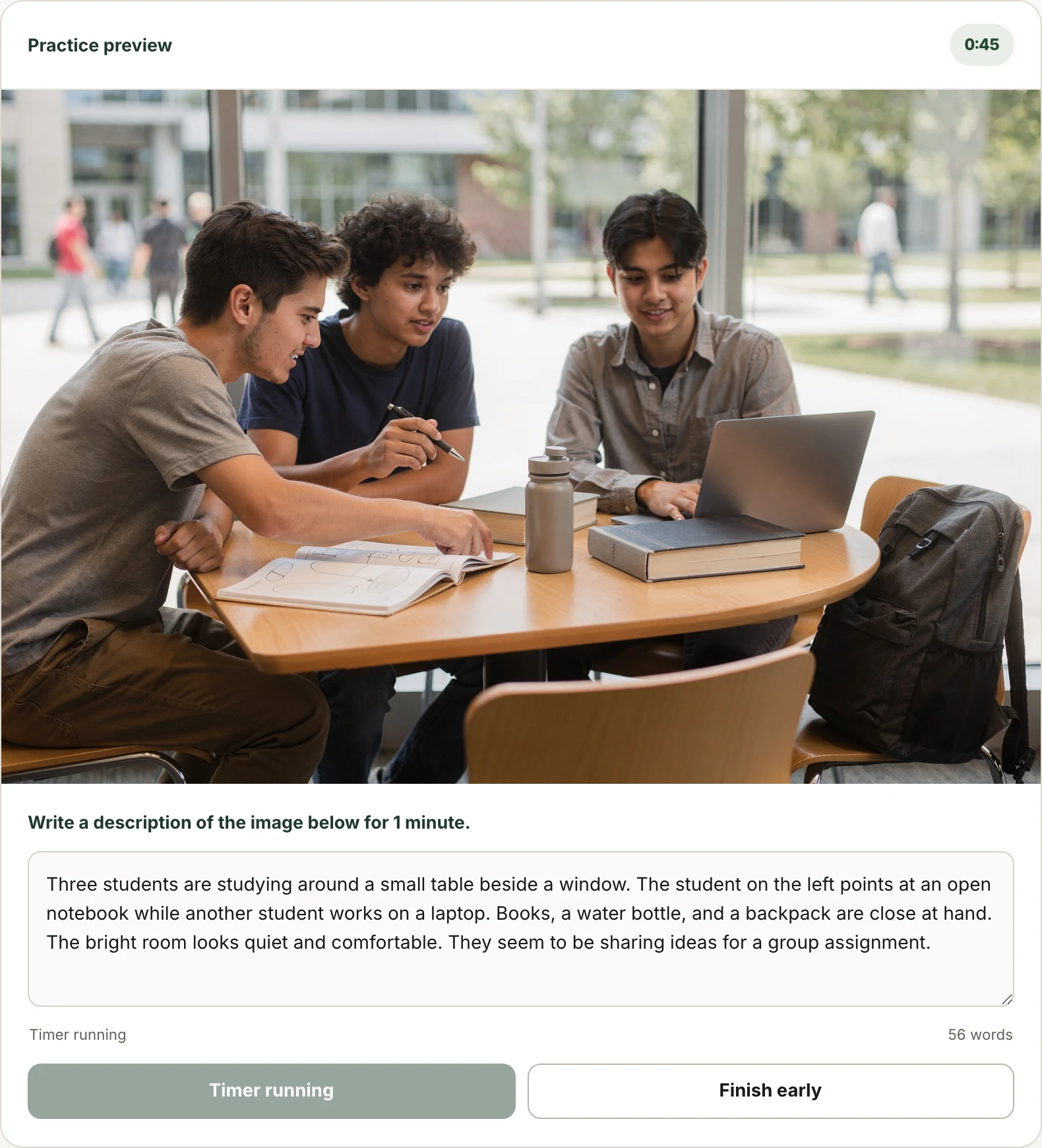
| Write About the Photo | Writing | 3 photos | 1 minute each | Describe a photo |
| Interactive Writing | Writing | 1 set of 2 questions | 30-second preview, 5 + 3 minutes | Answer, then a follow-up |
| Writing Sample | Writing | 1 | 30-second preview, 5 minutes | Short essay sent to institutions |
| Speak About the Photo | Speaking | 1 | 20 seconds, then up to 90 | Describe a photo aloud |
| Read, Then Speak | Speaking | 1 | 20 seconds, then up to 90 | Talk about a written question |
| Interactive Speaking | Speaking | 6–8 questions | 35 seconds each | Answer spoken questions |
| Speaking Sample | Speaking | 1 | 30 seconds, then up to 3 minutes | Talk on video sent to institutions |
Reading sample questions and answers
The four reading types run from single words to a whole text. A wrong answer costs no more than a blank, so always answer.
1. Read and Select
What you see: words one at a time; choose Yes for a real English word, No for an invented one. Time: 5 seconds a word.
harvest · fendrous · reluctant · dranicle · swollen · cluvery · thrive
Answer: real: harvest, reluctant, swollen, thrive. Not words: fendrous, dranicle, cluvery.
Why: the invented words follow English spelling patterns, so only knowing the real ones works in five seconds. Any number can be real, so don't count. Practise Read and Select.
2. Fill in the Blanks
What you see: one sentence with one unfinished word; type only the missing letters, one per space. Time: 20 seconds.
The museum was so crowded that we could hardly move, so we came back on a quie___ day.
Answer: ter, making quieter.
Why: "crowded" sets up a contrast, and "day" needs an adjective. Quietly also fits three spaces but is an adverb. Try Fill in the Blanks.
3. Read and Complete
What you see: a short titled text whose first and last sentences are complete; between them, every second word has lost its second half, and you type the missing letters. Time: 3 minutes.
Saturday Bike Repairs
Every Saturday, a small group of volunteers repairs bicycles outside the town library. People br___ bikes wi__ broken bra___, and t__ volunteers sh__ them h__ to f__ the pro____. Most rep____ take le__ than a_ hour a__ need on__ simple to___. Many visitors come back later to help others.
Answer: bring, with, brakes, the, show, how, fix, problem, repairs, less, an, and, only, tools.
Why: half the gaps are grammar words, and "bikes" and "fix" point to brakes, not brains or brands. See more Read and Complete passages or try one timed.
4. Interactive Reading
What you see: one passage that appears in stages, with six questions on it. Time: 7 or 8 minutes for all six. A shortened set:
Complete the Sentences (three to ten gaps on the test): choose the best word for each gap.
When Lina started work at a small bookshop, many customers left without [buying / selling / reading / opening / writing] anything. They glanced at the front shelves and walked out. Lina [suspected / denied / forgot / ordered / repeated] the problem was the layout: the newest titles were hidden at the back.
Complete the Passage: the rest appears. Choose the missing sentence.
… hidden at the back. [ ______ ] The owner agreed, though he doubted it would help. A month later sales had risen, and customers said a table of new books had caught their eye from the street.
A. The shop had been open for twenty years.
B. She asked to move a table of new books near the entrance for a month.
C. She decided to look for a job at a larger shop.
Then, on the full text: Highlight the Answer twice (What did Lina think was wrong with the layout? What caught customers' eye?); Identify the Idea (A. Moving the new books helped sales. B. Customers left because the books cost too much. C. The owner planned to close the shop.); Title the Passage (A. The History of a Bookshop. B. A Bookshop Raises Its Prices. C. How a New Layout Brought Customers In.)
Answers: buying, suspected; B; highlight the newest titles were hidden at the back and a table of new books; A; C.
Why: "The owner agreed" needs a request before it. Idea B gives a reason the passage never mentions. Try a full Interactive Reading set.
Listening sample questions and answers
The two listening types test catching exact words and following a conversation. The audio is written out here.
5. Listen and Type
What you hear: one spoken sentence, which you type exactly. Time: 1 minute, with up to three plays.
You hear: "Please return the forms to the front desk before the end of the week."
Answer: the sentence, word for word.
Why: the same meaning in other words isn't enough. Duolingo says a missing word costs more than a mistyped one, so write every word, the and to included. Practise Listen and Type.
6. Interactive Listening
What you hear: a scenario you can replay; you complete three or four sentences about it, pick the best reply five or six times in a conversation played once, then summarise it in writing. Time: 6 minutes 30 seconds for the questions, then 75 seconds for the summary.
Scenario: "You missed yesterday's group meeting for your history project because your bus was late. Talk to a classmate to find out what was decided."
Complete: You missed the meeting because ______. You want to find out ______.
Your classmate says: "Hey, we missed you yesterday. Is everything okay?"
A. Yes, sorry, my bus was late. What did I miss?
B. I'm taking the bus tomorrow.
C. The project is due next month.
D. No, I didn't go to the library.
Later, the work is split: you get the introduction and agree to send a draft by Thursday.
Answers: your bus was late; what the group decided; A. Summary: I spoke to a classmate because my late bus made me miss our history project meeting. She said the group had divided the work and given me the introduction, and I agreed to send a draft by Thursday.
Why: paraphrase is accepted, and the summary gives who spoke, about what, and the outcome, as Duolingo advises. Try a full set or study conversation summaries with audio.
Writing sample questions and model answers
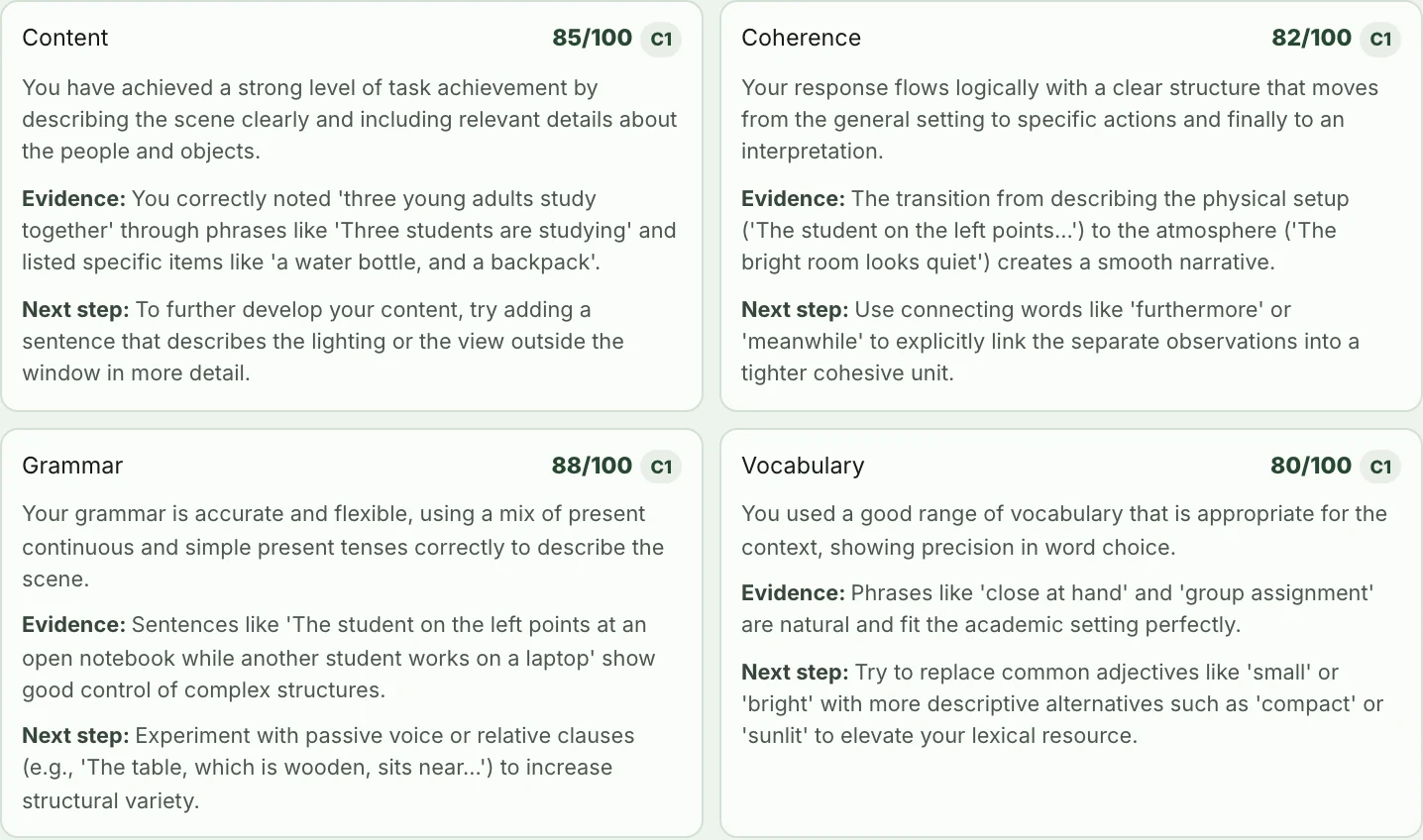
Writing is scored on content, coherence, vocabulary and grammar, so the models aim for clear, connected sentences, not rare words.
7. Write About the Photo
What you see: a photo, which you describe in writing. Time: 1 minute.
The photo shows an older man and a young girl kneeling in a vegetable garden. She holds a green watering can, he points at a row of small plants, and a wooden fence stands behind them.
Model answer: An older man and a young girl are working together in a vegetable garden. The girl is holding a green watering can while the man points at a row of small plants, perhaps showing her which ones need water. Behind them is a wooden fence.
Why: main scene first, then actions and positions, with one careful guess. Get a free score on Write About the Photo or read photo-writing examples.
8. Interactive Writing
What you see: a question, then a follow-up based on your answer; your first answer stays visible but can't be edited. Time: 30 seconds to read, 5 minutes to write, then 3 minutes for the follow-up.
Describe a skill you learned outside school. How did you learn it, and how has it been useful?
Follow-up: Would you recommend learning this skill the same way to someone else? Why or why not?
Model answer, shortened: The most useful skill I learned outside school is cooking. When I moved into a shared flat, I could barely boil rice, so I copied my flatmate's recipes. Within months I was cooking for friends and spending less on food. Follow-up: Mostly, yes. A friend is a cheap teacher, and you can ask questions as you cook. I'd add written recipes, though, since my flatmate often forgot the exact amounts.
Why: the follow-up adds new reasons rather than repeating the first answer. Get a free score on Interactive Writing or compare answers and follow-ups.
9. Writing Sample
What you see: an essay question; institutions that receive your results can read your answer. Time: 30 seconds to read, then 5 minutes to write.
Should cities close their central streets to cars at weekends? Explain your view with reasons and examples.
Model answer, shortened: I think closing central streets to cars at weekends is a good idea, as long as buses keep running. First, the centre becomes safer and quieter, so children can play near the shops. Second, local businesses benefit: when my city tried this one summer, cafés put tables in the road and were busier than usual. Some drivers would complain, but most trips into the centre are short enough to make by bus.
Why: the opinion comes first, both reasons are developed, and one objection is answered. Get a free score on Writing Sample or read model answers.
Speaking sample questions and model answers
Speaking is scored on aspects including content, fluency and pronunciation. Our guide to Duolingo English Test speaking questions has more prompts.
10. Speak About the Photo
What you see: a photo, which stays on screen while you describe it aloud. Time: 20 seconds to look, then up to 90 seconds to speak.
The photo shows a busy food market at night. A smiling woman at a stall hands a bowl of noodles to a customer, strings of lights hang overhead, and people wait in line.
Model answer, shortened: This photo shows a busy street market at night. In the centre, a smiling woman at a food stall is handing a bowl of noodles to a customer. Behind the customer, several people are queuing, so the food must be popular. Above them, strings of lights make the scene look warm and lively.
Why: Duolingo suggests describing the image to someone who can't see it, so go from the main action to the people, then the setting. Practise Speak About the Photo or hear spoken examples.
11. Read, Then Speak
What you see: a question with prompts, which stays on screen while you answer aloud. Time: 20 seconds to read, then up to 90 seconds to speak.
Describe a time when you had to change your plans at the last minute.
• What was your original plan?
• Why did it change?
• What did you do instead, and how did it turn out?
Model answer, shortened: Last spring I'd planned a weekend hiking trip with two friends, but heavy rain was forecast, so we cancelled. Instead, we visited a science museum in town that we'd ignored for years. I was disappointed at first, but it turned out to be one of the best days of the year.
Why: it answers every prompt, as Duolingo's guidance asks. Practise Read, Then Speak.
12. Interactive Speaking
What you hear: six to eight questions from an animated character, each played once, with later ones based on your answers. Time: 35 seconds an answer, starting when the question ends, so waiting to press Record costs time.
You hear: "Let's talk about free time. What do you usually do at the weekend?"
Later: "You mentioned cooking. What have you learned to cook recently?"
Model answers: On Saturdays I play football with friends, and on Sundays I stay at home, read and try cooking something new. One active day and one quiet day help me start the week with more energy. Then: I recently learned to make a vegetable curry. A friend showed me how, and now I make it most weeks because it's cheap.
Why: each answer responds at once, then adds a reason or detail. Practise Interactive Speaking or work through sets with model answers.
13. Speaking Sample
What you see: a topic; Duolingo sends your video answer to institutions that receive your results. Time: 30 seconds to read, then up to 3 minutes to speak.
Some people think the best way to learn about another culture is to live there. Others think books, films and the internet are enough. What do you think?
Model plan and opening: state your view, give two reasons with examples, say what books and films do well, then restate your view. I think living in a country is the best way to understand its culture, although it isn't the only way. When I spent a summer with a family abroad, I learned more from their dinner-table conversations than from any film.
Why: a plan keeps you talking for three minutes without repeating yourself; Duolingo suggests one- to three-minute practice talks. Practise the Speaking Sample.
How to practise with these sample questions
Try each sample untimed, then a new one of the same type under the real time limit, with grading. The guide to all 13 task types has tips; how to prepare for the Duolingo English Test turns them into a plan.
Then take a full-length DET practice test with DET Pro: about an hour, 44 timed responses across all 13 question types, and a saved 10–160 practice estimate to compare with the score your university asks for. They're written by experienced educators and test specialists to be as hard as the real test, and benchmarked against the sample questions Duolingo publishes. Once you reach your target, the PrepEx voucher covers the full test fee, comes with a 30-day or 90-day DET Pro plan and gets results within 24 hours at no extra cost. PrepEx is a member of the Duolingo English Test Global Partner Network.
Duolingo English Test sample questions: common questions
Can I download Duolingo English Test questions and answers as a PDF?
You can download Duolingo's free DET Question Guide, a PDF showing what each of the 13 question types looks like, with its timing and scoring, but Duolingo doesn't publish the certified test's own questions. For paper practice, PrepEx's Read and Complete passages, Writing Sample examples and DET vocabulary list each have a print button.
Where can I practise Duolingo English Test questions for free?
Duolingo's own practice test is free as often as you like once you create an account, takes about 45 minutes and ends with an estimated score range. PrepEx's Practice Hub has one free question of each of the 13 types, and a free account grades two answers a day.
What are the 13 question types on the Duolingo English Test?
Reading: Read and Select, Fill in the Blanks, Read and Complete, Interactive Reading. Listening: Listen and Type, Interactive Listening. Writing: Write About the Photo, Interactive Writing, Writing Sample. Speaking: Speak About the Photo, Read, Then Speak, Interactive Speaking, Speaking Sample.
How many questions are on the Duolingo English Test?
The number varies: the Duolingo English Test is adaptive and gives more or fewer questions depending on its grading engine's confidence in your score. Duolingo gives a range for each type, such as 15 to 18 Read and Select words.
Do Duolingo English Test questions repeat?
Duolingo says its questions come from an extremely large pool and you're highly unlikely to see the same one twice. Memorised answers won't help, so practise the 13 formats and their time limits until each one feels routine.
What is the Duolingo English Test Sample Test?
The Sample Test is a paid add-on to a certified test: full length, machine-scored, with a report of your overall score and subscores. It has no ID check or proctoring, so its result can't be sent to institutions.
Are Read Aloud and Listen, Then Speak still on the test?
No. Read Aloud and Listen, Then Speak left the Duolingo English Test on July 1, 2025, when Duolingo added Interactive Speaking, a conversation of six to eight questions with an animated character. Sample papers that still include them show the old format.
How are Duolingo English Test answers marked?
Question types with a correct answer are marked automatically, with partial credit for close answers; a wrong answer costs no more than a blank. A grading engine judges writing on content, coherence, vocabulary and grammar, and speaking on content, fluency and pronunciation, among other aspects.
Sources
All are Duolingo sources, read on November 21, 2026.
- DET Question Guide (2026, PDF) — each question type, its timing and scoring
- Test Structure — question types, counts, length, adaptivity
- New Interactive Speaking questions — types removed in 2025
- Expanded Interactive Listening question
- Read and Select
- Fill in the Blanks
- Read and Complete
- Interactive Reading: Complete the Sentences
- Listen and Type
- Interactive Listening: Listen and Respond
- Interactive Listening: Summarize the Conversation
- Write About the Photo
- Interactive Writing
- Writing Sample
- Speak About the Photo
- Read, Then Speak
- Interactive Speaking
- Speaking Sample
- How the Items Are Scored — how answers are marked
- The Practice Test — free, about 45 minutes
- What is the Sample Test? — paid add-on, unofficial result
Take a look before you try it.
Real PrepEx screens, with an example answer created for this demonstration. Open each view to explore.
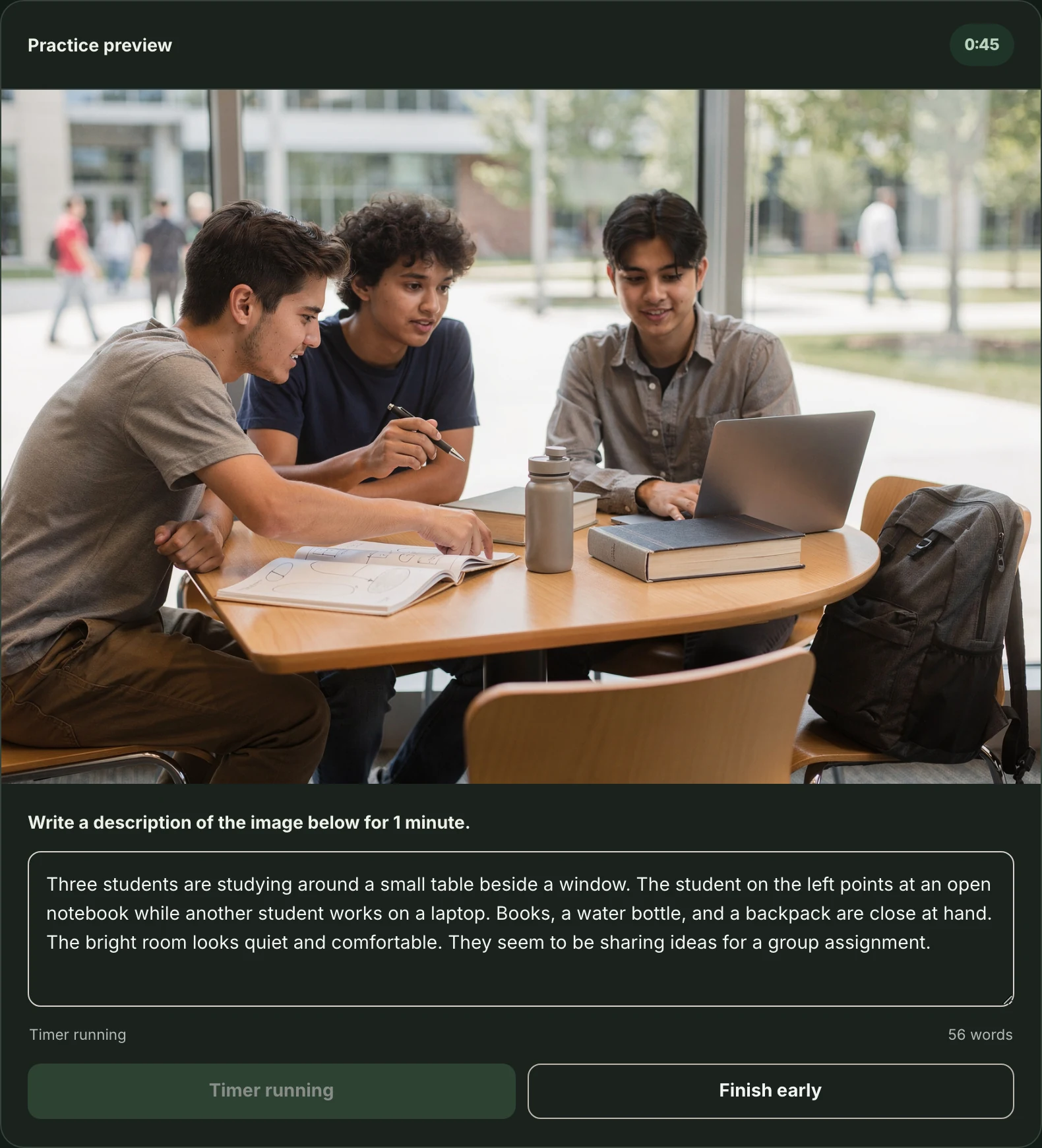
Write under the timerA photo, one minute, and space for your answer.
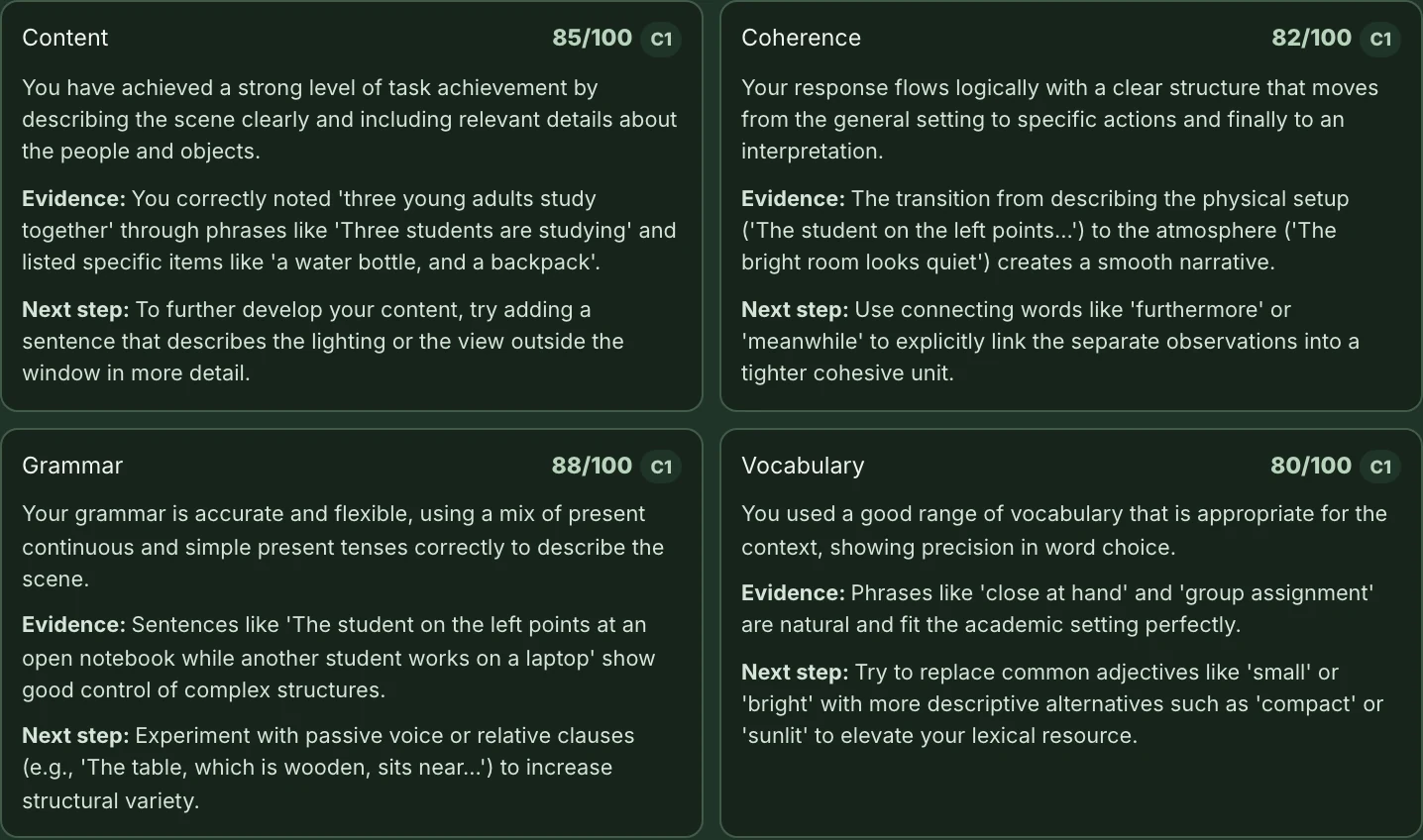
See what to improveFeedback on content, coherence, grammar, and vocabulary.
Choose your next mockBrowse the full-length tests included with DET Pro.
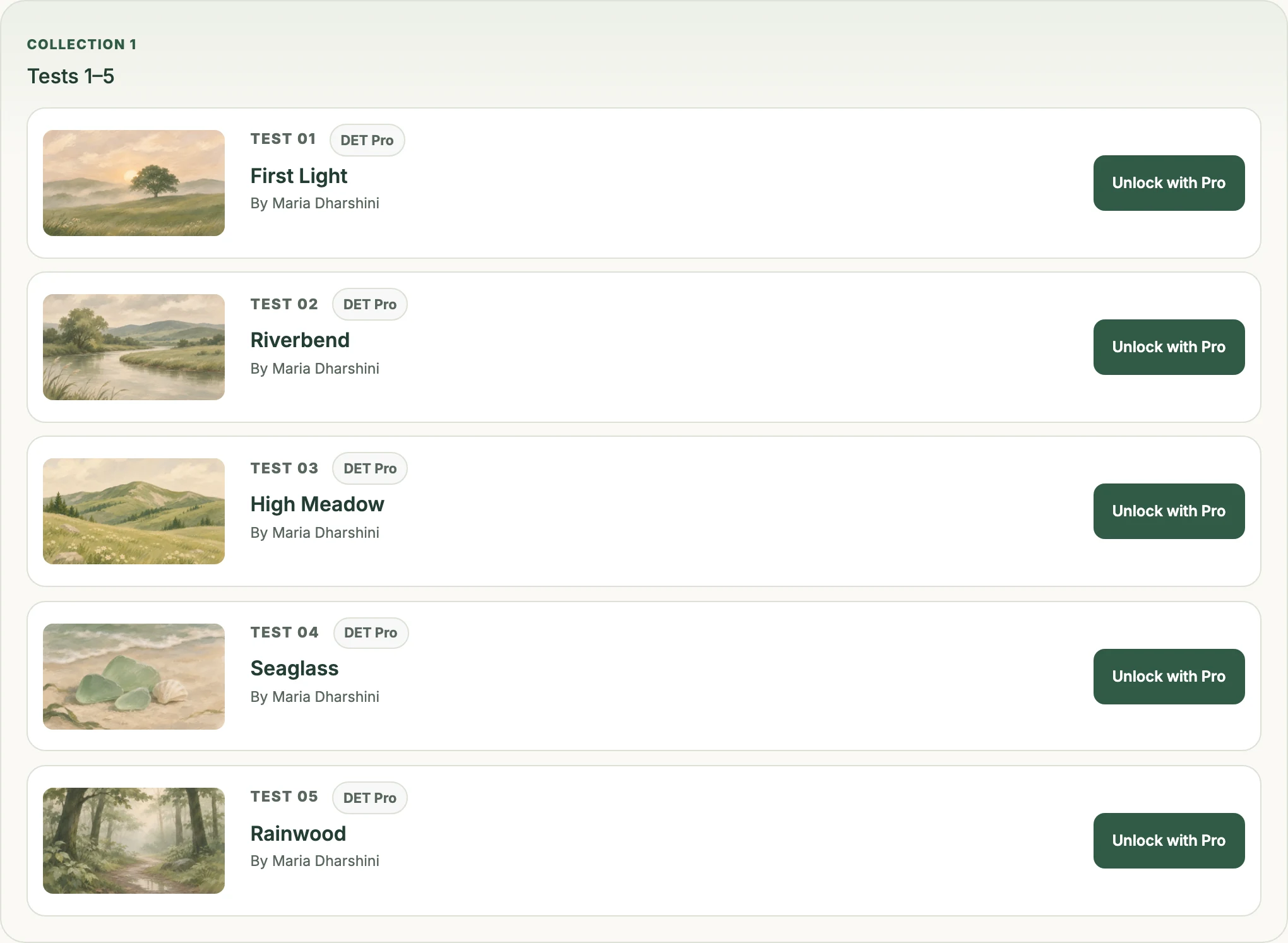
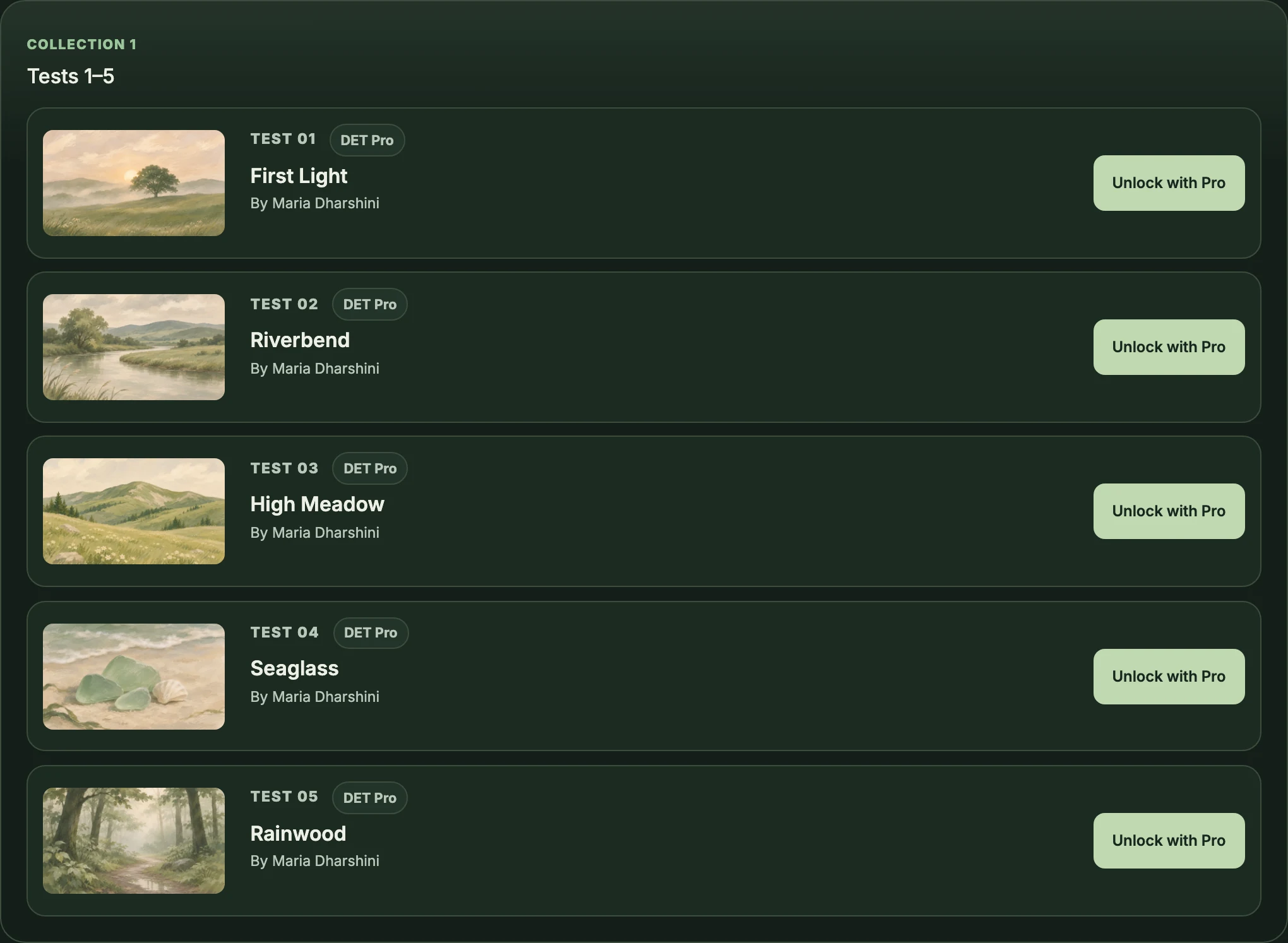
Product demo · Captured November 17, 2026
Keep exploring
More from the journal