
How to practice Speak About the Photo
Look at a picture for 20 seconds, then describe it aloud for up to 90 seconds. Those are the current preparation and response windows in the official DET task guidance. The picture remains visible while you speak. Try your own response before opening the example transcript or listening to its recording.
During preparation, identify the main scene, two or three useful details, and a sensible route through the image. You could move from the foreground to the background, or describe two connected actions. Plan mentally rather than writing notes: notes are not allowed in the real test. Speak at a natural pace and keep going after a small stumble.
The recordings below demonstrate complete possible answers, not a required script or accent. Their duration varies because an answer does not have to fill every second. Listen for how each speaker connects details; then describe a different picture in your own words. The transcripts alone cannot demonstrate pronunciation or fluency, and we do not assign them invented official scores.
10 original photo speaking examples
1. Shopping at an outdoor market
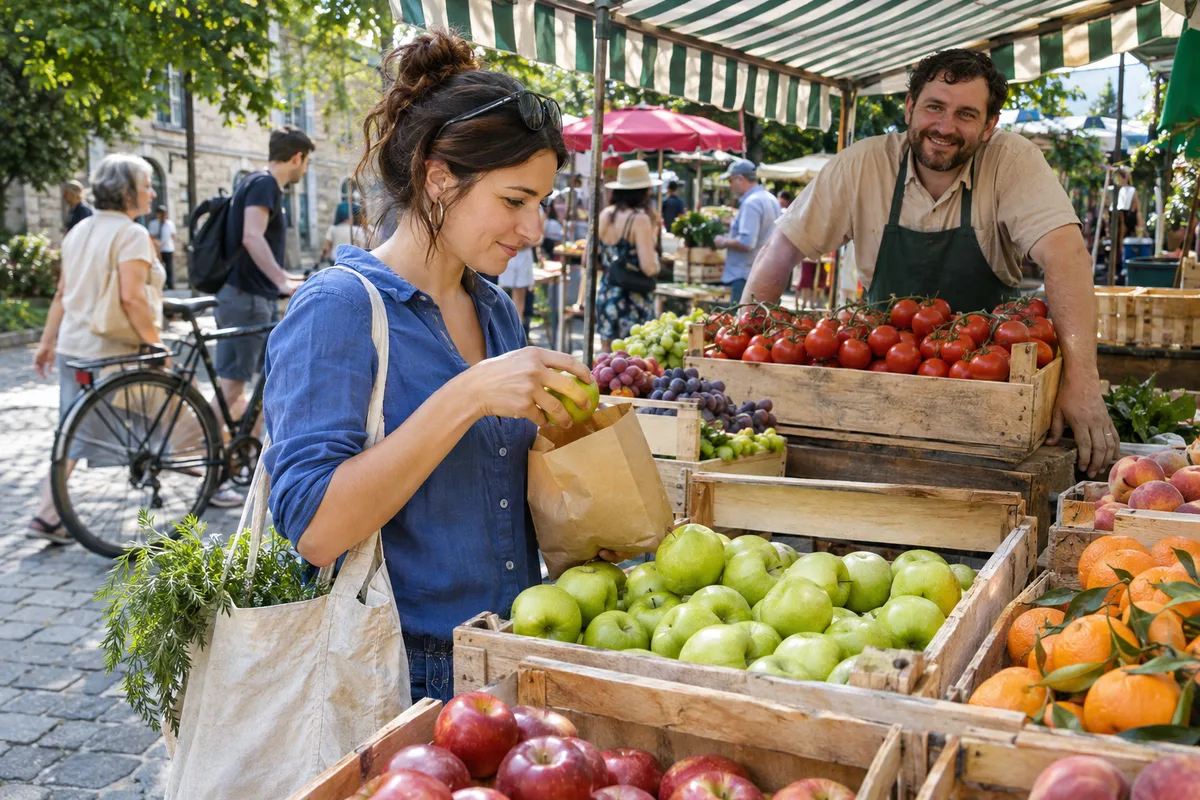
Planning notes, audio and complete example answer
Mental plan: Customer and apples → vendor and crates → canopy and shoppers.
This picture shows an outdoor market, with a woman choosing fruit at a stall. She is wearing a blue shirt and is putting a green apple into a brown paper bag. A large crate of apples fills the foreground, so the fruit is one of the first things you notice. Behind the stall, a man in an apron stands beside a display of red tomatoes. There are also grapes and other kinds of fruit arranged in separate wooden boxes. Above the two people is a green and white striped canopy, which shades the produce. The background is busier: several shoppers are walking past, and a bicycle is visible behind the woman. The scene has a relaxed, everyday feel. The woman is concentrating on the apple in her hand, while the vendor is looking toward her. Together, those details make the exchange at the stall the main focus of the photograph.
What to notice: The answer begins with the activity, develops the foreground, then moves back through the stall. The mood is presented as an impression; no price or dialogue is invented.
2. Choosing a library book
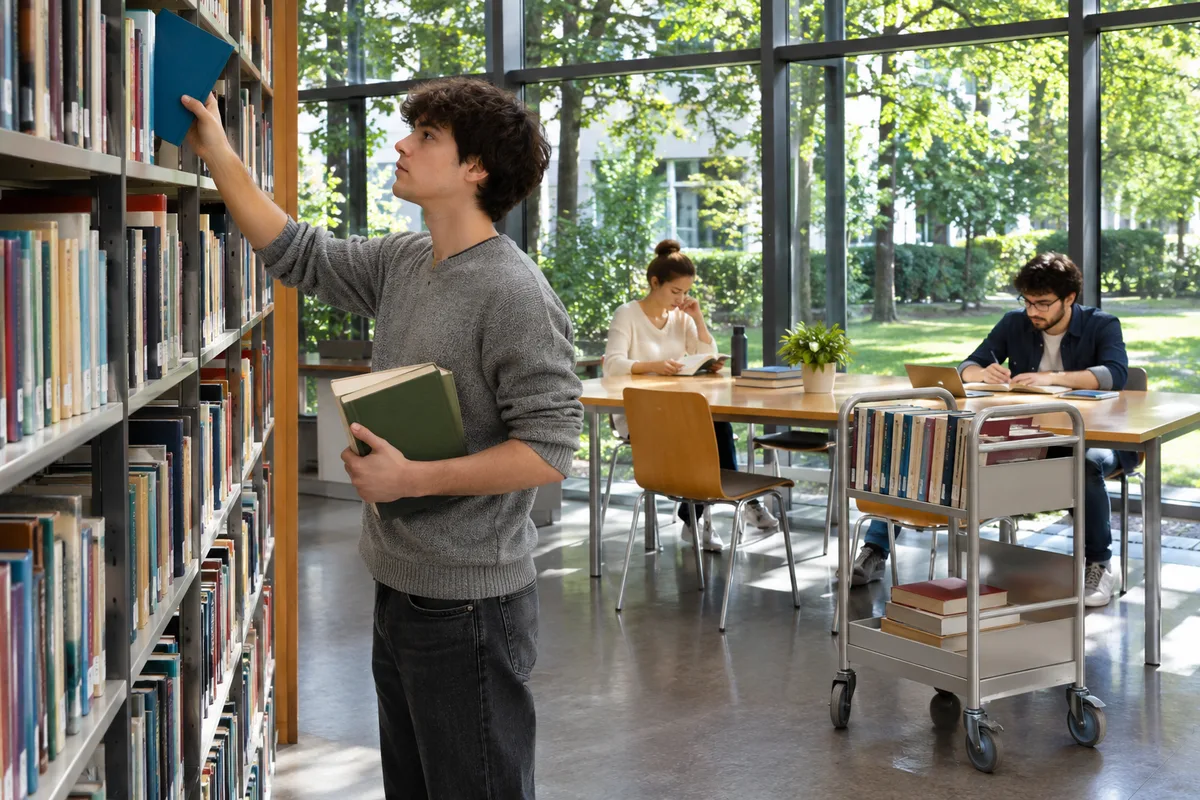
Planning notes, audio and complete example answer
Mental plan: Man and book → other readers → trolley → windows and setting.
The photograph was taken inside a bright library. In the foreground, a young man in a gray sweater is reaching for a blue book on a shelf. He already has two other books held against his body. It is difficult to tell whether he is taking the blue book out or putting it back, but his attention is clearly on that shelf. Behind him, two people are sitting at a long wooden table. One is reading, and the other appears to be working beside a laptop. A metal book trolley stands between the table and the camera, with books on its shelves. Large windows extend along the back of the room, and you can see grass and leafy trees outside. The daylight makes the room look open and comfortable. Most of the people are occupied with their own work, so the scene gives an impression of quiet concentration.
What to notice: Acknowledging the uncertain direction of the book movement keeps the description accurate. Listen for pauses after each change of focus rather than between every few words.
3. Waiting at a wet crossing
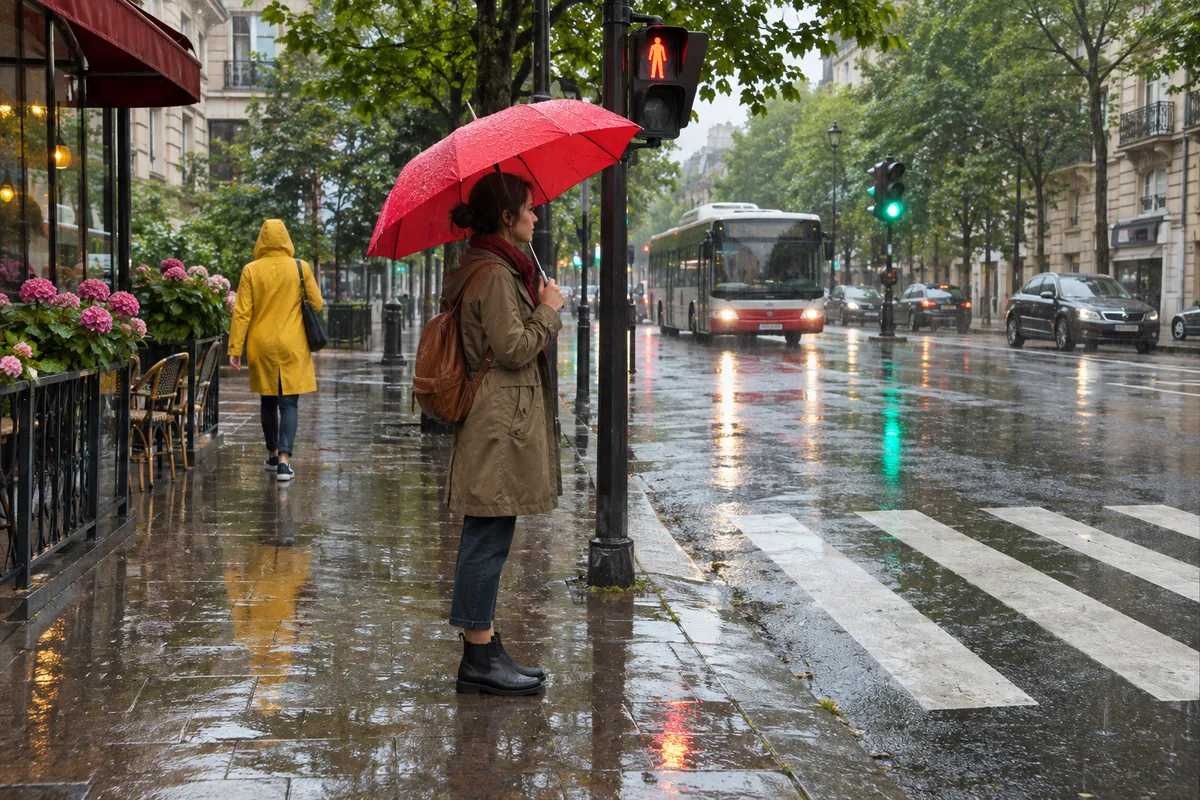
Planning notes, audio and complete example answer
Mental plan: Umbrella and crossing → other pedestrian → approaching bus → reflections.
This is a street scene in wet weather. A woman is standing beside a pedestrian crossing under a bright red umbrella. She is facing the road, and the pedestrian signal above her is red. Farther along the sidewalk, another person is walking away in a yellow raincoat. The two bright colors stand out against the gray road and the more muted buildings. A bus is approaching in the background, with several cars farther to the right. The road and paving are very shiny, and the traffic lights create colored reflections on the wet surface. On the left there are flowers and outdoor chairs beside a building, while trees run along the street. The woman seems to be waiting for an opportunity to cross, although we cannot know where she is going. The main contrast is between the people sheltering from the rain and the traffic continuing along the road.
What to notice: The answer connects weather, color and movement while keeping the destination unknown. “Seems to be waiting” signals a reasonable interpretation rather than a hidden fact.
4. Planting vegetables
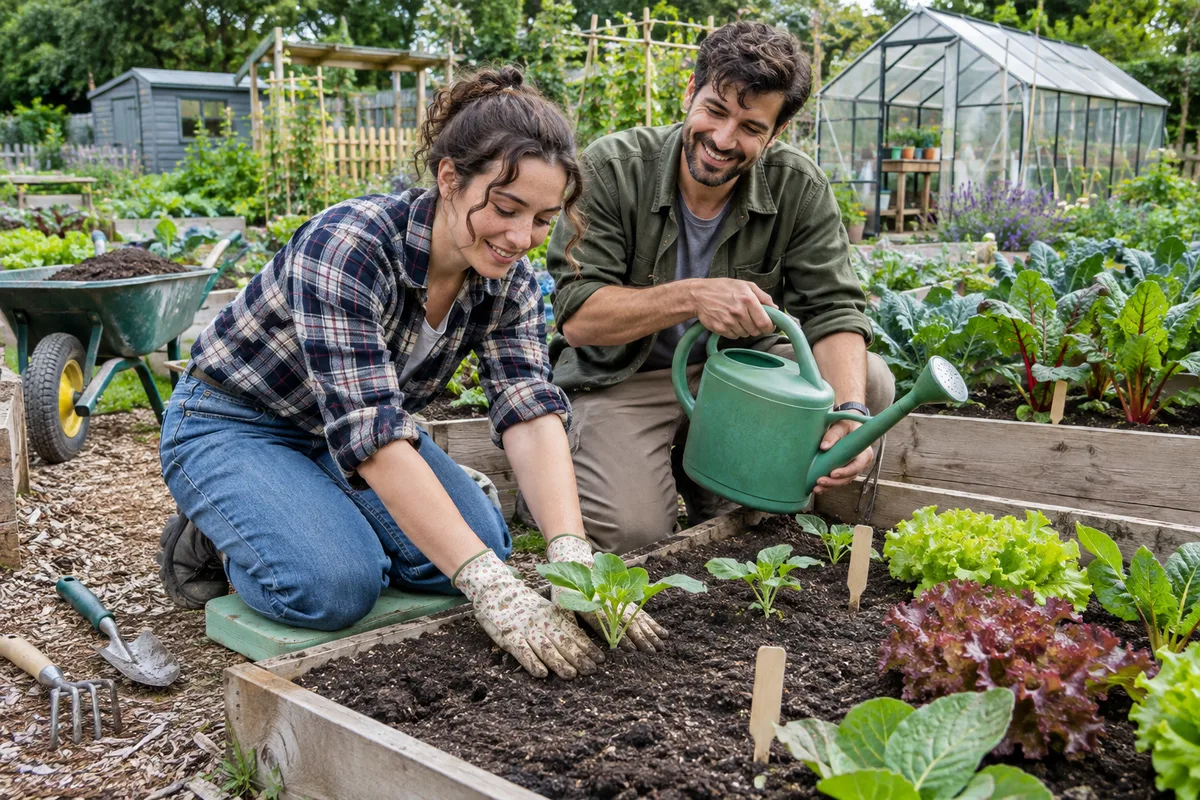
Planning notes, audio and complete example answer
Mental plan: Two gardeners → different actions → vegetables and tools → greenhouse.
Two people are working together beside a raised vegetable bed. The woman on the left is kneeling on a pad and wearing gardening gloves. She is using her hands to press the dark soil around a small plant. Beside her, a man is holding a green watering can close to the bed. There are several different leafy plants growing in neat groups, including larger leaves behind the young seedlings. A few small wooden markers stand in the soil, although there is no information on them that I can read. On the path to the left, there are hand tools and a wheelbarrow. Farther back, a glass greenhouse and wooden supports provide more context for the garden. Both people are looking down toward the plants rather than at the camera. Their positions and the tools suggest they are in the middle of planting or tending the bed, rather than simply posing beside it.
What to notice: The description distinguishes direct observations from the final interpretation. The answer uses the garden's depth to develop the response without inventing plant names or ownership.
5. Pumping up a bicycle tire
Planning notes, audio and complete example answer
Mental plan: Pump and bicycle → person holding it → tools → workshop.
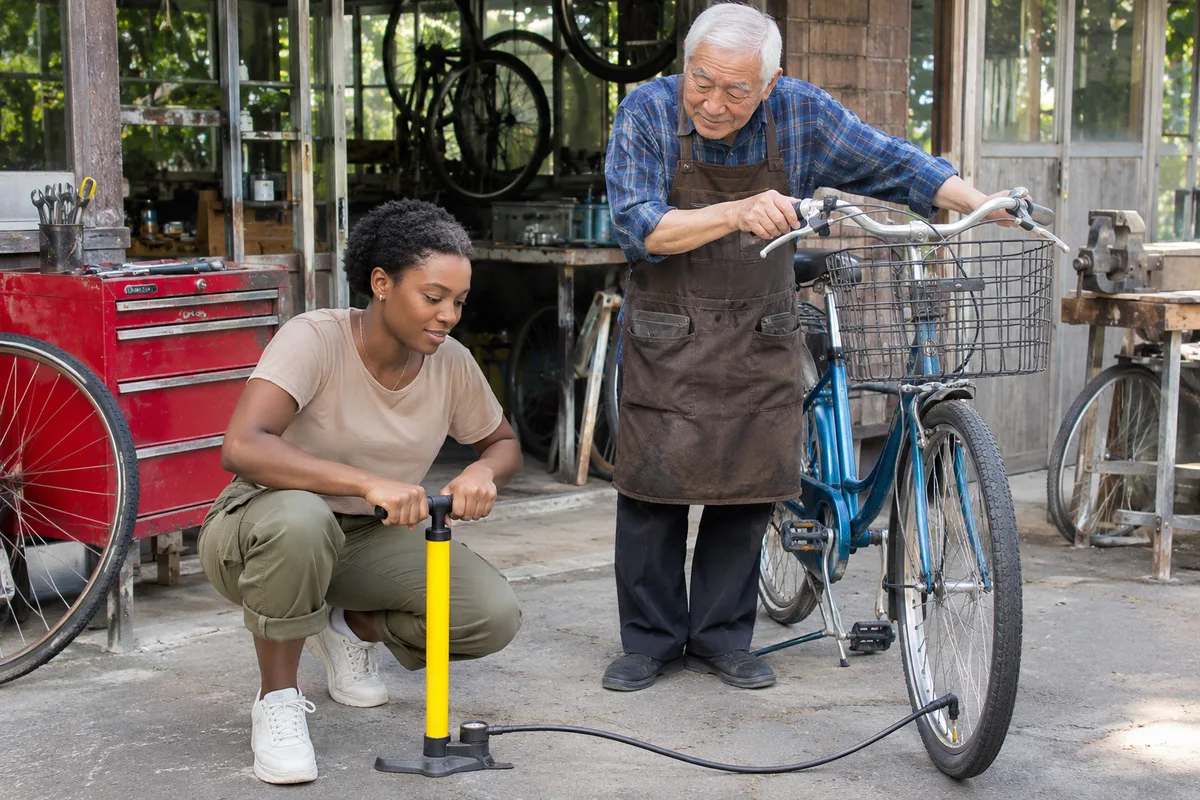
The main activity in this photograph is pumping up a bicycle tire. A woman is crouching beside a blue bicycle with both hands on the handle of a floor pump. A hose runs from the pump toward the front wheel. An older man stands on the other side of the bicycle, holding its handlebars so that it stays upright. Both people are looking down toward the work. A red tool cabinet stands nearby, with several tools resting on top. Behind them is an open workshop, where spare wheels and other equipment are visible. There are also plants around the entrance, which makes the setting feel like a small neighborhood repair shop. The two people have different roles in the activity: one is operating the pump, and the other is keeping the bicycle steady. The picture does not show a serious problem with the bike, so I would describe the visible maintenance rather than guess what happened earlier.
What to notice: The answer expands the relationship between the two actions. It describes the maintenance without claiming a puncture or a prior accident.
6. A quiet railway platform
Planning notes, audio and complete example answer
Mental plan: Woman and suitcase → man on bench → opposite train → overhead cover.
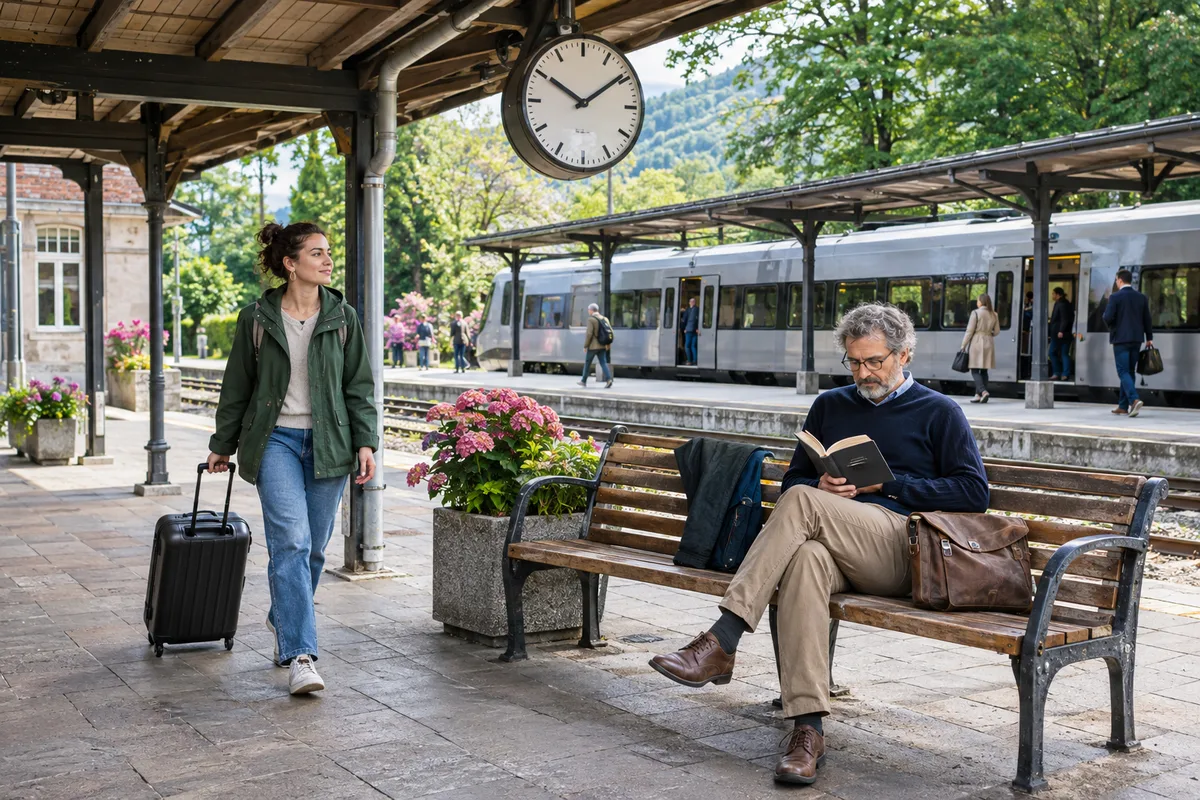
This picture shows people at a railway station. On the left, a woman in a green jacket is walking along the platform while pulling a small black suitcase. Near her, a man is sitting on a wooden bench with a book open in his hands. There are bags beside him, but he appears focused on reading rather than looking at the train. A large round clock hangs from the roof above the platform. Across the tracks, a silver train is standing with its doors open, and several people are nearby. Trees and flowers around the station make the setting feel quite green. The covered roof shades the foreground, while the opposite platform is brighter. The photograph captures different ways people occupy their time at a station: one person is moving through it with luggage, and another is sitting quietly. I cannot tell whether they are traveling together or waiting for the same train.
What to notice: The response compares two visible activities and explicitly avoids inventing a relationship. The precise time is unnecessary; the clock is enough as a setting detail.
7. Looking across a mountain lake
Planning notes, audio and complete example answer
Mental plan: Hikers and gesture → rocky slope → lake → wooded mountains.
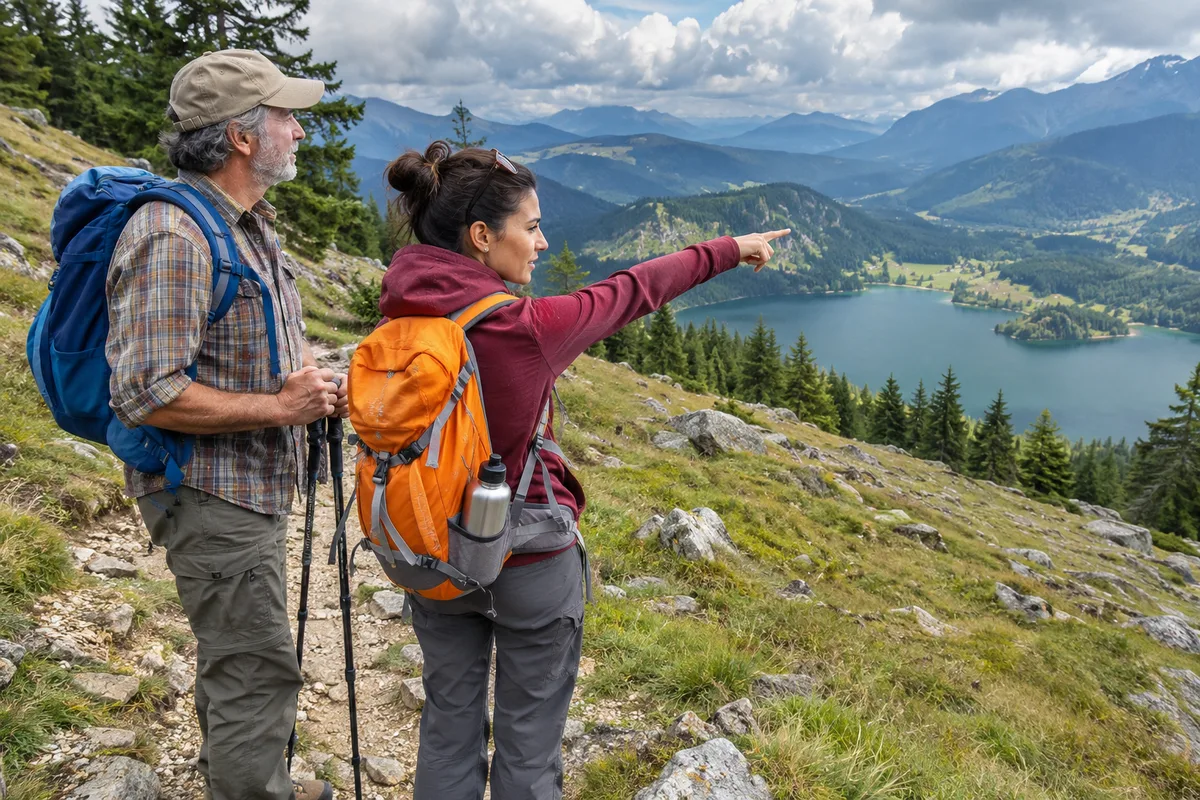
Two hikers have paused on a hillside to look out over a lake. The person closest to the center has an orange backpack and is pointing toward the view. Beside her, another hiker with a blue backpack is looking in the same direction. Their bags and outdoor clothing suggest that they have been walking, although the photo does not tell us how far. The ground around them is uneven, with rocks, grass and a narrow path. Below the slope, the lake stretches across the middle of the picture. Its shoreline curves around wooded areas, and more hills and mountains rise behind it. Clouds cover much of the sky, but there is still plenty of light on the landscape. I would describe this image by moving outward from the hikers to the lake and then to the distant mountains. That follows the direction of the pointing hand and keeps the large scene easy to understand.
What to notice: The route through the image follows the gesture. Notice how ordinary spatial language creates a connected answer without needing a place name or mountain vocabulary.
8. Working with clay
Planning notes, audio and complete example answer
Mental plan: Hands and bowl → second person's cup → shelves → light and workspace.
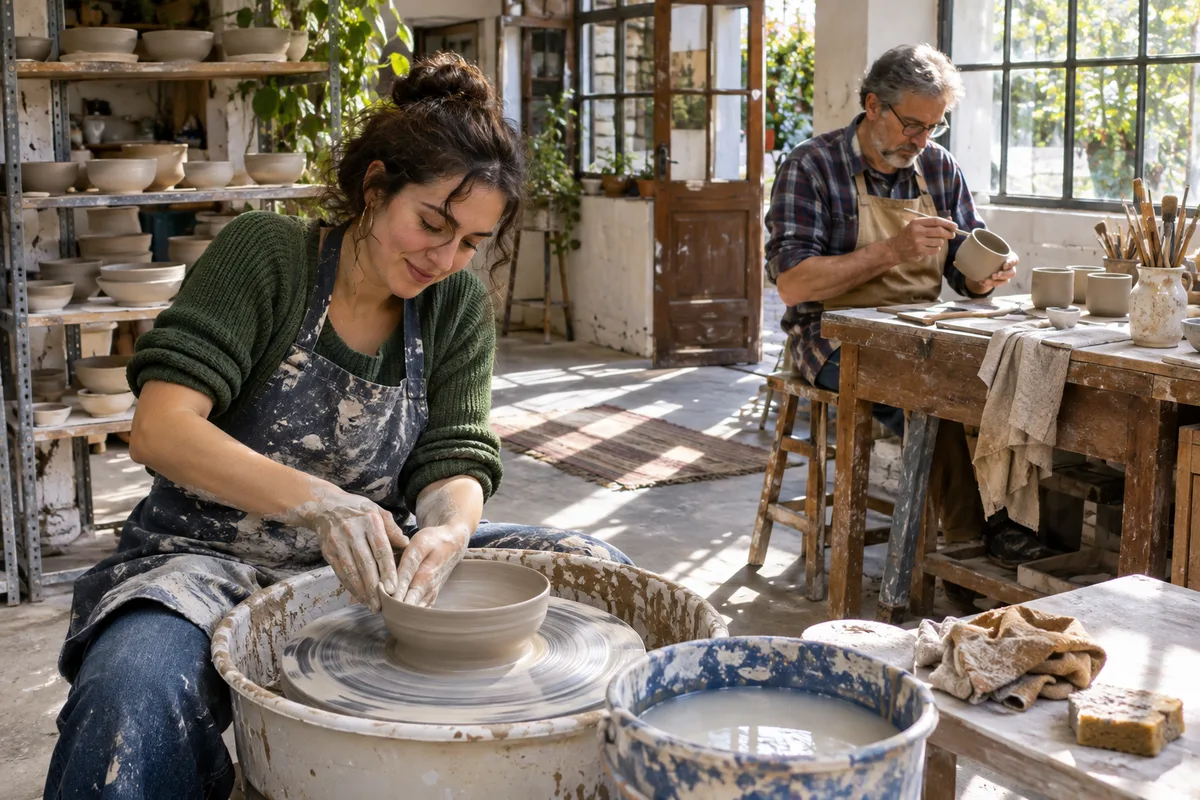
The photograph shows two people making pottery in a studio. In the foreground, a woman is sitting at a pottery wheel and shaping a bowl with her hands. Her apron and the area around the wheel are marked with clay, which makes the activity look like work in progress. Behind her, a man is sitting at a wooden bench. He is holding a cup and using a small tool on its surface. Shelves around the room contain many unfinished bowls and cups, so there are examples of their work at several stages. Large windows let in natural light, and a partly open door is visible toward the back. The woman is concentrating on the form of the bowl, while the man is working on a smaller detail. This contrast gives the picture more to describe than simply two people in a room. The tools, shelves and clay-covered surfaces all support the same central activity.
What to notice: The answer develops a contrast between shaping and finishing details. It avoids guessing the people's professional status or saying that the pots have already been fired.
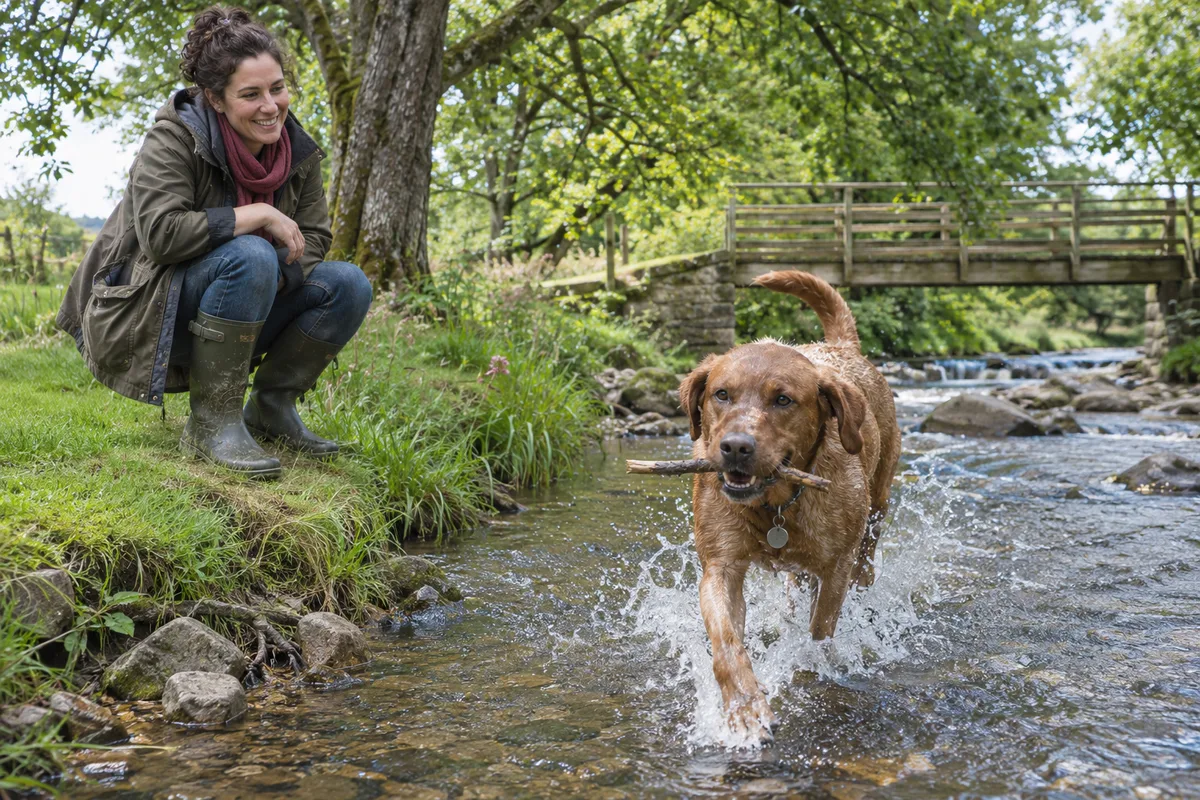
9. A dog in the stream
Planning notes, audio and complete example answer
Mental plan: Dog and stick → splashing water → person on bank → bridge and trees.
A brown dog is running through a shallow stream with a stick in its mouth. The dog is close to the camera, so its movement is the main focus of the photograph. Water is splashing around its front legs, and one paw is raised above the surface. On the left bank, a person in rubber boots is crouching near a tree and watching the dog. Grass and small stones line the edge of the water. Farther behind, a wooden footbridge crosses the stream, with leafy branches surrounding it. The picture suggests an outdoor walk or a game near the water, but the dog's exact relationship to the person is not shown. What is clear is the contrast between the moving animal and the person staying on the bank. The low viewpoint also makes the splashes and the stick easy to notice. There is enough detail to explain the action without needing to identify the dog's breed.
What to notice: The description prioritizes movement and position. The optional interpretation stays cautious, and the answer does not rely on a breed name or a claim about the dog's feelings.
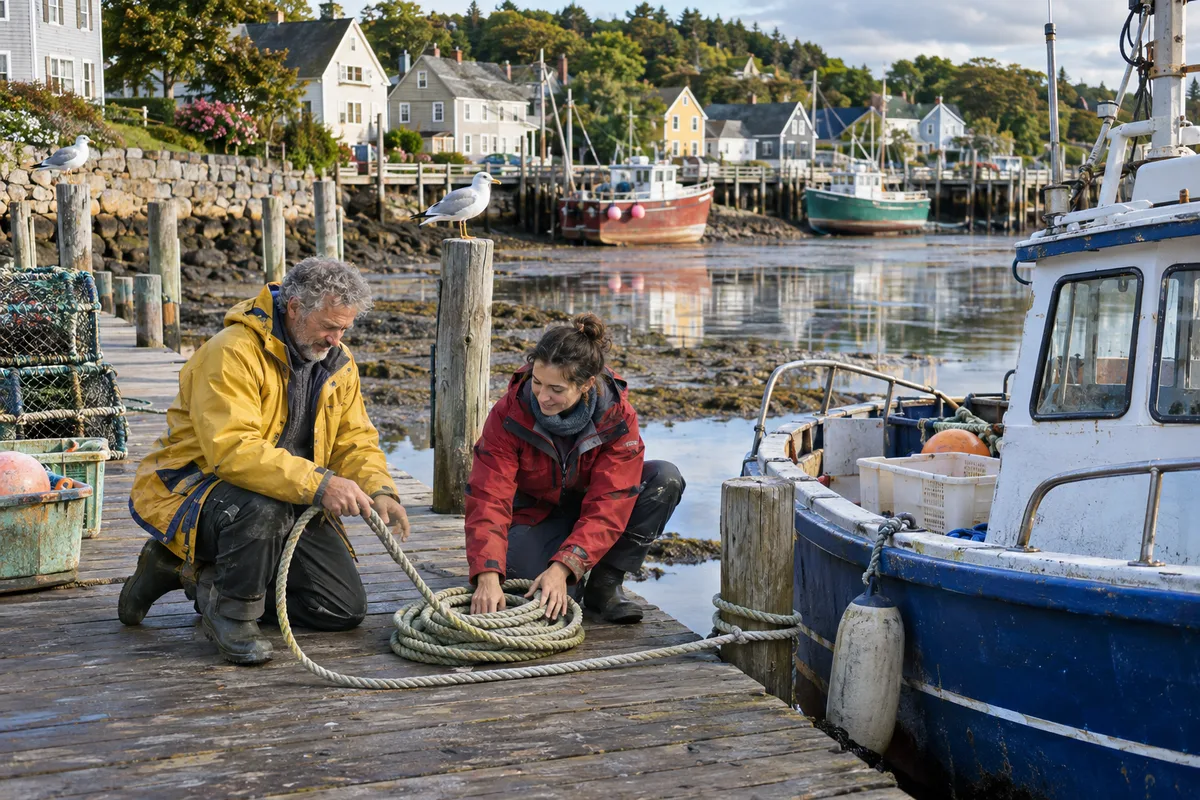
10. Coiling a rope at the dock
Planning notes, audio and complete example answer
Mental plan: People and rope → blue boat → posts and gulls → distant waterfront.
Two people are kneeling on a wooden dock beside a blue boat. They are gathering a thick rope into a neat coil between them. One person is wearing a yellow jacket and the other a red jacket, so they stand out clearly against the wood and water. The boat is tied beside the dock, and equipment is visible inside it. Several gulls are standing on posts nearby. Across the harbor, there are more boats and a row of houses along the waterfront. Patches of exposed mud can be seen near the shore, which suggests that the water level is relatively low. I would not guess the exact tide or the purpose of their trip from the picture alone. The important action is the two people arranging the rope together. The nearby boat explains why the rope is there, while the houses and other boats establish the wider harbor setting.
What to notice: The answer connects the foreground action to its setting. “Suggests” marks the water-level inference; the tide time, job titles and trip purpose remain unknown.
Check your own description
- Main scene: Would a listener or reader understand the central subject and action?
- Visible evidence: Are names, relationships, motives or destinations being invented?
- Connections: Do your sentences explain where things are or how actions relate?
- Language: Are verbs, articles and singular/plural forms accurate enough for the meaning to remain clear?
- Development: Does each new detail add something, rather than repeat “there is” or list colors?
Listen to your recording once without reading a transcript. Mark any place where pauses, restarts or unclear sounds interrupt the message. Choose one phrase to say more clearly, then practice a new image. A memorized rerecording can sound smoother without showing that the skill transfers.
Continue with the matching practice task
Use the Speak About the Photo guide and practice path, or compare the shorter descriptions in our 20 photo-writing examples. The seven-day DET plan helps you fit photo work around the other task types.
Photo-description questions
Should I memorize a DET photo-description template?
Use a flexible order, such as main scene followed by supporting details. Avoid memorizing full descriptions or forcing every picture into the same sentences. The response needs to fit the image you actually see.
Can I guess what people are thinking or who they are?
Prioritize visible evidence. You can mark a reasonable interpretation with language such as “appears to,” but names, family relationships, jobs and motives are often not established by a photograph.
Do these sample answers have official DET scores?
No. They are original PrepEx teaching examples with explanations, not official DET items or scored responses. Any score you receive in PrepEx practice is a practice estimate, not an official Duolingo English Test score.
Can I practice on my phone?
You can read these examples and play the audio on a phone. The real DET requires a desktop or laptop plus its separate equipment and room requirements. Read the test setup guide; practice-device compatibility does not establish test-day compliance.
Sources and editorial scope
Task timing checked against the linked official Help Center pages on November 10, 2026. Photos, descriptions and explanations are original PrepEx practice material. No official prompts, sample answers or private learner responses were copied into this collection.