The PrepEx Journal
Duolingo English Test Speaking and Interview Questions: 40 Prompts (2026)
The Duolingo English Test has four speaking question types, and its "interview" is Interactive Speaking plus the video Speaking Sample, not a live examiner. Here are 40 original PrepEx practice questions by topic, with timings, answer plans and free graded practice.
On this page
The Duolingo English Test has four speaking question types: Speak About the Photo; Read, Then Speak; Interactive Speaking; and the Speaking Sample. There's no live interview: the "interview" is Interactive Speaking, where an animated character asks you 6–8 questions, and the Speaking Sample, a recorded answer of up to three minutes that institutions see on video. Below are 40 original PrepEx practice questions in all four formats, grouped by topic, with timings and an answer plan, and PrepEx's Practice Hub grades your recorded answers (two a day on a free account).
Practise the four speaking tasks with a timer
PrepEx's speaking guide takes you through each task, then into timed practice. One question in each type is free, and a free account grades two answers a day.
We checked the task formats, timings and rules on this page against Duolingo's Help Center and its 2026 question guide on November 21, 2026.
What are the Duolingo English Test speaking questions?
Every Duolingo English Test has one of each of the four speaking tasks below, and Interactive Speaking is a single conversation of 6–8 questions. Duolingo says you're highly unlikely to see a question twice, so practise the formats rather than hunting for the questions.
| Task | What you get | Preparation | Speaking time |
|---|---|---|---|
| Speak About the Photo | One photo, which stays on screen while you speak | 20 seconds | Up to 90 seconds, one recording |
| Read, Then Speak | A written question with bullet points, which stays on screen | 20 seconds | Up to 90 seconds |
| Interactive Speaking | 6–8 spoken questions from an animated character, each played once | None: the clock starts when each question ends | 35 seconds per question; 3:30 to 4:40 in all |
| Speaking Sample | A written topic; institutions see the topic and a video of your answer | 30 seconds | Up to 3 minutes |
Lists that still include Read Aloud or Listen, Then Speak describe the old test: on July 1, 2025, Interactive Speaking replaced Listen, Then Speak and Read Aloud was removed.
Is there an interview in the Duolingo English Test?
No, the Duolingo English Test has no live interview with an examiner. Searches for Duolingo English Test interview questions are about two recorded tasks:
- Interactive Speaking, a simulated conversation: an animated character asks 6–8 questions, one at a time, and you have 35 seconds to answer each.
- The Speaking Sample, the closest thing to a video interview: up to three minutes on a written topic. Duolingo sends the video and the topic to every institution that receives your results.
Both count towards your score, and the Speaking Sample is a first impression too: look at the screen, speak clearly and stay on the topic.
How Duolingo English Test Interactive Speaking works
You hear each question once, and your 35 seconds start as soon as it ends. There's no separate preparation time, so you plan while you answer, and any wait before you press CLICK TO RECORD comes out of your 35 seconds. Press CONTINUE to submit. Because each question is chosen from your earlier answers, a follow-up may pick up a detail you mentioned.
Duolingo's tip is to speak as much as you can while answering the question asked; three or four full sentences fill 35 seconds at a natural pace.
Duolingo English Test speaking topics: 40 practice questions
The questions come from a very large pool, so there's no fixed topic list; these 40 original PrepEx questions cover eight everyday topics in each task's format. Each photo is described in words: picture it, then describe it. For Interactive Speaking, have someone read each question to you once, and keep to the real timings.
Family and friends
- Speak About the Photo: Three people set a long table outdoors: one carries plates, one unfolds a chair, and a bowl of fruit sits in the middle.
- Read, Then Speak: Talk about something you regularly do with family or friends.
- What do you do?
- How often, and where?
- Who joins in?
- Why does it matter to you?
- Interactive Speaking: Who do you talk to most during a normal week? Follow-up: What do you usually talk about?
- Speaking Sample: Do you prefer to plan your free time alone or with family or friends? Explain why, describe a time you planned something this way, and say what you would change next time.
Work and jobs
- Speak About the Photo: In a café, one person lines up cups by a coffee machine while another writes on a small board.
- Read, Then Speak: Describe a job you would like to try for one week.
- What is the job?
- What would you do each day?
- What skills would it need?
- What would you learn?
- Interactive Speaking: What kind of work would you be good at? Follow-up: What would be the hardest part of it for you?
- Speaking Sample: Would you choose a job with a fixed routine or one where every day is different? Explain why with an example, and describe one disadvantage of your choice.
Study and learning
- Speak About the Photo: Two people share a laptop at an outdoor table beside a pile of books; one types while the other points at the screen.
- Read, Then Speak: Talk about a subject or skill you found difficult at first.
- What was it?
- Why was it difficult?
- What helped you improve?
- How do you feel about it now?
- Interactive Speaking: Do you learn better by reading about something or by watching someone do it? Follow-up: Can you give an example?
- Speaking Sample: Do people learn more by working in a group or alone? Give your view and describe an experience that shaped it.
Technology
- Speak About the Photo: A person repairs a phone at a small workbench covered with tiny screwdrivers and cables, under a magnifying lamp.
- Read, Then Speak: Describe an app or website you use almost every day.
- What is it?
- What do you use it for?
- How has it changed the way you do something?
- What would you improve?
- Interactive Speaking: When do you like to switch off your phone or computer? Follow-up: What do you do instead?
- Speaking Sample: Some say technology makes it easier to stay in touch; others say it makes conversations less personal. Discuss both views and say which matches your experience.
Environment and nature
- Speak About the Photo: People in gloves and jackets collect litter on a riverbank; one holds a bag open, and a footbridge crosses the river behind them.
- Read, Then Speak: Talk about an outdoor green space you like.
- Where is it?
- What do people do there?
- When do you go?
- How could it be improved?
- Interactive Speaking: What is one small thing people near you do to waste less? Follow-up: Why don't more people do it?
- Speaking Sample: If your town could add one thing to become greener, such as trees, cycle lanes or a shared garden, what should it be? Explain how it would help residents and what might make it hard to introduce.
Travel and places
- Speak About the Photo: A person with a large backpack studies a paper map at a crossroads in a hilly town while a cyclist passes behind.
- Read, Then Speak: Describe a journey you remember well. It can be long or short.
- Where were you going?
- How did you travel?
- What happened on the way?
- Why do you remember it?
- Interactive Speaking: If a friend visited your town for one day, where would you take them? Follow-up: Why would that place interest a visitor?
- Speaking Sample: Do you prefer to plan every detail of a trip or decide as you go? Explain with an example from a trip or a day out, and describe when the other approach works better.
Hobbies and free time
- Speak About the Photo: Two people play a board game at a park table while a third watches, holding a cup.
- Read, Then Speak: Talk about a hobby you would recommend to someone who is often busy.
- What is the hobby?
- What does it need?
- How could they start?
- Why would it suit a busy person?
- Interactive Speaking: Did you have a hobby as a child that you no longer do? Follow-up: Would you start it again?
- Speaking Sample: Should a hobby be relaxing or challenging? Describe a hobby you have or would like to have, say which type it is, and explain what people gain from it.
Opinions on everyday life
- Read, Then Speak: Some cities close their centre to cars on certain days. Is this a good idea?
- What would change for residents?
- Who would benefit?
- Who might find it difficult?
- What is your view?
- Interactive Speaking: Is it better to have a few close friends or many friends? Follow-up: Has your view changed over time? Follow-up: Should friends always tell each other the truth, even when it hurts?
- Speaking Sample: Should everyone learn to cook, make simple repairs and manage a small budget before leaving school? Say whether you agree, which skill matters most, and how it could best be taught.
Speaking questions and answers: how to answer each type
Use a plan, not a script. Duolingo tells test takers to answer in their own words, not with prepared, memorised or rehearsed responses, so learn the shape of a good answer and fill it with what you think.
Speak About the Photo: the whole scene, then the details
Duolingo's advice is to describe the photo as if to someone who can't see it. Using the riverbank photo:
- One sentence for the whole scene: "This photo shows a group of people picking up litter beside a river."
- The main action: who is doing what, and with what.
- Where things are: in the front, on the left, behind them, in the background.
- One guess, marked as a guess: "It seems to be a cool day, because everyone is wearing a jacket."
Read, Then Speak: cover every bullet
Duolingo asks you to answer every part. For the green-space question, give each bullet about 20 seconds: name the place, say what people do there with one specific detail, describe a recent visit, then suggest one improvement and why it would help.
Interactive Speaking: answer, reason, example
For "Is it better to have a few close friends or many friends?":
"I'd rather have a few close friends. With a small group I can be honest, and I don't have to explain my whole life every time we meet. For example, two friends from my first job still know when I need help, even though we only talk once a month. Lots of friends sounds nice, but I couldn't give them all enough time."
That's about 30 seconds at a natural pace: an answer, a reason, an example and a contrast.
Speaking Sample: a clear path through three minutes
For the technology question: 20–30 seconds on which view matches your experience, about a minute on each view with a real example (a group chat that keeps you close to a friend who moved away, say), then 30 seconds weighing the two. Duolingo's tips: don't watch the timer, end at a natural conclusion, and practise speaking for one to three minutes before test day.
How Duolingo scores your speaking answers
A grading engine scores all four speaking tasks. Duolingo's Help Center says it looks at content (relevance and development), fluency (speed, natural pauses, filler words, repetition, starting and stopping) and pronunciation (how easy you are to understand, word and sentence stress, intonation), among other things.
Your speaking answers make up the Speaking subscore, which also feeds two integrated subscores: Conversation (Listening with Speaking) and Production (Writing with Speaking). That matters when a university sets subscore minimums: for undergraduate entry, PrepEx's University of Toronto profile shows 120 in Production, and the University of Waterloo profile shows 125 in both Production and Literacy. The DET scoring guide explains each subscore, and what counts as a good Duolingo English Test score covers common targets.
Common Duolingo English Test speaking mistakes
Six habits cost speaking marks or break the test rules:
- Reciting a memorised answer. Duolingo's rules forbid it, and it rarely fits the question asked.
- Waiting before you record in Interactive Speaking. The 35 seconds are already running.
- Answering half of a Read, Then Speak question. Glance at the bullets as you go.
- Telling a story about the photo. Describe what you can see.
- Stopping early, rushing, or filling time with "um". Add a reason or an example instead, and after a slip, correct it and keep going.
- Looking away from the screen. The rules require your eyes on the screen except when typing.
What you need for the speaking questions on test day
You answer on a desktop or laptop (Windows 10 or macOS 10.15 or later) with a front-facing camera, a microphone and speakers, plus a phone as a second camera filming your head, shoulders, screen and keyboard. You also need a physical ID accepted for your country, a private, well-lit room where you're alone, one keyboard and mouse, and any second monitor disconnected.
No headphones or earbuds: Duolingo won't certify a result taken with them, so questions play through your speakers. Notes, other devices besides the phone camera, outside help, dictionaries, translators, browser extensions and other applications are banned, and you mustn't speak until told to. The DET setup guide has the full checklist.
PrepEx practice also works on a phone or tablet and with headphones, which suits daily drills but isn't how you answer on the real test, so spend your last week practising on your computer, through its speakers.
Free speaking practice with feedback on PrepEx
PrepEx's Practice Hub has one free question in each of the 13 DET question types, and a free account grades two answers a day in any skill. Timed practice for each speaking task: Speak About the Photo, Read, Then Speak, Interactive Speaking and Speaking Sample. The Interactive Speaking teaching sets and Speak About the Photo examples add audio model answers, and our sample questions cover the other nine types. To fit speaking into a full study plan, see how to prepare for the Duolingo English Test.
DET Pro adds the complete practice library, unlimited grading in all four skills and AI feedback on speaking and writing. Its full-length DET practice tests, written by experienced educators and test specialists to be as hard as the real test and benchmarked against the sample questions Duolingo publishes, take about an hour, cover all 13 question types in 44 timed responses and end with a saved 10–160 practice estimate and report. PrepEx is a member of the Duolingo English Test Global Partner Network.
Duolingo English Test speaking: common questions
What speaking questions are on the Duolingo English Test?
The Duolingo English Test has four speaking question types: Speak About the Photo (describe a photo for up to 90 seconds), Read, Then Speak (answer a written question for up to 90 seconds), Interactive Speaking (6–8 spoken questions, 35 seconds each) and the Speaking Sample (up to three minutes on a written topic).
What are the Duolingo English Test interview questions?
The Duolingo English Test has no live interview with an examiner. "Interview questions" usually means Interactive Speaking, where an animated character asks 6–8 questions and you have 35 seconds to answer each aloud, or the Speaking Sample, a recorded answer of up to three minutes that institutions receiving your results can watch on video.
How long do you speak in the Duolingo English Test?
At most 9 minutes 30 seconds to 10 minutes 40 seconds in all, depending on whether you get 6, 7 or 8 Interactive Speaking questions: up to 90 seconds each for Speak About the Photo and Read, Then Speak, 35 seconds for each of the 6–8 Interactive Speaking questions, and up to three minutes for the Speaking Sample, plus 20 or 30 seconds to prepare for three of the tasks.
Can you replay the questions in Interactive Speaking?
No. Each Interactive Speaking question in the Duolingo English Test plays once, and your 35 seconds to answer start when it ends, so waiting before you press Record uses up answer time. If you miss a detail, answer the part you understood and add a reason or an example.
Is the Duolingo Speaking Sample scored?
Yes. Duolingo's Help Center lists the Duolingo English Test Speaking Sample under the Speaking, Conversation and Production subscores. Institutions that receive your results also see the topic and a video of your answer, so speak to the camera and finish at a natural conclusion within the three minutes.
Can I use a template for Duolingo English Test speaking answers?
Use a structure, not a memorised script. Duolingo tells test takers to answer in their own words, not with prepared, memorised or rehearsed responses. A plan such as answer, reason, example works for any question because you fill it with new content.
Can I wear headphones for the speaking questions?
No. Duolingo doesn't certify the result of a Duolingo English Test taken with headphones or earbuds, so you would have to take it again. Questions play through your computer's speakers, so practise listening to Interactive Speaking questions through speakers before test day.
What topics come up in Duolingo English Test speaking questions?
There's no topic list to learn: Duolingo says its questions come from a very large pool and you're highly unlikely to see the same one twice. Practise everyday subjects such as family, work, study, technology, the environment, travel and hobbies, plus opinion questions, and get used to organising ideas quickly on a topic you haven't prepared.
Where can I practise Duolingo English Test speaking questions for free?
Duolingo's practice test is free, has the same question types as the real test and can be taken as often as you like. PrepEx's Practice Hub has one free question in each speaking task, and a free PrepEx account grades two answers a day.
Sources
- Duolingo Help Center: Test Structure — tasks per test, question pool
- Duolingo Help Center: Speak About the Photo — timing and tips
- Duolingo Help Center: Read, Then Speak — timing
- Duolingo Help Center: Interactive Speaking — heard once, 35 seconds
- Duolingo Help Center: Speaking Sample — video shared
- Duolingo English Test Question Guide (2026, PDF) — the Interactive Speaking timer starts when the question ends; Read, Then Speak bullet points
- Duolingo Help Center: New Interactive Speaking questions — July 2025 change
- Duolingo Help Center: answering the graded speaking questions — no memorised answers
- Duolingo Help Center: How the Items Are Scored — grading
- Duolingo Help Center: Subscore Update — subscores
- Duolingo Help Center: Test Policies, Rules, and Requirements — rules
- Duolingo Help Center: headphones or earbuds — not allowed
- Duolingo Help Center: devices — computers
- Duolingo Help Center: phone camera — second camera
- Duolingo Help Center: Accepted Identification — ID
- Duolingo Help Center: a secure test environment — the room
- Duolingo Help Center: The Practice Test — free practice
Take a look before you try it.
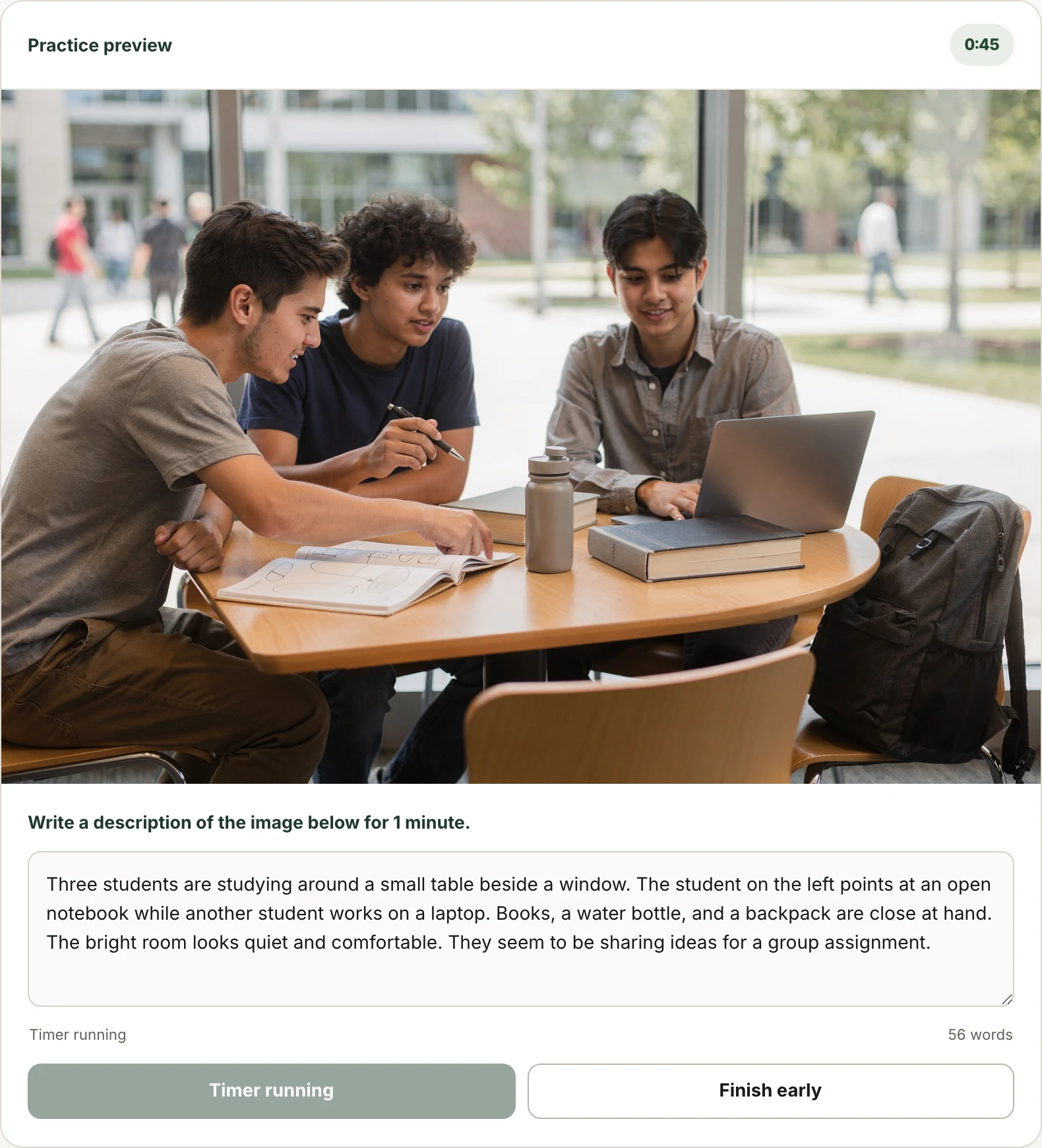
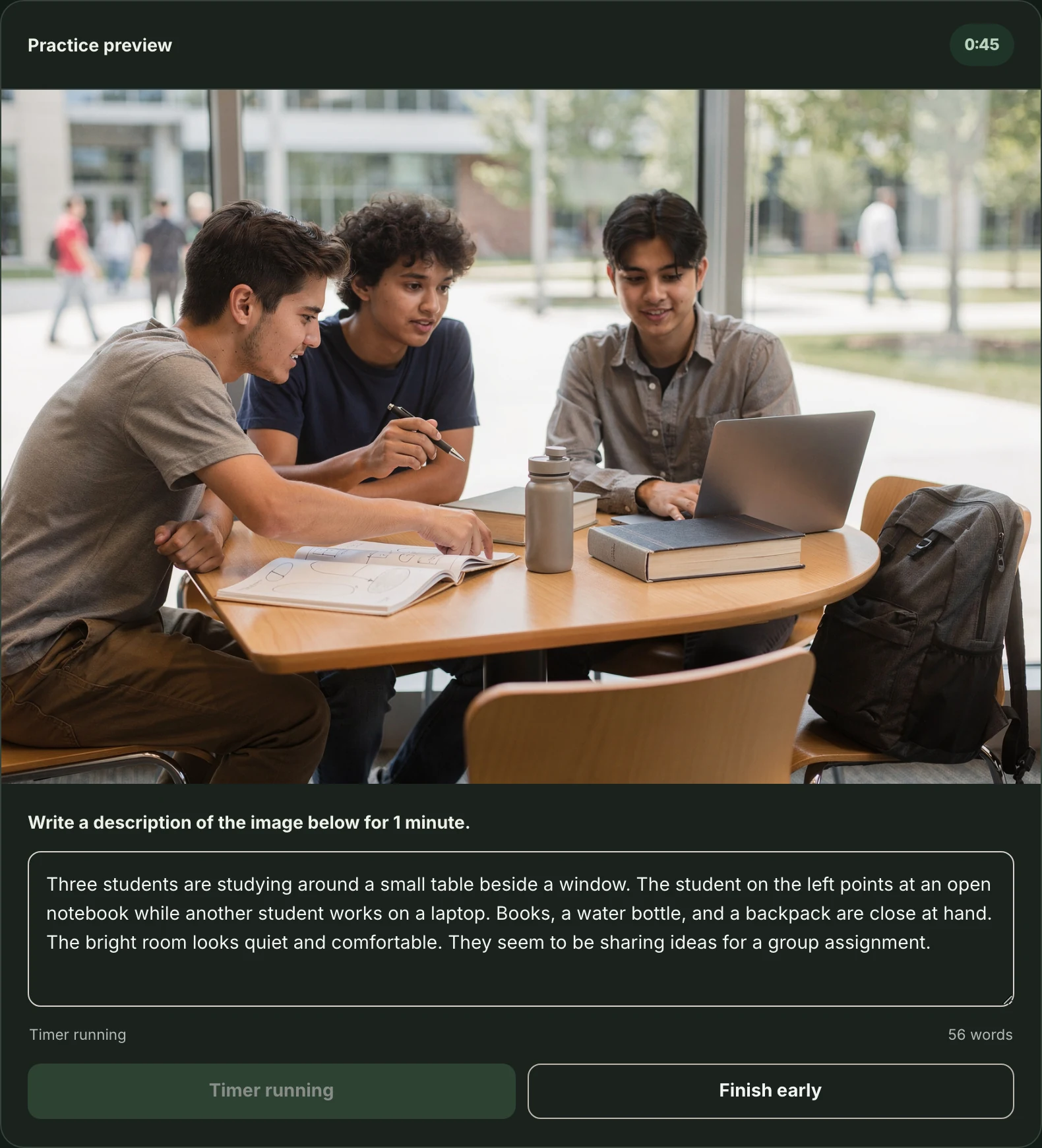
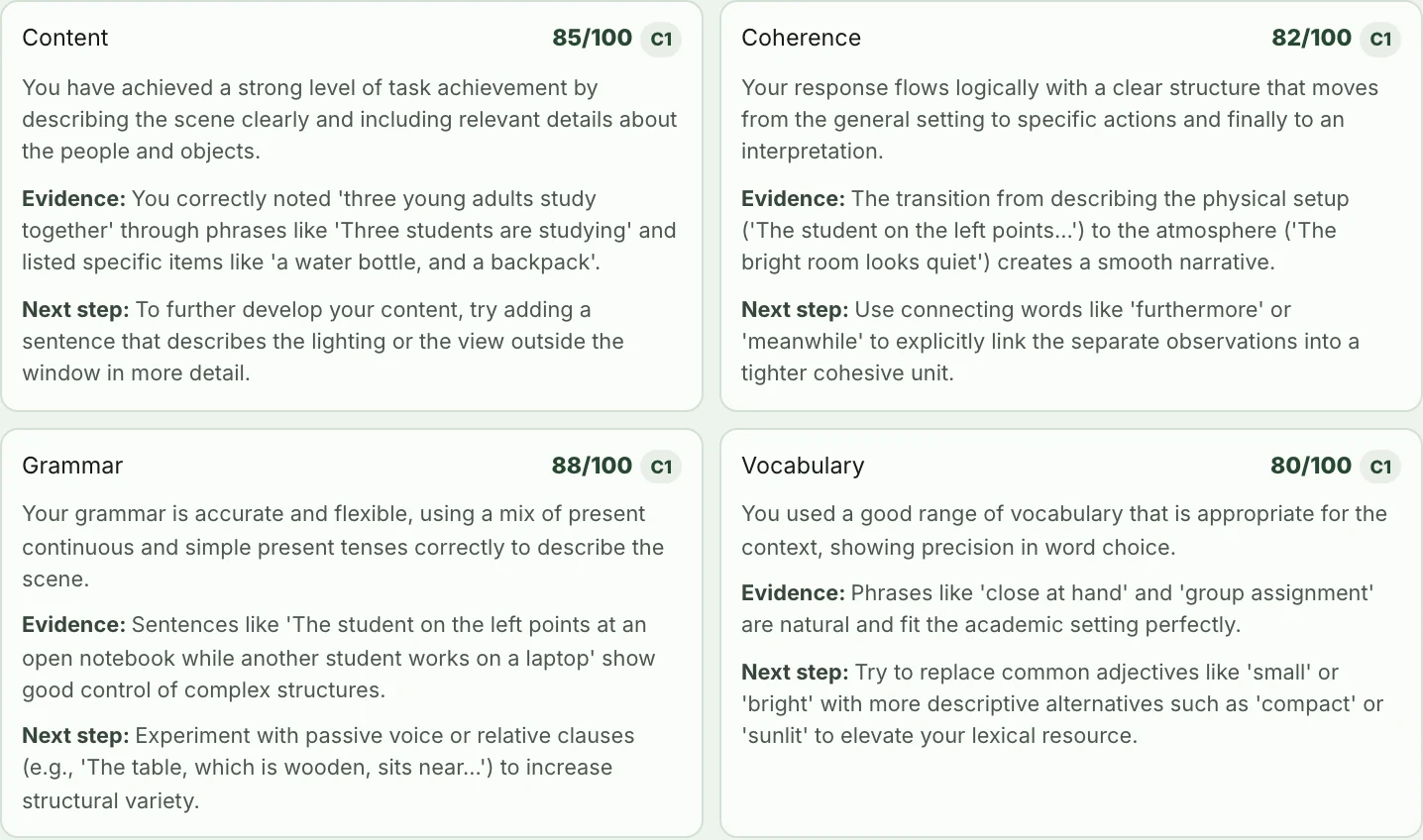
Real PrepEx screens, with an example answer created for this demonstration. Open each view to explore.
Write under the timerA photo, one minute, and space for your answer.
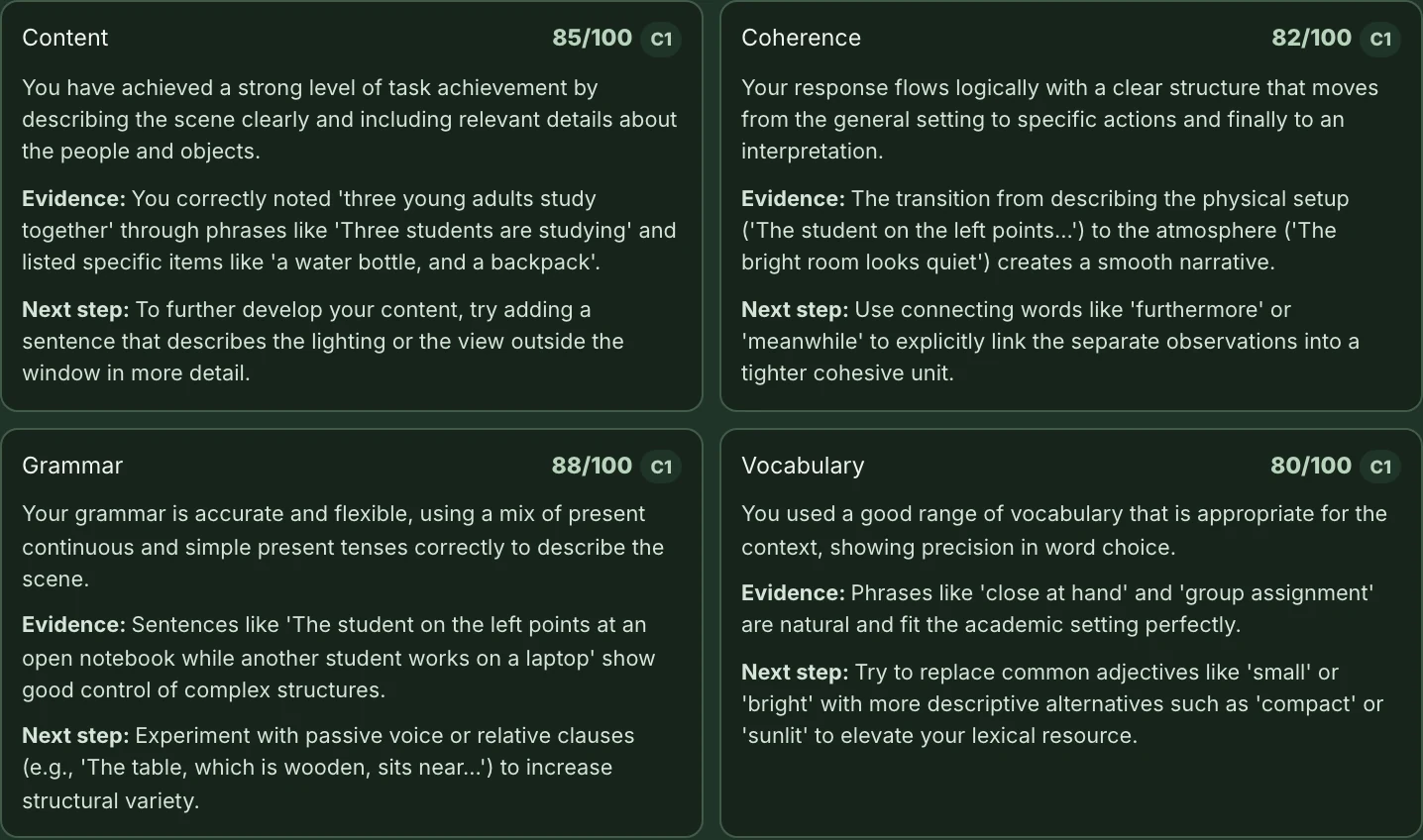
See what to improveFeedback on content, coherence, grammar, and vocabulary.
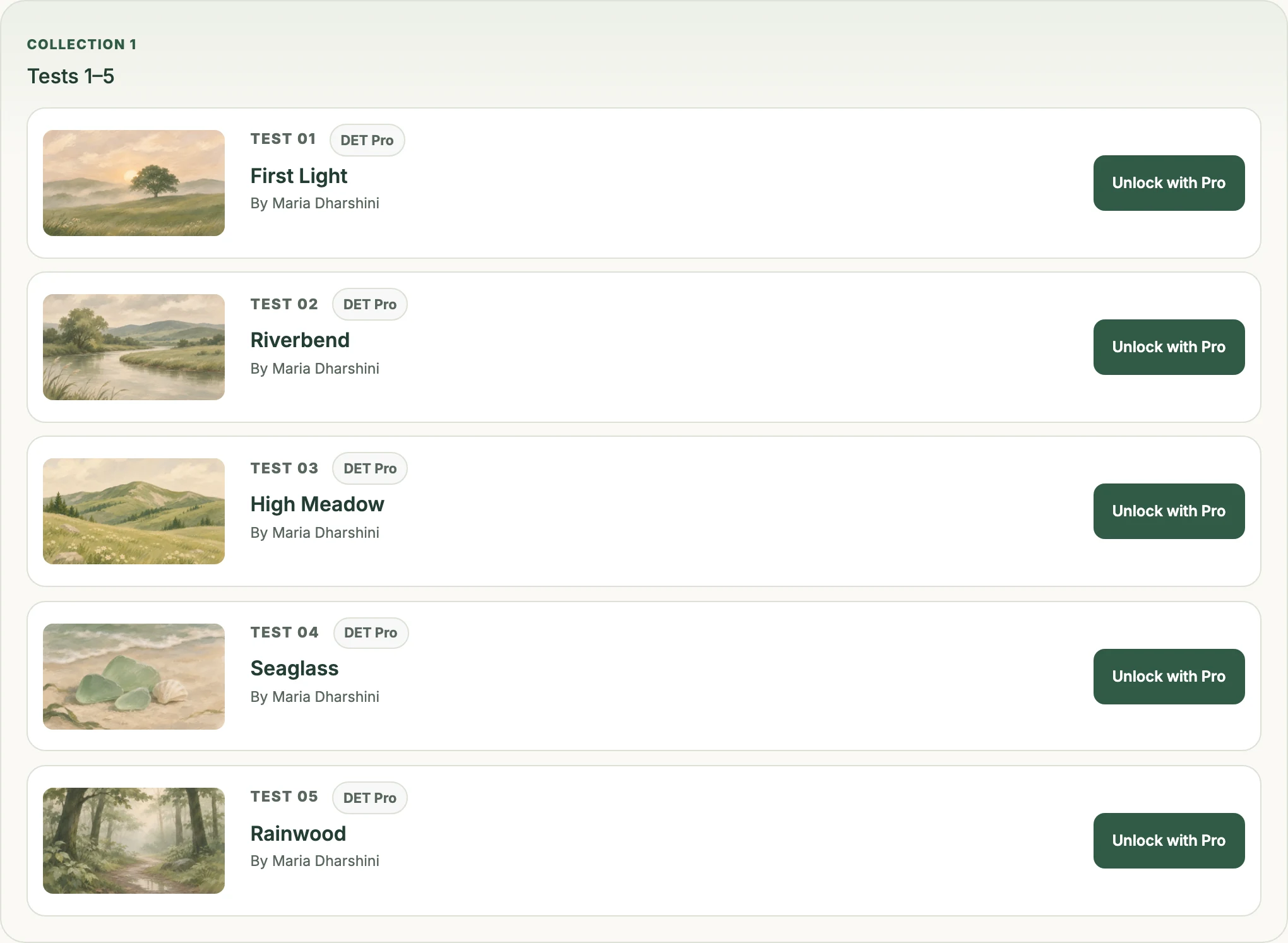
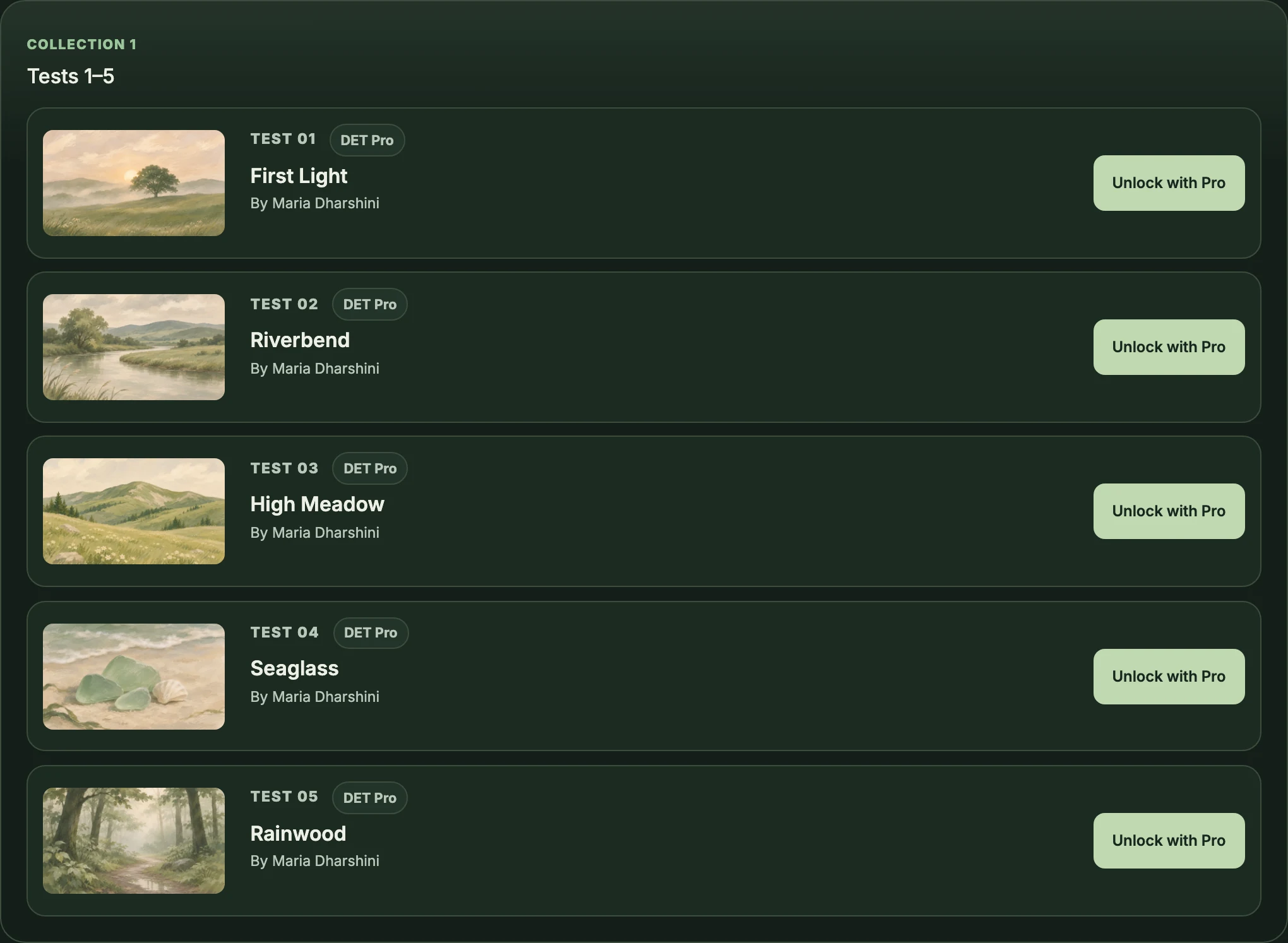
Choose your next mockBrowse the full-length tests included with DET Pro.
Product demo · Captured November 17, 2026
Keep exploring
More from the journal