
How to practice Write About the Photo
The official task gives you one minute to describe the picture in writing. Duolingo recommends going beyond labels and describing details; see its current task guidance. A useful response identifies the main scene, connects visible details and uses clear sentences. There is no required template or sentence count.
For each example, write your own description under a one-minute timer before opening the answer. Then compare it with the shorter first attempt and the developed version. The aim is to understand the revision, not memorize a paragraph. These original teaching examples have no official DET scores, and several different descriptions of the same picture can be effective.
Use your first few seconds to identify the main action. Spend most of the minute writing connected sentences and leave a short check for missing verbs, agreement and spelling. If typing is slow, prioritize a few accurate, complete sentences rather than an unfinished long response. The examples are models of content and organization, not word-count targets.
20 original photo writing examples
1. Shopping at an outdoor market
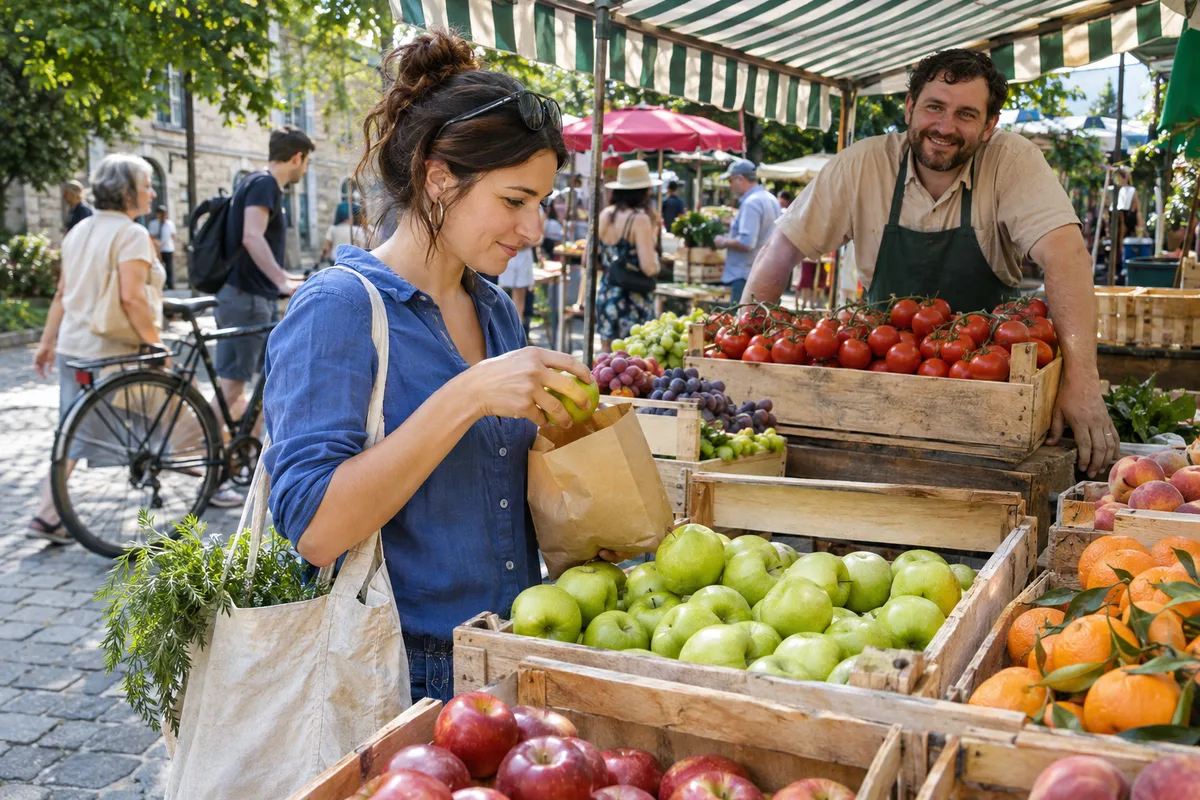
Compare the first attempt and developed answer
A limited first attempt: There is a woman and some fruit. She is shopping.
A woman in a blue shirt is putting a green apple into a paper bag at an outdoor market. In front of her, wooden crates hold apples and other fruit, while a vendor stands behind a large display of tomatoes. A striped canopy shades the stall, and several shoppers pass behind her.
Why the revision helps: The revision replaces vague nouns with visible actions and objects. “While” connects the customer and vendor; the final sentence places them in the wider market without inventing a conversation or a purchase price.
Useful language: placing an apple into a bag; behind the display; a striped canopy.
2. Choosing a library book
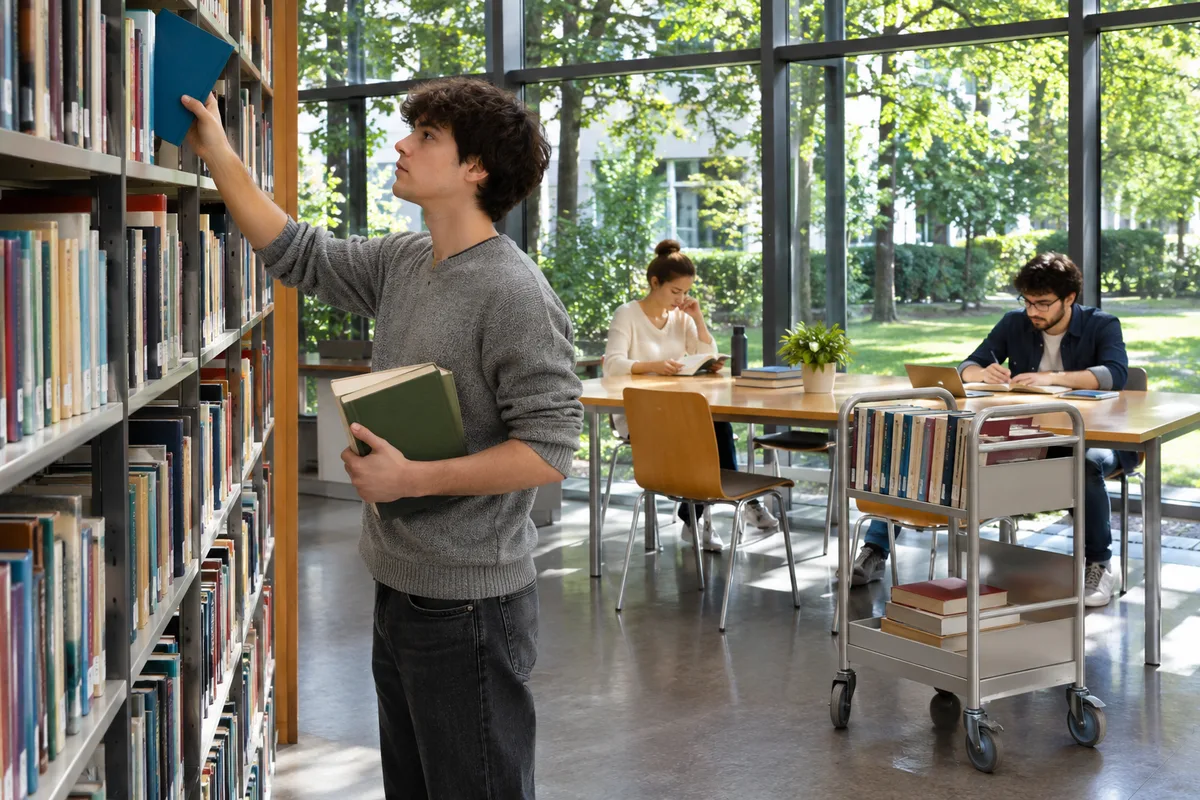
Compare the first attempt and developed answer
A limited first attempt: The man is in a library. He has books. There are other people.
A young man in a gray sweater is reaching for a blue book on a library shelf while holding two other books against his body. Behind him, two people sit at a table beside large windows. A wheeled book trolley stands nearby, and trees are visible through the glass.
Why the revision helps: “Reaching for” describes the visible movement without deciding whether he is taking the book out or putting it back. The answer separates the main action from the background and uses spatial details to connect them.
Useful language: reaching for; against his body; beside large windows.
3. Waiting at a wet crossing
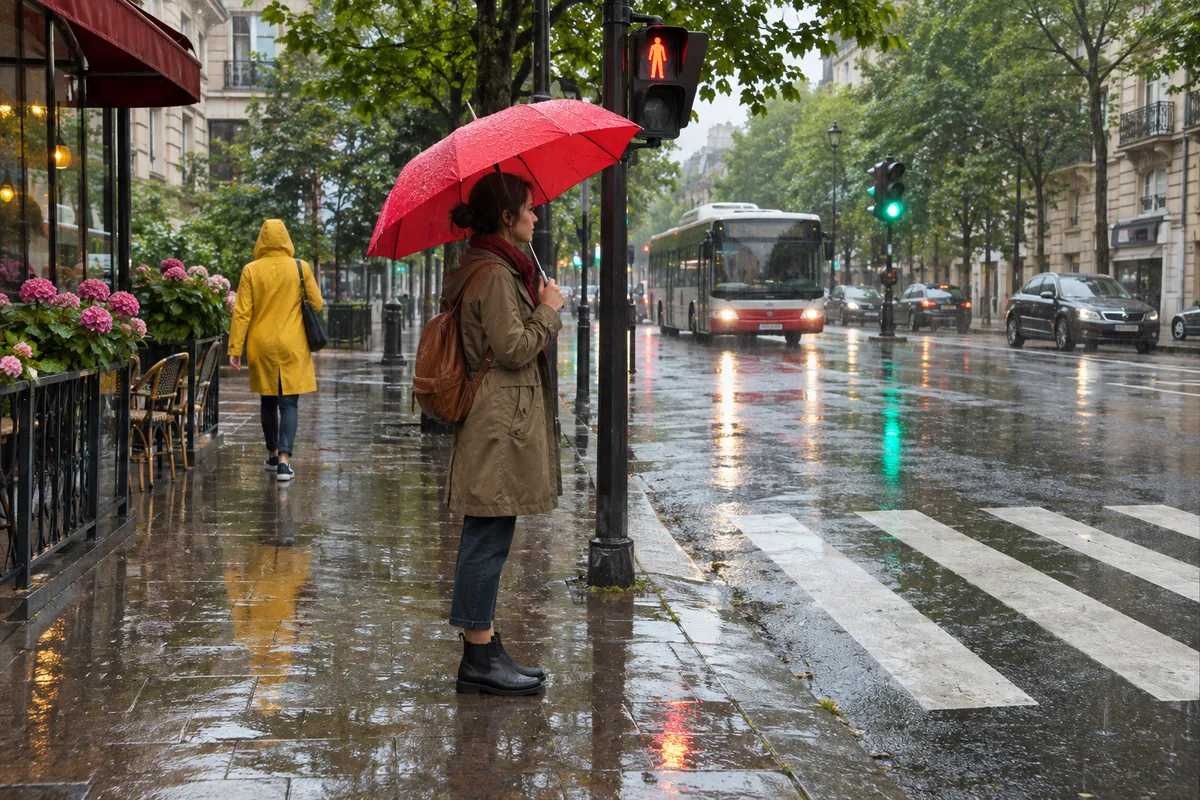
Compare the first attempt and developed answer
A limited first attempt: It is raining. There is an umbrella and a bus on the road.
At a wet pedestrian crossing, a woman stands beneath a red umbrella while a person in a yellow raincoat walks farther along the sidewalk. A bus approaches on the road, and colored traffic lights reflect on the shiny surface. Trees and buildings line the street behind them.
Why the revision helps: The weather is supported by the umbrella, raincoat and wet road. The description develops an action and a visual effect instead of repeating that it is raining. It does not guess where the people are going.
Useful language: beneath an umbrella; farther along; lights reflect on.
4. Planting vegetables
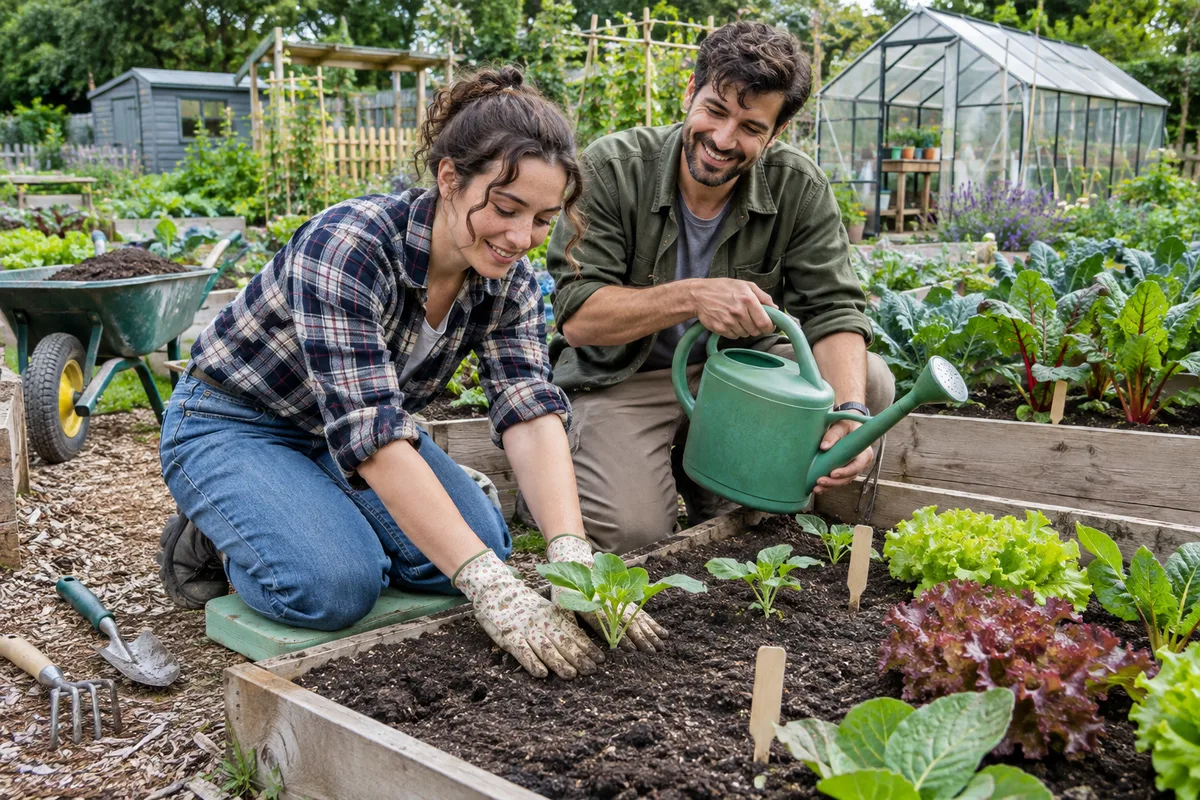
Compare the first attempt and developed answer
A limited first attempt: Two people are gardening. There are plants and tools.
Two people are working beside a raised vegetable bed. A woman wearing gloves presses soil around a small plant, while the man next to her holds a green watering can. Leafy vegetables fill the bed, and hand tools lie on the path. A glass greenhouse stands in the background.
Why the revision helps: The revision names the two different actions and gives the tools a location. “Presses soil around” is more informative than “does gardening.” It avoids claiming that the people own the garden or know each other.
Useful language: a raised vegetable bed; presses soil around; hand tools.
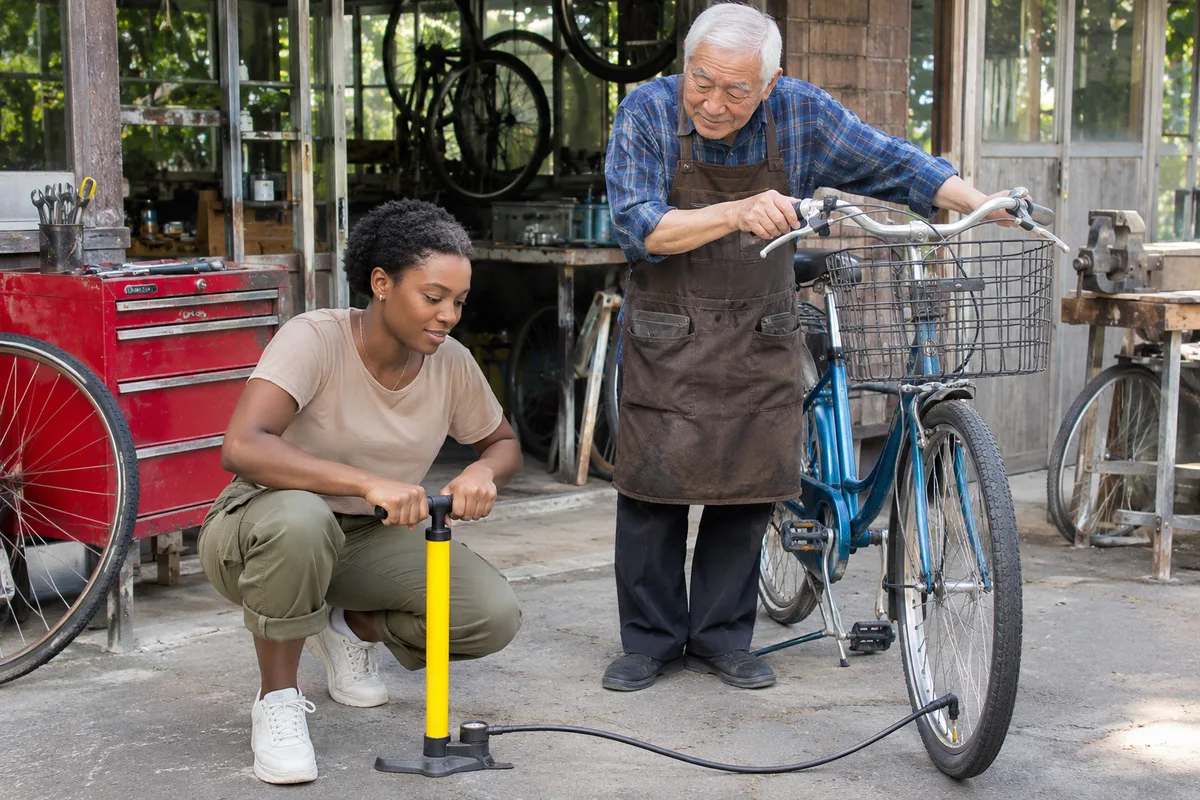
5. Pumping up a bicycle tire
Compare the first attempt and developed answer
A limited first attempt: A woman is fixing a bike. A man is helping.
A woman crouches beside a blue bicycle and operates a floor pump connected to its front tire. An older man holds the handlebars steady while looking down at her work. Tools rest on a red cabinet nearby, and spare wheels hang inside the workshop behind them.
Why the revision helps: The pump and hose support the specific action, so “operates a floor pump” is stronger than a general claim about repairs. “Steady” explains the second person's visible role without inventing a fault in the bicycle.
Useful language: holds the handlebars steady; connected to the tire; spare wheels.
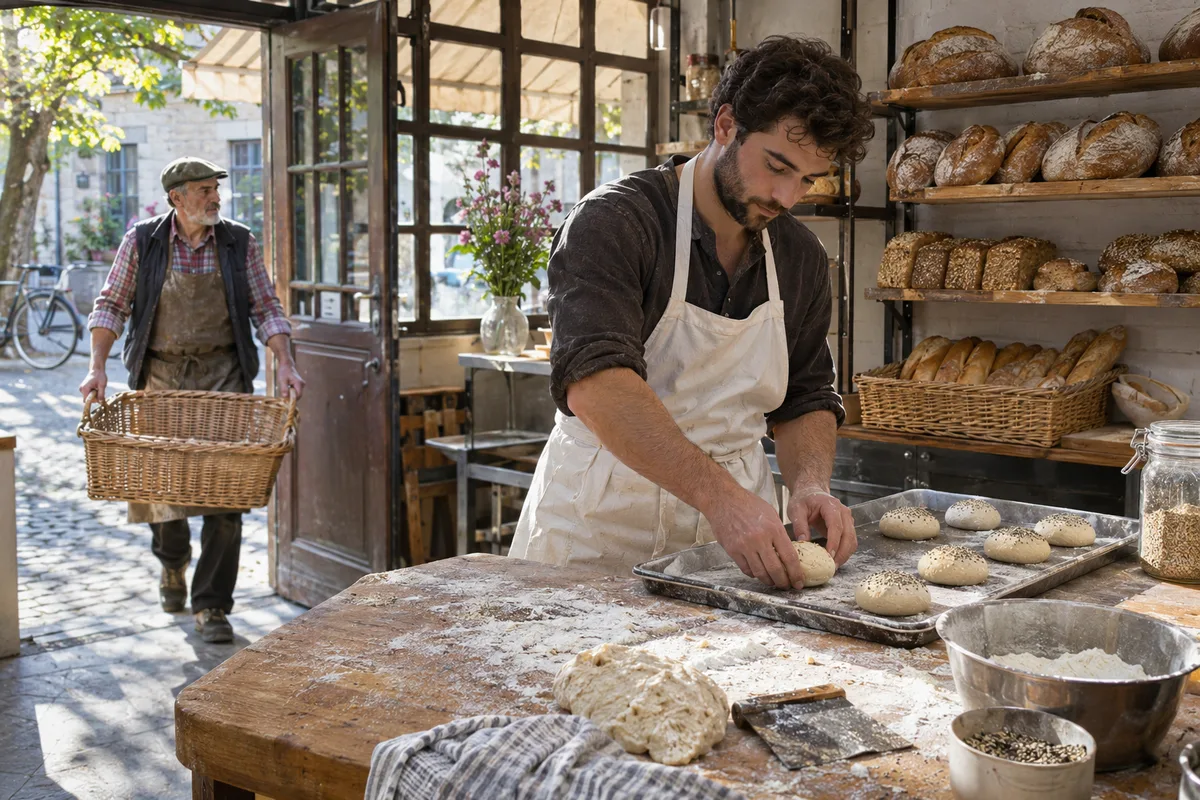
6. Preparing bread rolls
Compare the first attempt and developed answer
A limited first attempt: A man makes bread in a shop. There is flour everywhere.
A baker in a white apron arranges round pieces of dough on a metal tray. Flour is scattered across the wooden counter, where a larger piece of dough and baking tools are also visible. Behind him, shelves display baked loaves, and another person carries a large empty basket through the doorway.
Why the revision helps: The answer distinguishes unbaked dough on the counter from baked bread on the shelves. This adds useful detail without making up an exact time of day, a recipe or the second person's job.
Useful language: arranges pieces of dough; scattered across; shelves display.
7. Building a sandcastle

Compare the first attempt and developed answer
A limited first attempt: A child is on the beach. The sandcastle is beautiful.
A child wearing a sunhat kneels beside a sandcastle decorated with shells and a small red flag. An adult nearby fills a blue bucket with sand. A red umbrella shades a chair to the left, while small waves reach the shore behind them and two people walk along the beach.
Why the revision helps: The revision replaces a broad opinion with visible features. It moves from the sandcastle to the wider beach and does not assume that the adult is the child's parent.
Useful language: decorated with shells; fills a bucket; waves reach the shore.
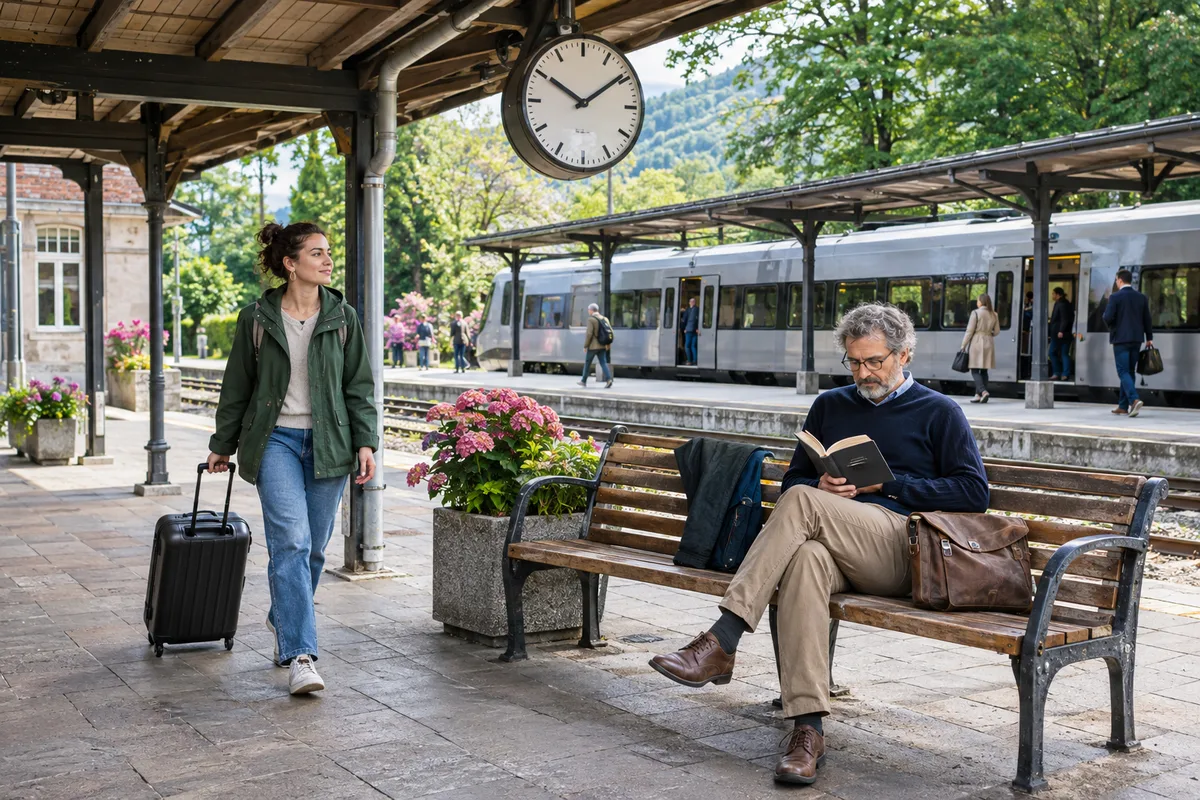
8. A quiet railway platform
Compare the first attempt and developed answer
A limited first attempt: People are waiting for a train. A man has a book.
A woman in a green jacket pulls a black suitcase along a covered railway platform. Beside her, a man sits on a wooden bench reading a book, with bags next to him. A large clock hangs overhead, and a silver train stands across the tracks with people near its open doors.
Why the revision helps: The different actions make the scene more precise than “people are waiting.” The description identifies the opposite platform without claiming that either foreground person is about to board the train.
Useful language: a covered platform; hangs overhead; across the tracks.
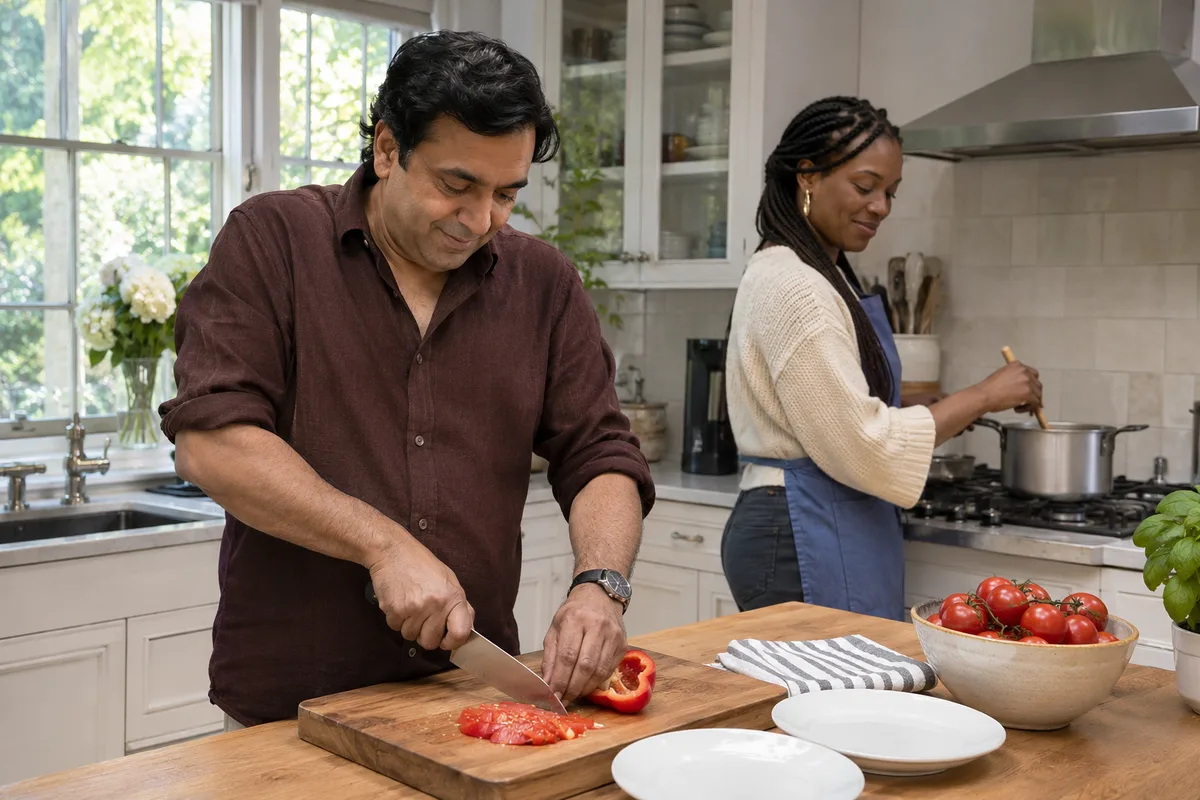
9. Cooking together
Compare the first attempt and developed answer
A limited first attempt: Two people are cooking food. The kitchen is nice.
At a wooden kitchen island, a man cuts red peppers on a chopping board while another adult stirs a pot on the stove behind him. A bowl of tomatoes, two empty plates and a folded towel are arranged on the counter. Daylight enters through a large window.
Why the revision helps: The revision develops the shared activity through two specific verbs, “cuts” and “stirs.” It uses the counter items to establish context without guessing the recipe or the people's relationship.
Useful language: on a chopping board; stirs a pot; on the counter.
10. Looking across a mountain lake
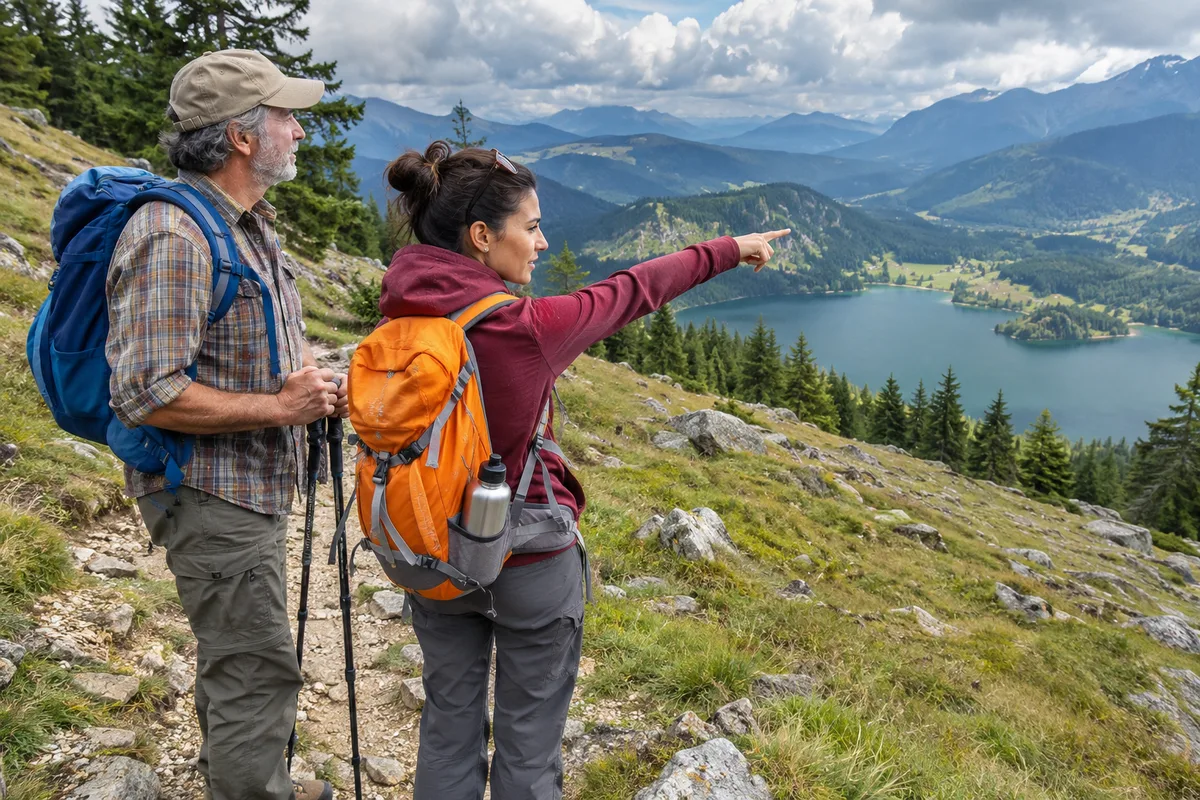
Compare the first attempt and developed answer
A limited first attempt: Two people are hiking. There is a lake and mountains.
Two hikers have stopped on a rocky hillside overlooking a lake. The person with the orange backpack points into the distance, while the other looks across the view. Grass and stones cover the slope around them. Beyond the lake, wooded hills rise toward mountains under a cloudy sky.
Why the revision helps: The location of each feature creates depth: slope, lake, hills and distant mountains. “Have stopped” fits the visible pause, while the answer avoids inventing their route or the distance they have walked.
Useful language: overlooking a lake; points into the distance; wooded hills.
11. Working with clay
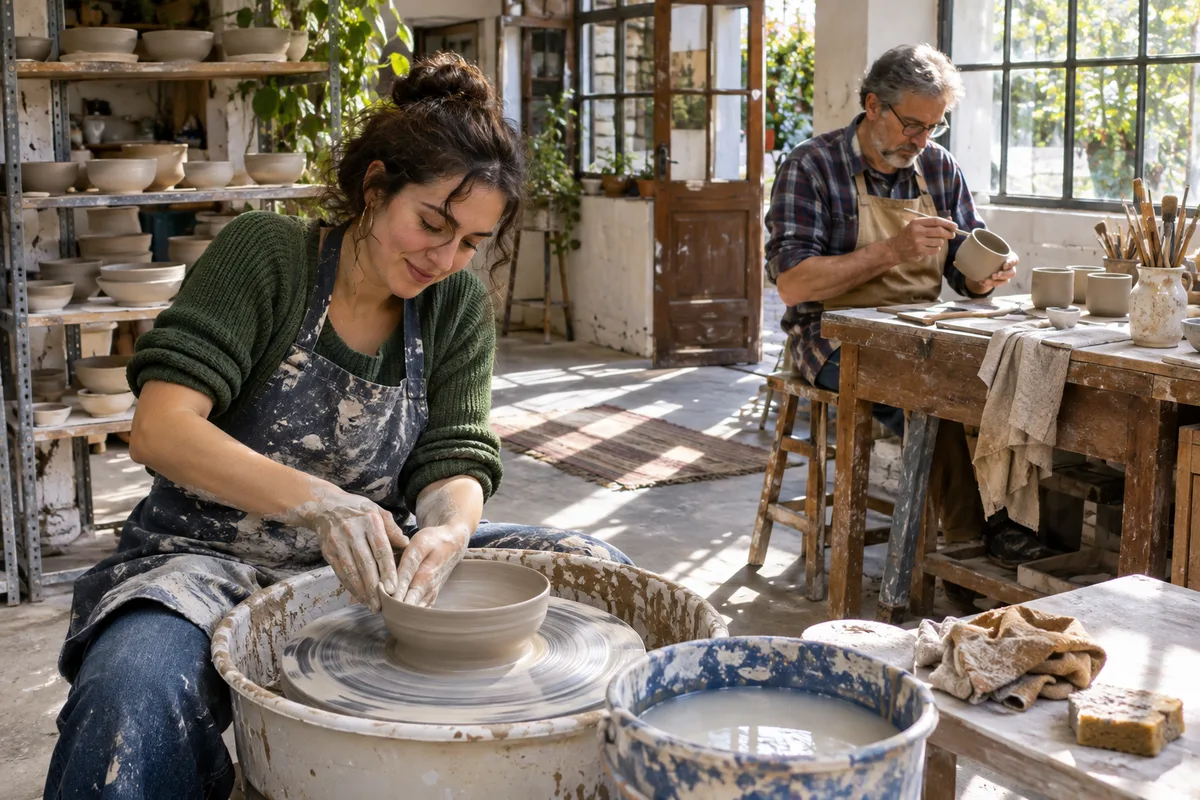
Compare the first attempt and developed answer
A limited first attempt: A woman makes a bowl. A man is working in the room.
A woman in a clay-stained apron shapes a bowl on a pottery wheel, keeping both hands close to its rim. At a workbench behind her, a man holds a cup and works on its surface with a small tool. Shelves of unfinished bowls and cups fill the bright studio.
Why the revision helps: The description connects hand position to the main action and contrasts two stages of making pottery. It does not claim the objects are finished, fired or ready to sell.
Useful language: a clay-stained apron; close to the rim; unfinished bowls.
12. Coffee on the terrace
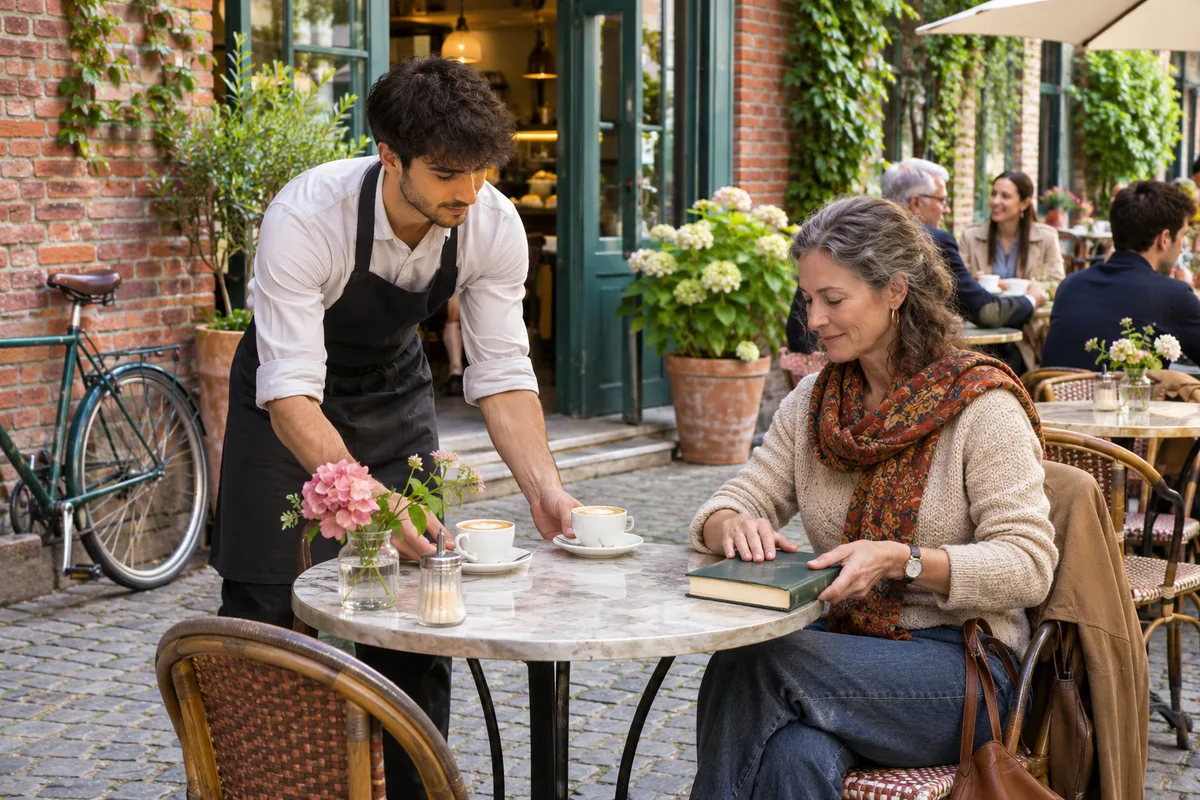
Compare the first attempt and developed answer
A limited first attempt: A waiter brings coffee. A woman is sitting outside.
A server in a dark apron places two cups on a round cafe table beside a seated woman. She rests her hands on a closed book in front of her. A bicycle leans against the brick wall, and potted plants surround the open doorway. Other customers sit at tables farther back.
Why the revision helps: The revised version adds the woman's action and a clear foreground-to-background order. “Cups” stays literal because the exact drinks cannot be established from the picture alone.
Useful language: rests her hands on; leans against; farther back.
13. A dog in the stream
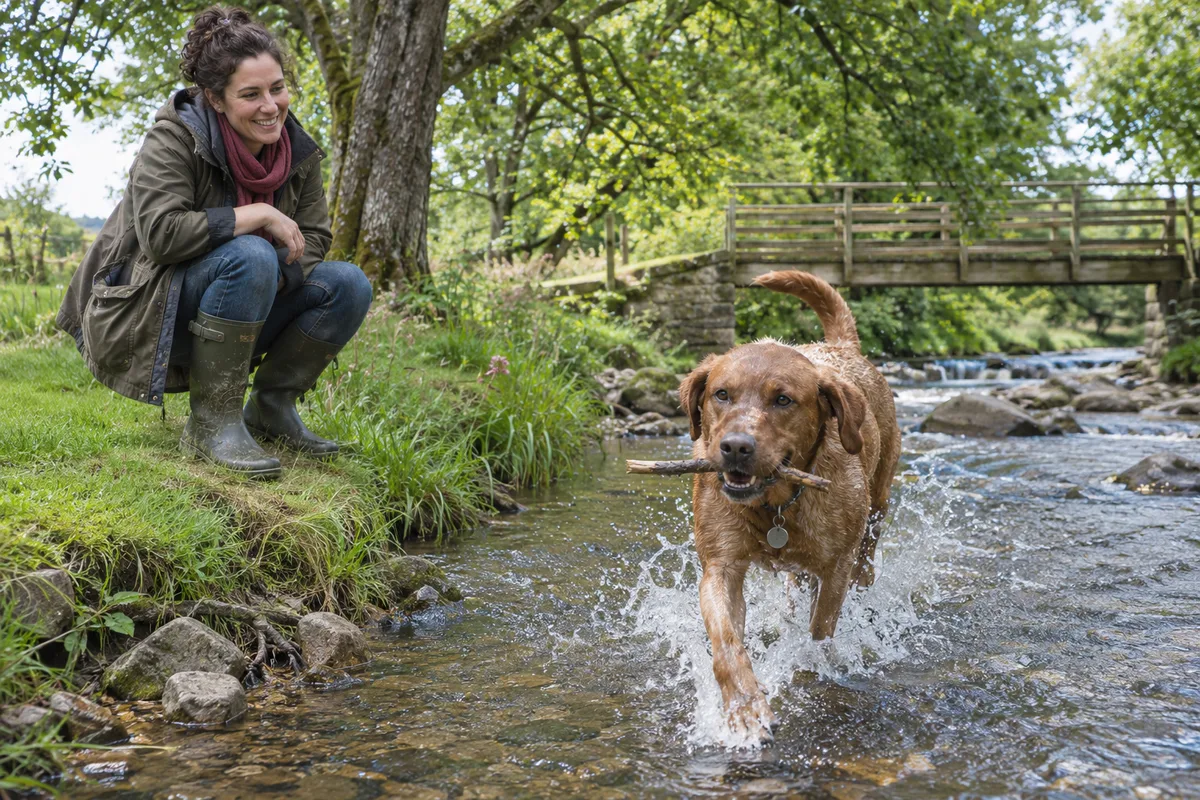
Compare the first attempt and developed answer
A limited first attempt: A dog plays in water. It is happy.
A brown dog runs through a shallow stream with a stick held in its mouth, splashing water around its front legs. On the grassy bank, a person in rubber boots watches from beside a tree. A wooden footbridge crosses the stream farther back, surrounded by leafy branches.
Why the revision helps: Visible movement replaces the unsupported statement about the dog's emotion. The stick, splashes and bank give the reader concrete details, and the bridge helps organize the background.
Useful language: a shallow stream; splashing water; on the grassy bank.
14. Discussing a painting
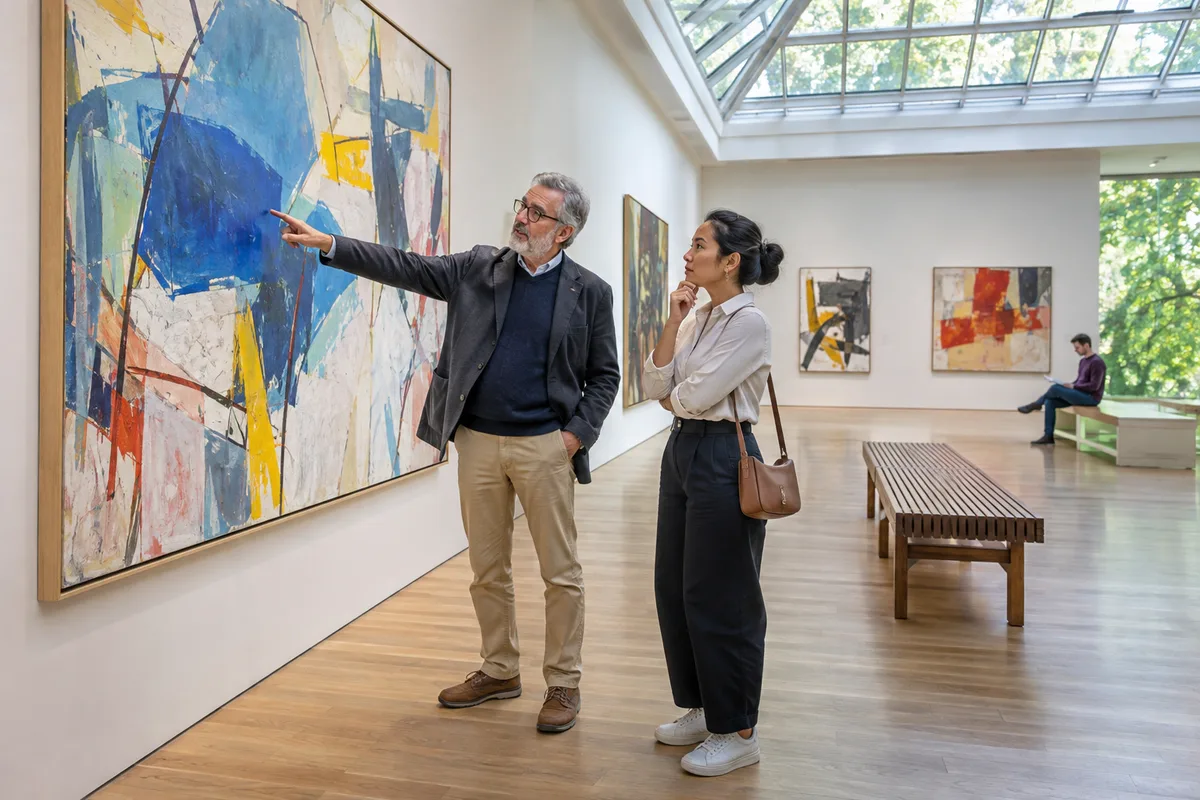
Compare the first attempt and developed answer
A limited first attempt: Two people look at art. It is a big museum.
Two visitors stand in front of a large abstract painting in a bright gallery. One points toward a blue section of the artwork while the other watches with a hand near her chin. A wooden bench occupies the open floor behind them, and daylight enters through the glass roof.
Why the revision helps: The answer describes the visible gesture instead of inventing the visitors' opinions. Calling it a “gallery” is enough; the picture does not establish the building's overall size or the artist's identity.
Useful language: points toward; an abstract painting; through the glass roof.
15. Carrying a bookcase
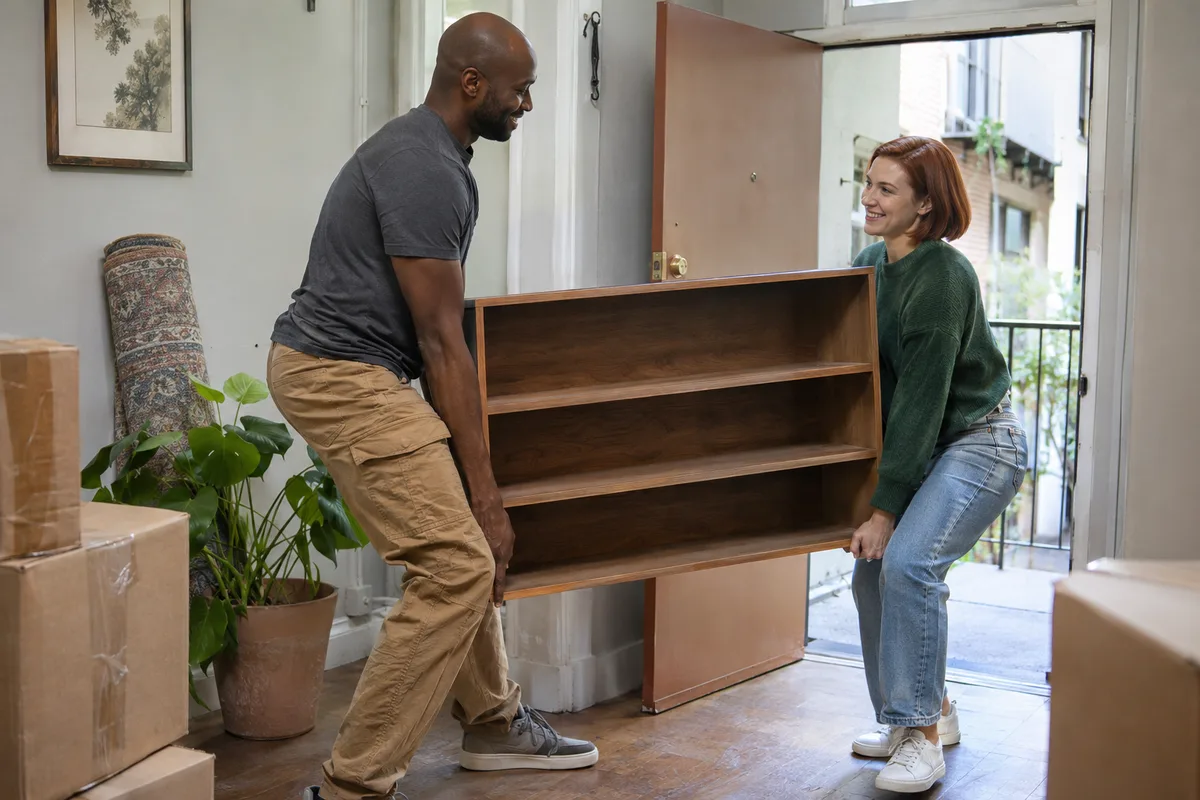
Compare the first attempt and developed answer
A limited first attempt: Two people move furniture. They are moving house today.
Two adults carry a small wooden bookcase through an open apartment doorway, each holding one end. Several cardboard boxes are stacked against the wall beside a rolled rug and a potted plant. The bookcase is empty, and the pair keep it raised above the wooden floor as they move.
Why the revision helps: The boxes suggest a move, but the revised answer describes what is certain rather than declaring a moving date or a new home. “Each holding one end” explains how the action is coordinated.
Useful language: each holding one end; stacked against; raised above.
16. Volleyball in the park
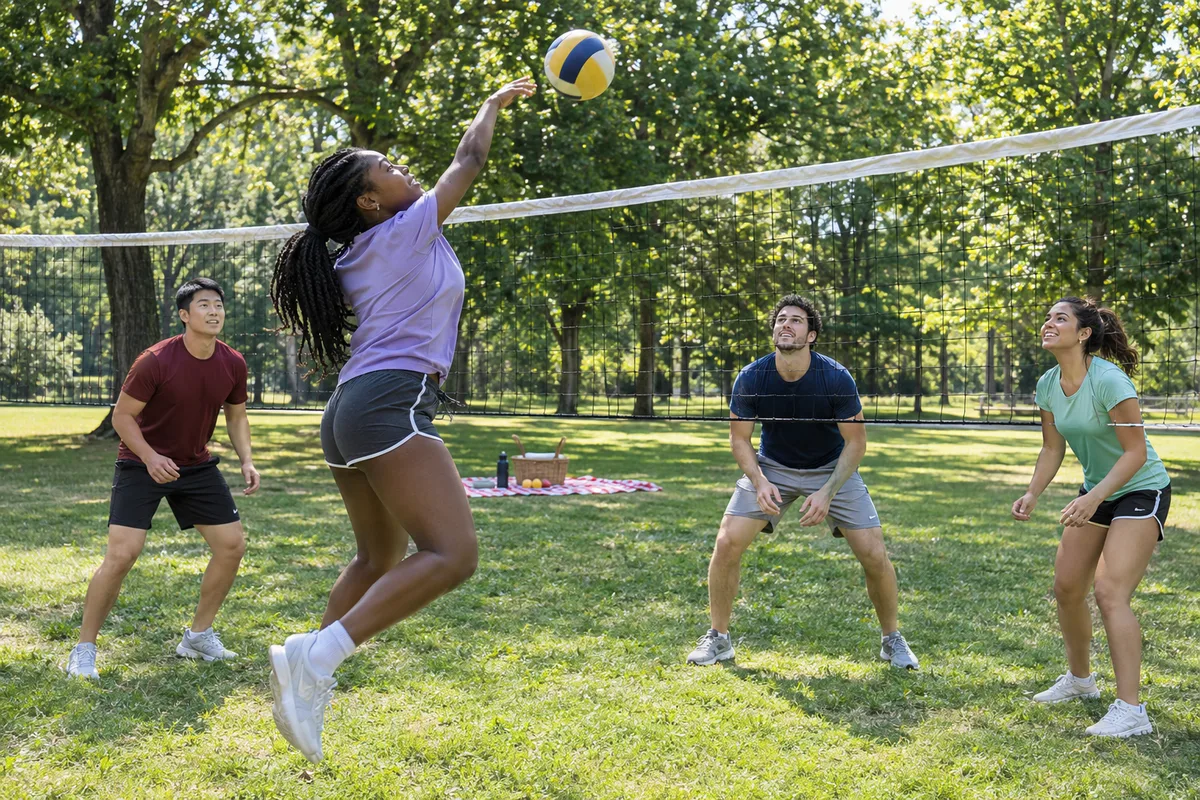
Compare the first attempt and developed answer
A limited first attempt: People are playing a game in a park. They enjoy it.
Four people play volleyball on a grassy court beneath leafy trees. One player reaches up toward a ball above the net, while the others watch and prepare to respond. A picnic blanket, a basket and water bottles lie beside the playing area. The trees provide shade around the court.
Why the revision helps: The revision makes the game and its current action clear. The objects beside the court add setting without asserting who owns them, who is winning or how the players feel.
Useful language: reaches up toward; prepare to respond; beside the playing area.
17. Tending seedlings
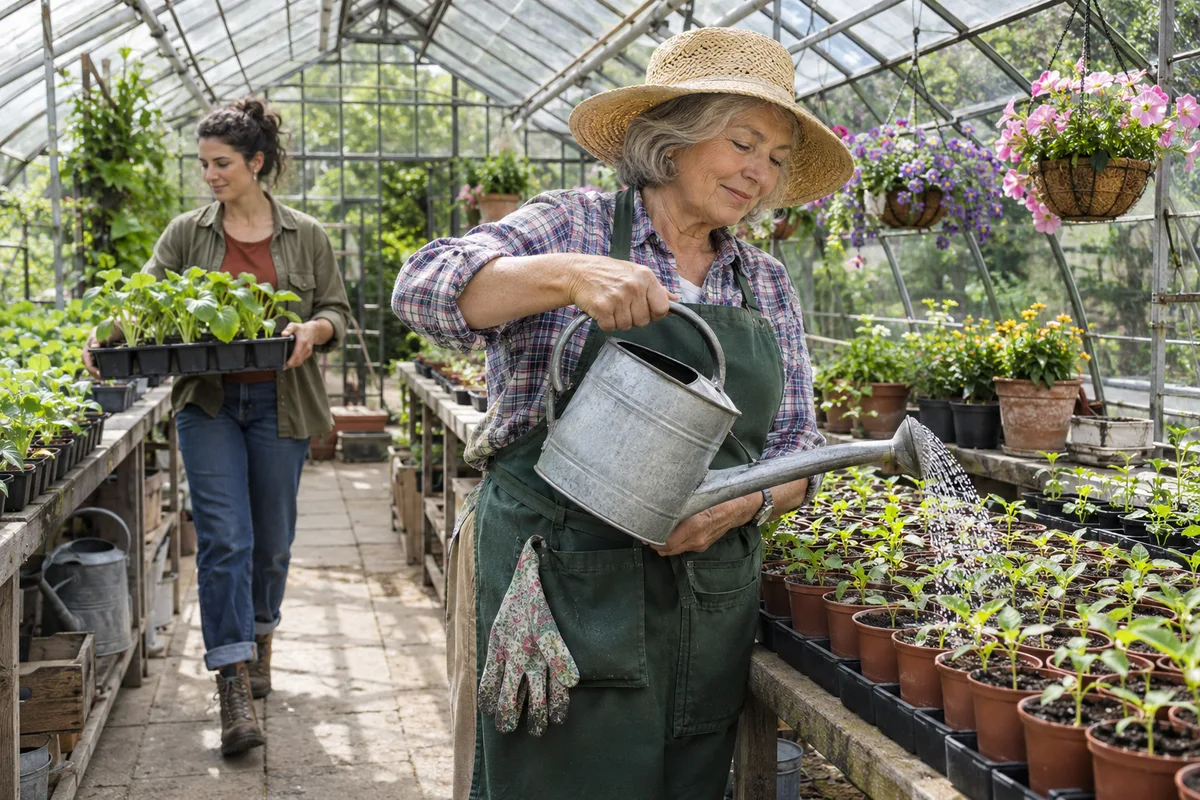
Compare the first attempt and developed answer
A limited first attempt: A woman waters plants. There are a lot of plants.
Inside a greenhouse, a woman in a straw hat waters rows of seedlings with a metal watering can. Another adult carries a tray of young plants along the aisle behind her. Pots line the raised benches on both sides, and baskets of flowers hang beneath the glass roof.
Why the revision helps: The revision distinguishes seedlings, pots and hanging flowers and gives each a place. It develops the repeated word “plants” through accurate relationships rather than replacing it with obscure vocabulary.
Useful language: rows of seedlings; along the aisle; beneath the glass roof.
18. Coiling a rope at the dock
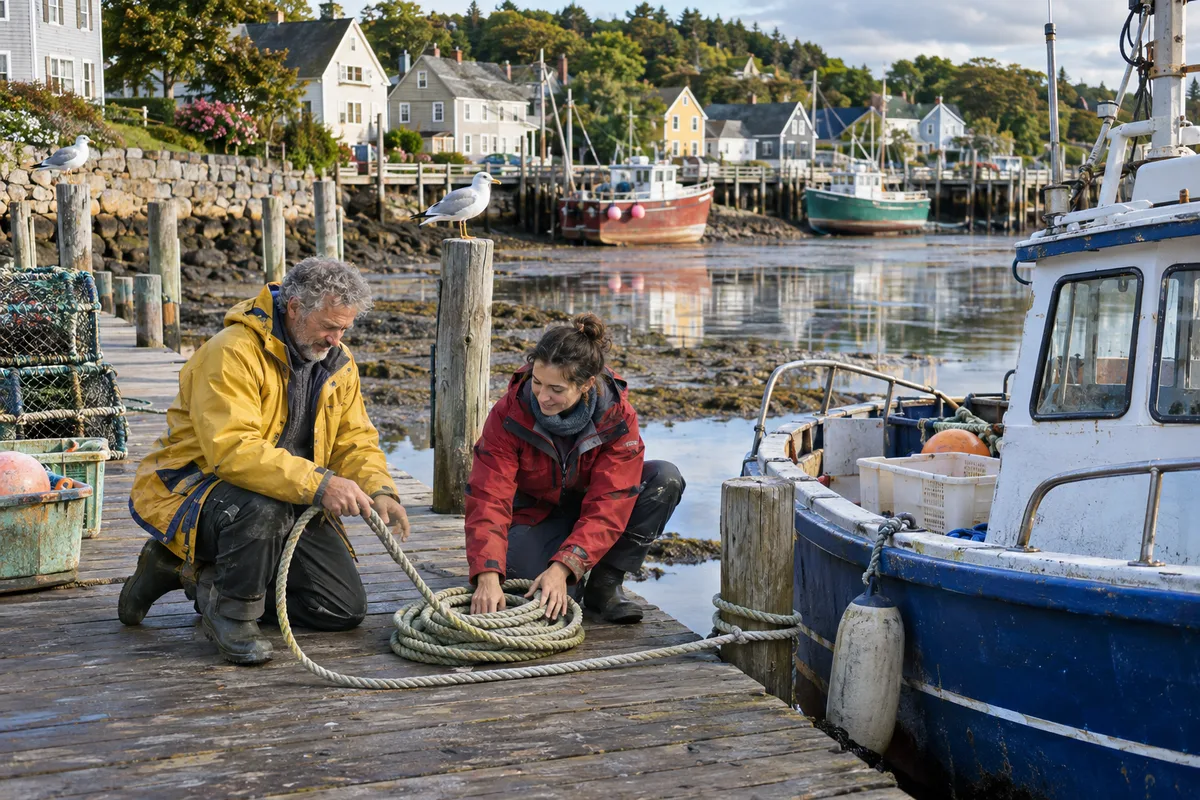
Compare the first attempt and developed answer
A limited first attempt: Two people work on a boat. The water is calm.
Two people kneel on a wooden dock beside a blue boat, gathering a thick rope into a coil. Gulls stand on nearby posts, and other boats sit farther across the harbor. Houses line the opposite waterfront, while patches of exposed mud are visible between the boats and the shore.
Why the revision helps: The action is on the dock, not aboard the boat. The revision corrects that location and adds a clear background. Exposed mud is visible; a precise tide time would be speculation.
Useful language: gathering rope into a coil; across the harbor; exposed mud.
19. Sewing blue fabric
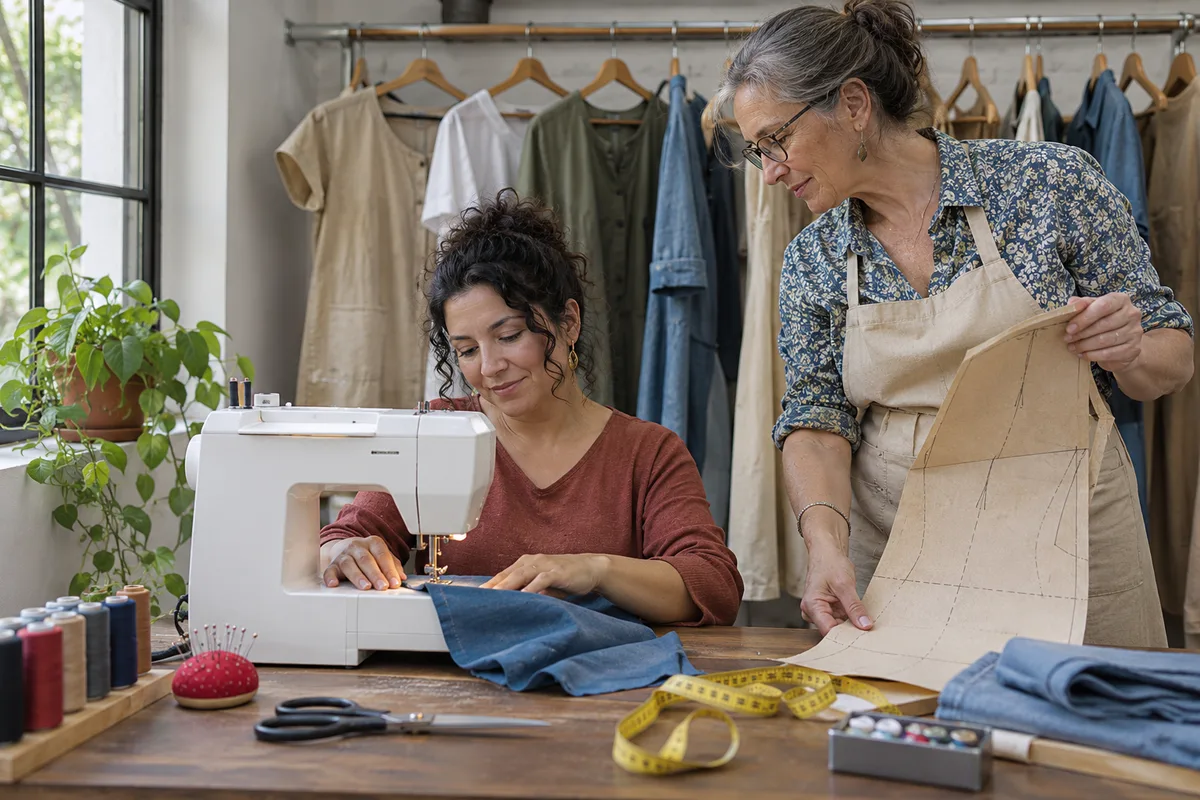
Compare the first attempt and developed answer
A limited first attempt: A woman makes clothes. Another woman helps her.
A woman guides blue fabric through a sewing machine while another woman stands beside her holding a large paper pattern. Spools of thread, scissors and a measuring tape lie across the wooden table. Several plain garments hang behind them, and light from a nearby window illuminates the work area.
Why the revision helps: “Guides fabric” and “holding a pattern” describe the two visible roles. The answer does not need to identify the garment being made or assume that one person is teaching the other.
Useful language: guides fabric through; spools of thread; illuminates the work area.
20. Clearing a snowy path
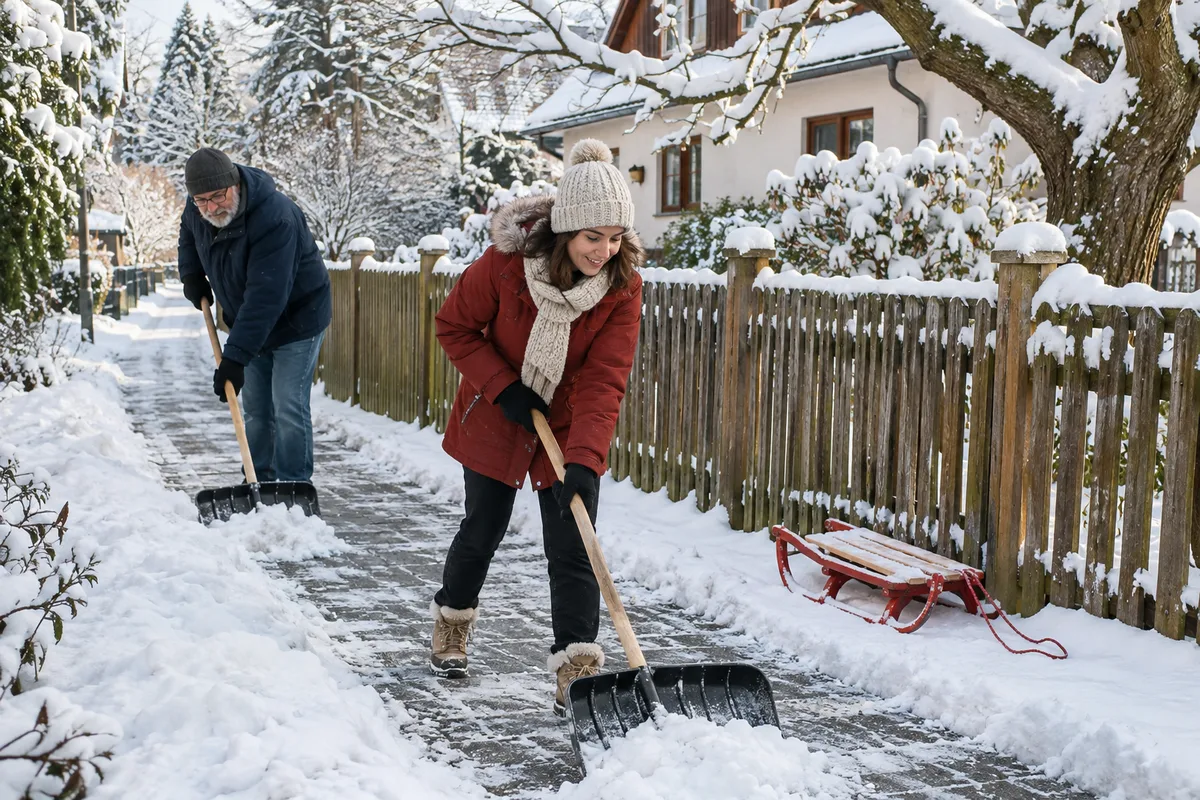
Compare the first attempt and developed answer
A limited first attempt: It is snowing and two people clean outside.
Two adults in warm coats clear snow from a path beside a wooden fence. The person in front pushes a broad shovel along the paving, while the other works farther back. A small red sled rests near the fence, and thick snow covers the branches and nearby house roofs.
Why the revision helps: The picture shows snow on the ground, not necessarily snow falling. “Clear snow” and “pushes a shovel” describe the task more accurately than “clean outside.” The final details establish the wintry setting.
Useful language: clear snow from; a broad shovel; thick snow covers.
Check your own description
- Main scene: Would a listener or reader understand the central subject and action?
- Visible evidence: Are names, relationships, motives or destinations being invented?
- Connections: Do your sentences explain where things are or how actions relate?
- Language: Are verbs, articles and singular/plural forms accurate enough for the meaning to remain clear?
- Development: Does each new detail add something, rather than repeat “there is” or list colors?
Choose one sentence that could be more precise, revise it, then try a new picture. Do not add difficult synonyms simply to sound advanced. An ordinary verb such as “stirs,” “reaches” or “carries” often communicates more than a vague phrase with elaborate vocabulary.
Continue with the matching practice task
Try the timed Write About the Photo preview, then explore 10 photo-speaking examples with audio to practice developing a longer description. The seven-day DET plan helps you fit photo work around the other task types.
Photo-description questions
Should I memorize a DET photo-description template?
Use a flexible order, such as main scene followed by supporting details. Avoid memorizing full descriptions or forcing every picture into the same sentences. The response needs to fit the image you actually see.
Can I guess what people are thinking or who they are?
Prioritize visible evidence. You can mark a reasonable interpretation with language such as “appears to,” but names, family relationships, jobs and motives are often not established by a photograph.
Do these sample answers have official DET scores?
No. They are original PrepEx teaching examples with explanations, not official DET items or scored responses. Any score you receive in PrepEx practice is a practice estimate, not an official Duolingo English Test score.
Can I practice on my phone?
You can read these examples and play the audio on a phone. The real DET requires a desktop or laptop plus its separate equipment and room requirements. Read the test setup guide; practice-device compatibility does not establish test-day compliance.
Sources and editorial scope
Task timing checked against the linked official Help Center pages on November 10, 2026. Photos, descriptions and explanations are original PrepEx practice material. No official prompts, sample answers or private learner responses were copied into this collection.