The PrepEx Journal
How to Prepare for the Duolingo English Test in 2026: A Week-by-Week Plan
Learn the 13 question types, take Duolingo's free practice test, practise your weakest types daily with feedback, then rehearse with full-length timed tests and check your setup. Here are one-week and two-week to one-month plans, and where PrepEx's free practice and full-length tests fit.

On this page
To prepare for the Duolingo English Test, learn its 13 question types, take Duolingo's free practice test, drill your weakest types daily, then rehearse with full-length timed tests and check your setup. If your practice score is already near your target, one to four weeks is a typical planning range. PrepEx gives you free graded practice in every question type, and DET Pro adds full-length practice tests that end with a 10–160 practice estimate.
Rehearse the whole test before you buy it
Each PrepEx DET practice test takes about an hour, covers all 13 question types in 44 timed responses and ends with a saved practice estimate and report.
We checked the facts on this page against Duolingo's Help Center and its test-readiness guide on November 21, 2026.
How to prepare for the Duolingo English Test in 5 steps
Work through these five steps in order:
- Learn the 13 question types. Know what each one asks and how long you get; our guide to the DET question types covers them all.
- Take Duolingo's free practice test. It takes about 45 minutes and gives an estimated score range to compare with the score your university asks for.
- Practise your weakest question types daily, with feedback. Thirty to 45 minutes a day on two or three types is easier to keep up than one long weekly session.
- Take full-length timed practice tests. They build your pacing over a full hour and show whether daily practice has carried over.
- Check your computer, phone camera, ID and room a day ahead. A rule broken by accident can cost you a certified result.
Duolingo's own test-readiness guide says your score improves as your English improves, and that studying the night before won't change it much.
How long should you prepare for the Duolingo English Test?
One to four weeks is a typical planning range if your practice score is already near your target. Start from your free practice-test range.
| Where you start | Typical planning range | Where the time goes |
|---|---|---|
| Your practice range already includes your target | A few days to a week | Formats, timing, one full-length practice test, setup check |
| Your range is just below your target | Two to four weeks | Your two or three weakest question types daily, then full-length practice tests |
| Your target is well above your range | One to three months or more | Everyday English first, with test practice added later |
| You've never seen the test | Add a few days | Learning the formats before you measure yourself |
These are planning ranges, not rules. Your score moves with your English, so a bigger gap needs more time on the language rather than more practice tests. Retake Duolingo's practice test every week or so to check the plan is working.
Is the Duolingo English Test hard?
Much of what makes the Duolingo English Test feel hard is its format rather than the English. It's adaptive, so the difficulty of some questions changes with your answers, and Duolingo says it's normal for some to seem easier or harder than others. What catches people out:
- Short timers: five seconds a word in Read and Select, 20 seconds a sentence in Fill in the Blanks.
- Shared timers: 7 or 8 minutes for all six Interactive Reading questions.
- Interactive Speaking questions that play only once.
- About an hour of uninterrupted testing.
Practising with the real timings takes the surprise out of all four. Duolingo says you're highly unlikely to see the same question twice, so learn the formats rather than memorising questions. To compare difficulty with other tests, see Duolingo English Test vs IELTS and DET vs TOEFL: which is easier.
Duolingo English Test question types and time limits
Each question type has its own timer, from five seconds a word in Read and Select to 7 or 8 minutes for each Interactive Reading set.
| Question type | On the test | What to practise |
|---|---|---|
| Read and Select | 15–18 words, 5 seconds each | Reading the whole word before deciding |
| Fill in the Blanks | 6–9 sentences, 20 seconds each | Endings and grammar that fit |
| Read and Complete | 3–6 passages, 3 minutes each | Spelling and word forms in context |
| Interactive Reading | 2 sets of 6 questions, 7 or 8 minutes per set | Main idea versus detail |
| Listen and Type | 6–9 sentences, 1 minute each, up to 3 plays | Small words and endings |
| Interactive Listening | 2 sets: 6:30 for 8–10 questions, then 75 seconds to summarise | Who wants what, and how it ends |
| Write About the Photo | 3 photos, 1 minute each | Accurate sentences, fast |
| Interactive Writing | 30 seconds to read, 5 minutes, then a 3-minute follow-up | New ideas in the follow-up |
| Writing Sample | 30 seconds to read, 5 minutes to write | A clear position with reasons |
| Speak About the Photo | 20 seconds to prepare, up to 90 seconds | The whole scene, then details |
| Read, Then Speak | 20 seconds to prepare, up to 90 seconds | Covering every bullet point |
| Interactive Speaking | 6–8 spoken questions, 35 seconds each | Answering at once, with a reason |
| Speaking Sample | 30 seconds to prepare, up to 3 minutes | Keeping going with examples |
Our sample questions show an original example of each type, and the speaking questions guide has 40 prompts for the speaking tasks.
A one-week Duolingo English Test plan
A week works when your practice range is already near your target. Plan on 30–45 minutes a day, and about an hour plus review on the full-test day.
| Day | What to do |
|---|---|
| Day 1 | Read how the 13 question types work, then take Duolingo's free practice test. Note your range and the three types that felt worst. |
| Day 2 | Reading: Read and Select, Fill in the Blanks, Read and Complete. Review every word you missed. |
| Day 3 | Listening: Listen and Type, Interactive Listening. Replay what you missed and write it out. |
| Day 4 | Writing: all three writing tasks. Check each answer against its question. |
| Day 5 | Speaking: all four tasks with real timings. Record, listen back, fix one thing, try a new question. |
| Day 6 | A full-length timed practice test (or Duolingo's practice test again), then review your weakest task. |
| Day 7 | Your two weakest types again, a setup check in your test room, and an early night. |
PrepEx's 7-day practice plan adds what to note down after each day.
A two-week to one-month Duolingo English Test plan
With more time, work in cycles: measure, practise, measure again. For two weeks, combine weeks 1 and 2, then do week 4.
| Week | Focus | What to do |
|---|---|---|
| Week 1 | Your starting point | Duolingo's practice test; every question type once; pick your three weakest |
| Week 2 | Weakest question types | 30–45 minutes a day on those three, with feedback; Duolingo's practice test again |
| Week 3 | Speaking and writing | Answers developed with reasons and examples; one full-length practice test |
| Week 4 | Full rehearsal | Two full-length practice tests in your test room; setup check; buy the test once your range is where you need it |
Speaking and writing get a week of their own because they're open answers, marked on content and development as well as language, and together they make up the Production subscore. For week 3, the DET vocabulary list groups useful words and phrases by what you need to say.
What to know about scoring before you practise
Scores run from 10 to 160 in steps of five, with an overall score, four individual subscores (Reading, Listening, Writing, Speaking) and four integrated subscores, each the average of two individual ones: Literacy (Reading and Writing), Comprehension (Reading and Listening), Conversation (Listening and Speaking) and Production (Writing and Speaking).
Check whether your university sets subscore minimums. For undergraduate entry, PrepEx's profiles show the University of Toronto asking for 120 in Production, Waterloo for 125 in both Literacy and Production, and Purdue saying its applicants generally have at least 110 in each individual subscore, so weak speaking or writing can hold you back even with a good overall score. See what counts as a good score for more targets.
Always answer: Duolingo says a wrong answer isn't penalised more than a skipped one, and several question types give partial credit. The DET scoring guide explains how each task is marked.
What you need on test day: computer, phone, ID and room
The real test needs a desktop or laptop (Windows 10 or macOS 10.15 or later; not a Chromebook, tablet or phone) with a front-facing camera, a microphone and speakers, and a phone as a second camera that films your head, shoulders, screen and keyboard. You need a physical ID accepted for your country, a private, well-lit room where you're alone, one keyboard and one mouse, and any second monitor disconnected.
Not allowed: headphones or earbuds, notes, other devices besides the phone camera, help from anyone, dictionaries or translators, browser extensions and other applications. The DET setup checklist goes through each item.
PrepEx practice also runs on a phone or tablet and with headphones, which suits daily drills, but the real test allows neither headphones nor a phone or tablet as the test device. Take your full-length practice tests on your computer, through its speakers, in the room you'll test in.
Why scores drop on test day
These six problems lower scores or stop a result being certified, and most have nothing to do with your level of English.
- A rule broken by accident. Headphones, looking away from the screen or a phone notification during the recording can stop your result being certified.
- Running out of time. Read and Complete's three minutes cover reading, every gap and checking.
- Leaving answers blank. In Read and Complete a blank scores the same as a wrong answer, so a guess costs nothing.
- Memorised speaking and writing. Duolingo's rules forbid rehearsed responses, and a template often misses the question.
- Short speaking answers. Long pauses and repeated words don't count as continuous speaking.
- Quitting and restarting. Every start uses one of your credit's three attempts, and an attempt used by quitting isn't restored.
When should you book the Duolingo English Test?
Buy it when your practice range is where you need it. There are no dates or slots to book: you take the test at home when you're ready, but a credit expires 21 days after purchase, with no extension. A test costs US$70; the Duolingo English Test fee guide covers the fee in every country.
Each credit gives up to three attempts and at most one certified result (the DET retake rules explain attempts and purchase limits). Results arrive within two days, or within 12 hours with faster results at US$39, so leave a few days before your deadline; how long results take has the detail.
To buy the test and your practice together, the PrepEx voucher covers the full test fee and comes with a new 30-day or 90-day DET Pro plan, and tests taken with it get results within 24 hours at no extra cost. Its 21 days start when you apply the code on Duolingo's checkout; current vouchers can be applied until October 21, 2027.
Free Duolingo English Test preparation resources
- Duolingo's practice test is free and unlimited once you create an account, with the same question types as the real test and an estimated score range at the end. Duolingo also sells a Sample Test as an add-on to a certified test: full length, with a score report and subscores, but not shareable with institutions, and it may not be available in every country yet.
- PrepEx's Practice Hub has one free question in each of the 13 question types, and a free account grades two answers a day. Write About the Photo, Interactive Writing and Writing Sample give a score and feedback with no account.
- Worked examples for Interactive Speaking, Speak About the Photo, Writing Sample and Read and Complete, and the DET resources page for format, scoring, results and setup.
DET Pro adds the complete practice library, unlimited grading in all four skills, AI feedback on speaking and writing, and full-length DET practice tests that end with a saved 10–160 practice estimate and report. They're written by experienced educators and test specialists to be as hard as the real test, and benchmarked against the sample questions Duolingo publishes. Plans run for 7, 30 or 90 days. PrepEx is a member of the Duolingo English Test Global Partner Network.
Preparing for the Duolingo English Test: common questions
How long does it take to prepare for the Duolingo English Test?
One to four weeks is a typical planning range when your practice score is already near your target. A bigger gap takes longer, because the Duolingo English Test score rises as your English does. Take Duolingo's free practice test first and plan from its range.
Can I prepare for the Duolingo English Test in one week?
Yes, if Duolingo's practice test already puts you at or near your target. A week is enough to learn the 13 question types, practise the weakest ones, take a full-length practice test and check your setup, but not to raise your English level much.
Is two weeks enough to prepare for the Duolingo English Test?
Two weeks suits a small gap between your practice range and your target. Spend the first week on your three weakest question types with feedback, and the second on full-length timed practice tests and a check of your computer, room and ID.
How many hours a day should I study for the Duolingo English Test?
Thirty to 45 minutes of focused practice on most days is a realistic plan for the Duolingo English Test, plus about an hour and review time on days you take a full-length practice test. Short daily sessions with feedback on your weakest question types usually beat one long weekly session, because you fix mistakes while they're fresh.
How many practice tests should I take before the Duolingo English Test?
Take Duolingo's free practice test at the start and again near the end, and two or three full-length timed practice tests in your last week or two. Review each one before the next, so you practise fixes rather than repeat mistakes.
Is the Duolingo practice test accurate?
Duolingo says its free practice test uses a scoring algorithm closely aligned with the certified test and gives a narrow, accurate estimated score range. Take it at the start of your preparation and again near the end to see whether your range has moved.
How difficult is the Duolingo English Test?
Much of what makes the Duolingo English Test feel difficult is its format: five seconds a word in Read and Select, 20 seconds a sentence in Fill in the Blanks, Interactive Speaking questions that play once, and an hour without a break. The test is adaptive, so some questions get harder as you do well. Practising with the real timings removes most of the surprise.
Can I prepare for the Duolingo English Test for free?
Yes. Duolingo's practice test is free and unlimited once you create an account, takes about 45 minutes and ends with an estimated score range. PrepEx's Practice Hub has one free question in each of the 13 question types, a free account grades two answers a day, and three writing tasks give a score and feedback with no account.
Should I memorise templates for the Duolingo English Test?
Learn structures, not scripts. Duolingo's rules forbid prepared, memorised or rehearsed speaking responses, and a template written for another question often misses the one on screen. A plan such as answer, reason, example works for any question.
What should I do the day before the Duolingo English Test?
Check your computer, camera, microphone, speakers and Duolingo's desktop app, charge the phone you'll use as a second camera, put your accepted ID out, clear the room and tell people you'll need an hour alone. Then stop studying and rest.
Sources
- Duolingo English Test blog: How to prepare — score improves with your English
- Duolingo Help Center: Test Structure — length, adaptivity, question counts
- Duolingo Help Center: Test Structure and Questions — timing of each type
- Duolingo Help Center: The Practice Test — free, unlimited, score range
- Duolingo Help Center: the Sample Test — paid add-on
- Duolingo Help Center: How the Items Are Scored — partial credit
- Duolingo Help Center: Subscore Update — subscores
- Duolingo Help Center: Test Policies, Rules, and Requirements — test-day rules
- Duolingo Help Center: headphones or earbuds — not allowed
- Duolingo Help Center: devices — supported computers
- Duolingo Help Center: phone camera — second camera, notifications
- Duolingo Help Center: Accepted Identification — ID by country
- Duolingo Help Center: a secure test environment — a well-lit room
- Duolingo Help Center: answering speaking questions — no memorised responses
- Duolingo Help Center: speaking enough — pauses and repetition
- Duolingo Help Center: time to take the test — 21 days
- Duolingo Help Center: chances per purchase — three attempts
- Duolingo Help Center: quitting the test — attempts not restored
- Duolingo Help Center: how often — three purchases in 30 days
- Duolingo Help Center: results timing — two days or 12 hours
- Duolingo Help Center: coupon codes — 21 days from applying
- Duolingo English Test purchase guide (PDF) — test and faster-results prices
Take a look before you try it.
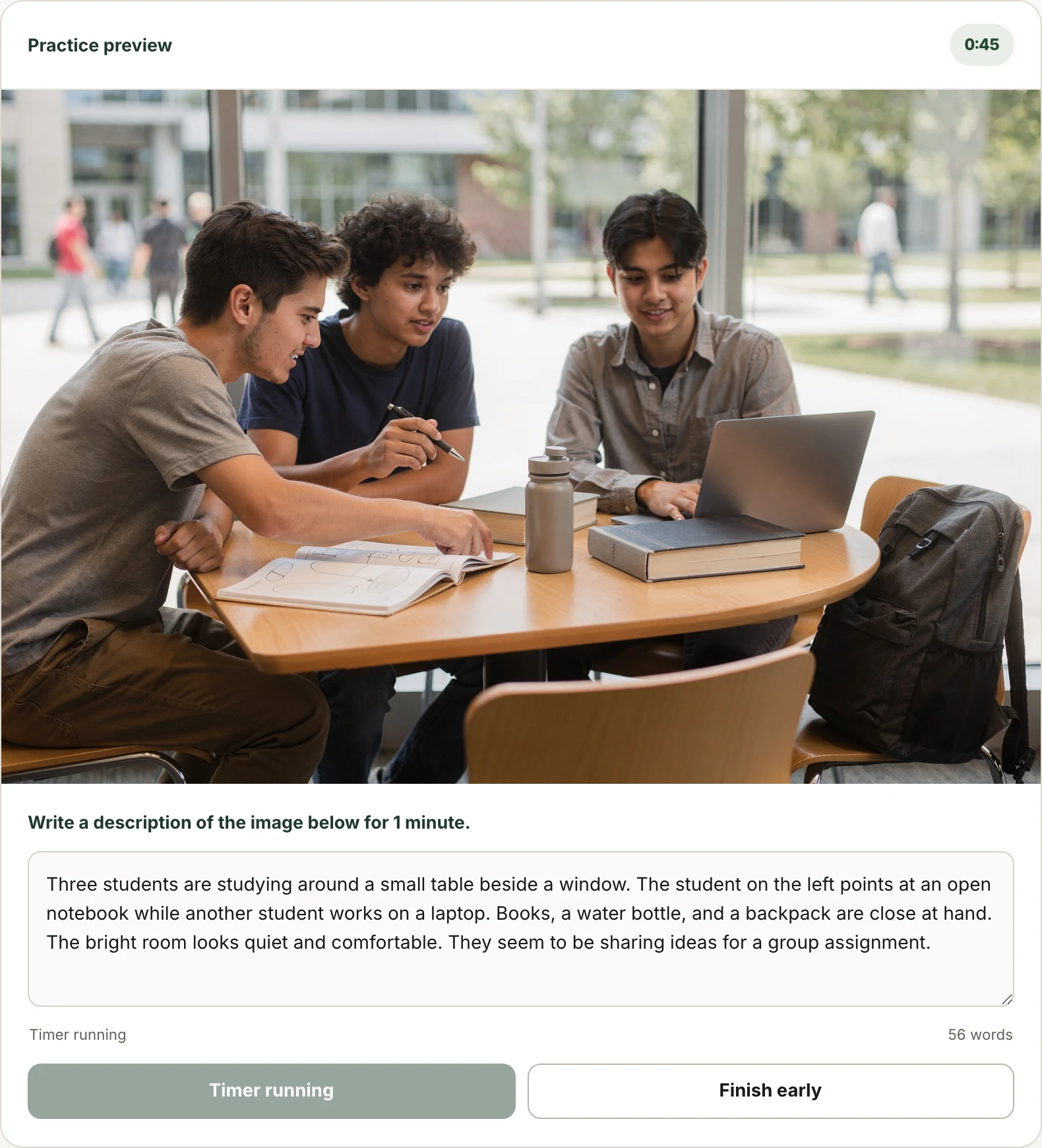
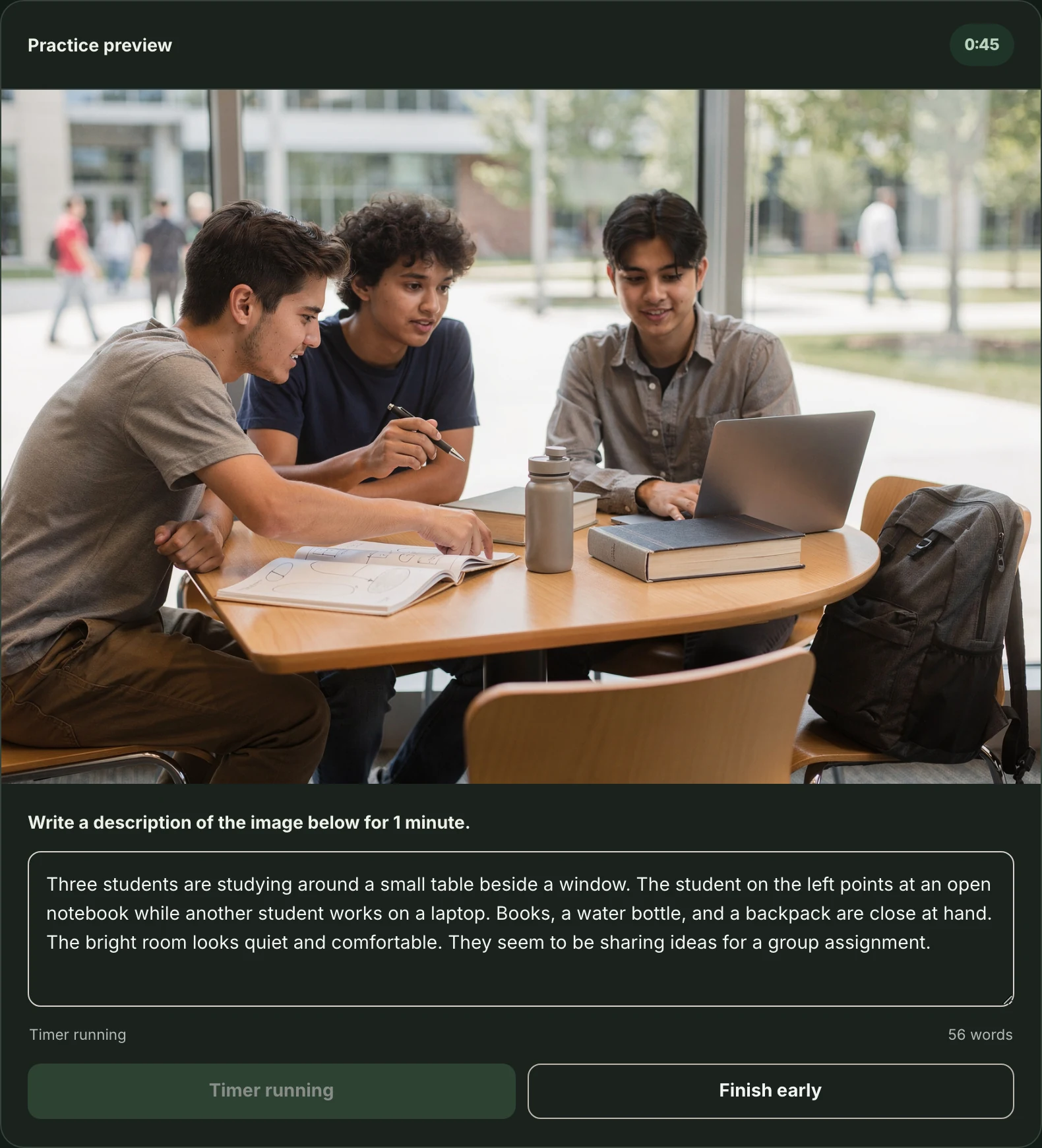
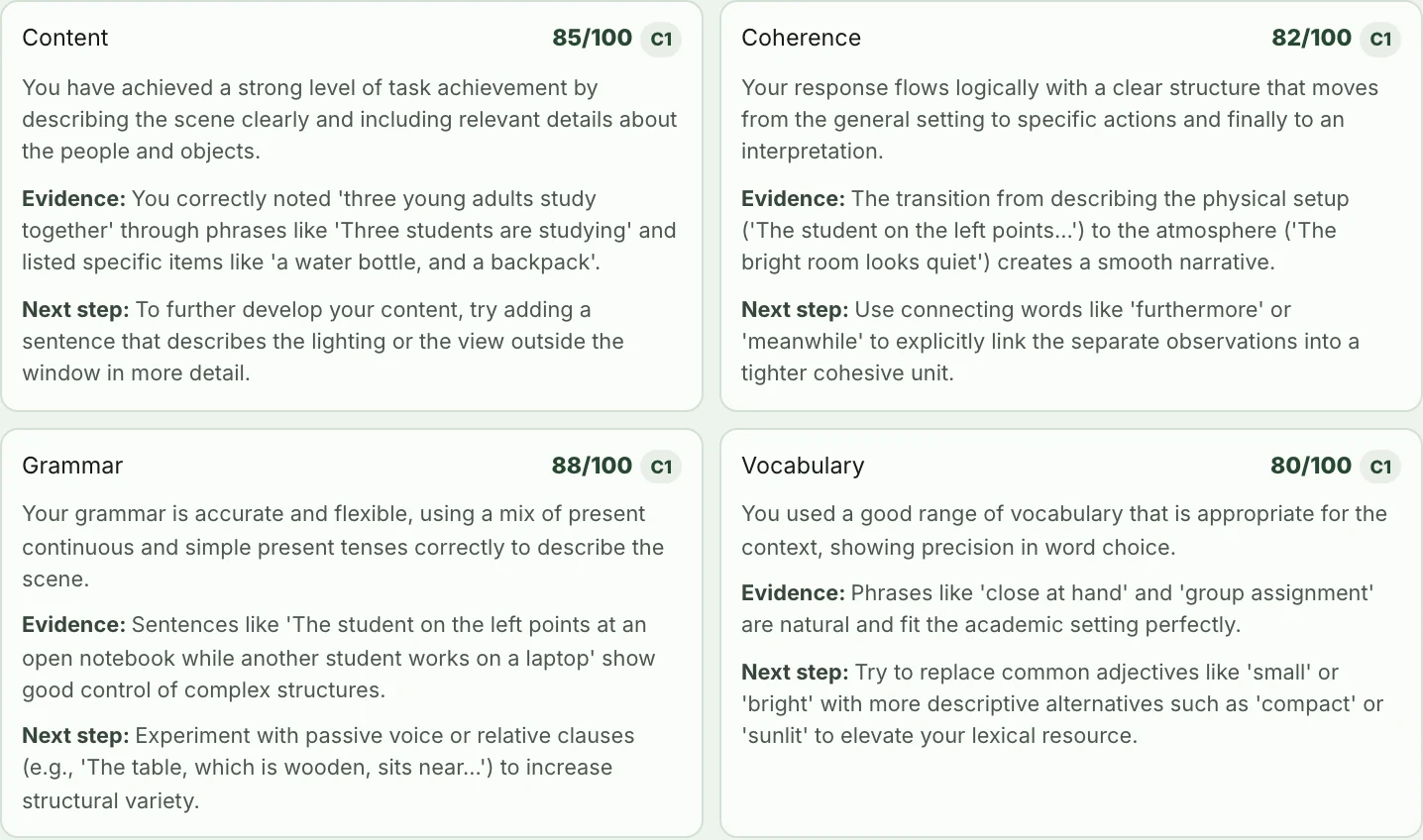
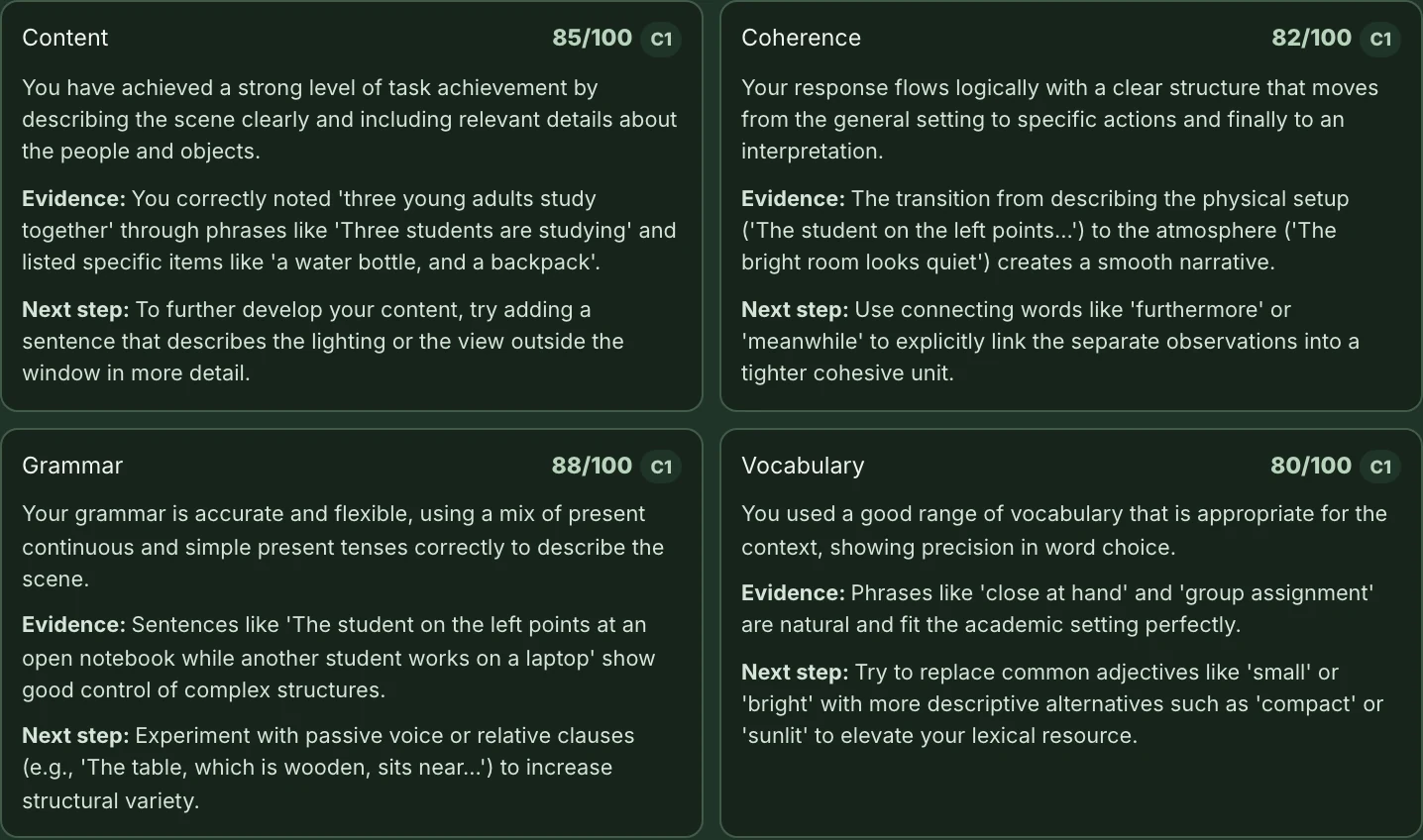
Real PrepEx screens, with an example answer created for this demonstration. Open each view to explore.
Write under the timerA photo, one minute, and space for your answer.
See what to improveFeedback on content, coherence, grammar, and vocabulary.
Choose your next mockBrowse the full-length tests included with DET Pro.
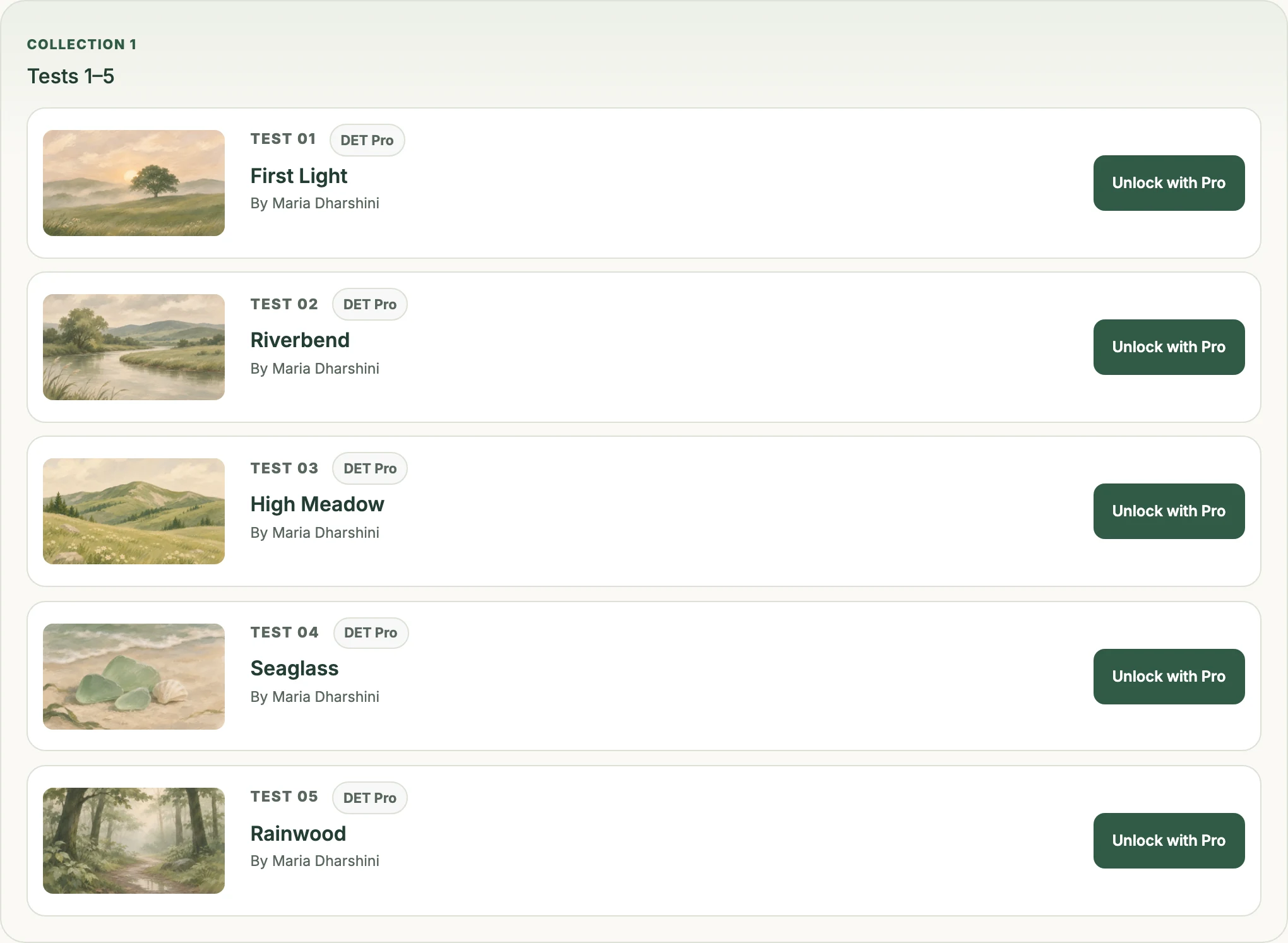
Product demo · Captured November 17, 2026
Keep exploring
More from the journal