The PrepEx Journal
CELPIP Reading Tips for 9 (and 10): Where Level 8 Loses Points and Why Reading Is the Hardest Skill
CELPIP Reading 9 takes roughly 31–33 of 38 correct on CELPIP's approximate chart, so you can miss about five to seven questions, and 32 or more keeps you clear of level 8. A Reading 8 usually loses its last answers in Part 3 paragraph matching, Part 4 viewpoints and the reader comment, and on the clock. Reading has the lowest average of the four skills: 7.27 in CELPIP's 2025 Data Report.

On this page
To get 9 in CELPIP Reading you need roughly 31–33 of 38 questions right on CELPIP's approximate chart; the score needed varies slightly by test form, so aim for 32 or more in timed practice. The answers between an 8 and a 9 usually go in Part 3 paragraph matching, Part 4 viewpoints and questions rushed when a part's clock runs out. PrepEx's free Reading practice explains every answer, so you can see which part costs you. Reading also has the lowest average of the four skills: 7.27 in CELPIP's 2025 Data Report.
Find the Reading part where your points go
Every PrepEx Reading question is marked against an answer key with an explanation. A free account gets two graded CELPIP practice sessions a day; after three graded sessions in at least two sections, a free full-length CELPIP-General practice test unlocks and gives an overall level estimate.
Facts checked on 27 November 2026 against CELPIP's Test Results, Test Format and Scoring, Test Overview and Policies pages, its Reading Pro Study Pack, its 2025 Data Report and official podcast, IRCC's Comprehensive Ranking System criteria and Australia's Home Affairs Superior English page. This is general information, not immigration advice.
How many questions can you miss and still get 9 in CELPIP Reading?
About five to seven of the 38, and six or fewer to stay clear of level 8. CELPIP's approximate chart puts Reading 9 at 31–33 correct and Reading 8 at 28–31. The ranges overlap, and CELPIP says the raw score needed for a level "may vary slightly from one test to another," so 31 correct could be an 8 on one form and a 9 on another. The computer marking scores a blank as wrong and takes nothing extra off for a wrong answer, so never leave a Reading question empty.
| CELPIP level (same CLB) | Correct out of 38 on CELPIP's chart | Misses that range allows | Lowest score clear of the level below |
|---|---|---|---|
| 10–12 | 33–38 | 0–5 | 34 (4 misses) |
| 9 | 31–33 | 5–7 | 32 (6 misses) |
| 8 | 28–31 | 7–10 | 29 (9 misses) |
| 7 | 24–28 | 10–14 | 26 (12 misses) |
PrepEx uses the last column as the practice target: a score the chart doesn't also list under the level below, so a form that runs slightly harder can't tip it down a level. A Reading 8 (28–31 correct) is one to four answers short of 32.
The same chart answers the "out of 38" questions: 34 is about level 10 or higher (the chart groups 10–12), 33 could be 9 or 10, 32 is about 9, 31 could be 8 or 9, 29 or 30 is about 8, 28 could be 7 or 8, and 27 is about 7. Convert a practice score with the CELPIP Reading score calculator, compare both skills on the CELPIP score chart or read how CELPIP is scored.
Why is CELPIP Reading so hard?
By the averages, Reading is the hardest CELPIP skill: CELPIP's 2025 Data Report gives it the lowest mean level (7.27) and the smallest share of results at 7 or higher (58.8%).
| Skill | Average level | 7 or higher | Exactly 8 | 9 or higher | 10 or higher |
|---|---|---|---|---|---|
| Reading | 7.27 | 58.8% | 10.6% | 33.0% | 18.6% |
| Listening | 8.33 | 76.7% | 10.8% | 53.2% | 34.3% |
| Writing | 7.87 | 83.8% | 36.1% | 24.1% | 14.7% |
| Speaking | 7.94 | 77.6% | 24.4% | 34.9% | 20.3% |
Reading doesn't have the fewest 9s: Writing does (24.1% against Reading's 33.0%), because Writing results bunch at exactly 8. Reading results spread out instead. Only 10.6% were exactly 8, and levels 8 and 9 each span only three or four raw scores, so a few answers move you up or down a level.
Vocabulary is only part of it. Test takers whose first language is English also scored lowest in Reading in 2025 (7.63, against 8.71 in Listening, 8.59 in Writing and 9.17 in Speaking). The right option often restates the text in other words while a wrong one reuses its exact words, three of the four parts end with a second text of blanks that depends on the first, and each part has its own clock. Every test also includes new items that look like scored ones but don't count. Test takers often report an extra Reading passage; you can't tell which items are unscored, so give every part full effort.
Where do level 8 readers lose points in CELPIP Reading?
Mostly in Parts 3 and 4, and on the clock. Reading has 38 scored questions in four parts. CELPIP's format page gives the section as 43–56 minutes, and the part times in its Reading study pack add up to about 43.
| Part | Questions and time | Where points go at level 8 |
|---|---|---|
| 1. Reading Correspondence | 11 (6 on a message, 5 blanks in a reply), about 11 minutes | "Why does the writer mention…" answered with content instead of purpose; a reply blank that fits the grammar but not the message |
| 2. Reading to Apply a Diagram | 8 (5 blanks in an email, 3 questions), about 9 minutes | An option that is in the diagram but breaks one condition in the email |
| 3. Reading for Information | 9 statements matched to Paragraph A–D or "Not stated in the text", about 10 minutes | A paragraph that covers half the statement; "Not stated" chosen too early, or avoided |
| 4. Reading for Viewpoints | 10 (5 on an article, 5 blanks in a reader comment), about 13 minutes | A view given to the wrong person or stated too strongly; time running out in the comment |
Test takers stuck at Reading 7 or 8, native speakers among them, tend to name Parts 3 and 4 as where the points go, and Part 4 as where time runs out.
CELPIP Reading tips for 9, part by part
The step from 8 to 9 is checking evidence for the whole question instead of the first matching word. The CELPIP Reading test guide explains each part's format and a basic strategy, and CELPIP Reading 8 to 9 walks through eight worked questions. The tips below are what to change in each part.
Part 1: Reading Correspondence
Purpose questions ("Why does the writer mention…?") want the reason, not the fact. Finish the sentence "She mentions it because…" before you look at the options: a new job may be mentioned to explain why she can't help on weekdays. For feelings, match the strength as well as the direction, since "a little disappointed" isn't "upset." In the reply, a blank is right only if it agrees with the first message and with what the reply writer is doing in that sentence: accepting, declining or asking. Practise Reading Part 1.
Part 2: Reading to Apply a Diagram
Before you look at the diagram, list every condition the email sets for the blank: a day, an age, a budget, a distance. The tempting wrong option is usually really in the diagram and meets all but one of them. Mark the words that narrow a choice, such as only, after, unless, except and at least. Practise Reading Part 2.
Part 3: Reading for Information
A paragraph is the answer only if it supports the whole statement. If B mentions a parking permit and D says when it must be renewed, a statement about renewing a permit by a certain date belongs to D. Choose "Not stated in the text" (often called "not given") only after you've searched all four paragraphs for the idea in other words; something likely or close isn't support. Don't pick it to balance your answers, and don't avoid it either. Practise Reading Part 3 free.
Part 4: Reading for Viewpoints
Wrong options here usually do one of three things: give the right idea to the wrong person, state a view more strongly than the person did, or drop its condition ("only if," "as long as"). Note each person in one line (name, position, reason, condition) and test every option against that line, not against what someone in that role would probably think. Before the reader comment, decide whether the commenter agrees, disagrees or accepts only part, and keep every blank consistent with that. Practise Reading Part 4 free.
PrepEx example, written for this article and much shorter than a real Part 4 article
Riverside's council wants to close Mill Street to cars on summer Saturdays for a market. Councillor Grace Price says it would bring families downtown and that the garage two blocks away has room. Tom Reyes, who runs a bakery on the street, welcomes the customers but says a 7 a.m. closure would stop his morning deliveries; he would back the plan if the street closed at 10 a.m. Ana Moretti, who lives above the shops, is against it and says the garage is full by noon on weekends.
What is Tom Reyes's view? (A) He opposes the plan because it would hurt his bakery. (B) He would support it if the closure started later. (C) He thinks the garage will be full by noon. (D) He supports it as it stands.
Answer: B. A tempts because Reyes names a problem, but he never rejects the plan. C gives Moretti's garage point to the wrong person. D drops his condition.
A time plan for CELPIP Reading: checkpoints and rescue moves
Treat each part's time as a budget with one checkpoint, and switch to the rescue move if you reach the checkpoint late.
| Part | Checkpoint | If you're behind |
|---|---|---|
| 1. Correspondence (about 11 minutes) | Questions 1–6 done with about 5 minutes left | Read the reply once, then fill the blanks in order |
| 2. Apply a Diagram (about 9 minutes) | Email blanks done with about 3 minutes left | Answer the last three questions from what you've already found; don't reread the whole diagram |
| 3. Information (about 10 minutes) | Paragraphs labelled by minute 3, then about 45 seconds a statement | Match the rest from your labels and answer every one |
| 4. Viewpoints (about 13 minutes) | Questions 1–5 done with about 6 minutes left | Decide the commenter's stance, then fill all five blanks in one pass |
If one question has taken about a minute, pick your best option and move on. Count only timed scores in your log, because untimed practice doesn't show whether you can find the evidence in time. Time single parts in the CELPIP Practice Hub, and use the time management lesson for pacing drills.
Keep a CELPIP Reading error log
Write one line per miss and reuse the same cause words so you can count them.
| Part and question | Cause | What happened | Next time |
|---|---|---|---|
| Part 3, statement 6 | Half-match | Chose B for the permit; D says when it must be renewed | Check both halves of the statement |
| Part 3, statement 9 | Paraphrase missed | Chose "Not stated"; C's "free for anyone under 18" is the statement's "children don't pay" | Search for the idea in other words first |
| Part 4, question 3 | Wrong person | Gave a resident's parking point to the shop owner | Note name, position and reason first |
| Part 4, blank 8 | Stance drift | Chose an option backing the plan; the commenter accepts the problem but rejects the fix | Decide the stance before the first blank |
Add "condition missed," "too strong" (the option says "refuses" where the text says "has doubts"), vocabulary and time as you need them. After 20 or 30 misses, count the causes; the top one or two are your plan for the next two weeks. When the cause is a missed paraphrase, add the pair (the text's words and the option's words) to a list and reread it before each session. PrepEx explains every Reading answer, which gives you the "what happened" line, and signed-in learners can review saved mistakes.
Fill your error log with fresh, timed Reading questions. Start the free practice test
How to get 10 in CELPIP Reading
Getting 10 takes about 33 or more correct, so the miss budget shrinks to about five and no part can be weak. At 9, misses can cluster in one part; at 10 they can't. In 2025, 18.6% of CELPIP-General Reading results were 10 or higher.
- Aim for 34 or more on two fresh timed sections in a row, since 33 is shared with level 9 on the chart.
- Log your lucky guesses. Mark answers you got right but weren't sure of; they're where the next misses come from.
- Explain every wrong option, not only the right one. The last misses are usually inference: why a writer mentions something, or how far a person agrees.
Check what 10 is worth first. For Express Entry, one ability moving from CLB 9 to 10 adds 3 core CRS points (31 to 34 single, 29 to 32 with a spouse), and 11 and 12 add nothing more. Australia's Home Affairs asks for CELPIP General Reading 10 for Superior English. Moving from 8 to 9 is worth more: 8 points single or 7 with a spouse, and if Reading is your only skill under 9, reaching 9 also opens the higher skill-transferability points for education and for foreign work experience, which need CLB 9 in all four abilities. See CLB 9 in CELPIP, CLB 10 in CELPIP, CELPIP score for PR and the CELPIP CLB calculator.
Before you book a retake for Reading
Book only when fresh timed practice reaches your target, because you can't retake Reading on its own: CELPIP has said it doesn't offer single components and can't combine scores from two tests. The CELPIP retake policy covers how soon you can book. A CELPIP re-evaluation is unlikely to change Reading, because CELPIP computer-rates Listening and Reading.
If you've just tested, wait for the score report: usually 2–4 business days, though some CELPIP pages say 3–4 (see CELPIP results). If Reading went down on a retake, read why a CELPIP score can go down. If it hasn't moved in two attempts, see how to get 9 when you're stuck at 7 or 8, the CELPIP retake guide and practice test vs real test; how to work toward CLB 9 covers all four skills.
If Reading isn't your only 8, see the CELPIP Listening tips for 9 and 10, Writing tips, Speaking tips, Writing 8 to 9 and Speaking 8 to 9, and plan Writing and Speaking with structures rather than memorized templates.
Test your Part 3 and Part 4 fixes on a full Reading section. Take a free CELPIP practice test
CELPIP Reading score questions
What is 34 out of 38 in CELPIP Reading?
About level 10 or higher, which is CLB 10 or higher. On CELPIP's approximate chart, 33–38 correct is the 10–12 range, and the chart doesn't separate those levels. CELPIP notes that the raw score needed for a level "may vary slightly from one test to another."
What is 29 out of 38 in CELPIP Reading?
About level 8. On CELPIP's approximate chart, 29 sits inside the level 8 range of 28–31 and isn't shared with level 7 or 9; level 9 starts at about 31.
How do I get 9 in CELPIP Reading?
Reach 32 or more out of 38 in timed practice on new material, since level 9 is roughly 31–33 correct. The biggest gains usually come from checking Part 3 statements against whole paragraphs and keeping one-line notes on each view in Part 4. PrepEx's free Reading practice explains every answer, so you can log why each miss happened.
How do I get 10 in CELPIP Reading?
Aim for 34 or more out of 38 on two fresh timed sections in a row, since the 10–12 range starts at about 33 and 33 is shared with level 9. At that level no part can be weak, so explain every wrong option, not only the right one.
Why is CELPIP Reading so difficult?
The right answers are paraphrased, three parts add a second text with blanks, and each part runs on a tight clock. In CELPIP's 2025 Data Report, Reading had the lowest average of the four skills (7.27), even among test takers whose first language is English (7.63).
What is the hardest part of CELPIP Reading?
CELPIP doesn't publish results by part, but test takers often name Part 4, Reading for Viewpoints, and Part 3. Part 4 has the most to read and several views to keep apart; Part 3 punishes matching words instead of whole statements.
How do I improve in CELPIP Reading Part 3?
Label each paragraph in a few words first, then match a statement only to a paragraph that supports all of it. Choose "Not stated in the text" after checking all four paragraphs for the idea in other words, and log every half-match you fall for.
What is 32 out of 38 in CELPIP Reading?
About level 9, which is CLB 9. On CELPIP's approximate chart, 32 sits inside the level 9 range (31–33) and isn't shared with level 8 or with the 10–12 range, which is why it's the practice target for a Reading 9.
How much time do I get for each CELPIP Reading part?
About 11 minutes for Part 1, 9 for Part 2, 10 for Part 3 and 13 for Part 4, going by the part times in CELPIP's Reading study pack, which add up to about 43. CELPIP's format page gives the whole section as 43–56 minutes, and each part runs on its own clock.
Which CELPIP Reading part should I practise first?
The one where your log shows the most misses. Score each part separately on timed practice and log every miss with its cause; after 20 or 30 misses, one or two parts usually stand out. On PrepEx, signed-in learners keep a history of every attempt and can review saved mistakes, and CELPIP Pro adds a level for each skill on every full test.
Sources we checked
- CELPIP: Test Results — the approximate Reading chart out of 38 and its "may vary slightly" caveat, computer scoring with blanks marked incorrect, many test forms, unscored new items, re-evaluation of Listening and Reading unlikely to change a score, and results in 2–4 business days
- CELPIP: Test Format and Scoring — Reading takes 43–56 minutes
- CELPIP Reading Pro Study Pack 2026 — the four Reading parts, their question design, the "Not stated in the text" option in Part 3 and approximate part times
- CELPIP 2025 Data Report — mean levels by skill, the level-by-level distribution, means for test takers whose first language is English, and no deduction for wrong answers
- CELPIP: Policies and Forms — re-evaluating Listening and Reading is unlikely to change scores
- Official CELPIP Podcast #25 — no single-component retakes, and scores from two tests can't be combined
- CELPIP: Test Overview — results within 3–4 business days (the results page says 2–4)
- IRCC: Comprehensive Ranking System criteria — core language points per ability for CLB 8, 9 and 10 or more, and skill-transferability points that need CLB 9 in all four abilities
- Home Affairs: Superior English — CELPIP General at least 10 in Reading
See the practice experience.
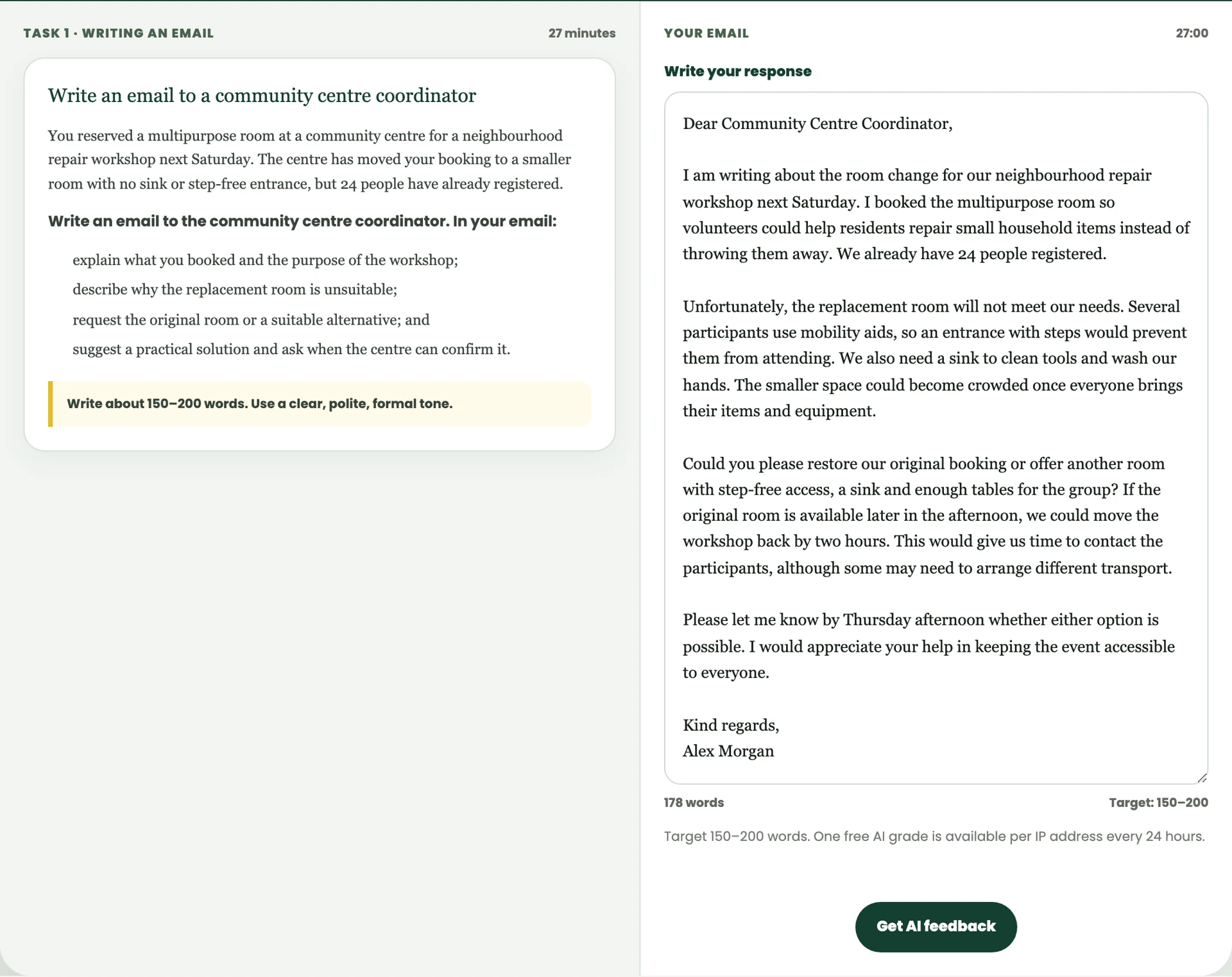
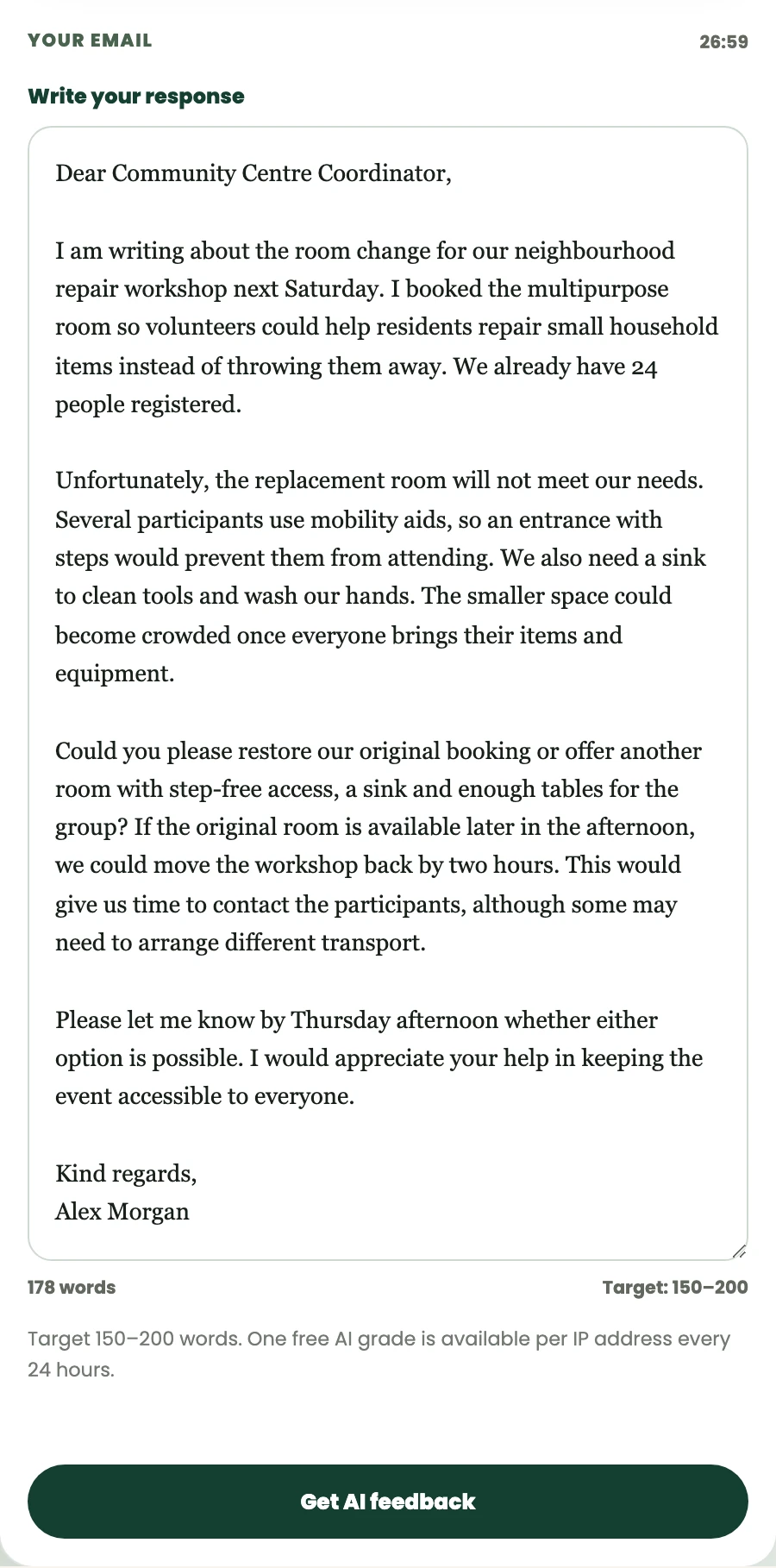
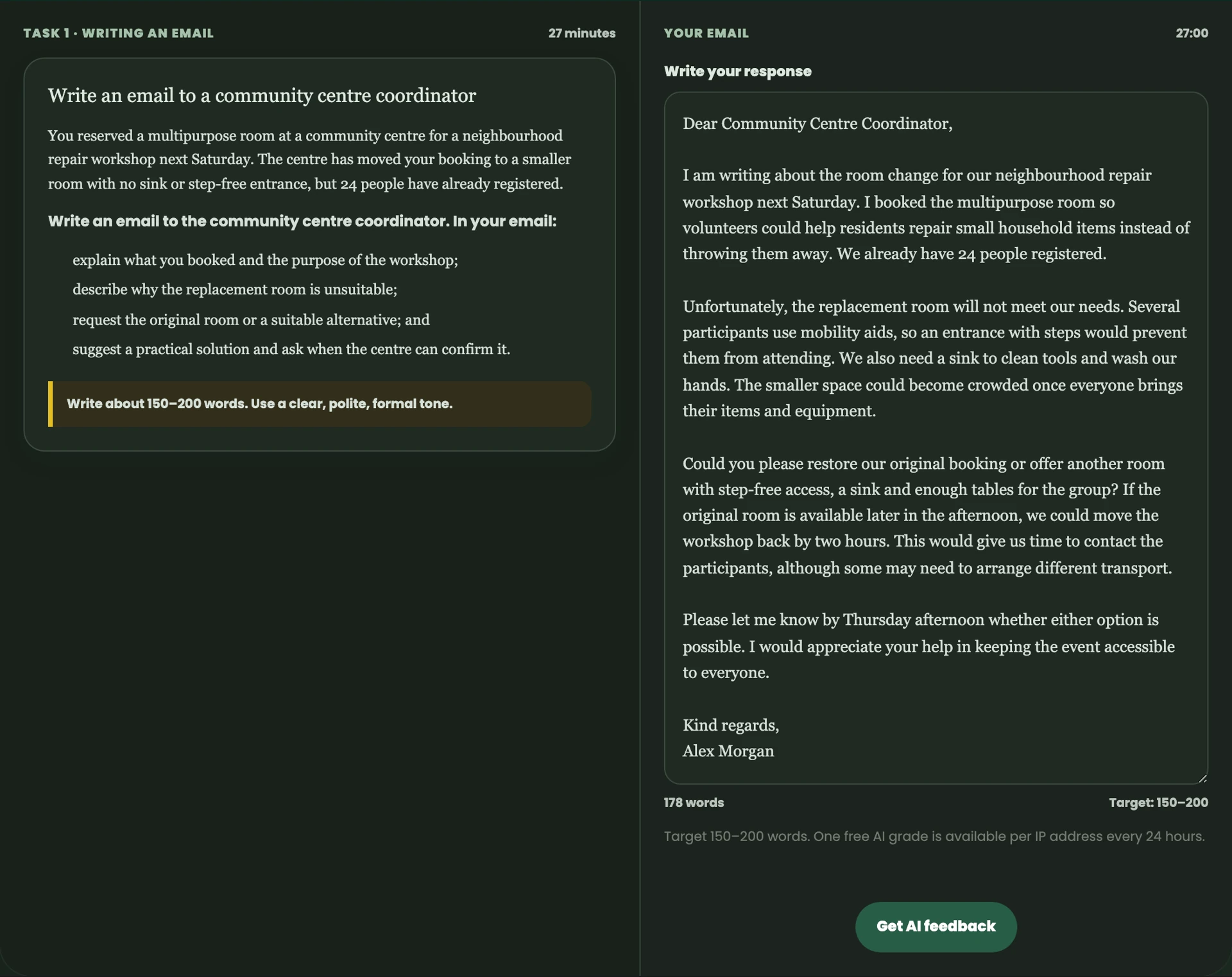
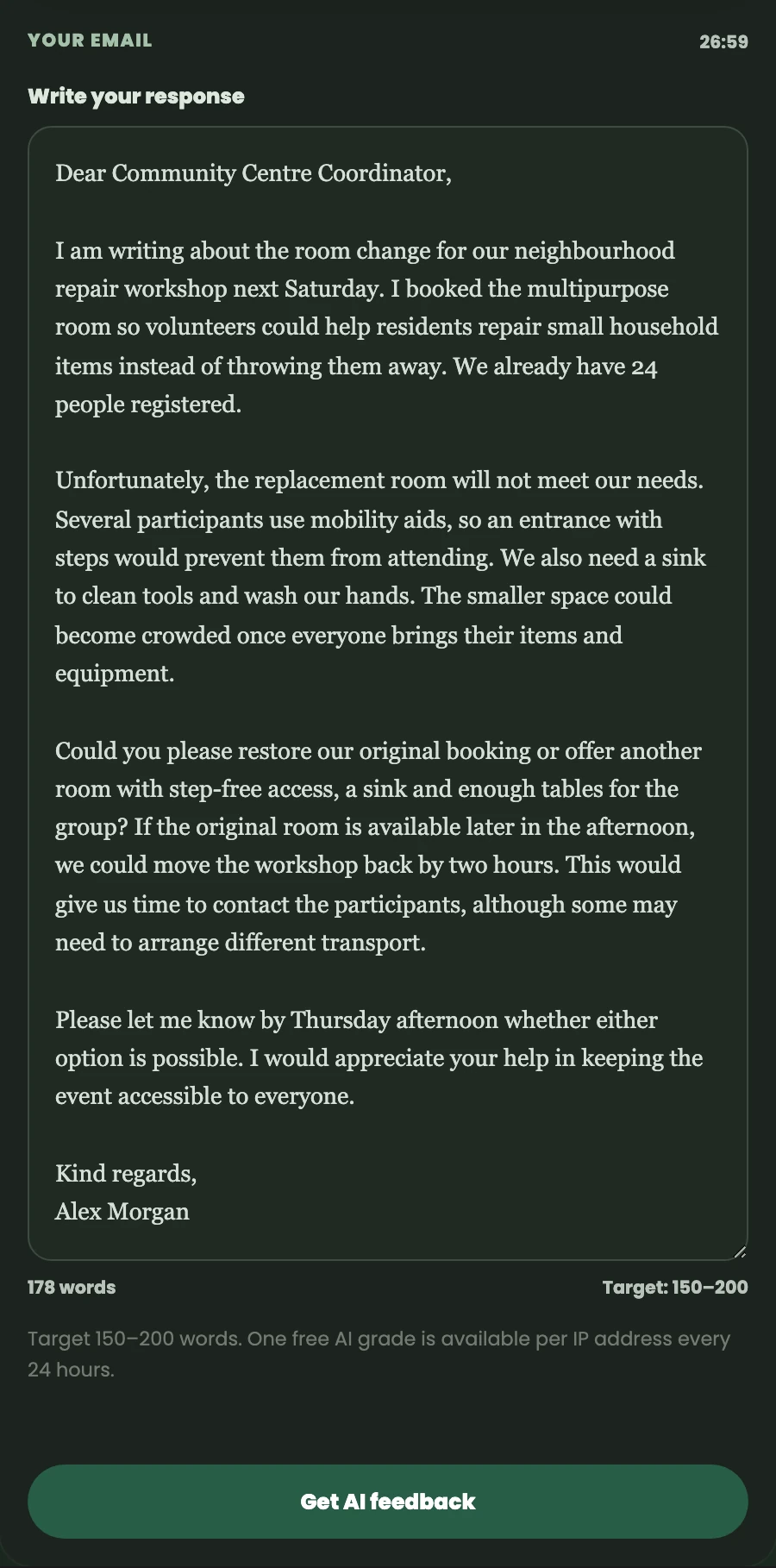
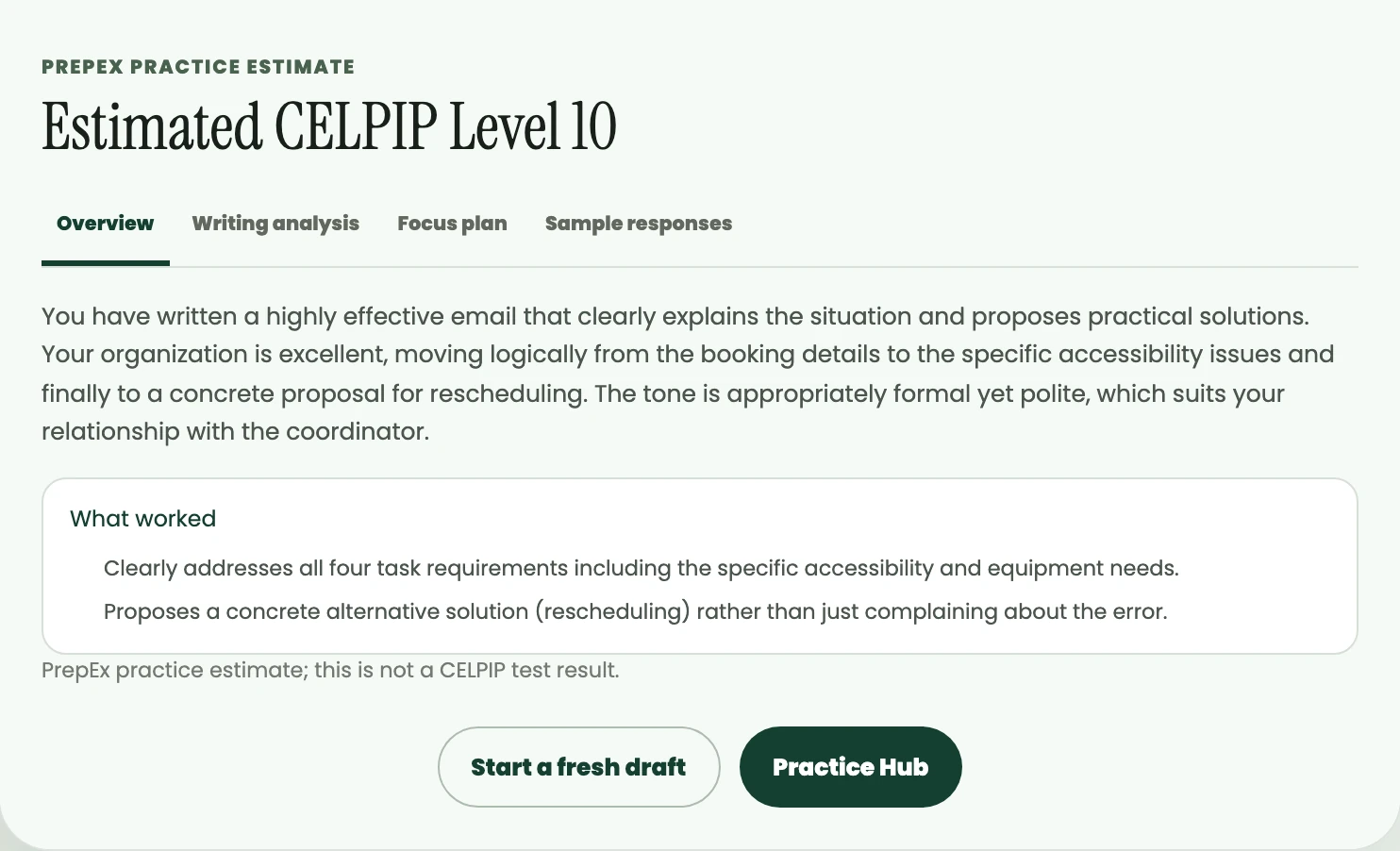
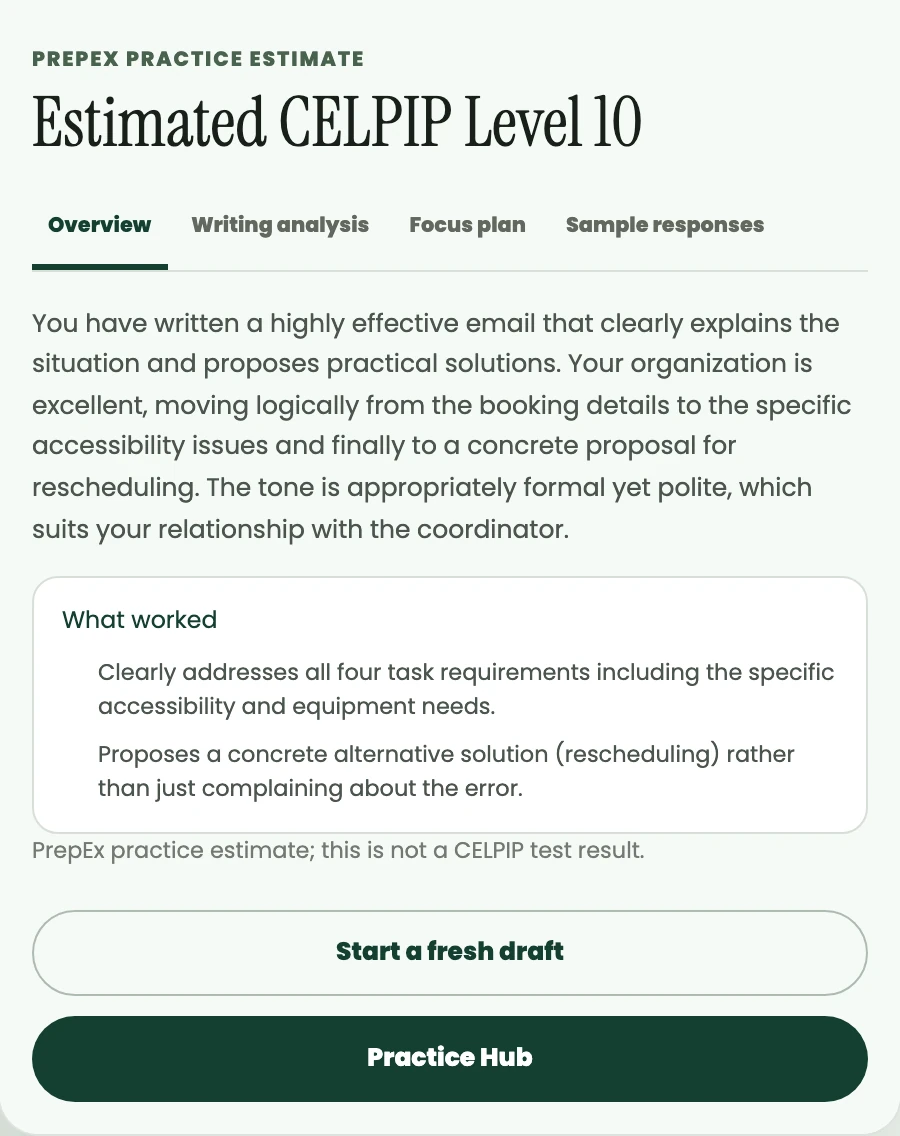
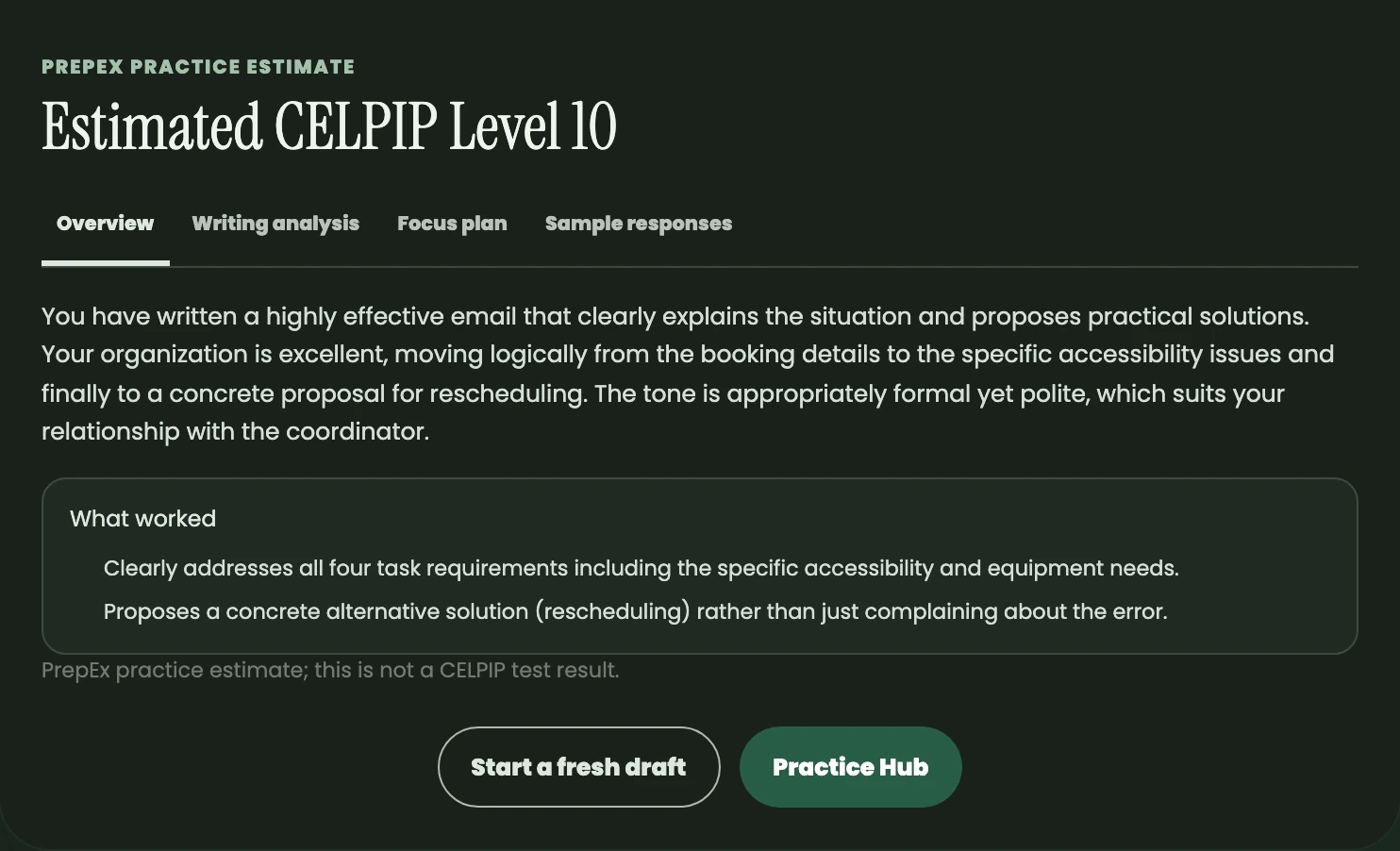
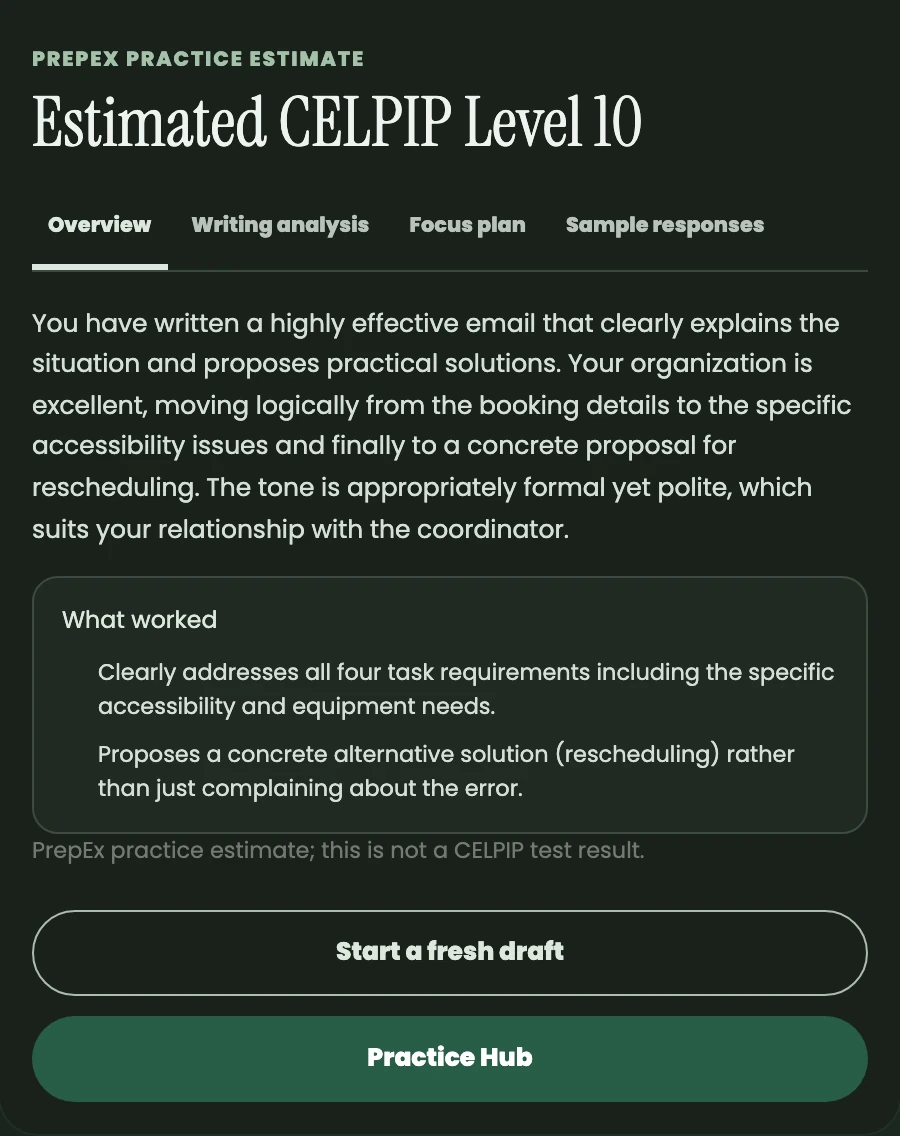
Real PrepEx screens with a fictional answer written for this product demo and the feedback PrepEx returned. Open a view, then select its image to read it at full size.
Complete a practice taskWrite an email with the prompt, timer and word count beside you.
 View full-size screenshot
 View full-size screenshot
 View full-size screenshot
 View full-size screenshot
Read your feedbackSee the practice estimate and what worked in your response.
 View full-size screenshot
 View full-size screenshot
 View full-size screenshot
 View full-size screenshot
Find your next improvementExplore evidence and next steps across all four Writing criteria.
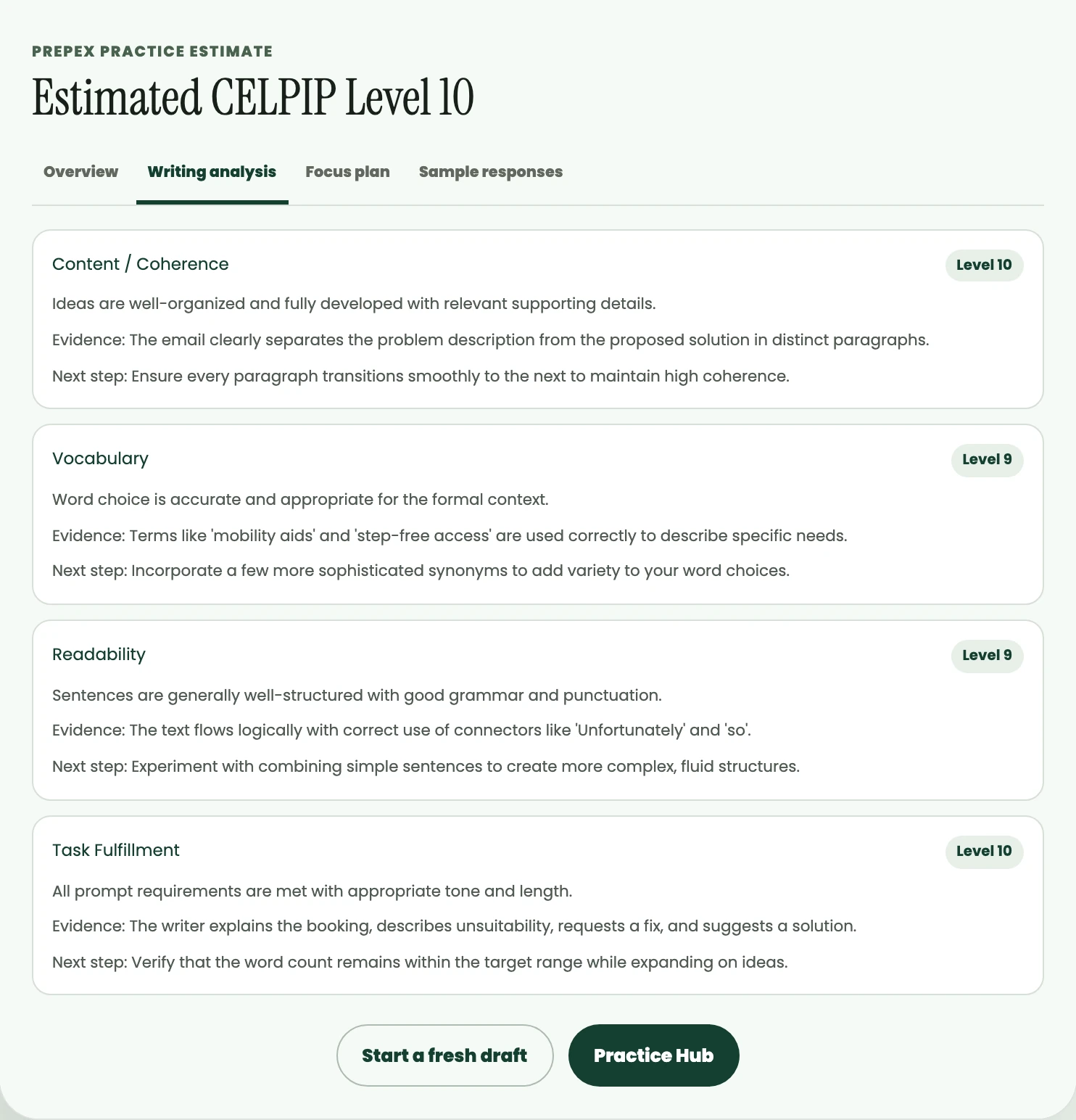 View full-size screenshot
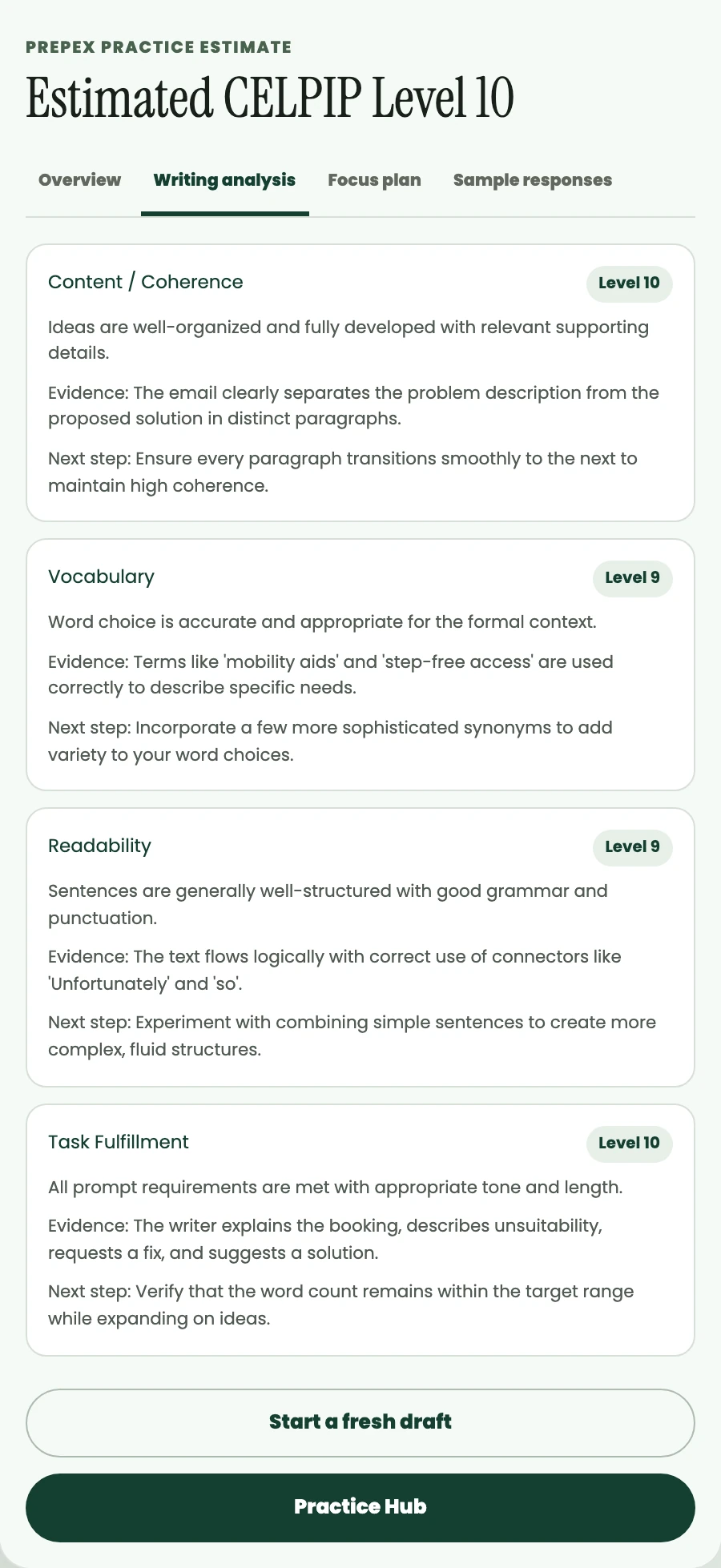 View full-size screenshot
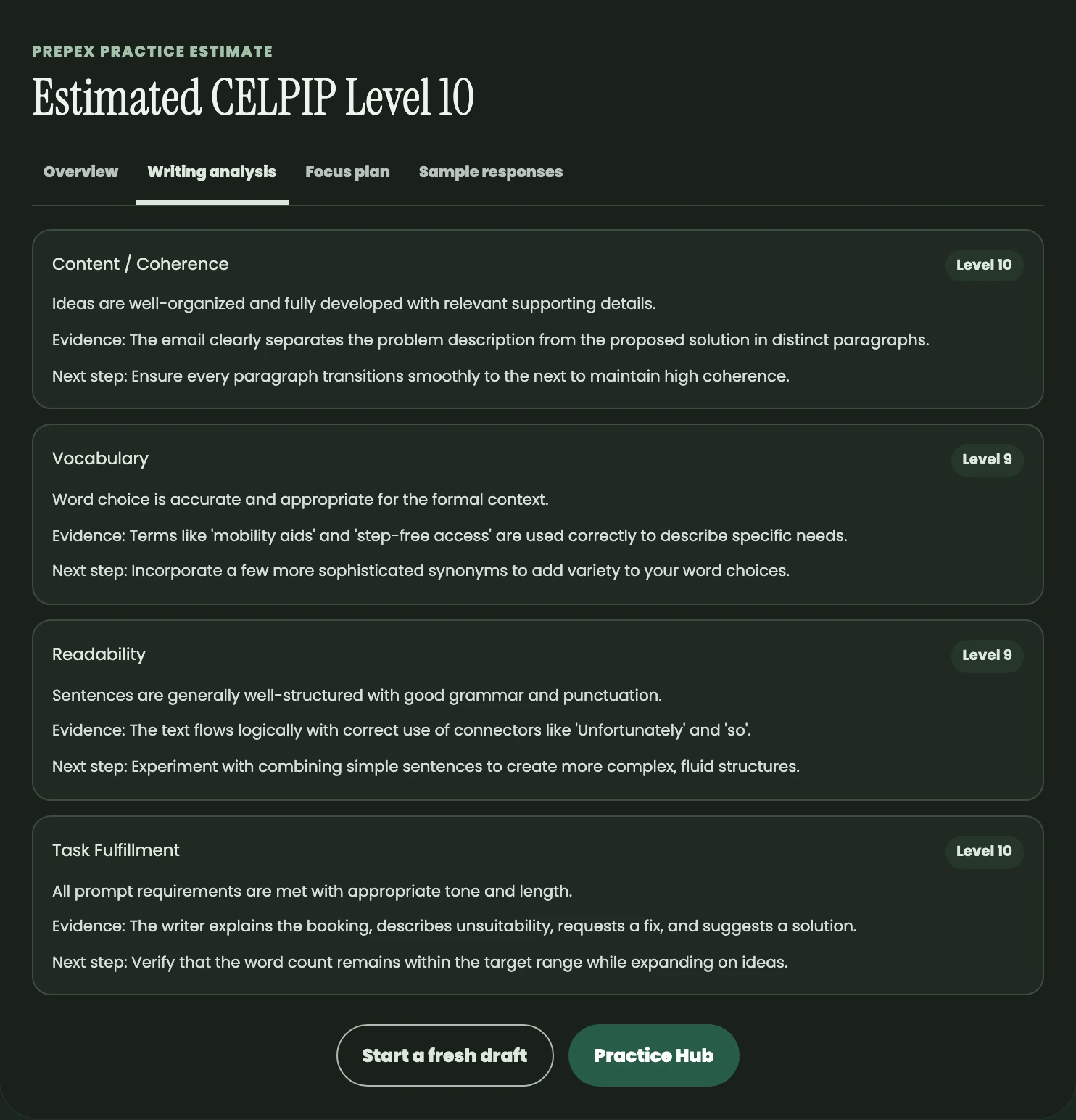 View full-size screenshot
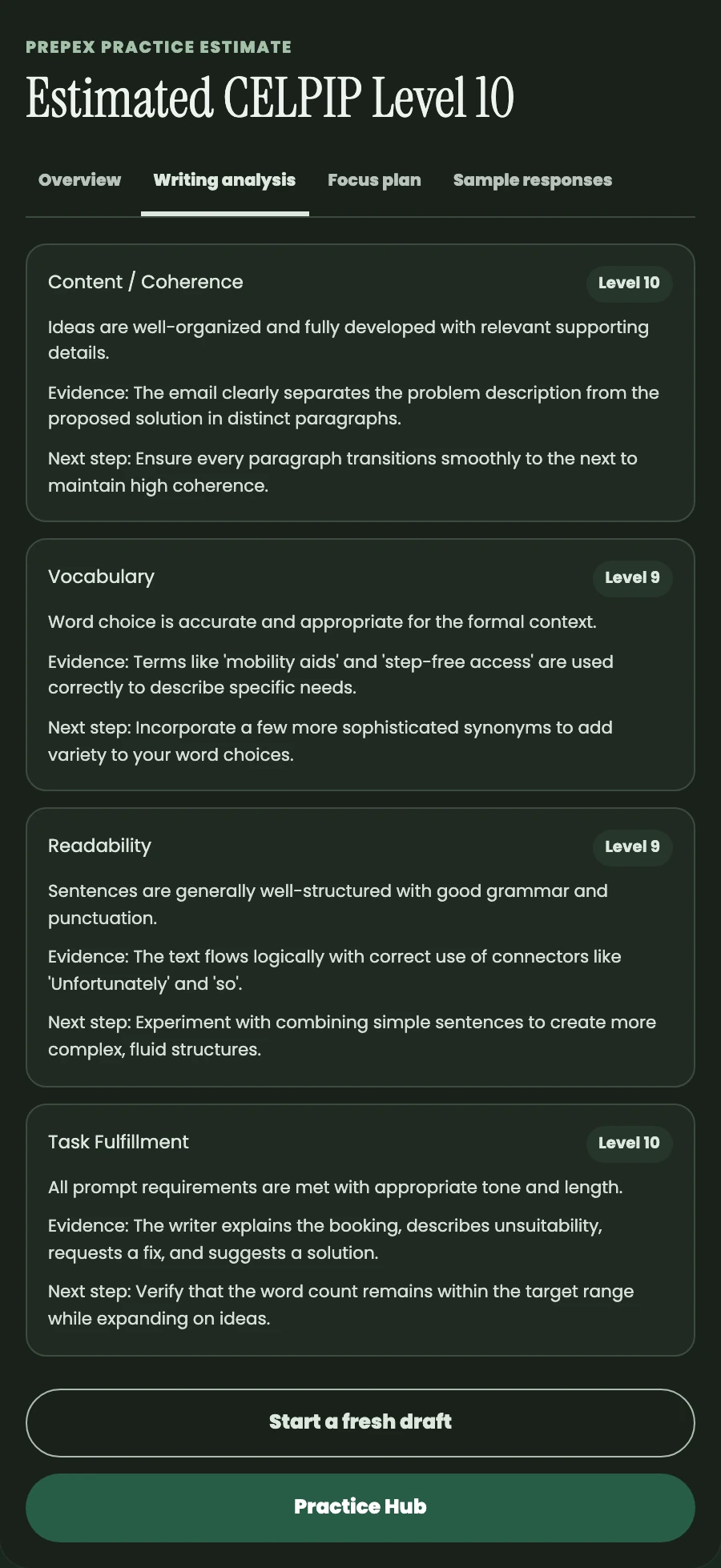 View full-size screenshot
Browse the mock testsChoose a full CELPIP-General mock and check its access label.
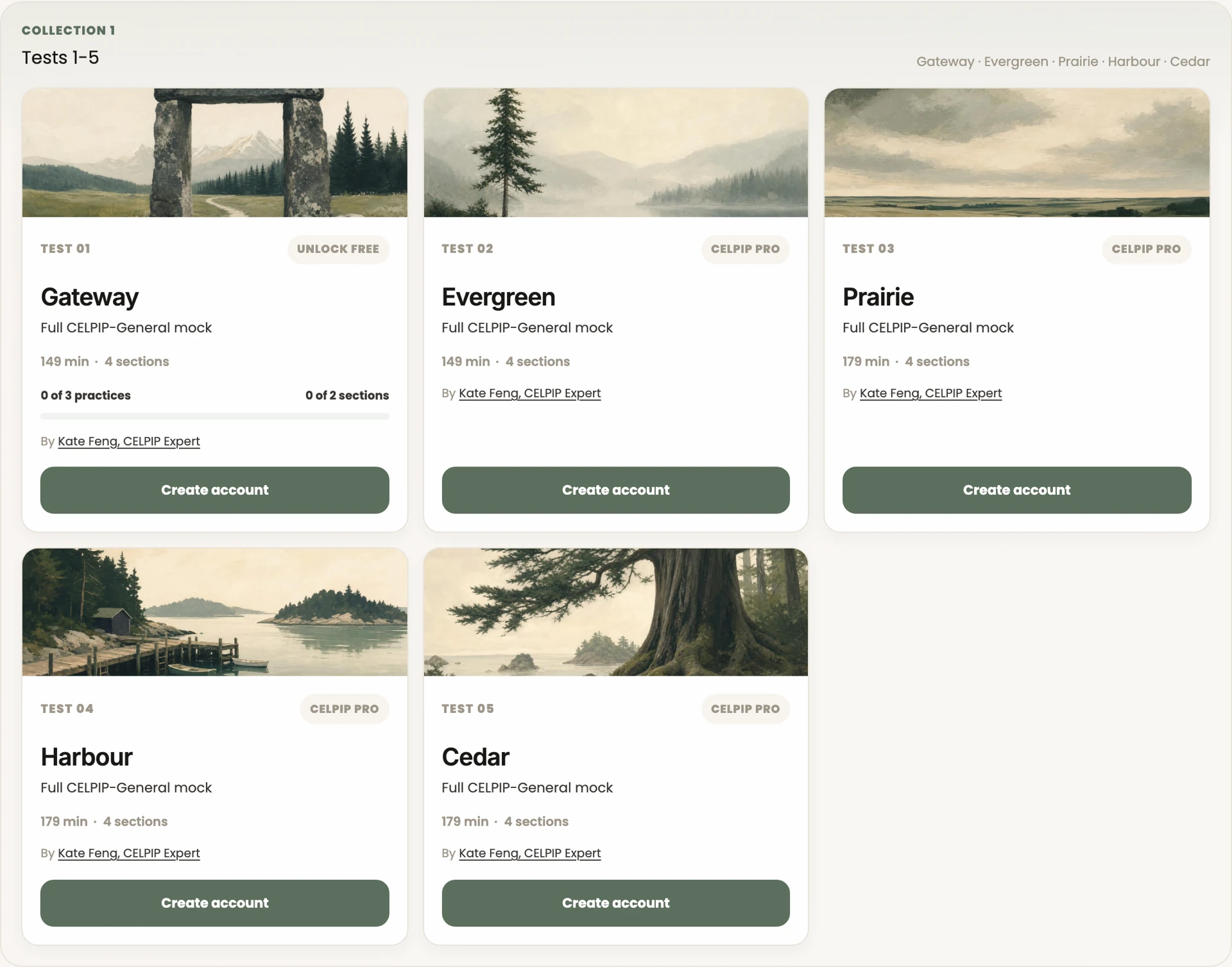 View full-size screenshot
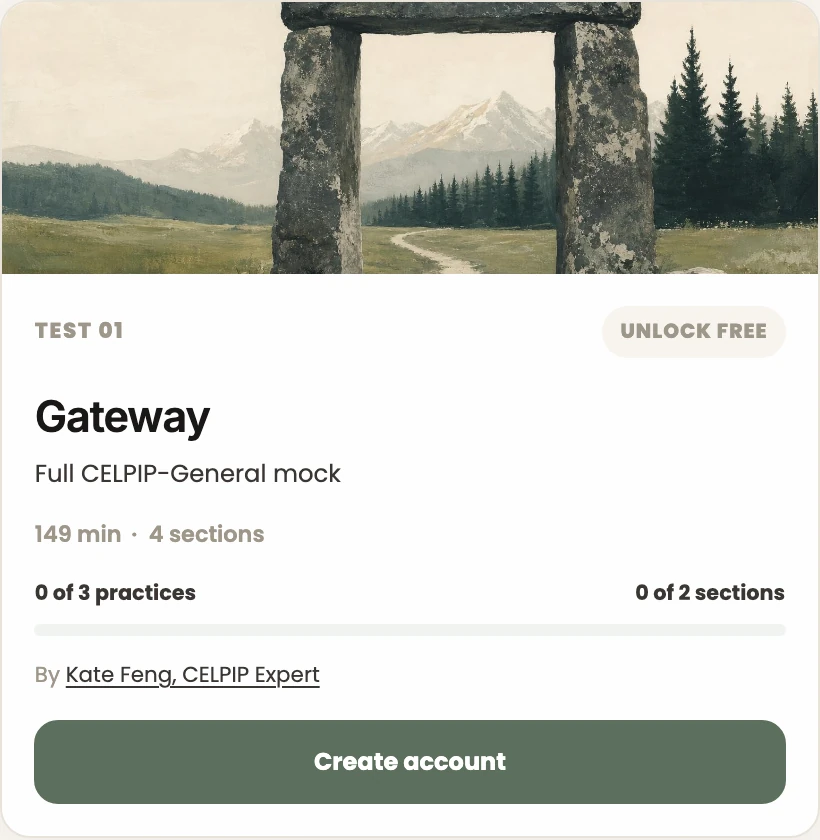 View full-size screenshot
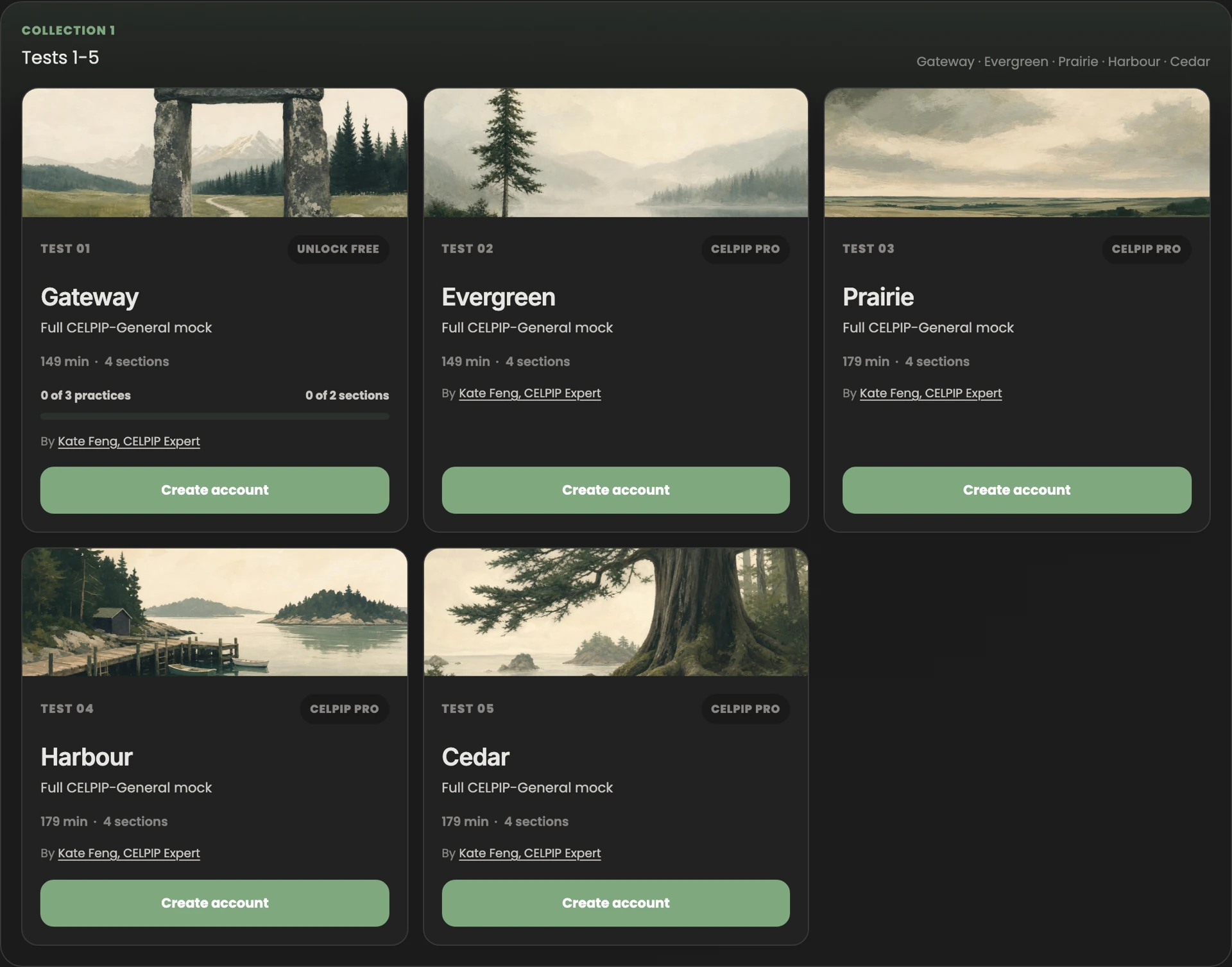 View full-size screenshot
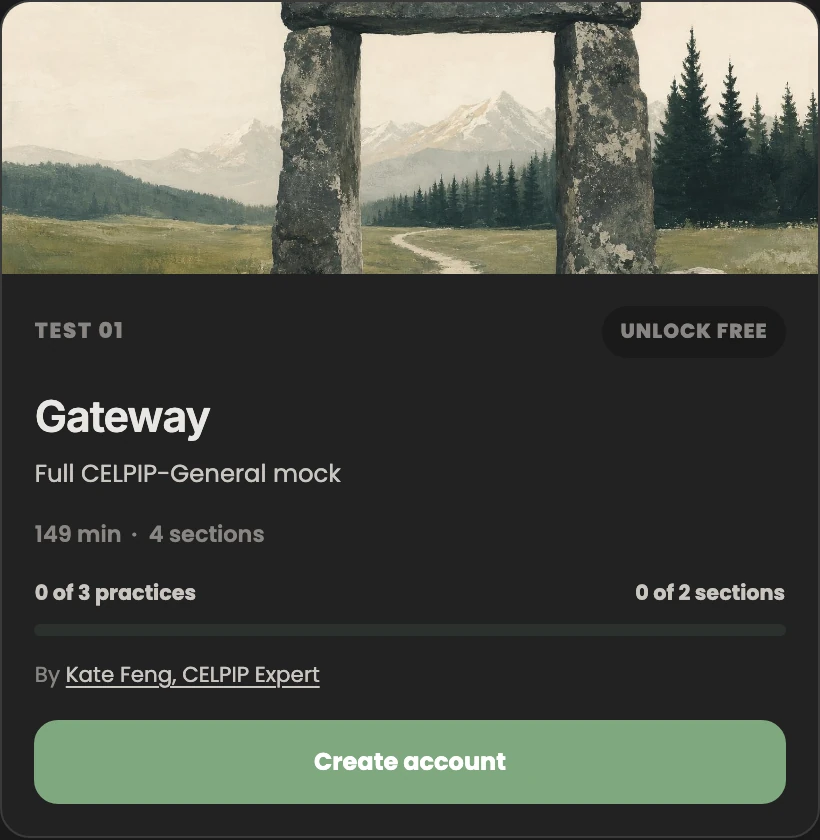 View full-size screenshot
Product demo · Captured November 17, 2026 · No learner information shown
Keep exploring
More from the journal