The PrepEx Journal
How to Get 9 in CELPIP When You're Stuck at 7 or 8
To get from 8 to 9 in CELPIP, find the one rating dimension or question type that keeps costing you, drill it and check it on a fresh task, because a level stays put when each attempt shows the same evidence. 8 was the most common Writing result in CELPIP's 2025 Data Report (36.1%) and the most common Speaking level (24.4%).

On this page
A CELPIP skill stuck at 7 or 8 moves to 9 once you find the one rating dimension or question type that keeps costing you and change that habit, because a level stays put when each attempt shows the raters, or the answer key, the same evidence. It's common: 8 was the most frequent Writing result in CELPIP's 2025 Data Report (36.1%) and the most frequent Speaking level (24.4%). PrepEx's free graded Writing and Speaking tasks show feedback on all four rating dimensions and what to fix first; its free full-length practice test gives an overall level estimate.
Find the dimension or question type holding you at 8
One Writing or Speaking task a day is graded free with no account, with a practice level estimate and feedback on all four rating dimensions. A free account adds two graded practice sessions a day across all four skills, and a free full-length practice test opens after three graded sessions in at least two sections.
Facts checked on 27 November 2026 against CELPIP's results, policies, FAQ and Test Day pages, Level Descriptors, 2024 and 2025 Data Reports, Writing study pack, official blog and podcast, and IRCC's CRS criteria and language requirements manual. This is general information, not immigration advice.
Why your CELPIP score stays at 8 and won't improve
A CELPIP level repeats when your English and your habits haven't changed between sittings. In Writing and Speaking, trained raters score each answer on four dimensions: Content/Coherence, Vocabulary, Readability (Writing) or Listenability (Speaking), and Task Fulfillment, and your level is derived from those ratings. Raters work independently, and CELPIP's FAQ says Writing is scored by an AI-human hybrid system that its rating team reviews. If the dimension that held you at 8 last time is still weak, the ratings land on 8 again.
Listening and Reading are marked by computer, right or wrong, out of 38. On CELPIP's approximate charts, Listening 8 covers 30–33 correct answers and 9 covers 33–35; Reading 8 is 28–31 and 9 is 31–33. The ranges overlap because the raw score needed for a level "may vary slightly from one test to another," in CELPIP's words. So a Listening or Reading 8 is usually one to three correct answers short of 9, and missing the same kinds of question every time keeps it there. The CELPIP score chart shows every level.
CELPIP's 2025 Data Report shows how crowded 8 is. That year 36.1% of CELPIP-General Writing results were exactly 8, up from 27.3% in 2024, while Writing results at 9 or higher fell from 29.8% to 24.1%. Listening is the skill where most results reach 9, at 53.2%.
Score histories that test takers shared publicly between January 2024 and November 2026, which PrepEx reviewed by hand, point the same way. Writing 8 was the stickiest result in them: about six in ten retakes that started at Writing 8 came back as 8, while a Speaking 8 went up about half the time. People tend to post when they're stuck or when they finally break through, so read that as a reported pattern, not a rate.
CELPIP 8 to 9 by skill: what holds you back and what level 9 asks for
Start with the skill below your target, then look for the reason inside it. CELPIP's blog on moving from level 7 to 9 warns that "completing more exercises isn't always enough"; you need to know why an answer fell short. The level 9 column uses CELPIP's descriptors for Writing and Speaking and its raw-score charts for Listening and Reading. The other columns are PrepEx's diagnosis.
| Skill | What usually holds it at 7–8 | What level 9 asks for | The drill | Read next |
|---|---|---|---|---|
| Writing | A requested point answered in one thin sentence; reasons without specific detail; words that are roughly right, not exact; the same grammar slips in every email; long sentences forced in for show | Key ideas supported with relevant facts, descriptions or details; words that give accurate details and comparisons; control of a range of complex and diverse structures | Rewrite an old answer with one concrete detail for each requested point, then practise your two most frequent errors in new sentences | CELPIP Writing tips for 9 |
| Speaking | One reason, then repetition; time running out mid-point; fillers and restarts (the level 8 descriptor already expects very few); talking about the topic instead of to the person in the task | Ideas supported with moderately complex reasons; common and context-specific vocabulary; style and tone adjusted to a range of audiences, including peers and authority figures | Record and transcribe a task, mark every restart and filler, then answer a fresh prompt with a reason and an example for each point | CELPIP Speaking tips for 9 |
| Listening | Misses in the later parts (the discussion and the viewpoints); questions on a speaker's attitude or implied meaning; options that repeat words you heard | About 33–35 of 38 correct, against 30–33 at 8 | Keep an error log by part and trap type; take notes that record who said what and whether they agreed | CELPIP Listening tips for 9 and 10 |
| Reading | Part 3 matching, especially statements no paragraph fully supports ("Not stated in the text"); Part 4 viewpoints and the reader comment; time running out in the last part | About 31–33 of 38 correct, against 28–31 at 8 | For every miss, find the line that proves the right answer; time each part on its own | CELPIP Reading tips for 9 |
If two skills are below target, start with the one further from 9. CELPIP's Express Entry advice says a stronger score in one skill won't offset a lower one, and that your lowest score may show where preparation helps most. If that lowest skill is a 7, what a CELPIP 7 is good for shows whether it already meets your program's minimum. For the wording raters use at every level, see CELPIP's scoring criteria explained.
Find what's holding you at 8: a diagnostic you can copy
PrepEx plateau diagnostic, part 1: Writing and Speaking
Take your last three Writing answers or Speaking recordings, or produce three new ones under real timing. For each answer, mark each dimension "8" or "9" using these questions and CELPIP's level descriptors.
- Content/Coherence: Does every point have a reason and a specific detail, such as a day, a place or a consequence? Could a reader follow the order without going back?
- Vocabulary: Where did you use a word that's roughly right when an exact one exists? Are your words specific to this situation?
- Readability or Listenability: Which grammar or punctuation slip appears in more than one answer? In a recording, how many restarts and long pauses do you hear in a minute?
- Task Fulfillment: Did you do everything the task asked, in a tone that suits the reader or listener, within about 150–200 words or the speaking time?
The dimension marked lowest in at least two of the three answers is next week's target.
Part 2: Listening and Reading
List your last 30 wrong answers from timed practice. Next to each, write the part number and one reason: vocabulary, missed detail, distractor (the option repeated words from the text or audio but meant something else), attitude or implied meaning, or time. Count the reasons by part. The biggest cell is your target.
End each error-log row with the change you'll make next time. The Listening and Reading tips linked in the table above each have a full error log with worked rows to copy.
Not sure how to mark your answers? Two graded practice sessions a day are free. Get a free practice level
Why practice scores rise but your CELPIP result stays at 8
Practice says 9, the score report says 8 again. Three habits usually explain it.
Repeating familiar material. A Reading passage you've seen before tests memory, and so does a fifth rewrite of the same email. On test day every passage, recording and prompt is new to you.
Practising without the clock. Untimed Reading lets you reread every paragraph; the real section times each part. Pausing and restarting a Speaking answer at home hides the restarts a rater would hear.
A grader that gives everything the same level. If every answer comes back at the same level, careful or rushed, the grader can't show you what changed. Test it once with a deliberately weaker version of a good answer. If the level doesn't move, it can't tell you what's holding you at 8.
Check yourself on new material. PrepEx's practice tests are written to be as hard as the real test, and benchmarked against CELPIP's official sample tests. Is the real CELPIP test harder than practice tests? covers the gap in more detail.
Will a template get you from 8 to 9 in CELPIP?
Not a memorized one. A former CELPIP Writing rater said on CELPIP's official podcast that raters are very familiar with the templates test takers bring and that they judge each response as a whole, not by counting errors. A memorized opening and closing use up time and words that a 9 needs for detail about this prompt and this reader. CELPIP's Test Day page also says answers that aren't original or spontaneous can lead to a cancelled score.
A planning pattern is different. Knowing that an email needs its purpose up front, a paragraph for each thing the prompt asks and a close that suits the reader is a plan; the sentences inside it should be new every time. The CELPIP templates and planning structures page shows that approach for every task. Among the changes test takers credit when they report finally getting past 8 are answering every part of the task and fixing recurring grammar, and some say loosening their template was what worked.
How to get all 9s in CELPIP on the same test
Reaching 9 in each skill at some point isn't the same as reaching 9 in all four on one test report, and Express Entry rewards the second. IRCC gives the larger skill-transferability points only for CLB 9 or more in all four abilities, and its staff manual says the results must all be on the same single test report. CELPIP has no one-section retake, so every attempt re-scores all four skills.
The usual near-miss is one skill reaching 9 while another slips, often because all the practice went to the weak skill. Shared score histories often show skills moving in opposite directions between attempts; why a CELPIP score can go down on a retake has the figures. Three habits help:
- Keep strong skills warm. Do one timed Listening or Reading set and one Speaking recording every week, even in a Writing week.
- Build stamina. Sit at least one full-length practice test under timing before you book, all four sections back to back.
- Book on evidence. Wait until your weakest skill reaches 9 on new material more than once without the others dropping.
Moving one skill from CLB 8 to 9 adds 8 core CRS points for a single applicant (23 to 31). CLB 9 in CELPIP works through what 9 in all four is worth, and how to work toward CLB 9 covers study by skill. PrepEx's free full-length practice test gives an overall level; CELPIP Pro adds a level for each skill on every full test.
Before you book again: when a re-evaluation or retake fits
A CELPIP re-evaluation fits one Writing or Speaking result that came back a level below your usual, when that level matters. Listening and Reading are computer rated, and CELPIP says re-evaluating them is unlikely to change the score. What test takers report after re-evaluation shows which results tend to move.
A retake fits once new work shows the change, not just more of it; CELPIP itself recommends more study before retaking. Every retake is the full test, and how soon you can sit again depends on where you test (see the CELPIP retake policy). Kate Feng's CELPIP retake guide weighs the two options and has a four-week plan between attempts.
A weekly loop to move one CELPIP skill from 8 to 9
Repeat this each week until the target holds on new material.
- Attempt a fresh task under test timing: an email or survey response with its real time limit, a Speaking task with its preparation and speaking time, or a full Listening or Reading part with its clock.
- Get feedback by dimension, or by part and trap type. The dimension, not the level, says what to change. Note the lowest one.
- Drill only that for the week. For Task Fulfillment, underline each thing the prompt asks and tick where you did it. For Vocabulary, swap three approximate words in an old answer for exact ones. For Listenability, re-record the same answer with fewer restarts.
- End the week with a new task, not a rewrite. Compare the target dimension with last week's, not just the level. CELPIP suggests naming one thing you did well and one to improve after each session.
A dimension is fixed when it holds on two new tasks in a row. On PrepEx, signed-in learners keep a history of every attempt with feedback on each dimension, review saved mistakes and try a task again in the CELPIP Practice Hub. For Speaking, start with a free Task 1 recording.
Check where each skill stands before you book again. Take a free CELPIP practice test
Questions from test takers stuck at 8
How do I get from 8 to 9 in CELPIP?
Find the dimension or question type that keeps costing you, drill that one thing for a week, then test it on a fresh task. In Writing and Speaking that usually means fuller task coverage, specific supporting detail and exact words. In Listening and Reading it usually means removing the one or two trap types behind most of your misses.
How do I get all 9s in CELPIP?
Get your weakest skill to 9 on new material more than once without the others dropping, then book, because IRCC needs all four results on a single test report. Keep one timed Listening or Reading set and one Speaking recording in every week, and sit at least one full-length practice test with all four sections back to back before you book.
How many more questions do I need for 9 in CELPIP Listening or Reading?
Usually one to three more correct answers out of 38. On CELPIP's approximate charts, Listening 9 is 33–35 correct against 30–33 at 8, and Reading 9 is 31–33 against 28–31, varying slightly by test.
Why am I stuck at 7 in CELPIP?
Usually because answers are incomplete or thinly supported. CELPIP's level 8 Writing descriptor asks you to develop a main idea with supporting details, and level 8 Speaking already expects very few self-corrections, repetitions or inappropriate pauses. In Listening and Reading, 7 to 8 is about three more correct answers on CELPIP's approximate charts.
How can I improve if I don't know my mistakes?
Get feedback that names the dimension or question type, not just a level. PrepEx grades one Writing or Speaking task a day free with no account, with a level and feedback for each of the four rating dimensions. For Listening and Reading, keep an error log by part and trap type.
How long does it take to go from CLB 8 to CLB 9 in CELPIP?
CELPIP doesn't publish a typical time, and it depends on what's holding you back. Judge readiness by evidence instead of weeks: book when your weak dimension or question type holds at 9 on two new timed tasks in a row, without your other skills dropping.
How do I find which CELPIP skill is holding me back?
Compare your levels on fresh, timed practice in all four skills, then look inside the lowest. A free PrepEx account gets two graded practice sessions a day across the four skills, and its free full-length practice test gives an overall level after three graded sessions in at least two sections.
Sources we checked
- CELPIP: Test Results — the four rating dimensions, independent raters, Listening and Reading scored by computer, the approximate raw-score charts out of 38 that may vary slightly by test, and Listening and Reading re-evaluations unlikely to change
- CELPIP 2025 Data Report — the share of results at each level by skill in 2025
- CELPIP 2024 Data Report — Writing results at exactly 8 and at 9 or higher in 2024
- CELPIP Level Descriptors (May 2026) — what Writing and Speaking levels 8 and 9 describe in each dimension
- CELPIP: Contact Us and FAQ — Writing is scored by an AI-human hybrid system reviewed by CELPIP's rating team
- CELPIP: Test Day Information — answers that aren't original or spontaneous can lead to a cancelled score
- CELPIP Writing Pro Target 9 Study Pack (2026) — a suggested length of about 150–200 words for each Writing task
- The Official CELPIP Podcast, Episode 11 — a former Writing rater on templates and rating the response as a whole
- CELPIP: From CLB Level 7 to Level 9 — more exercises aren't always enough, and one thing done well and one to improve after each session
- CELPIP: Improve Scores for Express Entry — a stronger skill doesn't offset a weaker one, and the lowest score shows where to prepare
- CELPIP: Policies and Forms — CELPIP recommends additional study before retaking
- The Official CELPIP Podcast, Episode 25 — CELPIP doesn't offer single components, so every retake is the full test
- IRCC: Comprehensive Ranking System criteria — core points for CLB 8 and 9, and skill-transferability points that need CLB 9 in all four abilities
- IRCC: Federal Skilled Workers language selection criteria — results must all be on the same single test report
See the practice experience.
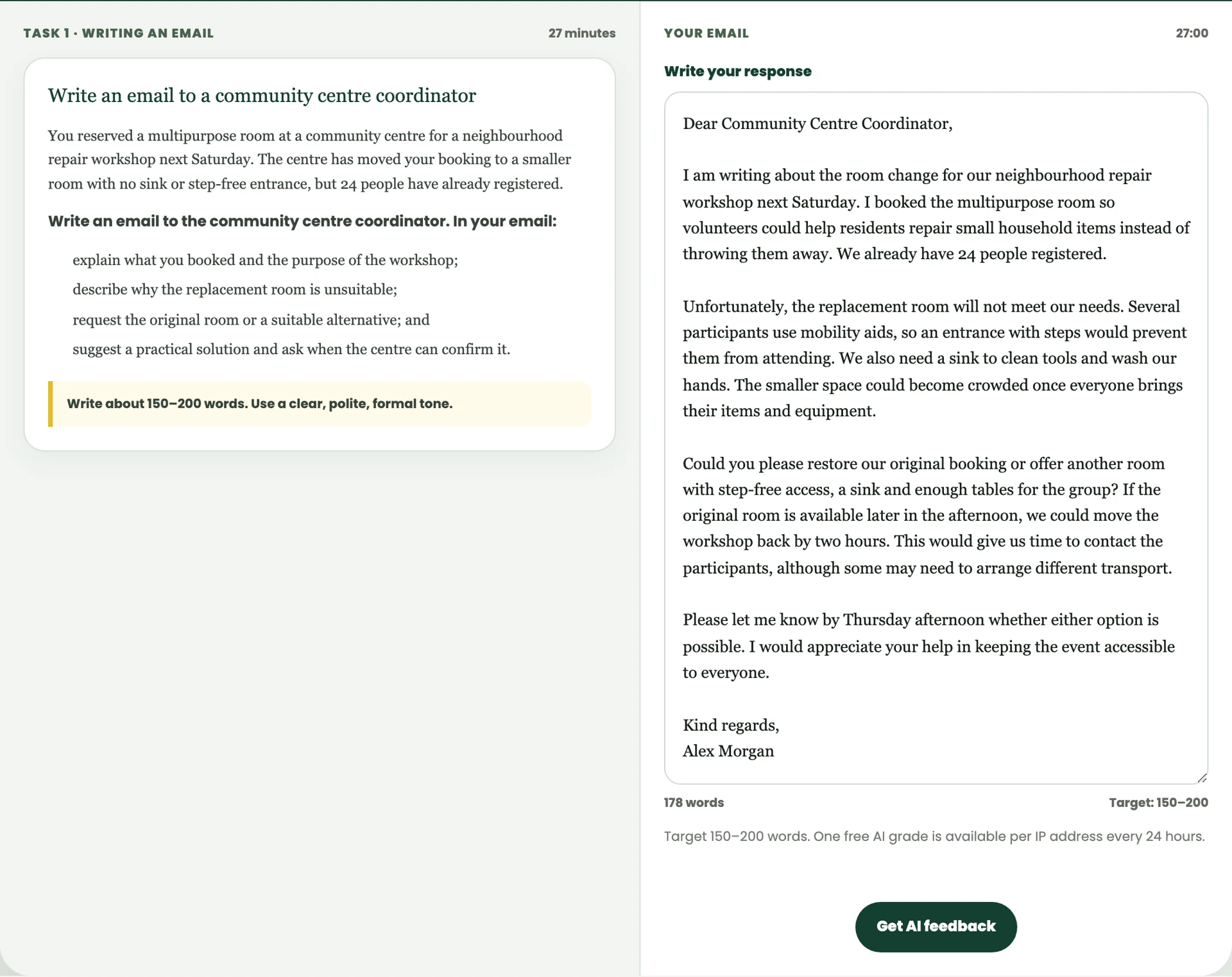
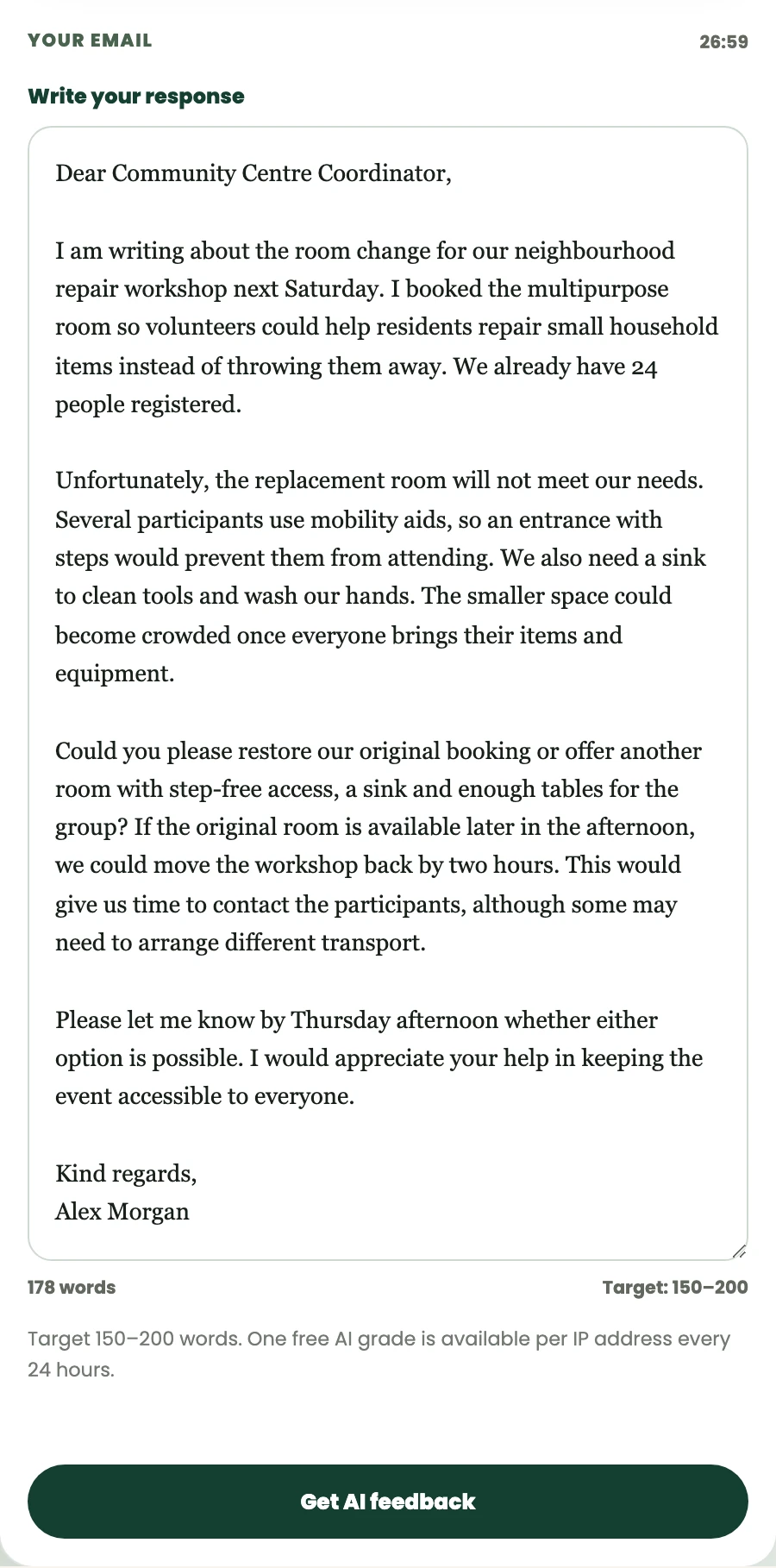
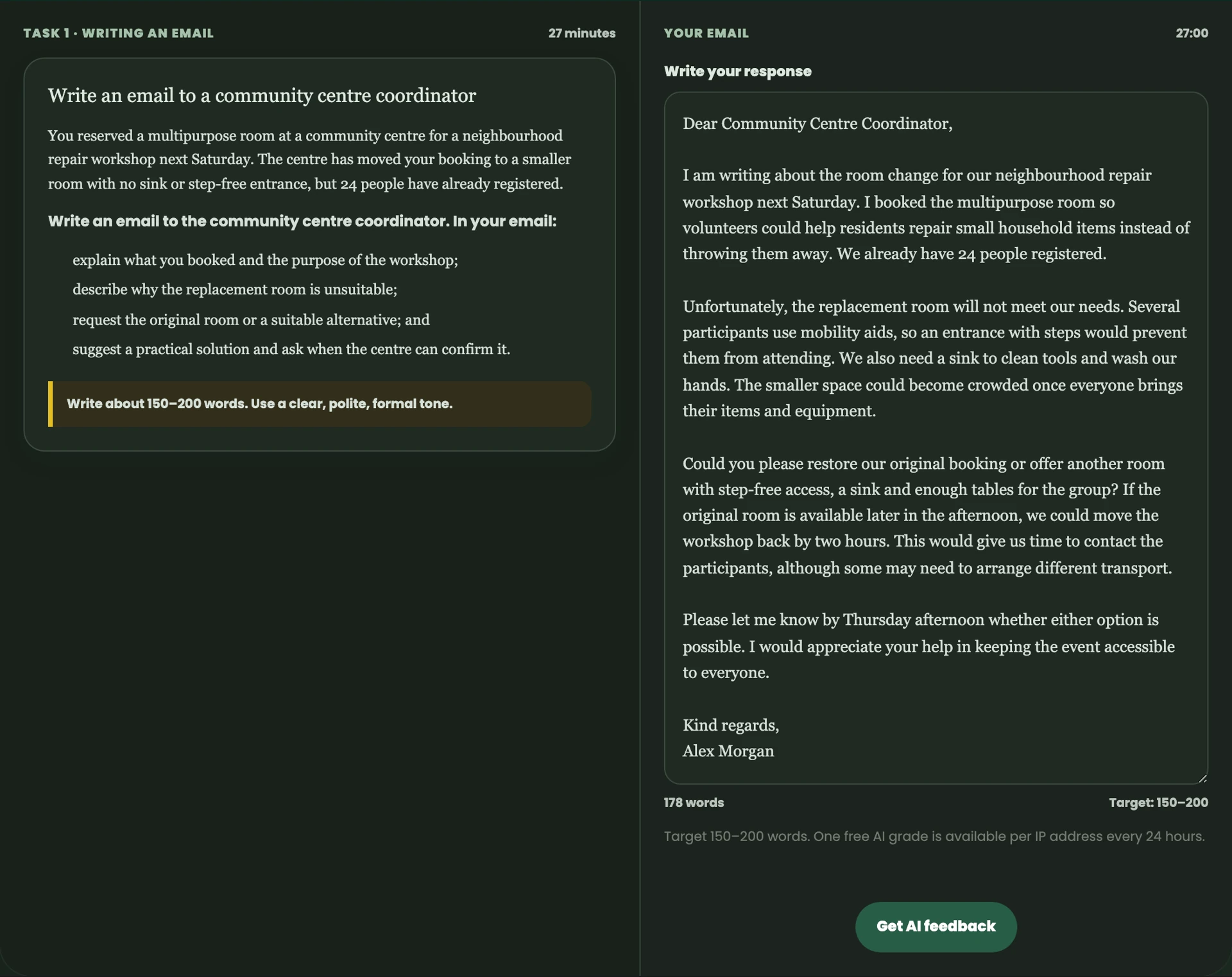
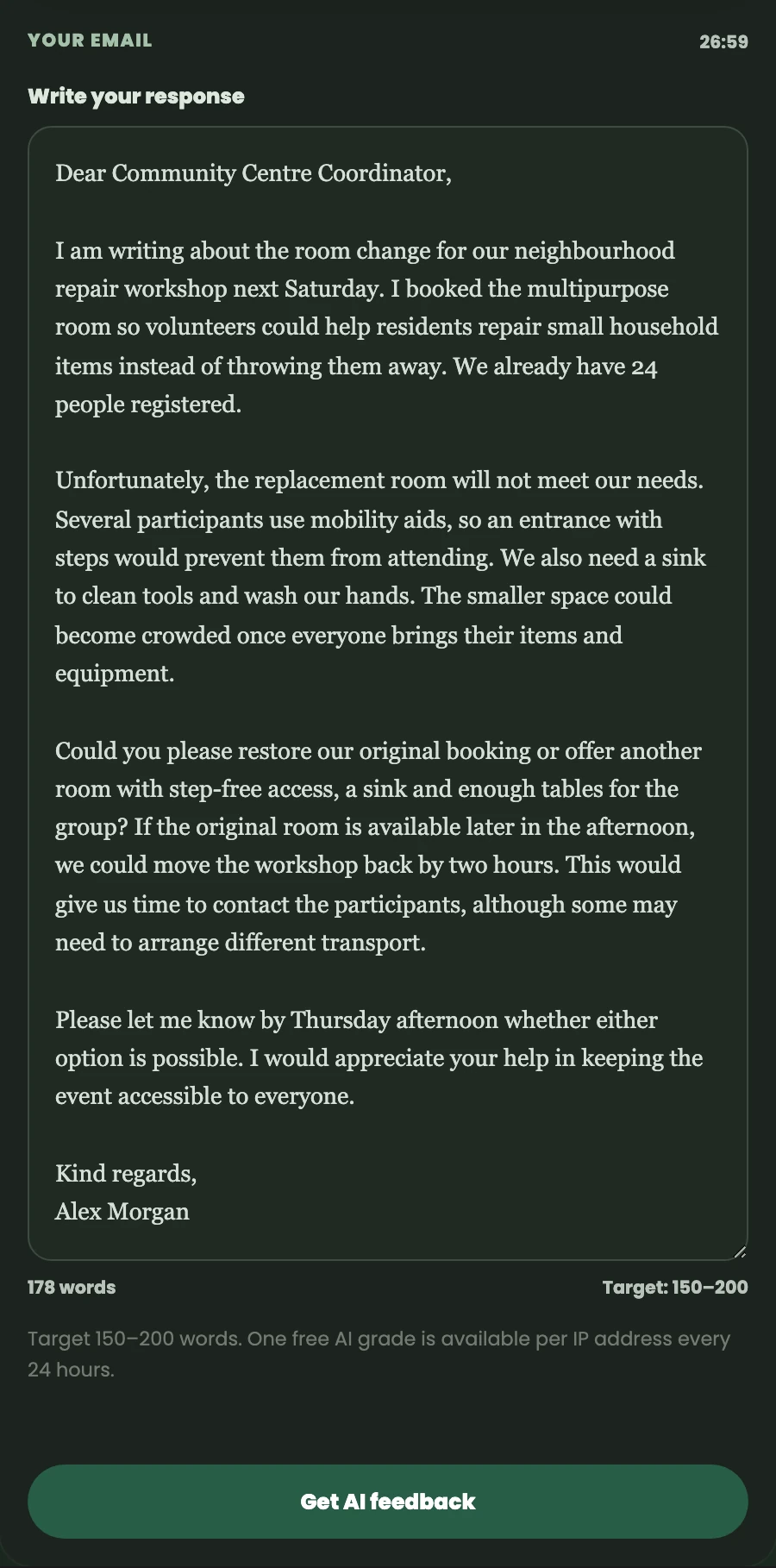
Real PrepEx screens with a fictional answer written for this product demo and the feedback PrepEx returned. Open a view, then select its image to read it at full size.
Complete a practice taskWrite an email with the prompt, timer and word count beside you.
 View full-size screenshot
 View full-size screenshot
 View full-size screenshot
 View full-size screenshot
Read your feedbackSee the practice estimate and what worked in your response.
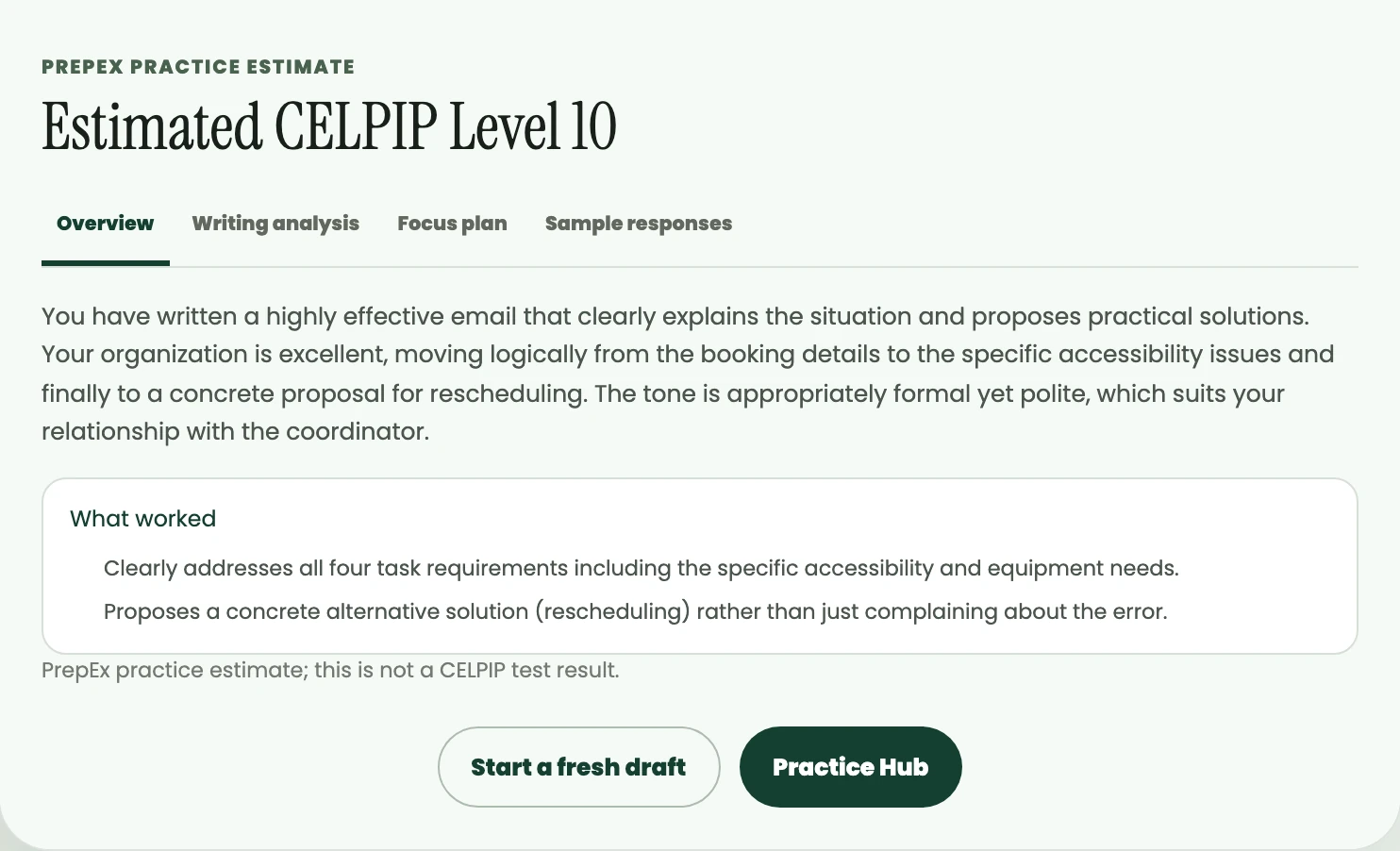 View full-size screenshot
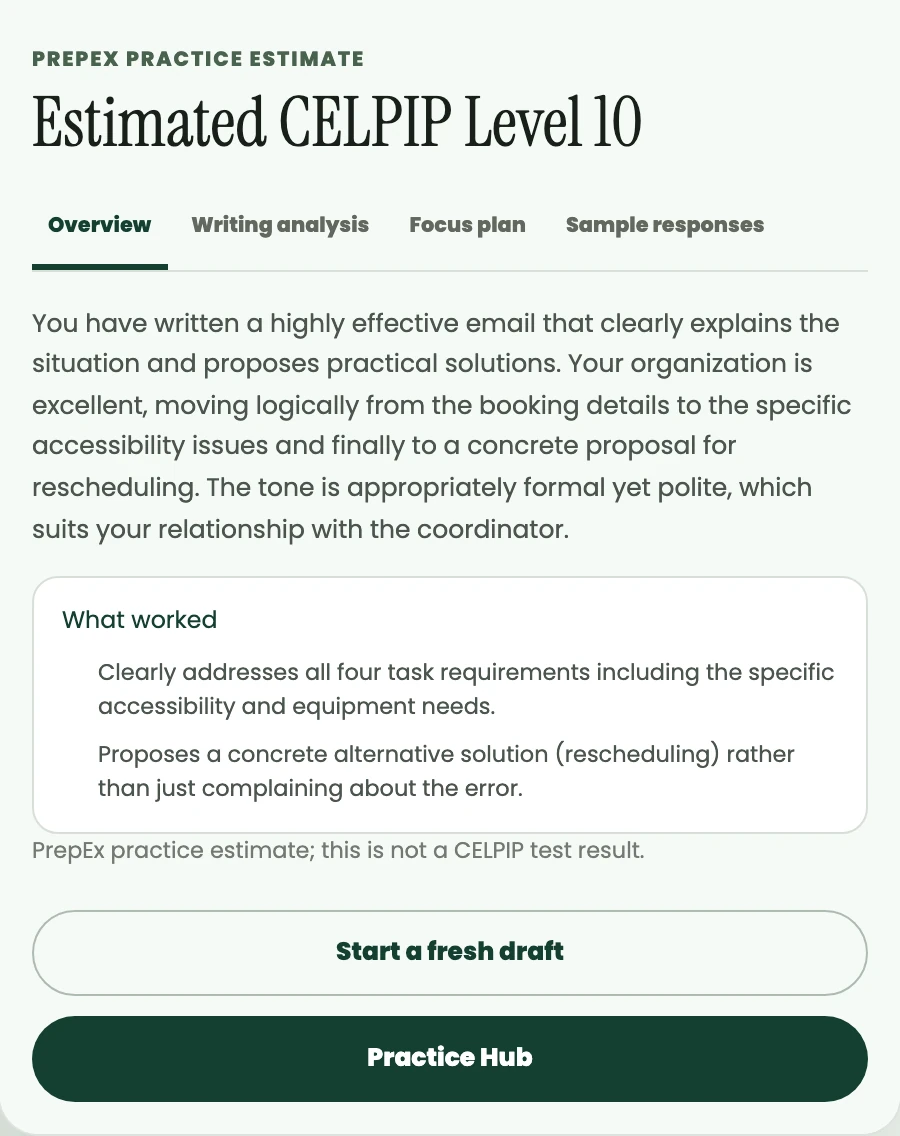 View full-size screenshot
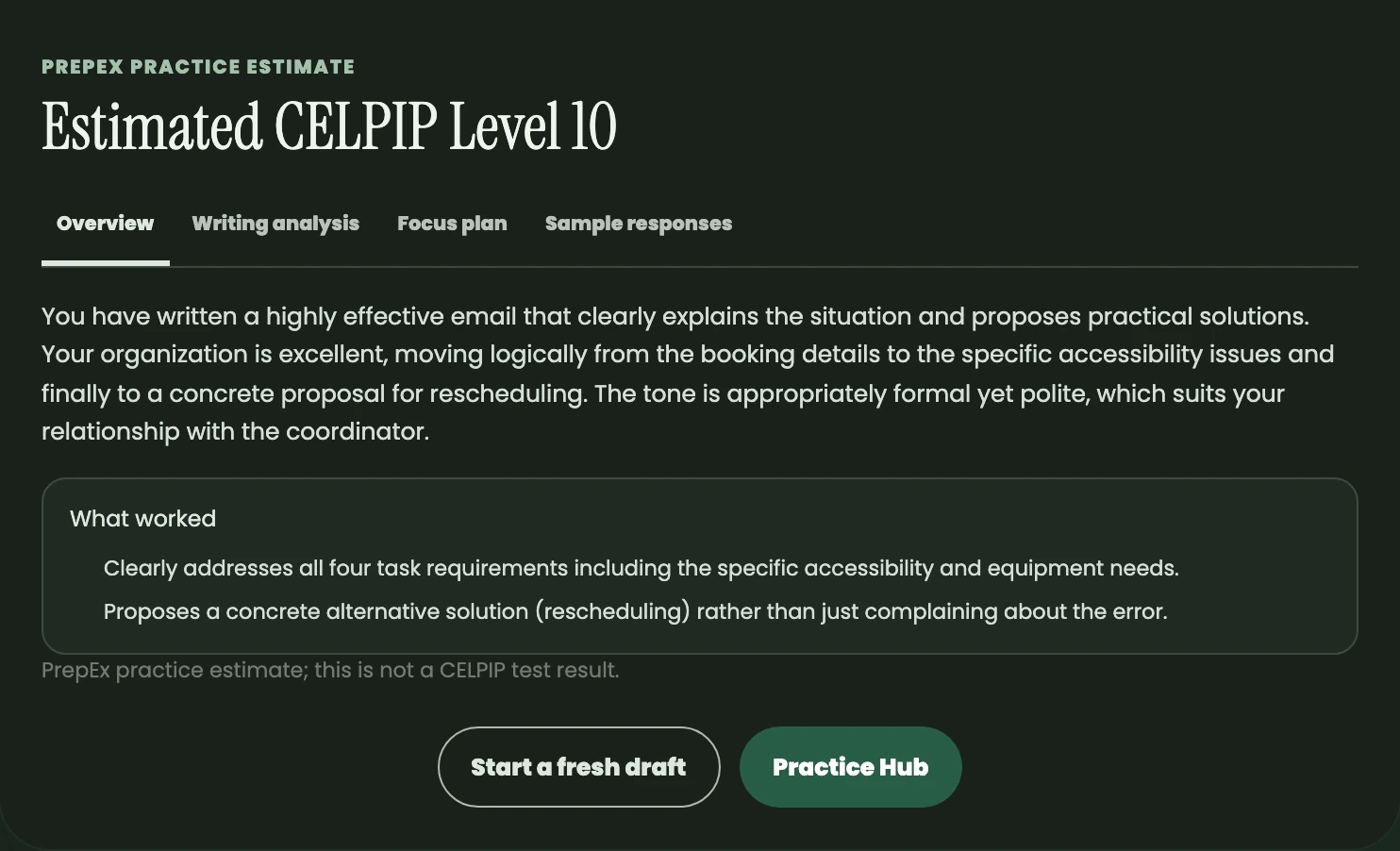 View full-size screenshot
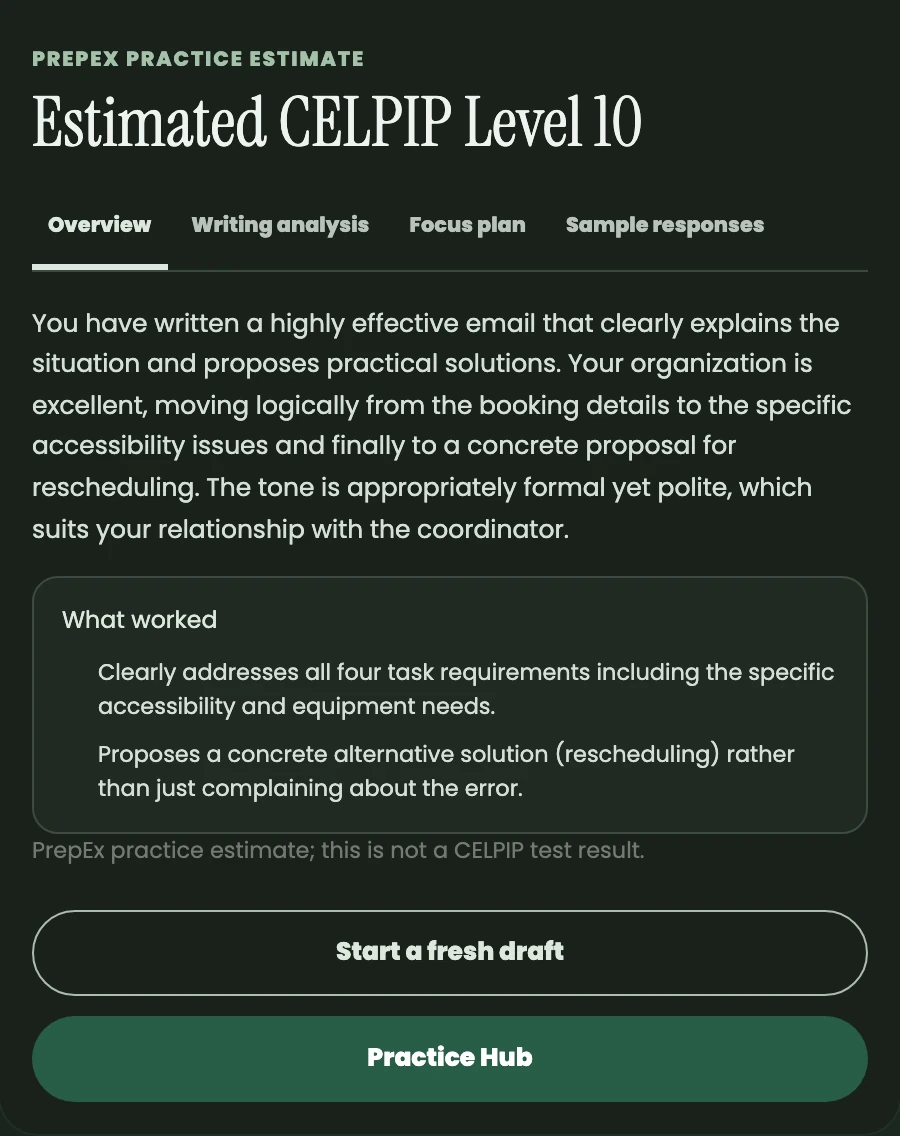 View full-size screenshot
Find your next improvementExplore evidence and next steps across all four Writing criteria.
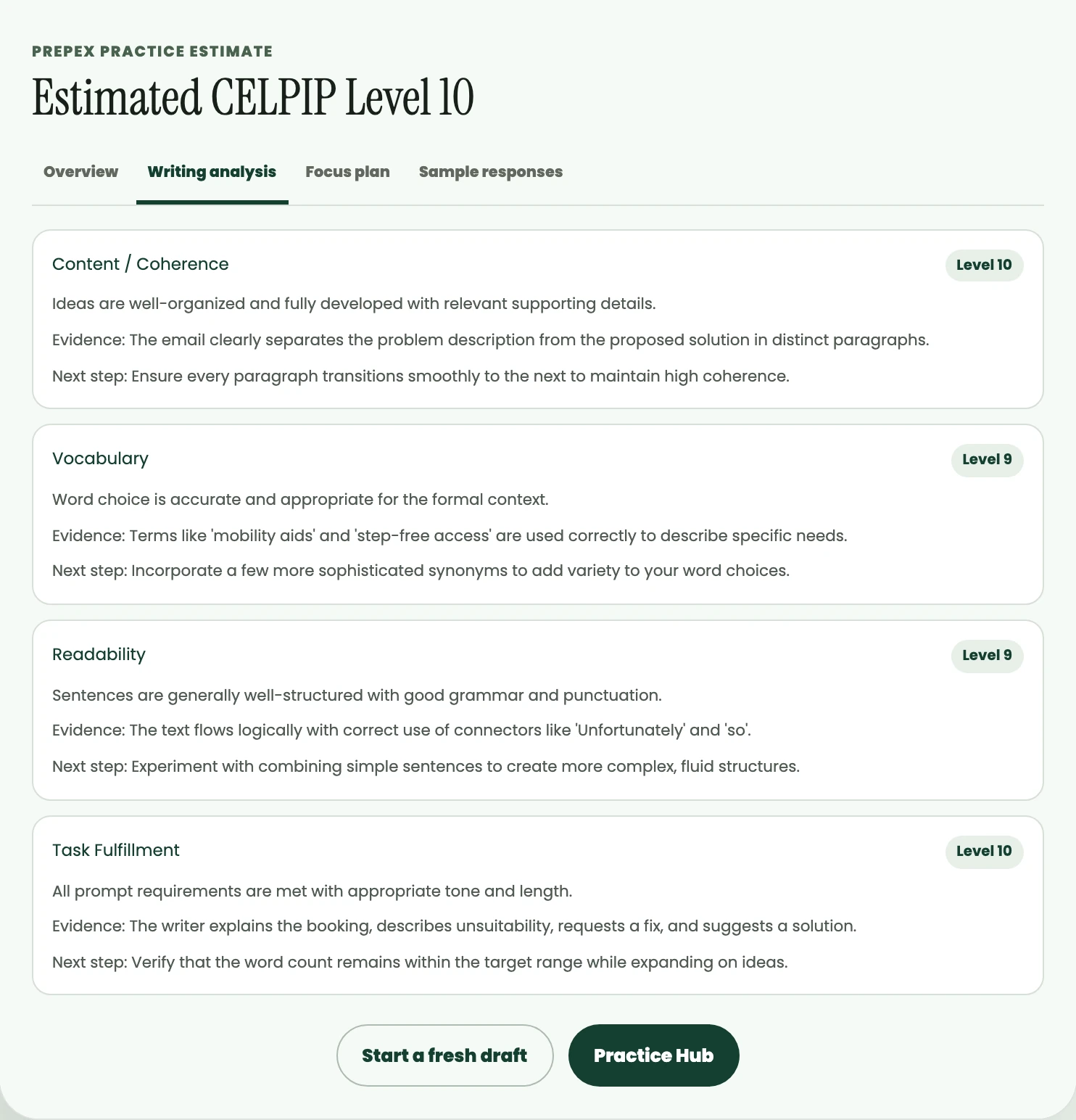 View full-size screenshot
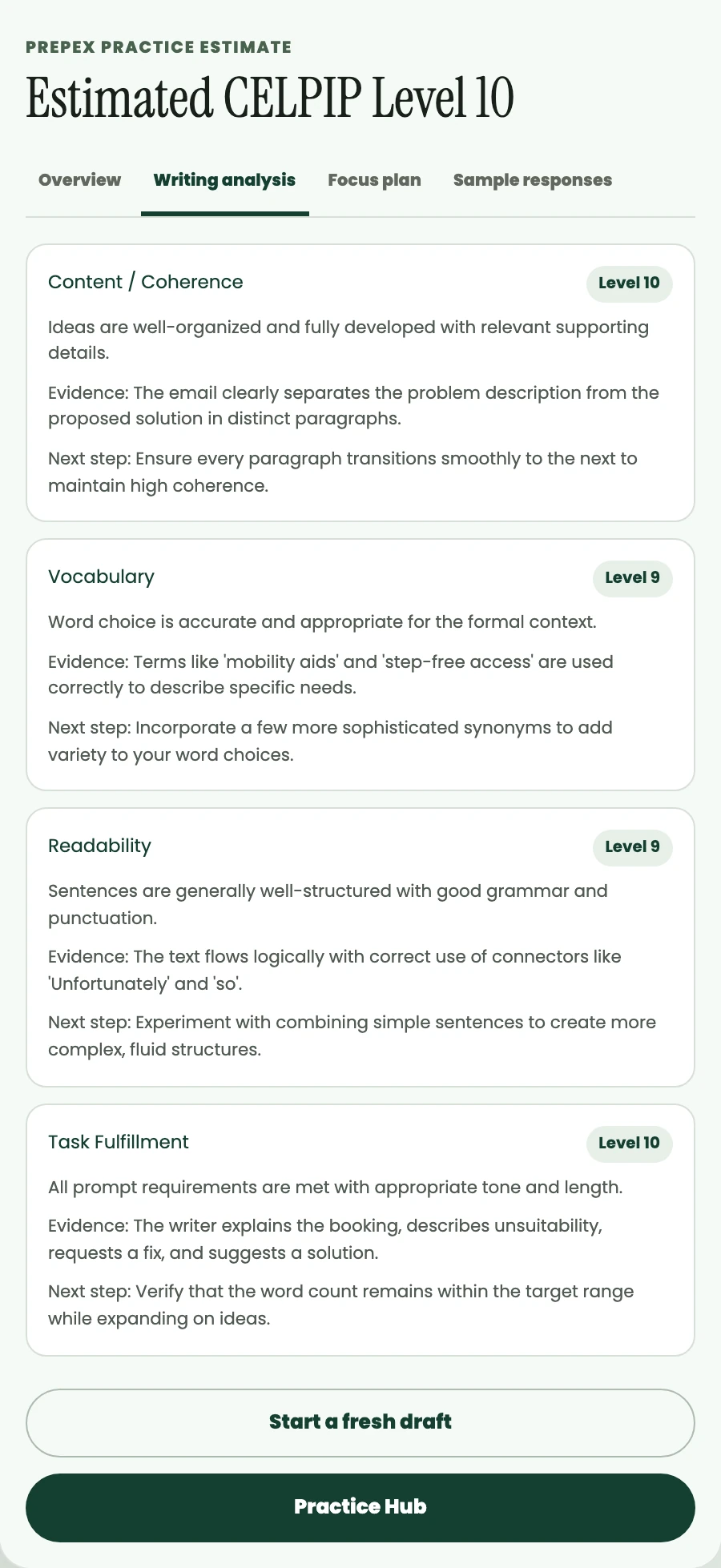 View full-size screenshot
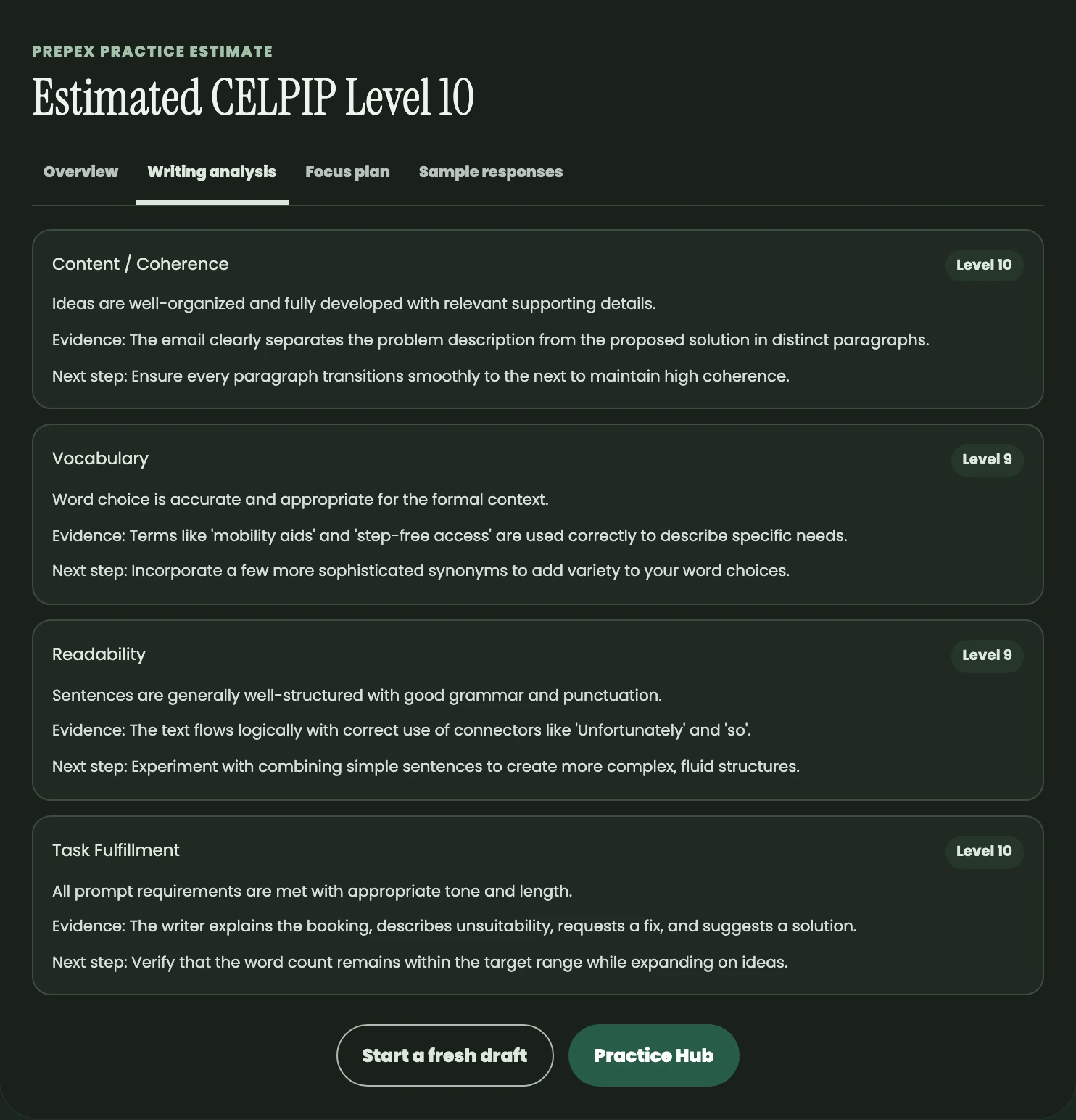 View full-size screenshot
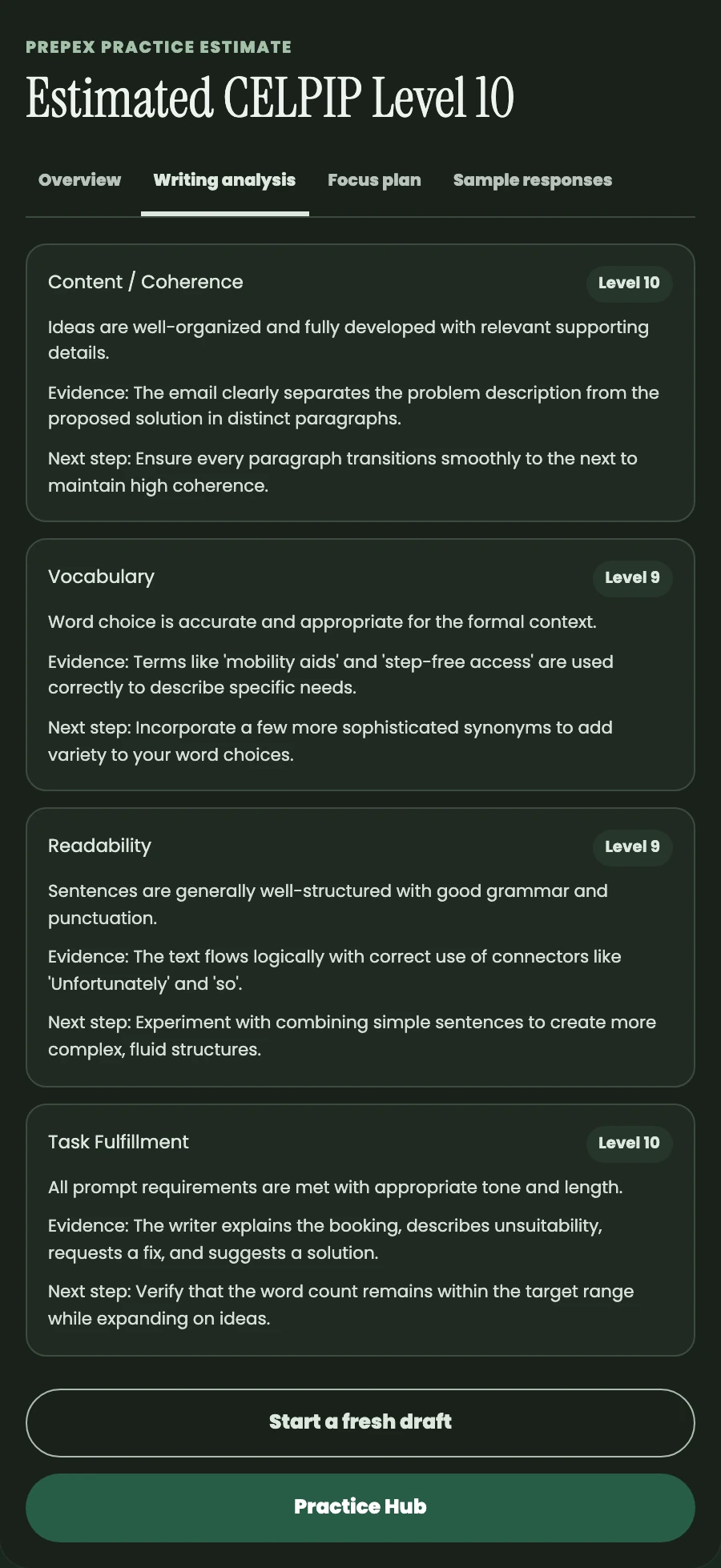 View full-size screenshot
Browse the mock testsChoose a full CELPIP-General mock and check its access label.
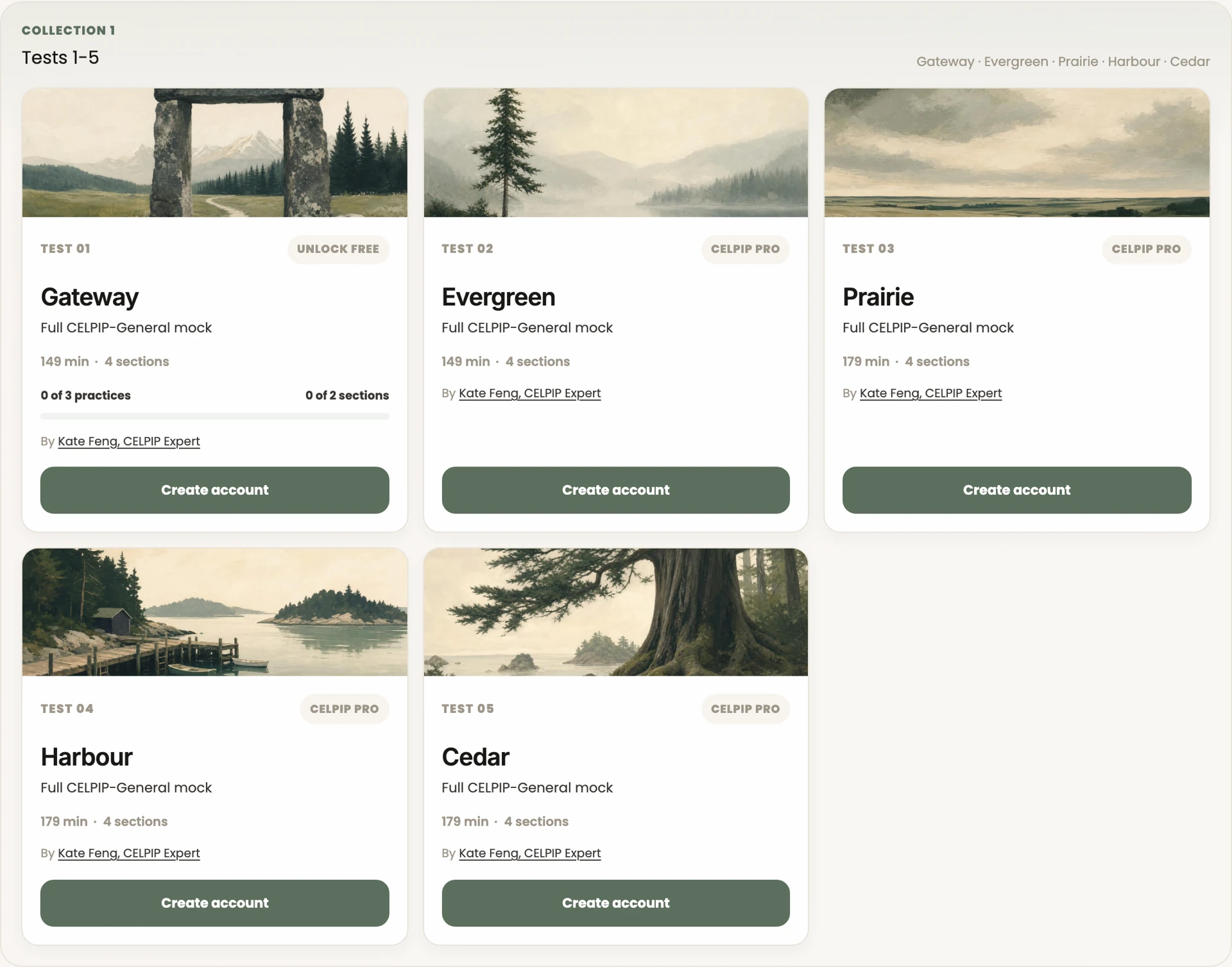 View full-size screenshot
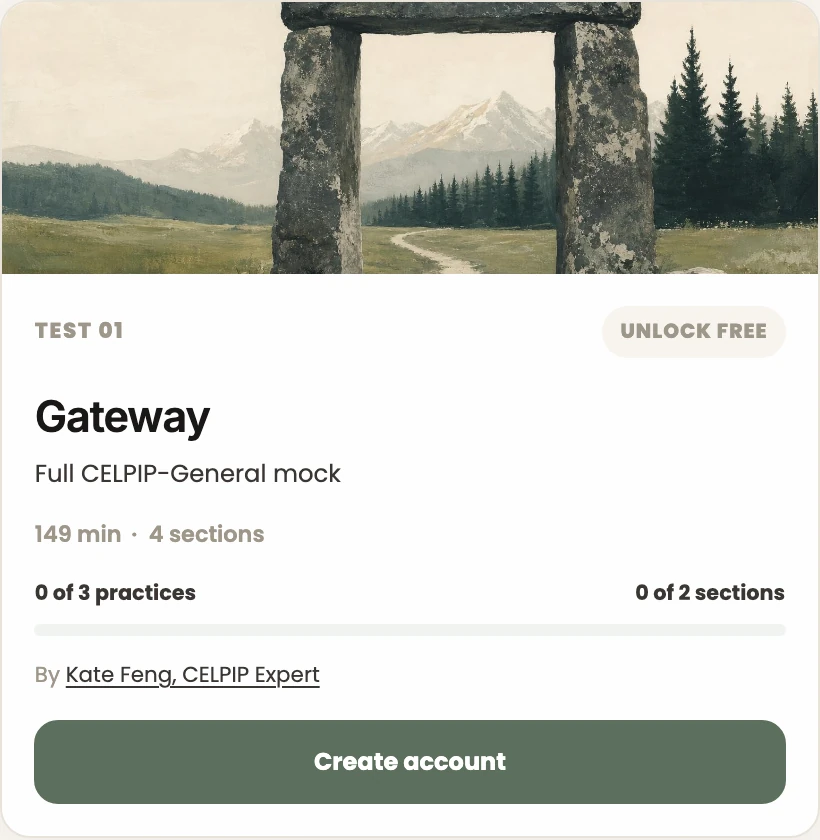 View full-size screenshot
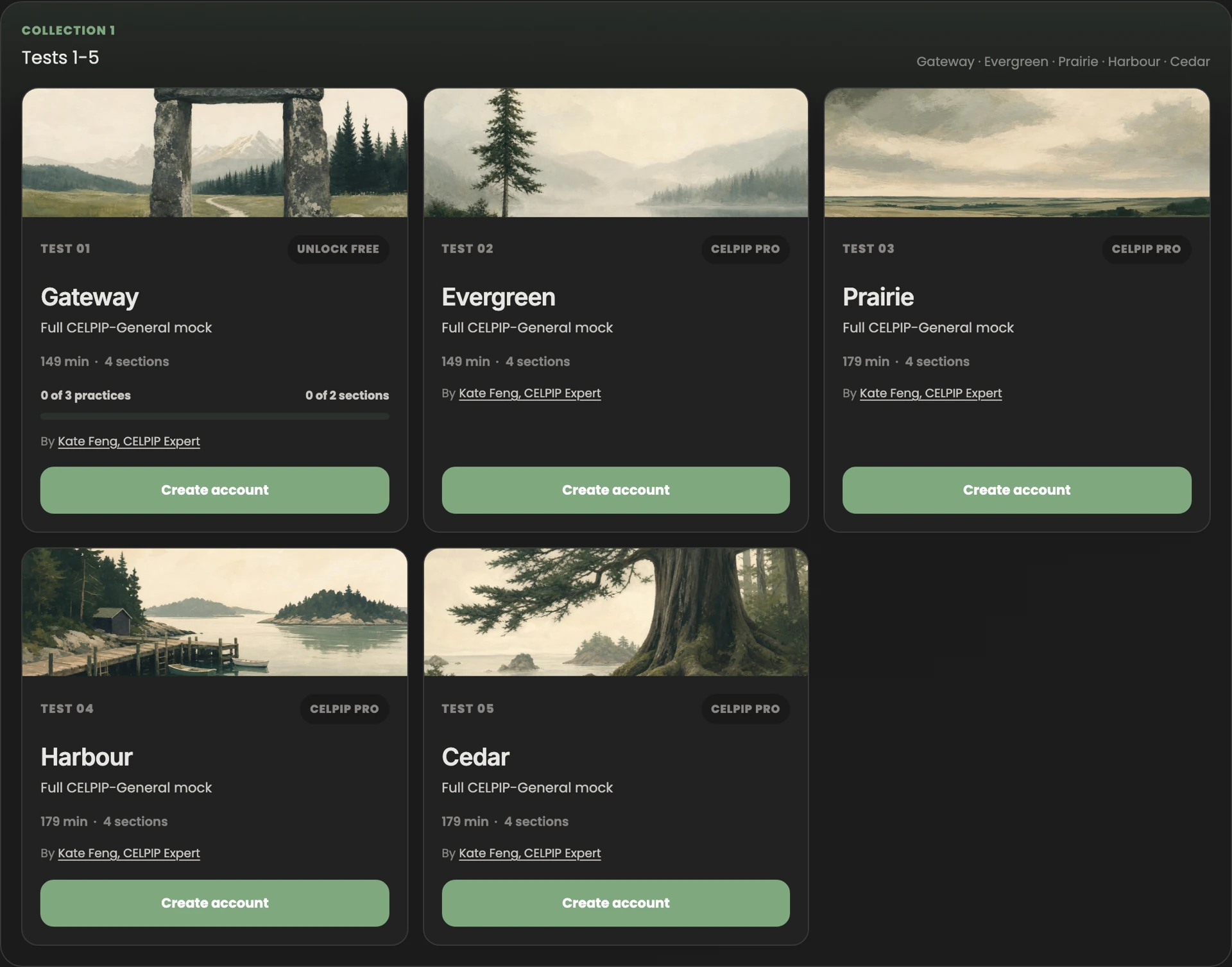 View full-size screenshot
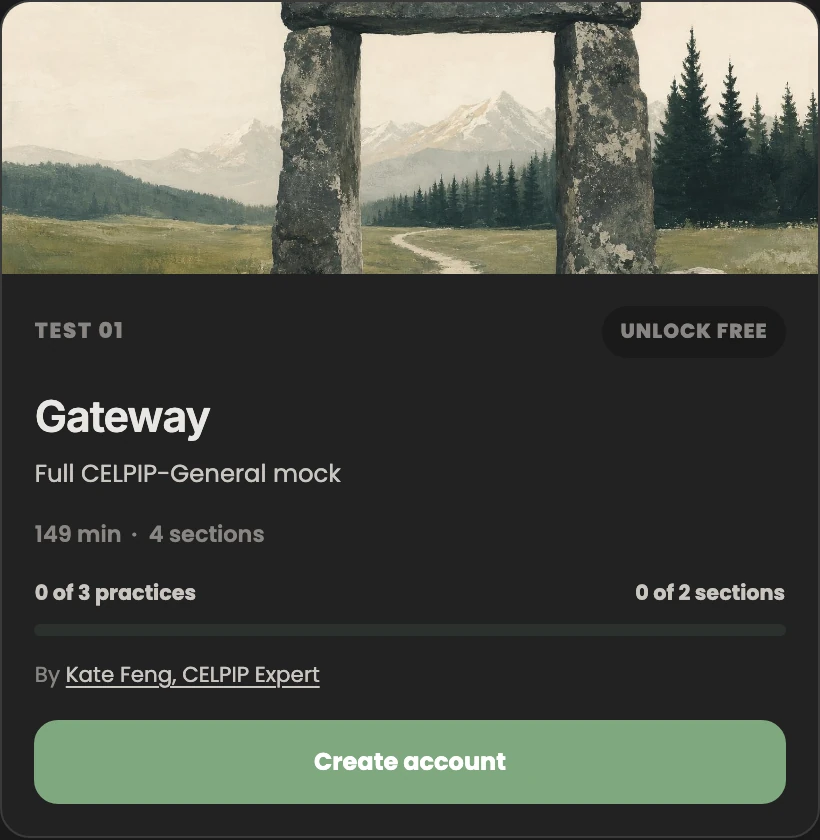 View full-size screenshot
Product demo · Captured November 17, 2026 · No learner information shown
Keep exploring
More from the journal