The PrepEx Journal
CLB 9 in CELPIP: The Score You Need, How Hard It Is and the CRS Points It Earns
CLB 9 in CELPIP is a level of 9 in a skill: about 33–35 correct out of 38 in Listening and 31–33 in Reading on CELPIP's approximate charts, with raters setting Writing and Speaking. It's hardest in Writing, where 24.1% of 2025 results reached 9, and 9 in all four is where the biggest CRS gain sits.

On this page
CLB 9 in CELPIP is a CELPIP-General level of 9 in a skill, since CELPIP levels 3 to 12 equal the same CLB number: about 33–35 correct out of 38 in Listening and 31–33 in Reading on CELPIP's approximate charts, with raters setting the Writing and Speaking levels. PrepEx's free CELPIP practice shows which of your skills is still below 9, with two graded sessions a day and a free full-length practice test. Express Entry counts each skill separately and doesn't use the score report's "Average", so CLB 9 in all four means four separate 9s.
Find the skill keeping you below CLB 9
A free PrepEx account gets two graded CELPIP practice sessions a day across all four skills. After three graded sessions in at least two sections, a full-length CELPIP-General practice test opens free and gives an overall level estimate.
Facts checked on 27 November 2026 against CELPIP's test results, FAQ and Test Day pages, its blog, Level Descriptors, Writing study pack and 2024 and 2025 Data Reports, and IRCC's Express Entry language test, Comprehensive Ranking System and Federal Skilled Worker pages. This is general information, not immigration advice.
What score is CLB 9 in CELPIP?
A 9 in a CELPIP skill is CLB 9 in that skill. CELPIP says its levels 3 to 12 match the same-numbered CLB level, and IRCC's Express Entry tables read the same way, so there's no conversion and no overall CLB. CELPIP's name for level 9 is "effective proficiency" in some high-stakes contexts, one step above level 8's "good proficiency".
For Express Entry it has to be CELPIP-General. CELPIP's blog says the LS version, which tests only Listening and Speaking, isn't accepted for Express Entry permanent residence applications.
Listening and Reading are marked by computer, and CELPIP's charts of correct answers out of 38 are approximate: the number needed "may vary slightly from one test to another". Writing and Speaking have no raw score: raters judge four dimensions and those ratings become a level (how CELPIP is scored has the detail).
| Skill | How the level is set | What level 9 takes | 9 or higher, 2025 |
|---|---|---|---|
| Listening | Computer-marked, out of 38 | About 33–35 correct, so 3–5 wrong | 53.2% |
| Reading | Computer-marked, out of 38 | About 31–33 correct, so 5–7 wrong | 33.0% |
| Writing | Raters, four dimensions | Key ideas backed by relevant detail, in accurate words | 24.1% |
| Speaking | Raters, four dimensions | Ideas backed by reasons, context-specific words, tone for a range of listeners | 34.9% |
The raw ranges overlap. On the chart, 33 correct in Listening appears under both 8 and 9, and 31 in Reading does the same. So 34 or more in Listening and 32 or more in Reading put you at 9 or higher, while a 33 or a 31 could land on either side. The CELPIP score chart lists every score out of 38; for the levels below, see Is 7 a good CELPIP score?
The Average printed on your CELPIP results doesn't count: CELPIP's FAQ says IRCC doesn't use it. Listening 10, Reading 9, Writing 8 and Speaking 10 prints an Average of 9 and is still CLB 8 in Writing.
Is it hard to get 9 in CELPIP?
Getting 9 is hardest in Writing and easiest in Listening. In CELPIP's 2025 Data Report, 53.2% of CELPIP-General Listening results were 9 or higher, against 34.9% in Speaking, 33.0% in Reading and 24.1% in Writing.
Writing piles up at 8. In 2025, 36.1% of Writing results were exactly 8, the most common single level in any skill, and only 9.4% were exactly 9. In the 2024 report the figures were 27.3% at 8 and 29.8% at 9 or higher. Speaking bunches at 8 too (24.4% in 2025).
Reading has the lowest average of the four skills, 7.27, against 8.33 in Listening, 7.94 in Speaking and 7.87 in Writing. Far more Reading results sit below 8 than at 8, so the gap to 9 there is often two levels or more.
CELPIP doesn't publish the share that reaches 9 in all four skills, but it can't be higher than the Writing figure of 24.1%. The usual near-miss is three skills at 9 or above and Writing on 8.
How many CRS points is CLB 9?
For a single Express Entry applicant, each skill at CLB 9 earns 31 core CRS points, against 23 at CLB 8: 8 more per skill, or 124 for all four. With a spouse or partner it's 29 against 22, so 7 more per skill and 116 for all four. Going from 9 to 10 adds only 3 per skill, and 11 or 12 add nothing.
| CLB in one skill | Single applicant | With spouse or partner |
|---|---|---|
| CLB 8 | 23 | 22 |
| CLB 9 | 31 | 29 |
| Gain from 8 to 9 | +8 | +7 |
The bigger jump needs 9 in all four. Two skill transferability categories pair your language result with education and with foreign work experience, with a lower tier for CLB 7 or more in all four (one or more under 9) and a higher tier for CLB 9 or more in all four:
- one post-secondary credential of one year or longer: 13, or 25 with four 9s;
- two or more credentials (one of three years or longer), a master's, an entry-to-practice professional degree or a doctorate: 25, or 50;
- one or two years of foreign work experience: 13, or 25;
- three or more years: 25, or 50.
Each category is capped at 50, and skill transferability at 100. Core points are counted skill by skill, but the lowest skill decides the transferability tier: one 8 among three 9s keeps you on the lower tier in both.
IRCC's 3 November 2026 changes left the language and skill transferability points as they were. CLB 9 also earns the most Federal Skilled Worker grid points for language: 6 per skill, against 5 at CLB 8. Every level's points are in CELPIP score for PR, and whether CLB 10 is worth it weighs the extra 3.
Worked example: Listening 9, Reading 8, Writing 8, Speaking 9
Take a single applicant with a master's degree and two years of foreign work experience whose result is Listening 9, Reading 8, Writing 8 and Speaking 9. The table counts only the points tied to that CELPIP result.
| CELPIP result (L, R, W, S) | Core language | Education + language | Foreign work + language | Total |
|---|---|---|---|---|
| 9, 8, 8, 9 | 108 | 25 | 13 | 146 |
| 9, 9, 8, 9 | 116 | 25 | 13 | 154 |
| 9, 9, 9, 9 | 124 | 50 | 25 | 199 |
Raising Reading to 9 adds 8 points. Raising Writing as well adds 45 more, because the last skill to reach 9 moves both transferability categories to the higher tier at once: 53 points from the first row to the last. With a spouse or partner, the core part runs from 102 to 116 instead, and the total gain is 51. Moving Listening from 9 to 10 would add 3.
See which of your skills is still at 8 before you book. Find my weakest skill free
Is 8777 CLB 9?
Yes, if those are IELTS General Training bands. IRCC's CLB 9 line for IELTS General Training is 8.0 in Listening and 7.0 in Reading, Writing and Speaking, which is where the shorthand 8777 comes from.
CELPIP has no split like that: CLB 9 is a 9 in each skill, Listening included. If 8, 7, 7, 7 are CELPIP levels, that's CLB 8 in one skill and CLB 7 in three: enough for the Federal Skilled Worker minimum, two levels short of 9 in three skills. CELPIP to IELTS lines up the other levels.
What separates 8 from 9 in Writing and Speaking?
In CELPIP's Level Descriptors, level 9 Writing backs key ideas with relevant facts in accurate words, and level 9 Speaking adjusts its tone to a range of audiences. CELPIP publishes these descriptors for Writing and Speaking only; Listening and Reading have the raw-score chart.
| Skill and dimension | Level 8 | Level 9 |
|---|---|---|
| Writing: Content/Coherence | Develops a main idea with supporting details | Supports key ideas with relevant facts, descriptions or details |
| Writing: Vocabulary | Common or context-specific words that carry the meaning | Words chosen to give accurate details, descriptions and comparisons |
| Writing: Readability | Well-organized paragraphs, good control of complex grammar | Control of a range of complex and varied structures |
| Writing: Task Fulfillment | Common writing conventions, for a familiar or clearly defined reader | Some formal and most informal conventions, for a defined reader in a formal or informal situation |
| Speaking: Vocabulary | Common words and some context-specific vocabulary | Common and context-specific vocabulary |
| Speaking: Task Fulfillment | Style and tone adjusted to some audiences and situations | Adjusted to a range of audiences, including peers and authority figures |
In Speaking that mostly means range: context-specific words throughout, and a tone that fits whoever the task puts in front of you, a neighbour, a manager or a landlord.
PrepEx example, written to show the content difference between an 8 and a 9 in a complaint email:
Developing the point: "The construction next to my building is very noisy, and it is affecting my sleep and my work."
Backing it with detail: "Since the crew started on the lot next door last Monday, the drilling has begun before 7 a.m. every weekday. I've been woken an hour before my alarm all week, and on Thursday I was late for a client call after a broken night."
The second gives the reader facts to act on. CELPIP's score comparison chart has rated samples at every level, and our Writing 8 to 9 and Speaking 8 to 9 pages work through full examples.
Memorized templates don't close this gap, and an answer that isn't your own can get the score cancelled (CELPIP templates explains the risk). Plan the shape of an answer, then fill it with detail written for that prompt.
Where each CELPIP skill usually falls short of 9
Each skill has its own usual gap below 9, so start with your lowest. CELPIP's own advice is that a stronger score in one skill won't offset a lower one, and that your lowest score can point to where study helps most.
- Listening: log every miss by part and cause. Level-8 listeners tend to lose points in the later parts, on speaker attitude and on options that repeat words from the audio (CELPIP Listening tips for 9).
- Reading: the clock is often what runs out (CELPIP Reading tips for 9, with worked questions in Reading 8 to 9).
- Writing: answer every point in the prompt with detail and stay near the 150–200 words CELPIP's Writing study pack suggests; raters check length under Task Fulfillment (CELPIP Writing tips for 9).
- Speaking: use the time, give a reason and an example for each point, and match your tone to the listener (CELPIP Speaking tips for 9).
All four 9s have to sit on one test report, because CELPIP can't combine scores from two tests and IRCC wants the results on a single report; getting all 9s on the same test covers how to keep the strong skills from slipping. For a step-by-step method, read how to work toward CLB 9.
On PrepEx, signed-in learners keep a history of every attempt, can review saved mistakes and try a task again, so you can compare the four dimensions on the same task type a week apart. One Writing or Speaking task a day is graded free without an account, such as a CELPIP Writing Task 1 email or a Speaking Task 1 answer, with a practice level estimate and feedback on all four rating dimensions.
Check where you stand before you book
Book the real test when several practice results, not one, put your weakest skill at 9 or above. PrepEx's practice tests are written to be as hard as the real test, and benchmarked against CELPIP's official sample tests; practice test vs real test covers how the two compare. If you want a level for each skill on every full test, a new full-length test every week and unlimited graded practice, that's CELPIP Pro.
If your last result missed 9 by one level in Writing or Speaking and the other skills already meet your target, CELPIP re-evaluation is the other route, within six months of the test date; Listening and Reading are computer-scored and unlikely to change. The CELPIP retake guide compares re-evaluating with retaking.
Get a practice level in all four skills before you book the real test. Start the free practice test
CLB 9 in CELPIP: FAQ
What score is CLB 9 in CELPIP?
A CELPIP level of 9 in that skill. On CELPIP's approximate charts that's about 33–35 correct out of 38 in Listening and 31–33 in Reading; raters assign the Writing and Speaking levels.
Is it hard to get 9 in CELPIP?
It's hardest in Writing: in CELPIP's 2025 Data Report, 24.1% of CELPIP-General Writing results were 9 or higher, against 33.0% in Reading, 34.9% in Speaking and 53.2% in Listening.
Is CELPIP 9 hard even for native English speakers?
It can be, in Reading and Writing. In CELPIP's 2025 Data Report, test takers whose first language is English averaged 7.63 in Reading and 8.59 in Writing, both below 9, and a former CELPIP Writing rater has noted that Writing is hard for native speakers too.
Do I need CLB 9 for Express Entry?
No. The language minimum is CLB 7 in all four skills for the Federal Skilled Worker Program and for Canadian Experience Class jobs in TEER 0 or 1, and CLB 5 for TEER 2 or 3 jobs. CLB 9 earns more CRS points; it doesn't decide eligibility.
How many CRS points is CLB 9?
31 per skill for a single applicant (124 for all four) and 29 per skill (116) with a spouse or partner. CLB 9 in all four also lifts skill transferability points to the higher tier.
Is 8777 CLB 9?
Yes, in IELTS General Training: Listening 8.0 with 7.0 in Reading, Writing and Speaking is IRCC's CLB 9 line. In CELPIP, CLB 9 means a 9 in each skill.
Do I need 9 in every skill for CLB 9?
Yes. IRCC checks each skill on its own and doesn't use the Average on your score report, so Listening 10, Reading 9, Writing 8 and Speaking 10 is still CLB 8 in Writing. PrepEx's free full-length practice test gives an overall level estimate, and CELPIP Pro shows a level for each skill on every full test.
How can I check if I'm at CLB 9 before booking CELPIP?
Take a full practice test in one sitting. On PrepEx, a free account gets two graded sessions a day, and a full-length practice test with an overall level estimate opens after three sessions in at least two sections.
Sources we checked
- CELPIP: Test Results — approximate Listening and Reading charts out of 38 and the "may vary slightly" caveat, computer marking, the four rating dimensions, the level 8 and 9 names, and re-evaluation of some or all components within six months
- CELPIP: CLB scores and CELPIP results — CELPIP levels 3 to 12 equal the same CLB level; IRCC considers the four skills separately; LS isn't accepted for Express Entry
- CELPIP: Contact Us and FAQ — IRCC doesn't use the Average on the score report
- CELPIP 2025 Data Report (PDF) — share of CELPIP-General results at each level by skill, skill means, and means for English as a first language
- CELPIP 2024 Data Report (PDF) — Writing at level 8 (27.3%) and at 9 or higher (29.8%) in 2024
- CELPIP Level Descriptors (PDF, May 2026) — what level 8 and level 9 describe in Writing and Speaking
- CELPIP: Score Comparison Chart — rated Writing and Speaking samples for each level
- CELPIP Writing Pro Target 9 Study Pack 2026 (PDF) — a suggested length of about 150–200 words for each Writing task
- CELPIP: Test Day Information — responses that aren't original or spontaneous may lead to score cancellation
- The Official CELPIP Podcast, episode 11 (5 October 2021) — a former Writing rater on Writing being hard for native speakers too
- CELPIP: Improve scores for Express Entry — a stronger score in one skill won't offset a lower one; the lowest score shows where to study
- IRCC: Express Entry language test results — CELPIP-General is required, CELPIP level equals CLB level, the IELTS General Training CLB 9 line, and the CLB 7 and CLB 5 program minimums
- IRCC: Comprehensive Ranking System criteria — core language points per skill and the skill transferability tiers and caps
- IRCC: Express Entry changes — skill transferability rules aren't changing in the 3 November 2026 update
- IRCC: Federal Skilled Workers — 6 selection-grid points per skill at CLB 9 or higher, 5 at CLB 8
- IRCC: Federal Skilled Workers, official language proficiency (staff manual) — the results must all be on the same single test report
- The Official CELPIP Podcast, episode 25 (6 April 2022) — CELPIP can't combine the scores of two separate tests
See the practice experience.
Real PrepEx screens with a fictional answer written for this product demo and the feedback PrepEx returned. Open a view, then select its image to read it at full size.
Complete a practice taskWrite an email with the prompt, timer and word count beside you.
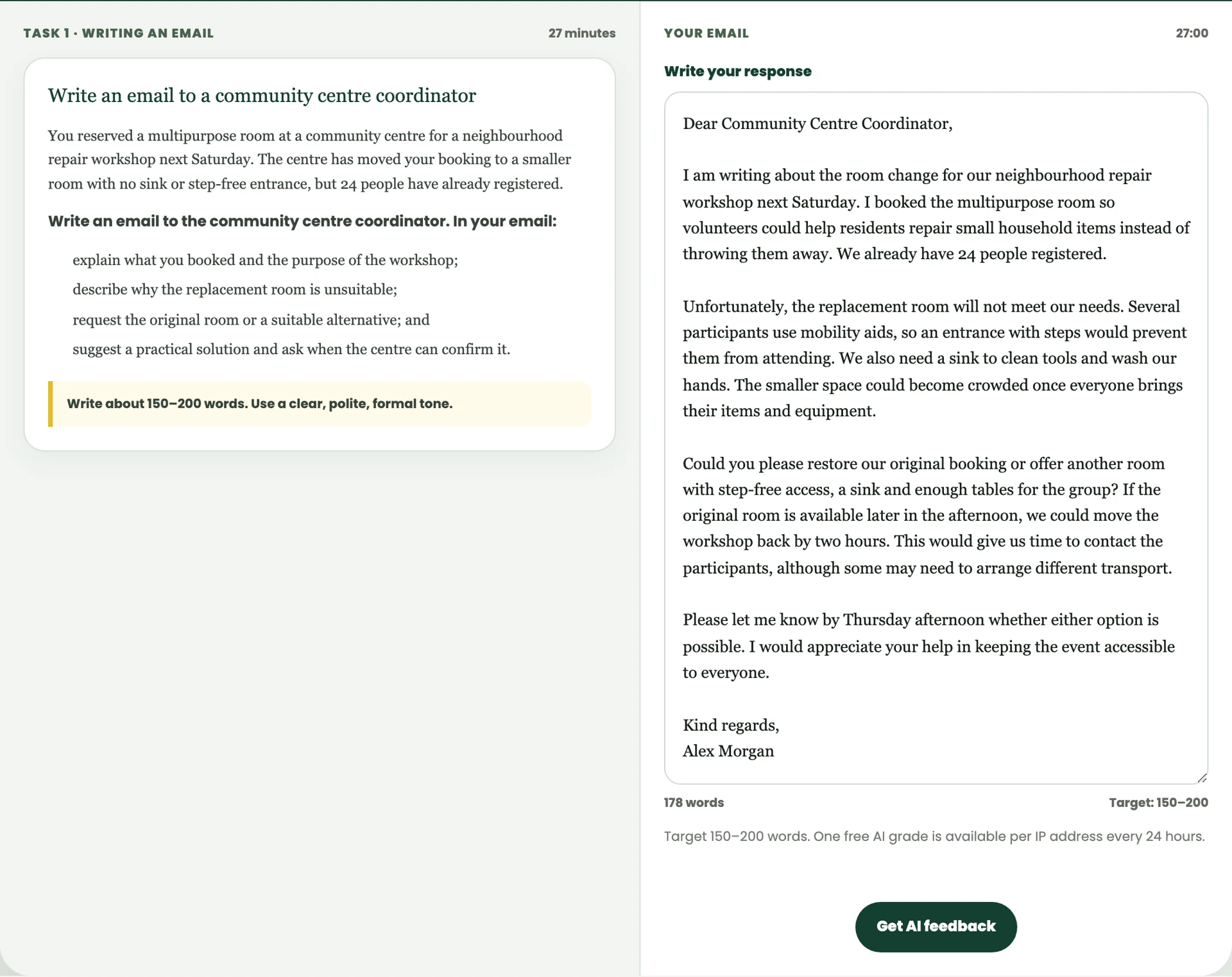 View full-size screenshot
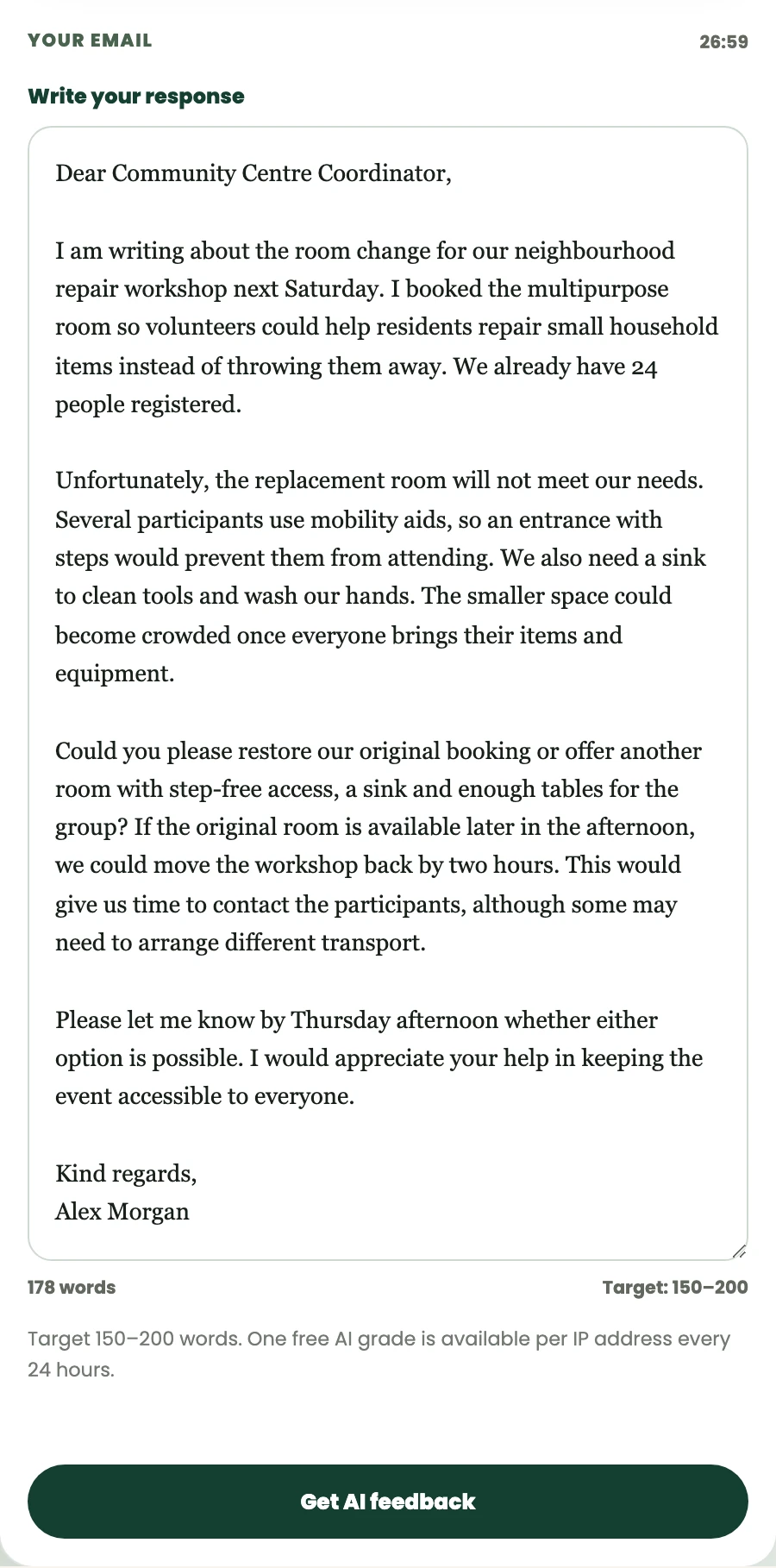 View full-size screenshot
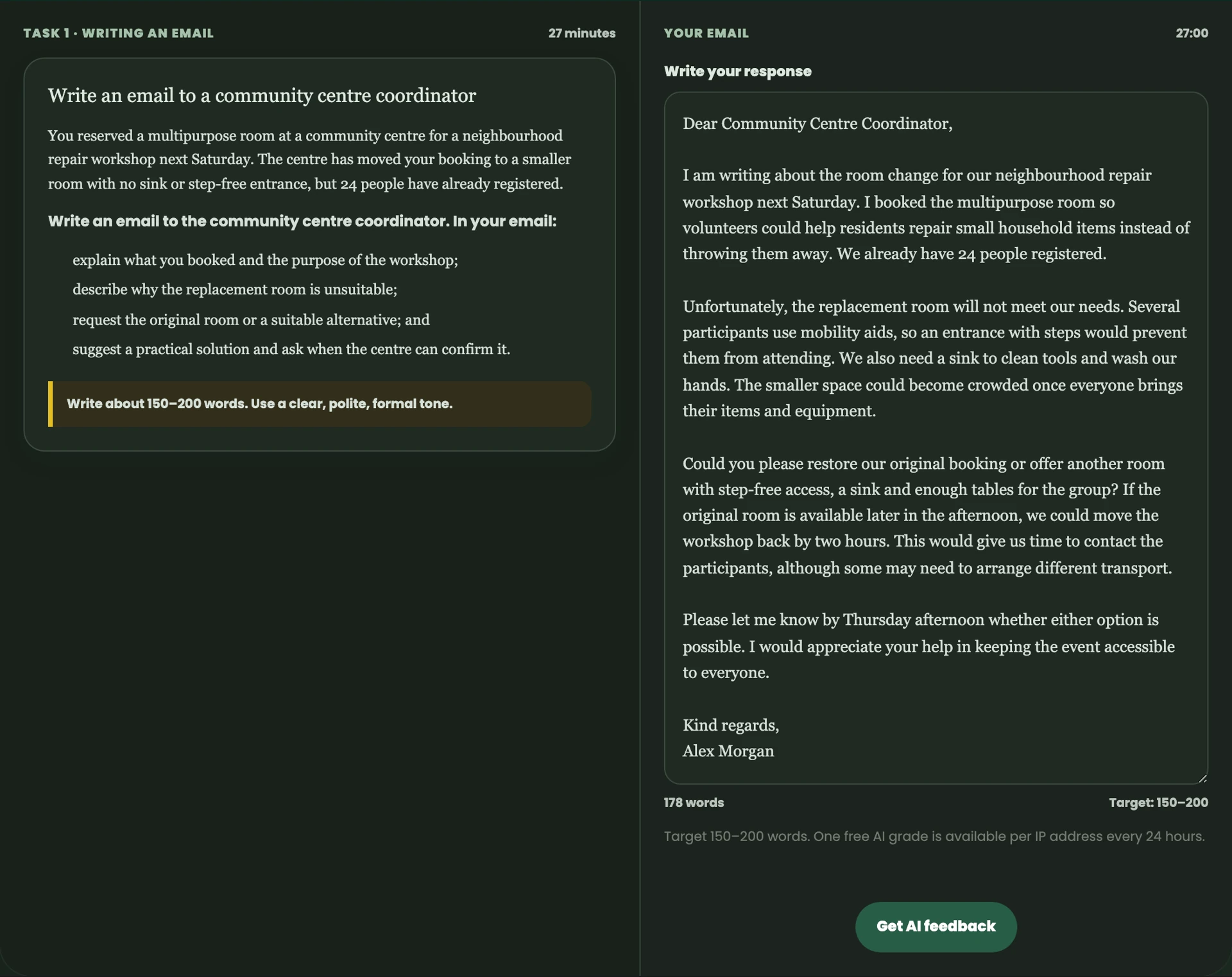 View full-size screenshot
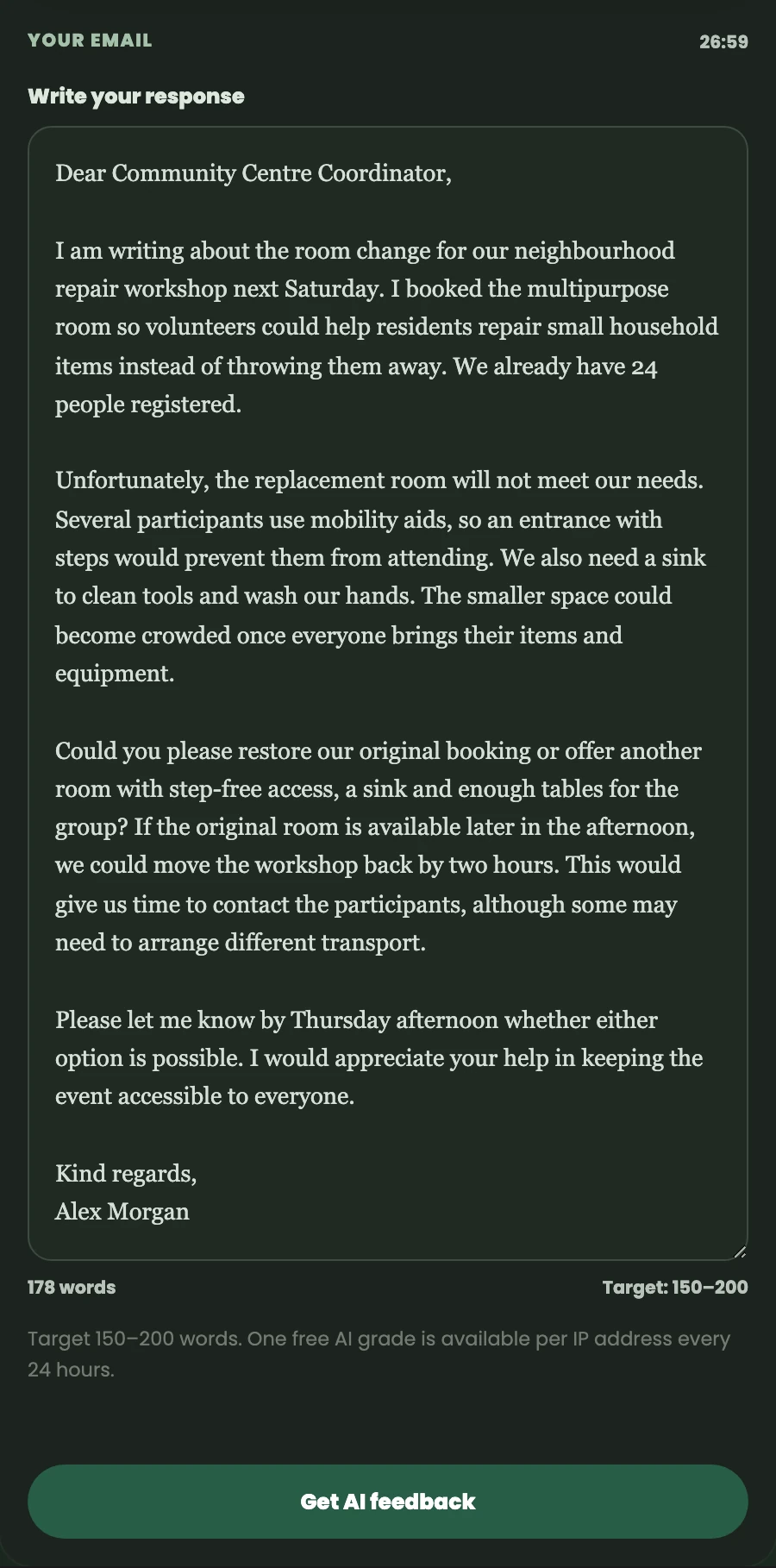 View full-size screenshot
Read your feedbackSee the practice estimate and what worked in your response.
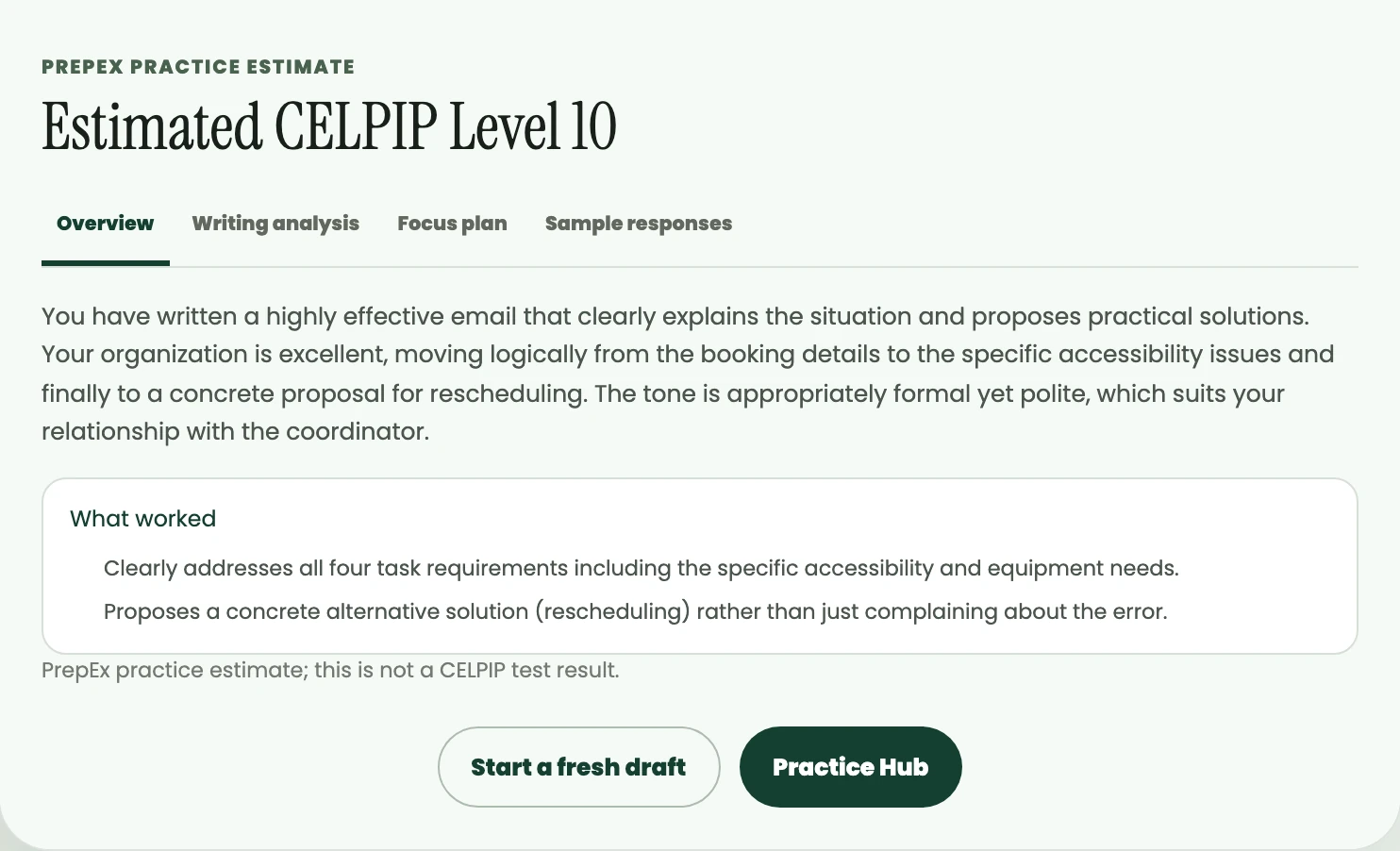 View full-size screenshot
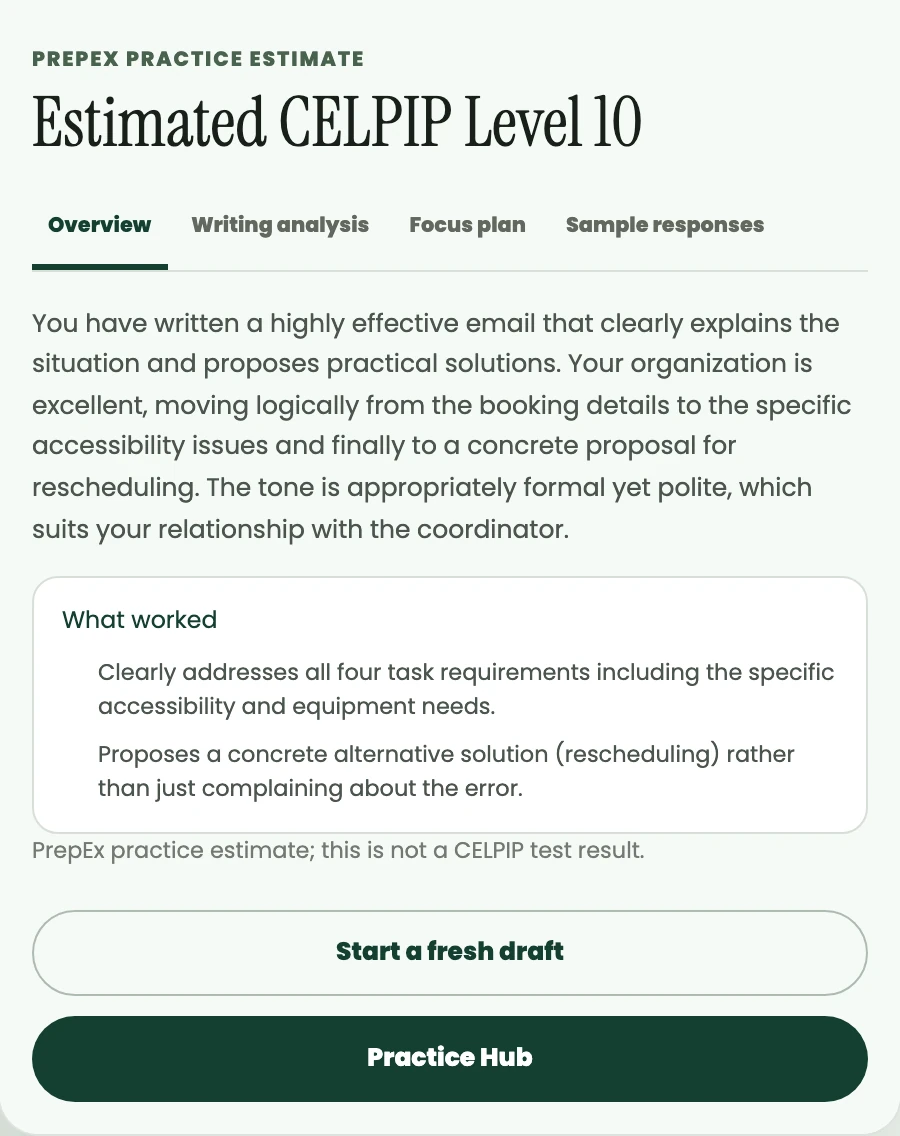 View full-size screenshot
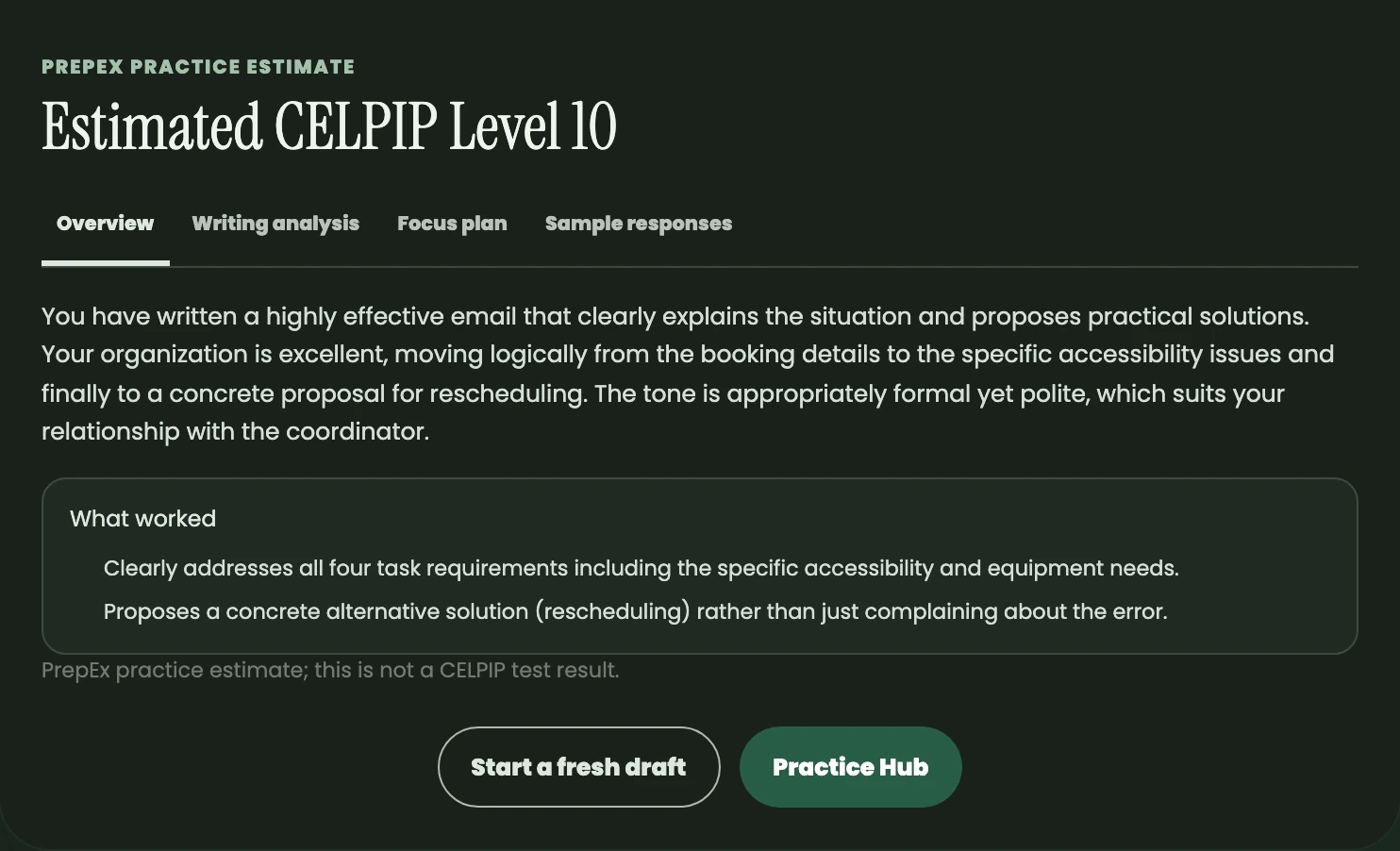 View full-size screenshot
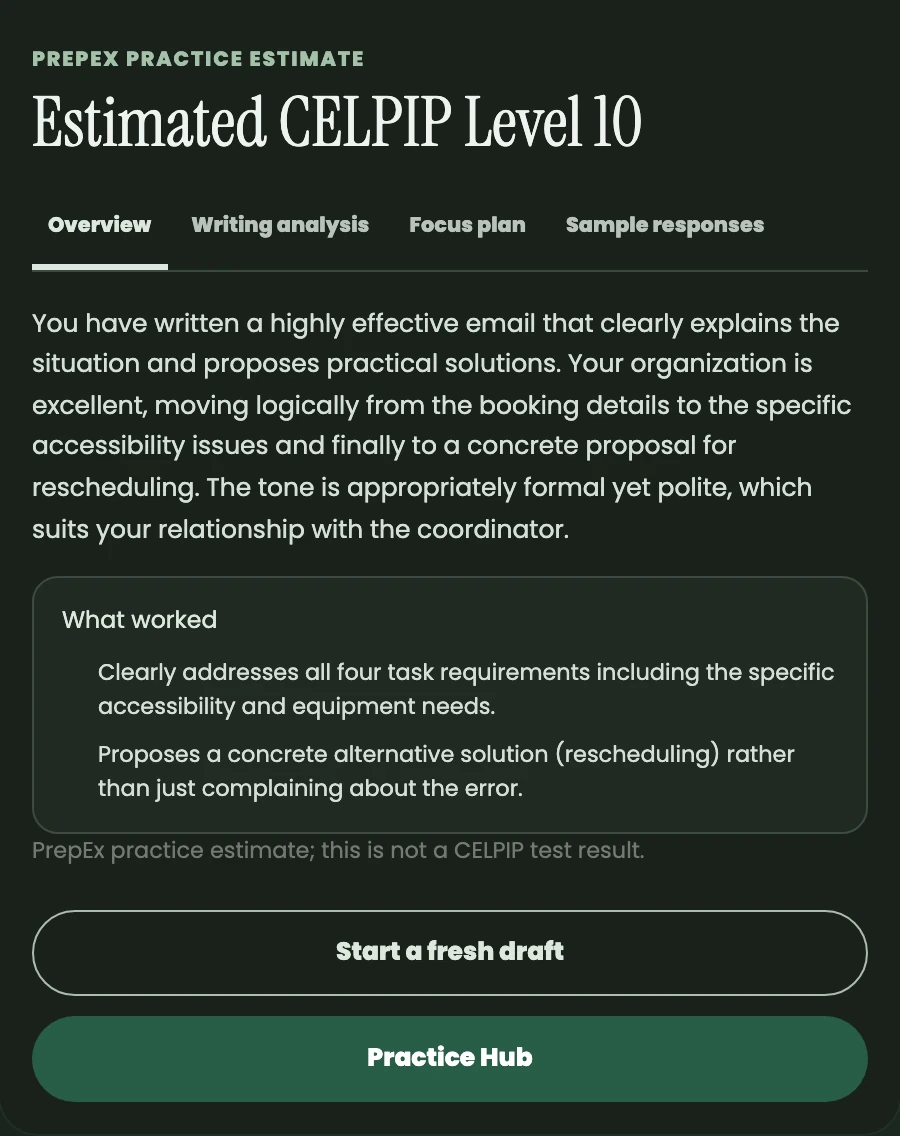 View full-size screenshot
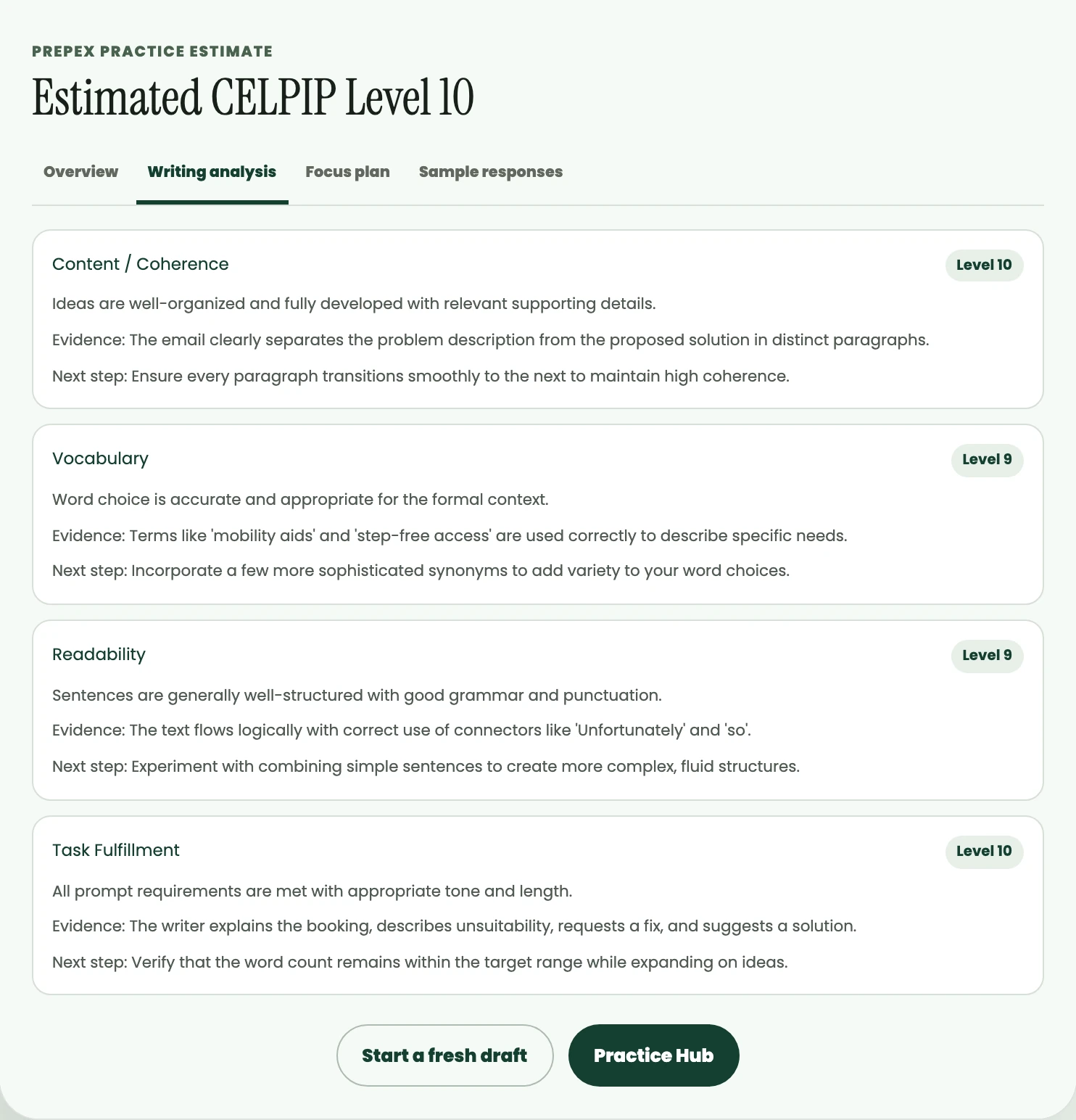
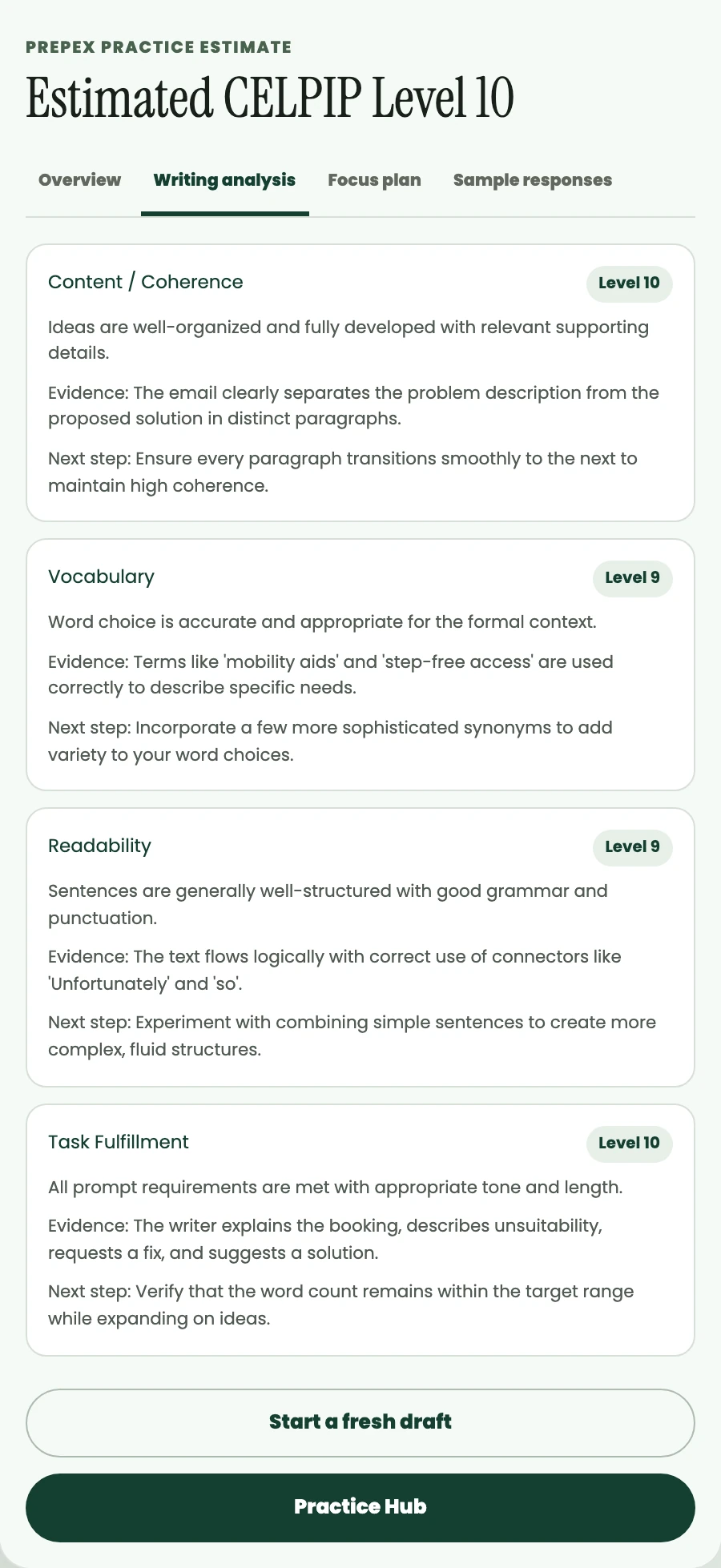
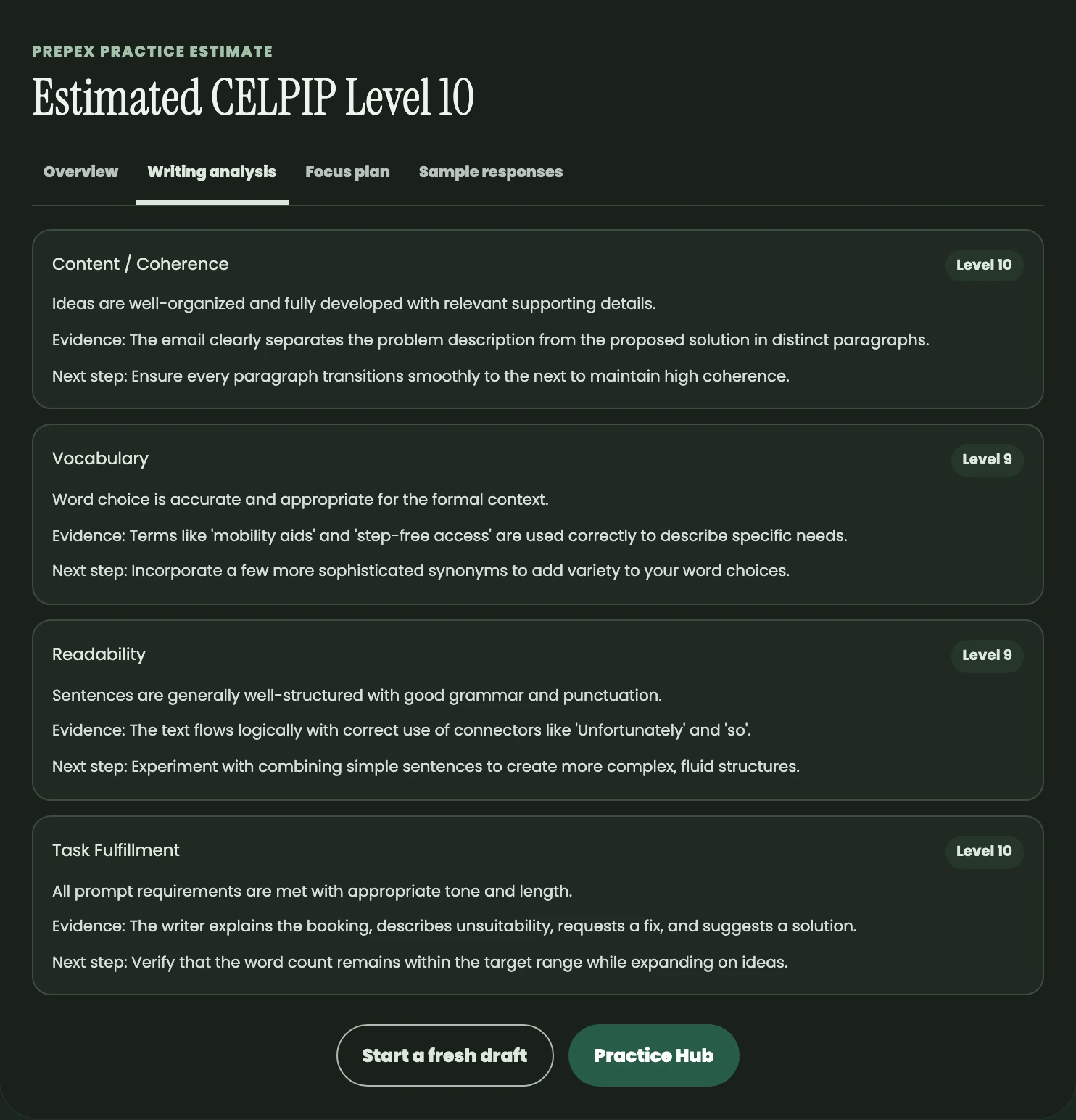
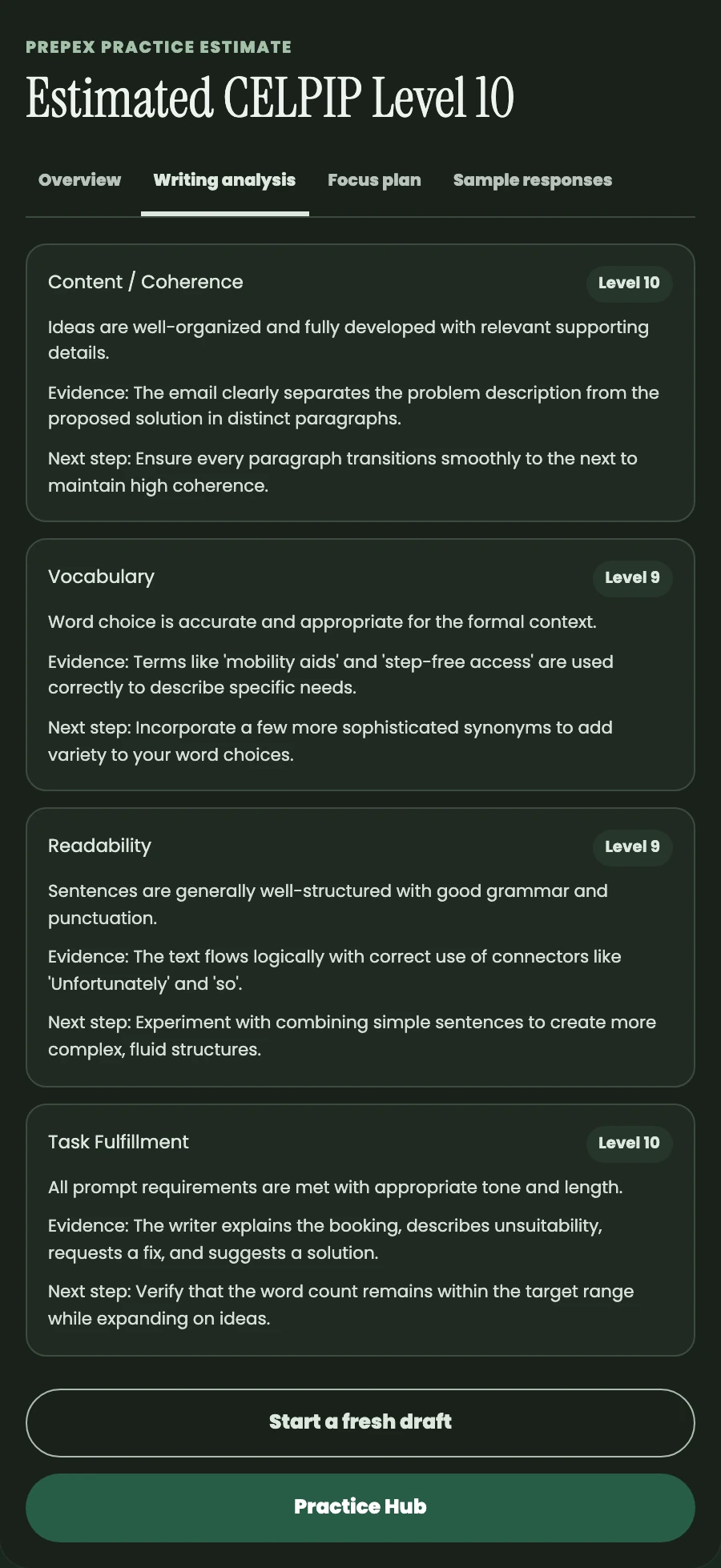
Find your next improvementExplore evidence and next steps across all four Writing criteria.
 View full-size screenshot
 View full-size screenshot
 View full-size screenshot
 View full-size screenshot
Browse the mock testsChoose a full CELPIP-General mock and check its access label.
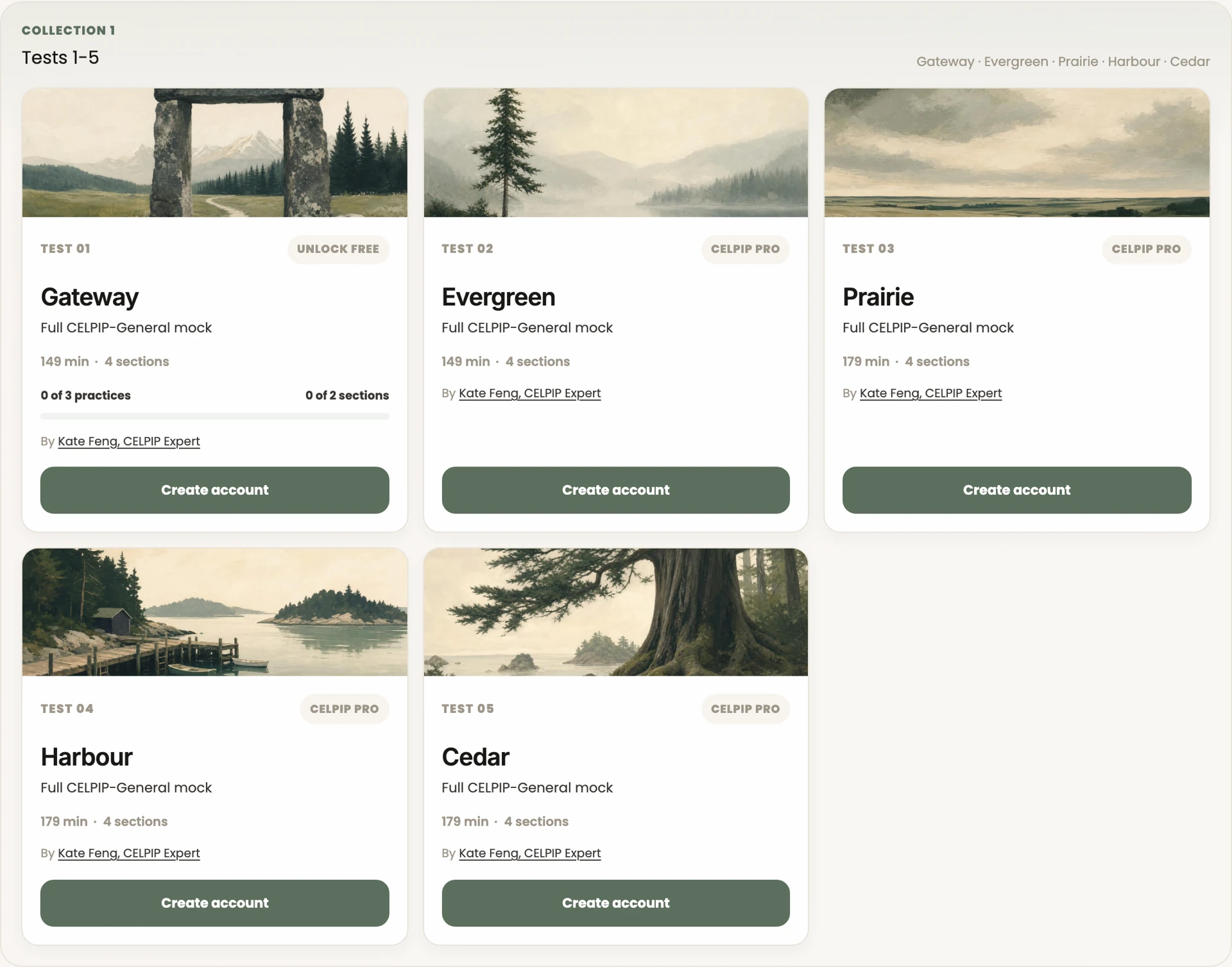 View full-size screenshot
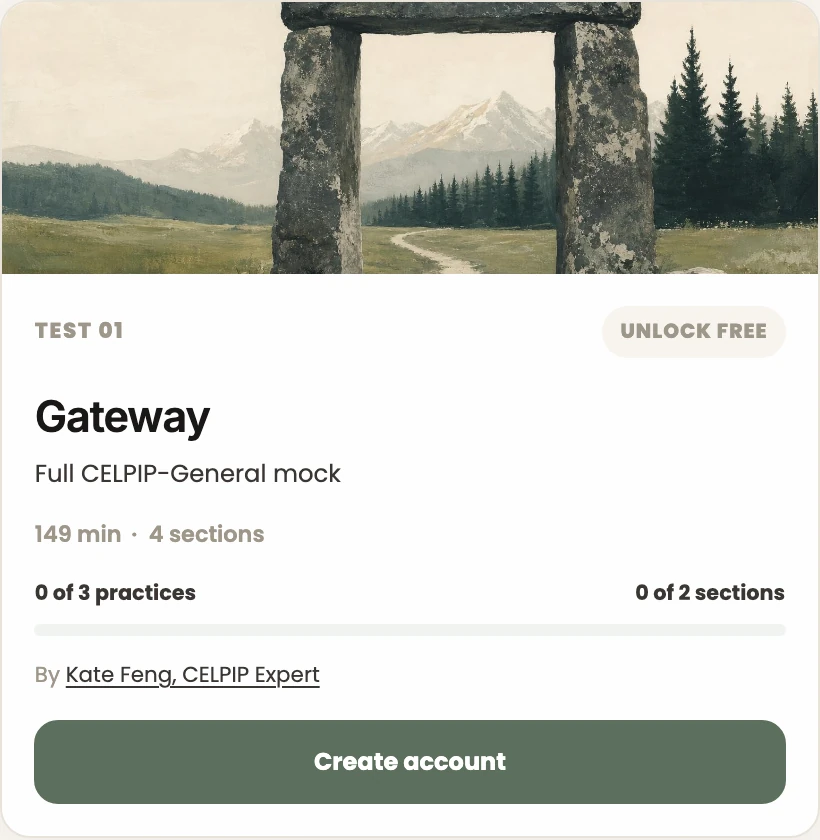 View full-size screenshot
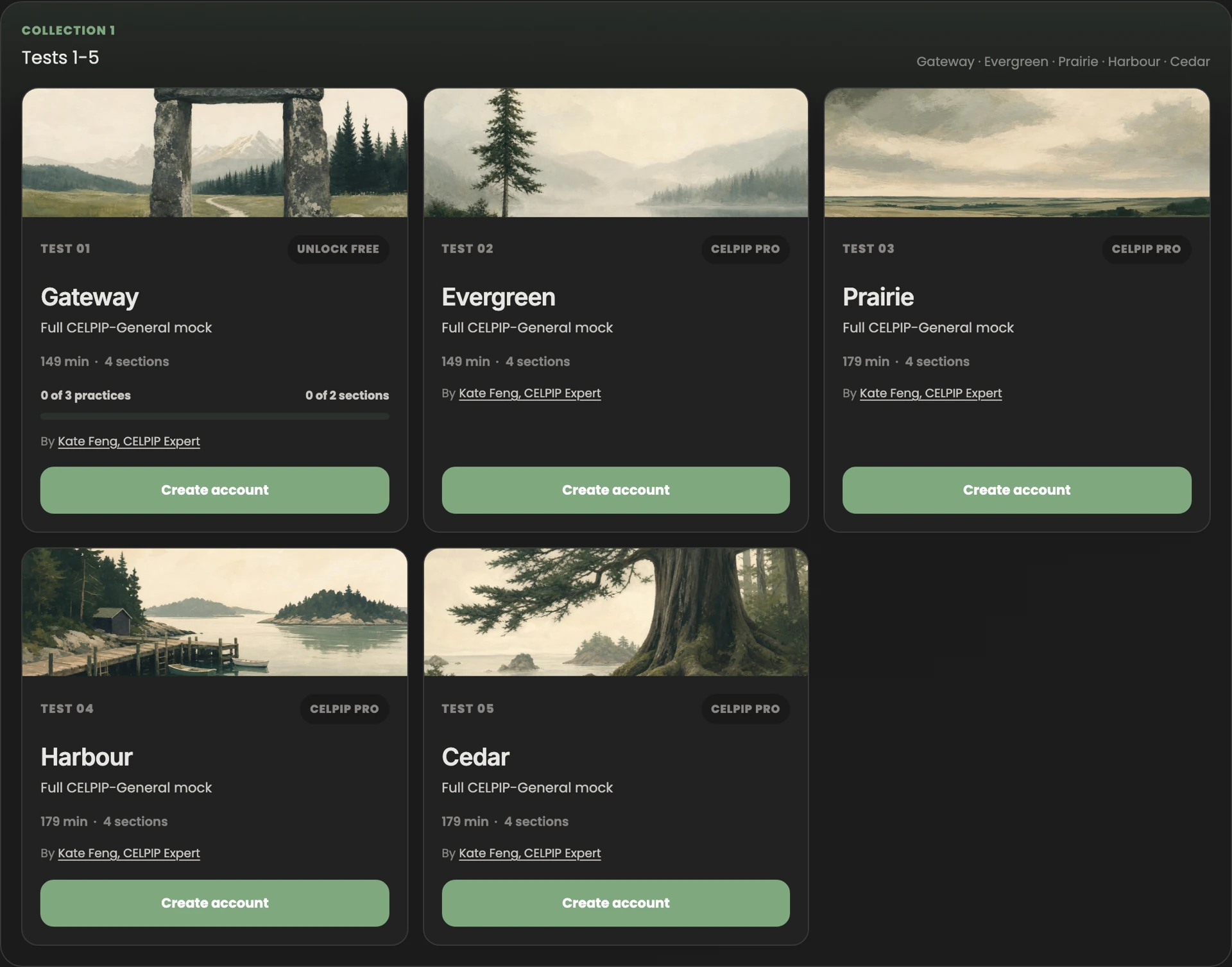 View full-size screenshot
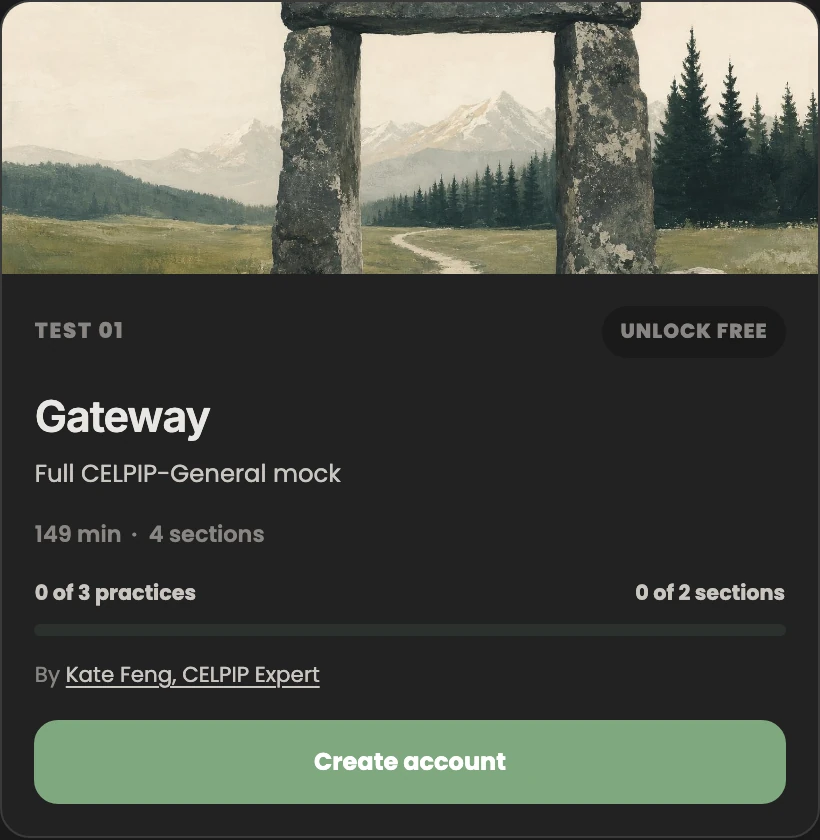 View full-size screenshot
Product demo · Captured November 17, 2026 · No learner information shown
Keep exploring
More from the journal