The PrepEx Journal
CELPIP Listening Tips for 9 and 10: How to Get Past 8, With a Miss Budget and Error Log
CELPIP Listening 9 takes roughly 33–35 of 38 correct on CELPIP's approximate chart, so you can miss about three to five questions, and 10 or higher takes about 35–38. The ranges overlap and vary slightly by test form, so aim for 34 or more in practice. Level 8 listeners usually lose their last answers to five traps, often in Parts 5 and 6: the wrong speaker, a reported view or a dropped condition.

On this page
CELPIP Listening 9 takes roughly 33–35 of 38 questions right on CELPIP's approximate chart, and 10 or higher about 35–38; the ranges overlap and vary slightly by test form, so aim for 34 or more in practice. PrepEx's free Listening practice marks every question against an answer key and explains it, so you can see which part and which trap cost each point. Level 8 listeners often lose their last few answers in Parts 5 and 6, to the wrong speaker or a reported view.
See which Listening part and which trap cost you each point
Every PrepEx Listening question is marked against an answer key and explained. A free account gets two graded CELPIP practice sessions a day, and after three graded sessions in at least two sections a full-length CELPIP-General practice test unlocks free, with an overall level estimate.
Facts checked on 27 November 2026 against CELPIP's Test Results, Test Format and Scoring, Test Overview and Policies pages, its Listening Pro Study Pack, its 2025 Data Report, blog and official podcast, IRCC's Comprehensive Ranking System criteria and Australia's Home Affairs English pages. This is general information, not immigration advice.
How many questions can you miss and still get 9 in CELPIP Listening?
About three to five of the 38. CELPIP's approximate chart puts Listening 9 at 33–35 correct and the 10–12 range at 35–38. The ranges overlap, and CELPIP says the raw score needed for a level "may vary slightly from one test to another," so 33 correct could be an 8 on one form and a 9 on another. A computer marks each answer right or wrong, a blank counts as wrong and nothing is deducted for a wrong answer, so answer every question.
| CELPIP level (same CLB) | Correct out of 38 on CELPIP's chart | Misses that range allows | Lowest score clear of the level below |
|---|---|---|---|
| 10–12 | 35–38 | 0–3 | 36 (2 misses) |
| 9 | 33–35 | 3–5 | 34 (4 misses) |
| 8 | 30–33 | 5–8 | 32 (6 misses) |
| 7 | 27–31 | 7–11 | 29 (9 misses) |
The last column is PrepEx's practice target: the lowest score the chart doesn't share with the level below, because a score on a shared boundary can go either way. From an 8, reaching 34 takes one to four more correct answers. Every test also includes some new, unscored questions that look like scored ones, so treat each question as if it counts. Convert a practice score with the CELPIP Listening score calculator, compare both skills on the CELPIP score chart or read how CELPIP is scored.
Is it hard to get 9 in CELPIP Listening?
Less hard than in any other skill: Listening is where a 9 is most common. CELPIP's 2025 Data Report shows 53.2% of CELPIP-General Listening results at 9 or higher and 34.3% at 10 or higher, against 34.9% at 9 or higher in Speaking, 33.0% in Reading and 24.1% in Writing. Level 9 was the most common single Listening result (18.9%), and only 10.8% of Listening results were exactly 8, against 36.1% in Writing.
Fluent speakers still drop marks. In the same report, test takers whose first language is English averaged 8.71 in Listening, below their 9.17 in Speaking. The format is what costs them: one hearing per recording, 30 seconds for each spoken question and wrong options built from words that really are in the audio. If Reading is your lower skill, the CELPIP Reading tips for 9 explain why Reading scores lowest.
For Express Entry, Listening 9 instead of 8 adds 8 core CRS points for a single applicant (31 against 23) and 7 with a spouse (29 against 22), and the top skill-transferability points need CLB 9 in all four abilities. See CLB 9 in CELPIP, CELPIP score for PR and the CELPIP to CLB calculator.
Why CELPIP Listening stalls at 8: five traps
The last few misses before 9 usually come from the same five traps, and they turn up in every part. The CELPIP Listening test guide explains what each part looks like and how to set up basic notes; this page covers what changes between an 8 and a 9.
- The echo: a wrong option repeats words from the recording but attaches them to a different point.
- The dropped idea: a plan is suggested, turned down, then offered back to you as an option.
- The wrong owner: the view is real, but someone else holds it.
- The soft answer: "That's one way to do it" sounds like agreement and isn't.
- The late correction: a detail changes, and both versions stay in your head.
Listening has 38 scored questions in six parts over 46–55 minutes, and each recording plays once.
| Part | Questions | Where points go at level 8 |
|---|---|---|
| 1. Problem Solving | 8 spoken, after three sections | The dropped idea; who suggested what |
| 2. Daily Life Conversation | 5 spoken | The soft answer: feelings, purpose, a polite refusal |
| 3. Listening for Information | 6 spoken | The late correction; steps out of order |
| 4. News Item | 5 written blanks | The echo; a plan reported as decided when it's only proposed |
| 5. Discussion (video) | 8 written | The wrong owner; whose idea the group adopts; implied meaning |
| 6. Viewpoints | 6 written blanks | A reported view taken as the speaker's own; a dropped condition; fatigue |
Parts 5 and 6 hold 14 of the 38 questions, and both ask who thinks what, and why. Test takers stuck at Listening 8 often say Parts 1 to 4 felt fine and the discussion or viewpoints part didn't.
CELPIP Listening tips for 9, part by part
The habits that move an 8 to a 9 are about two checks: whose idea an option is, and whether it still stands at the end of the recording.
Parts 1 to 3: the 30-second spoken questions
- Stop writing when a question starts and catch its verb. "What does she suggest?", "What does she agree to?" and "What is she worried about?" can have three different answers in one conversation.
- In Part 1, box the plan as it stands before the next section plays. Later questions tend to ask about the final plan, and the first idea makes a tempting wrong answer.
- In Part 2, decide what the speaker will actually do. "I'd love to, but my sister's visiting that weekend" is a no, however warm it sounds.
- In Part 3, the last version wins. "Actually," "sorry, I mean" and "that used to be" all mark a change.
- Choose within the 30 seconds and let it go. A doubt carried into the next question costs you that one too.
Part 4: the news item
All four options usually fit the sentence, so choose on meaning and on how certain the report is. A news item keeps what has happened apart from what is planned or only proposed: an option saying the city "will close" the pool is wrong if the report said council "is considering" it.
Part 5: the video discussion
Write each idea under the name of the person who said it, and when a new voice starts, look up long enough to match it to a face. Note concessions: "fair enough" or "I could live with that" can mean a position has moved, and a question can ask whose proposal the group adopts. Try it on the free Part 5 discussion exercise.
Part 6: viewpoints
The longest recording, about three minutes, comes last. For each view, note whose it is and any condition attached ("as long as," "only if"), and star the speaker's own position when you hear "personally" or "my view is." Try it on the free Part 6 viewpoints exercise.
PrepEx example, written for this article and much shorter than a real Part 6 recording
"The library board wants to stay open until 10 p.m. on weeknights. Some staff worry that hardly anyone will come after eight. But when the Northgate branch tried late hours last winter, its study rooms were booked almost every evening. Personally, I'd support the change, as long as the board starts with its two busiest branches."
The speaker thinks the board should ______.
A. keep its current hours because few people come late
B. begin the late hours at its two busiest branches
C. add more study rooms at the Northgate branch
D. repeat last winter's trial at the Northgate branch
The answer is B. "Personally" marks the speaker's own view, and "as long as" adds its condition. A is the staff's worry, which the speaker answers with the Northgate result. C and D reuse "study rooms," "Northgate" and "last winter," but nobody proposes either.
Try the who-said-what habit on a full Listening section. Take a free CELPIP practice test
CELPIP Listening note-taking tips for 9: keep who said what
Notes that get you to 9 put an owner on every line. A list of points without names can't answer "who suggested Sunday?" or "why does Marc disagree?", and Parts 1, 2, 3 and 5 all have two or three speakers. Write names, numbers, changes and reasons, and let everything else go.
PrepEx example: Part 5 notes for a three-person discussion about a park clean-up
Left · Priya: Saturday, more volunteers free → Sunday OK if it rains
Centre · Marc: Sunday, park quieter · likes Priya's sign-up sheet
Right · Dana: unsure → Sunday, if the city lends tools
Decided: Sunday + Priya's sign-up sheet
If a question asks why Marc prefers Sunday, or whose idea the group adopts, the answer is on one line.
The arrow records a change of mind, each condition stays with the person who set it, and the last line records the decision. For ten short recordings with model notes, use the CELPIP Listening note-taking practice.
A CELPIP Listening error log you can copy
CELPIP's own blog on moving from CLB 7 to 9 says more exercises aren't always enough; understanding why you missed a question matters as much. Log every miss for two or three weeks:
| Part | Question type | I chose / the answer was | Why I missed it | Next time |
|---|---|---|---|---|
| Part 6 | Speaker's own view | Staff worry / two busiest branches first | Distractor: chose the staff's view, not the speaker's | Star the speaker's view; test each option against it |
| Part 3 | Detail that changed | 6 p.m. / 6:30 p.m. | Missed detail: kept the first time | Cross out and arrow every correction |
| Part 2 | Attitude | Happy to help / declining | Attitude: heard "I'd love to" as yes | Note what the speaker will actually do |
| Part 1 | Suggestion | Guessed at the last second | Time: still on the previous question | Choose and move on |
| Part 4 | Who is affected | Drivers / cyclists | Vocabulary: didn't recognize "bylaw" | List city and community news words |
Keep to five reasons so they can be counted: vocabulary, missed detail, distractor, attitude and time. After 20 or 30 misses, the biggest group is next week's practice. For distractors, say what the speaker meant before you read the options; for time, drill Parts 1 to 3 at a strict 30 seconds; for vocabulary, keep a list of the words behind each miss. Signed-in PrepEx learners keep a history of every attempt and can review saved mistakes, so you only add the reason column.
How to improve CELPIP Listening from 8 to 9
Spend most of your practice on the part and trap your error log names, then retest on recordings you haven't heard.
- Baseline: all six parts in one sitting, each recording heard once, with a score for each part.
- Drill: two or three sessions a week on the part with the most misses. Answer after one hearing, then replay with the explanation and find the exact line you missed.
- Transfer: retest that part on new recordings. A repeated recording measures memory, which is one reason practice scores can run ahead of real ones; see practice tests vs the real CELPIP test.
- Stamina: once a week, a full section at the time of day you'll test. Part 6 comes last, when you're most tired.
You're ready for 9 when two fresh full sections in a row reach 34 or more. The CELPIP Listening practice page has an exercise for each part and the CELPIP Practice Hub has more; CELPIP Pro adds a level for each skill on every full test, question-level review and a new full-length test every week.
How to get 10 in CELPIP Listening
Getting 10 takes about 35 or more correct, so the whole section allows roughly three misses and the work becomes removing one-off slips.
- Aim for 36 or more on two fresh full sections in a row; 35 is shared with level 9 on the chart.
- Protect Parts 1 to 3. Nineteen of the 38 questions are spoken 30-second items, and a lapse there costs as much as the hardest Part 6 question.
- Listen to longer unscripted talk, such as radio interviews and public meetings, where speakers qualify and correct themselves.
Check whether you need 10 first. For Express Entry, CLB 10 adds 3 core CRS points per ability over CLB 9 (34 against 31 single, 32 against 29 with a spouse), and CLB 11 or 12 add nothing more. Australia's Home Affairs sets CELPIP General Listening 9 for Proficient English and 10 for Superior English. CLB 10 in CELPIP weighs whether the extra level is worth it.
Should you retake CELPIP for a Listening score?
Retake only when fresh practice sections reach your target, because a retake is the whole test: CELPIP's podcast says it doesn't offer single components, and CELPIP recommends more study before a retake. You can request a CELPIP re-evaluation of Listening, but CELPIP says Listening and Reading results are unlikely to change because they're computer rated.
The CELPIP retake policy covers how soon you can book, and results usually arrive within 2–4 business days, though some CELPIP pages say 3–4 (see CELPIP results). If your Listening level dropped, read why a CELPIP score can go down. The CELPIP retake guide weighs a retake against re-evaluation, and stuck at 7 or 8 in CELPIP helps if several skills won't move.
A retake scores all four skills again, so check the others before you book: Reading 8 to 9 worked questions, Writing 8 to 9, Speaking 8 to 9, why memorized templates hold Writing and Speaking down and how to work toward CLB 9 in all four skills.
Drill the parts your log names, then sit a full CELPIP practice test free. Start the free practice test
Listening 9 and 10: your questions
How many questions can I get wrong in CELPIP Listening and still get 9?
About three to five out of 38, because level 9 is roughly 33–35 correct on CELPIP's approximate chart. Keep to four misses or fewer in practice (34 correct), since 33 is shared with level 8 and the line can shift slightly between test forms.
What is 32 out of 38 in CELPIP Listening?
About level 8. On CELPIP's approximate chart, 32 sits in the level 8 range of 30–33 and level 9 starts at about 33, so two more correct answers would give you 34, a safer 9.
What is 31 out of 38 in CELPIP Listening?
Level 7 or 8. On CELPIP's approximate chart, 31 is the top of the level 7 range (27–31) and inside the level 8 range (30–33), and CELPIP says the score needed for a level may vary slightly from one test to another.
How do I get 9 in CELPIP Listening?
Reach 34 or more out of 38 in timed practice on recordings you haven't heard, log every miss by part and reason, and fix the part that costs you most first. PrepEx's free Listening practice explains every answer, and a free account gets two graded practice sessions a day.
How do I get 10 in CELPIP Listening?
Aim for 36 or more out of 38 on two fresh full sections in a row, since 10 or higher is roughly 35–38 correct. At that level the misses are one-off slips, often in the 30-second spoken questions of Parts 1 to 3.
Why is CELPIP Listening so hard?
Each recording plays once, the spoken questions in Parts 1 to 3 give you 30 seconds each, and wrong options reuse words from the audio. Even so, Listening had the highest average of the four skills in CELPIP's 2025 Data Report (8.33).
Which part of CELPIP Listening is the hardest?
CELPIP doesn't publish results by part, but many test takers say their points go in Parts 5 and 6. Together those parts hold 14 of the 38 questions, and both ask you to track several views and whose each one is.
How is CELPIP Listening scored?
A computer marks each scored question right or wrong and converts the number correct out of 38 to a CELPIP level. Blanks count as wrong, and nothing is deducted for a wrong answer.
What are the most common traps in CELPIP Listening?
Five catch most level 8 listeners: an option that echoes words from the recording but means something else, an idea that was suggested and then dropped, a real view given to the wrong speaker, a polite reply that sounds like agreement but isn't, and a detail corrected later in the recording. Most of them come down to whose idea an option is and whether it still stands at the end.
How can I find which Listening part is holding me at 8?
Score each part separately and log every miss with a reason; after 20 or 30 misses, one or two parts usually stand out. On PrepEx, Listening practice explains every answer, and signed-in learners keep a history of every attempt and can review saved mistakes.
Sources we checked
- CELPIP: Test Results — the approximate Listening chart out of 38 and its "may vary slightly" caveat; computer scoring with blanks marked wrong; new unscored items in every test; many test forms; Listening and Reading re-evaluations unlikely to change; results in 2–4 business days
- CELPIP: Test Format and Scoring — Listening takes 46–55 minutes
- CELPIP Listening Pro Study Pack 2026 — the six parts and their question counts; spoken questions with 30 seconds each in Parts 1–3; Part 1 in three sections; written questions in Parts 4–6; the Part 5 video discussion; Part 6 at about three minutes; each recording plays once
- CELPIP: Test Overview — results within 3–4 business days in this page's wording
- CELPIP 2025 Data Report — 2025 level shares and averages by skill, English-first-language averages, and no points deducted for wrong answers
- CELPIP: Policies and Forms — Listening and Reading re-evaluation unlikely to change scores; CELPIP recommends more study before a retake
- The Official CELPIP Podcast, Episode 25 — no single components of the test; a retake is the entire test
- CELPIP blog: From CLB Level 7 to Level 9 — more exercises aren't always enough; understanding why you missed a question matters as much
- IRCC: Comprehensive Ranking System criteria — core points per ability at CLB 8, 9 and 10 or more; skill-transferability points for CLB 9 in all four abilities
- Home Affairs: Proficient English — CELPIP General at least 9 in Listening
- Home Affairs: Superior English — CELPIP General at least 10 in Listening
See the practice experience.
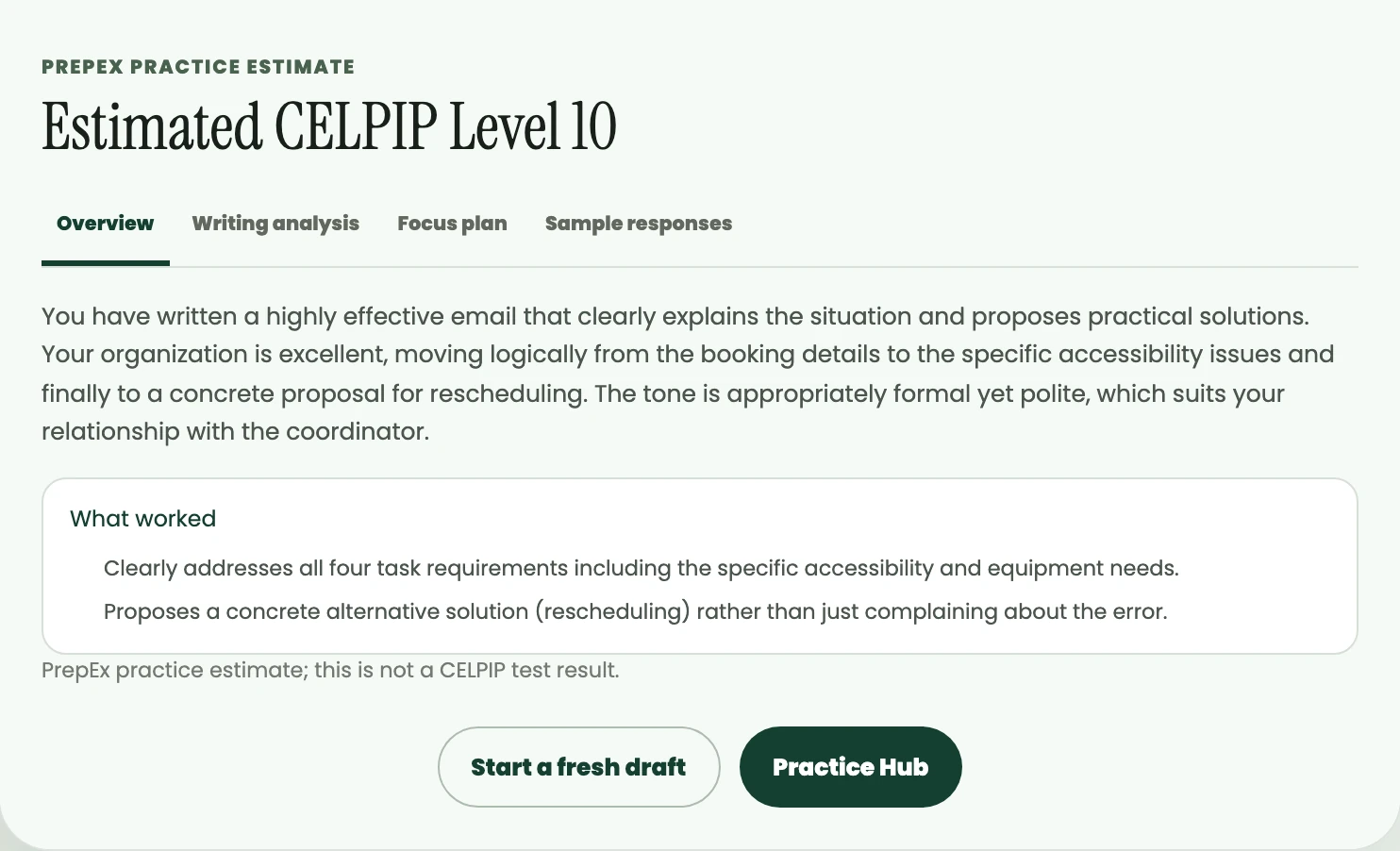
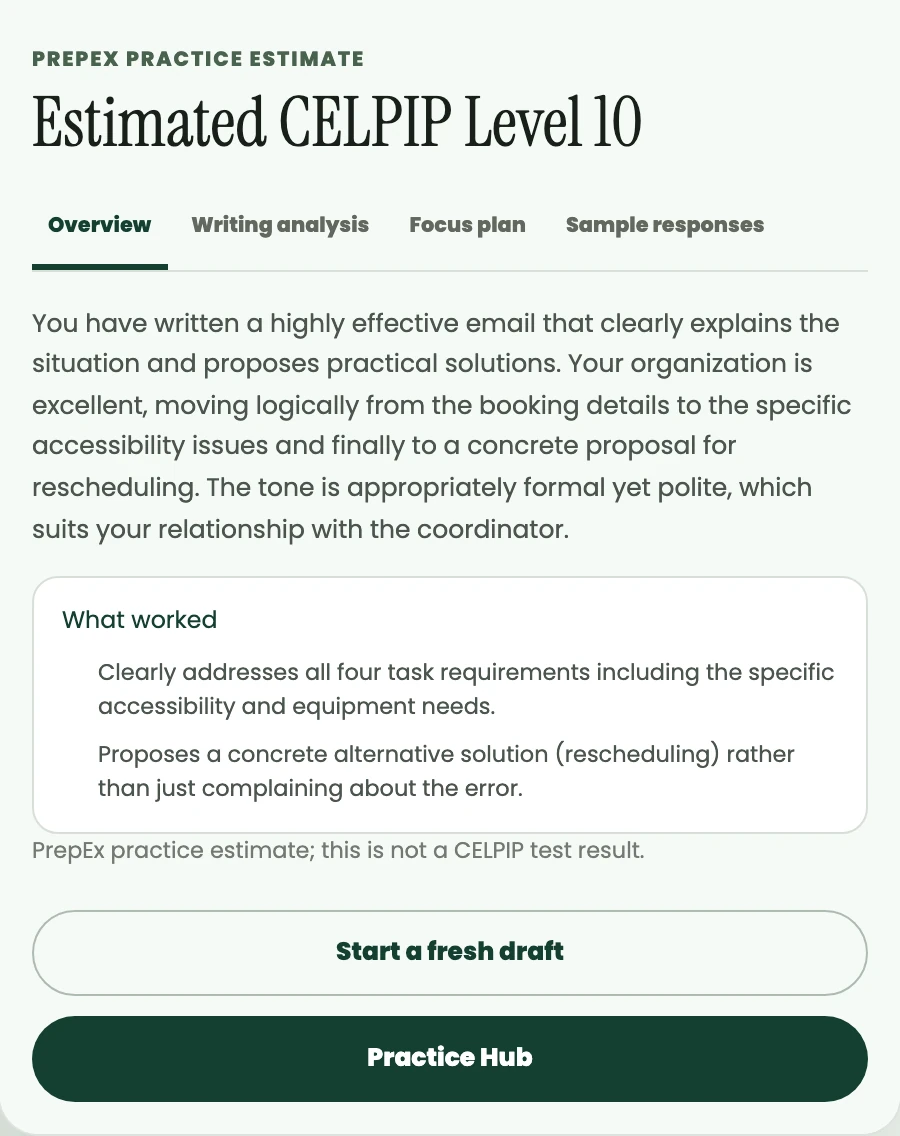
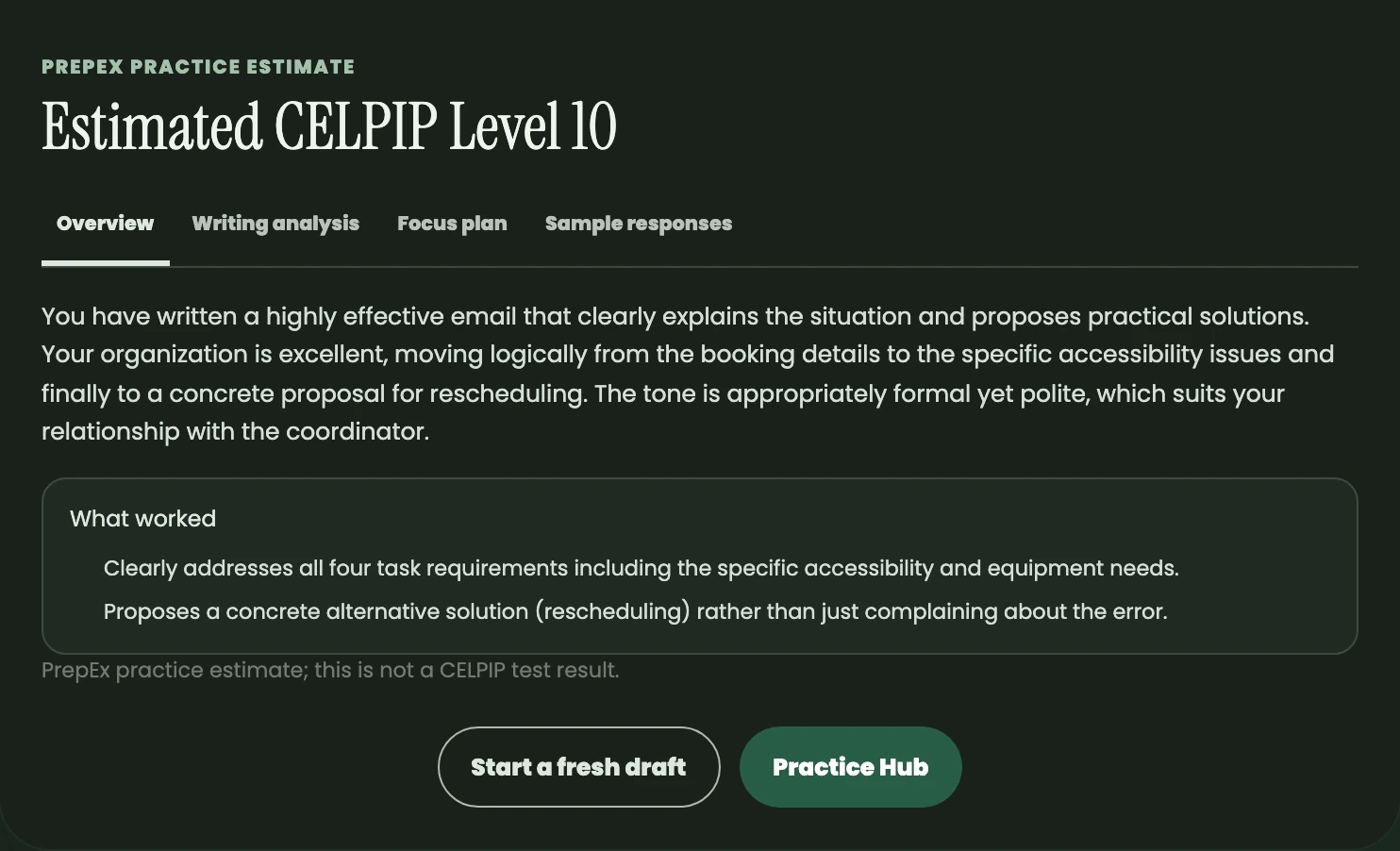
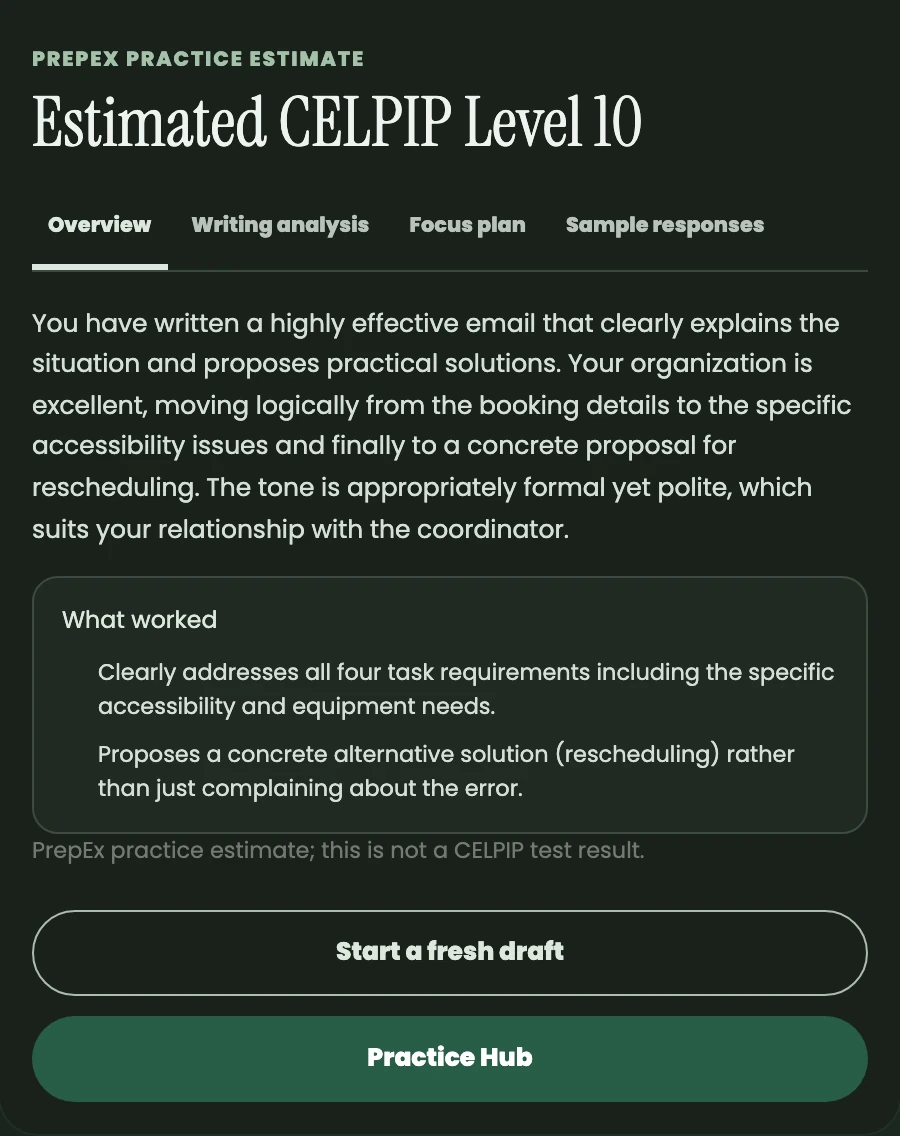
Real PrepEx screens with a fictional answer written for this product demo and the feedback PrepEx returned. Open a view, then select its image to read it at full size.
Complete a practice taskWrite an email with the prompt, timer and word count beside you.
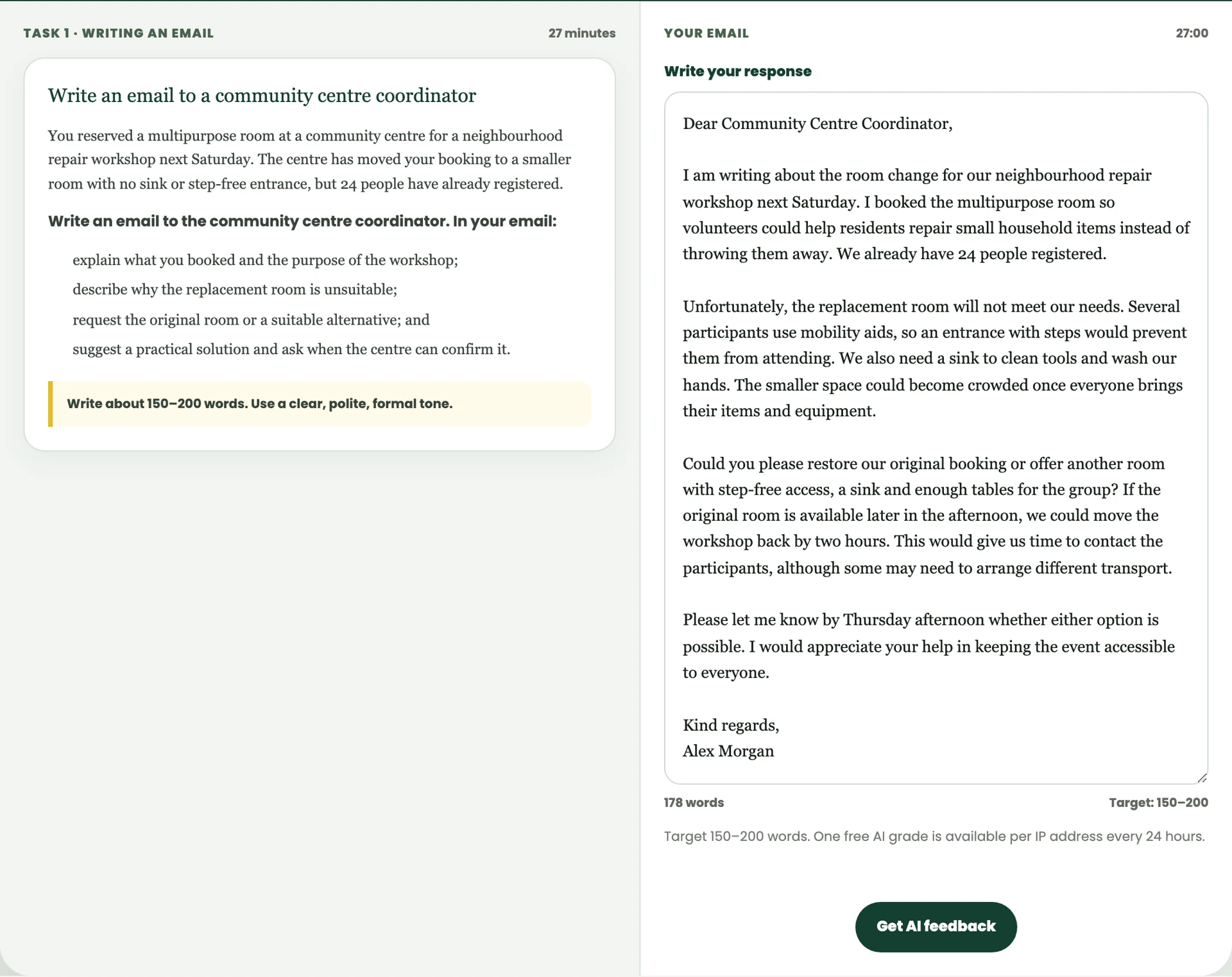 View full-size screenshot
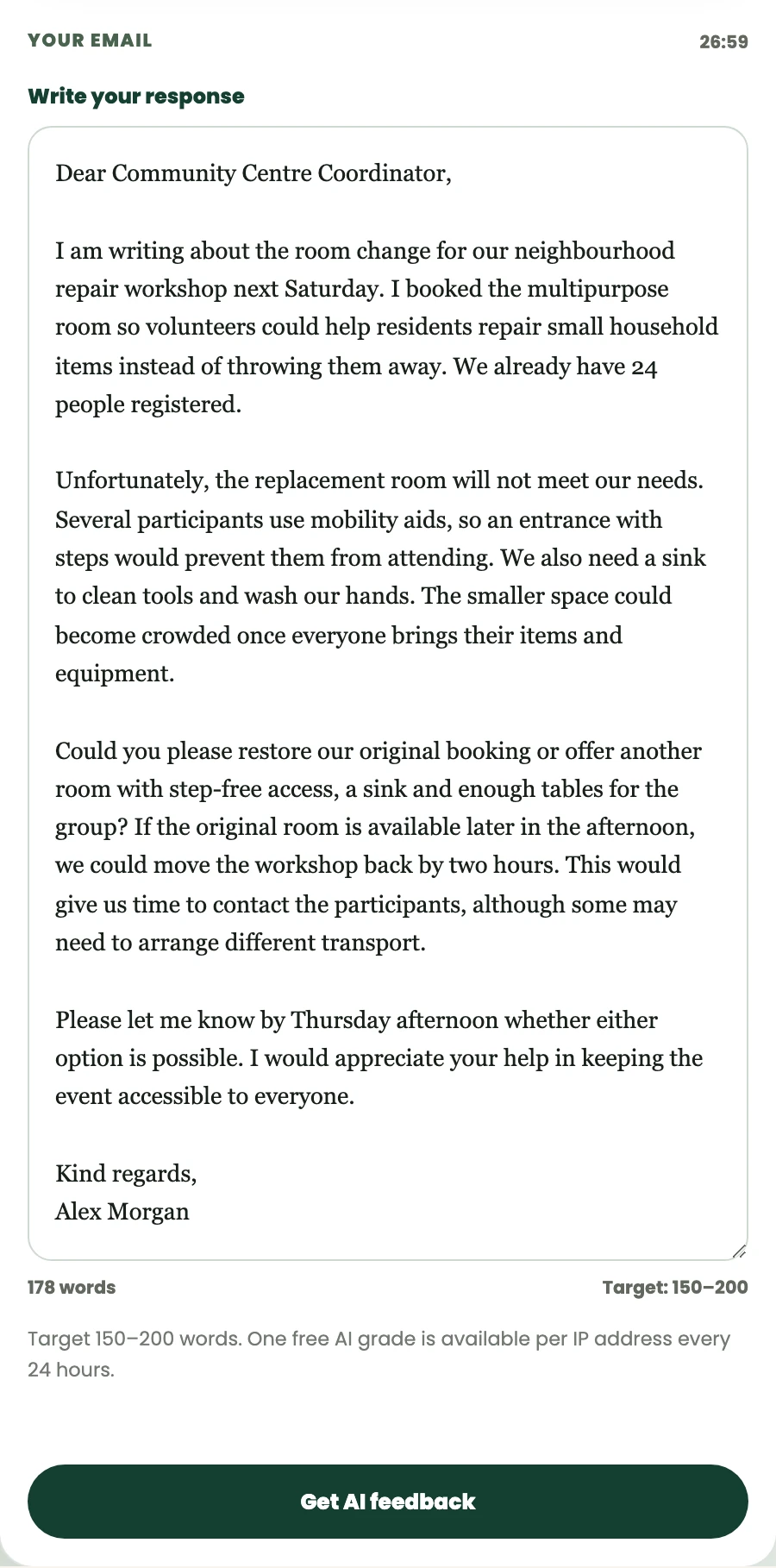 View full-size screenshot
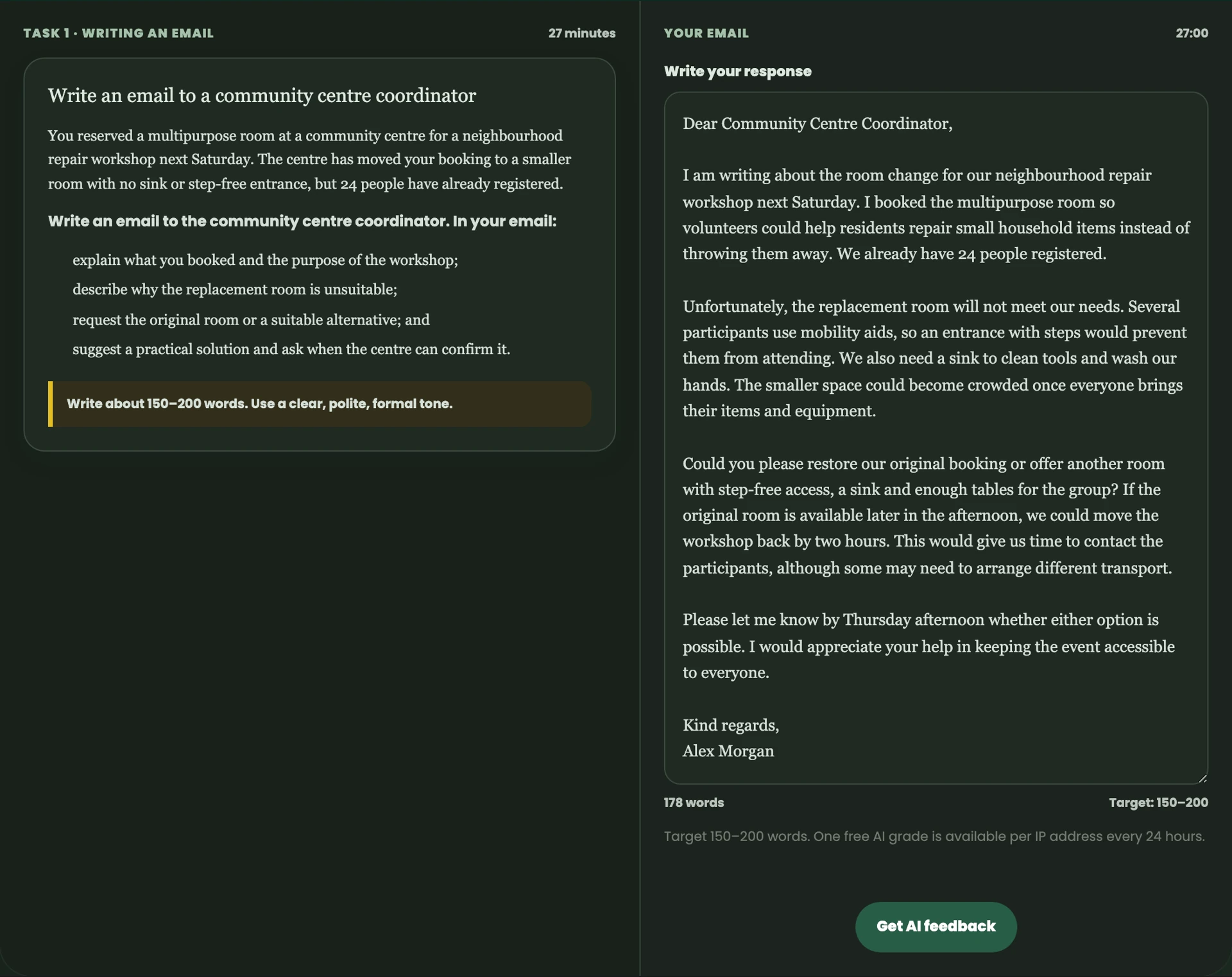 View full-size screenshot
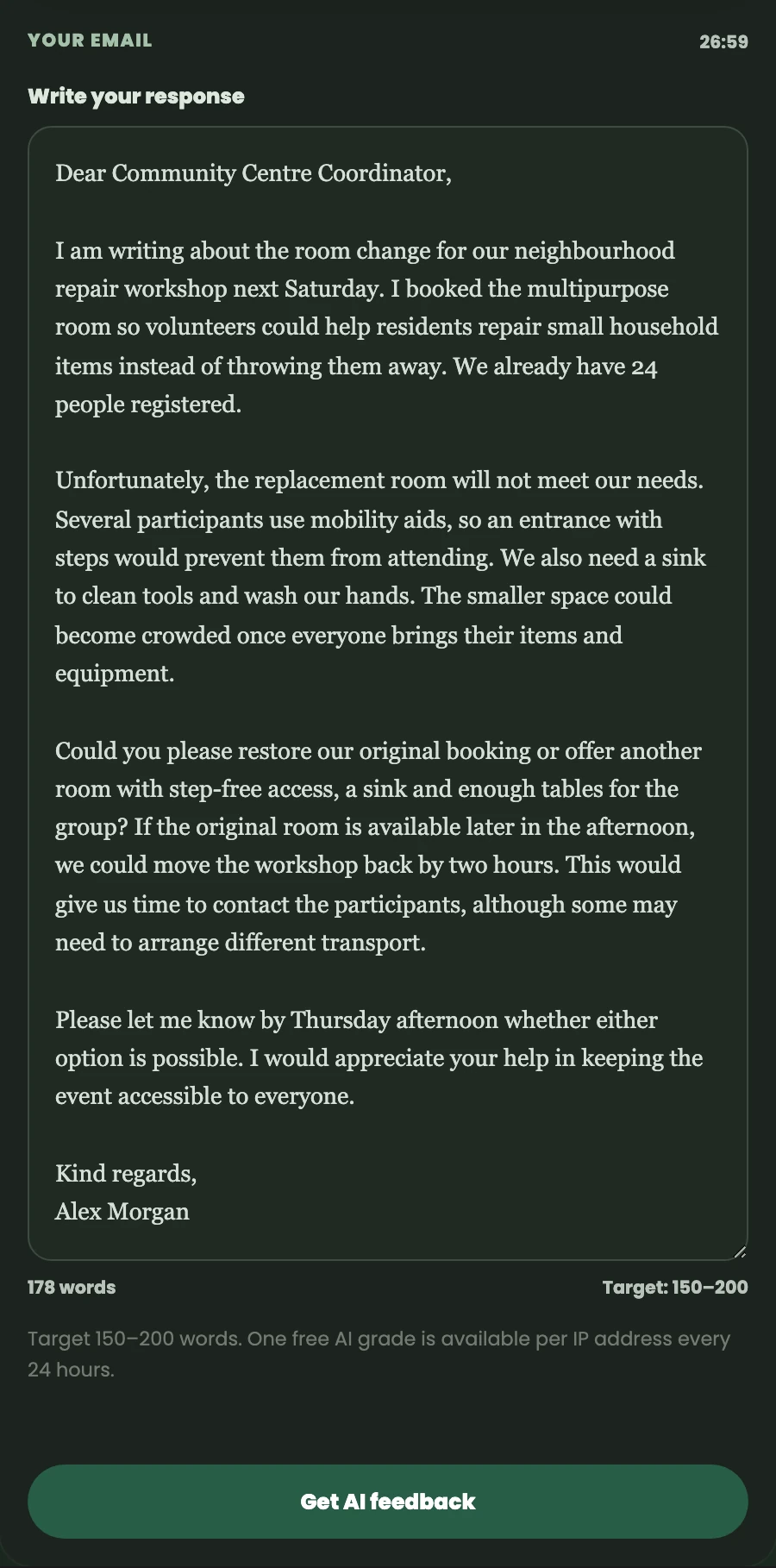 View full-size screenshot
Read your feedbackSee the practice estimate and what worked in your response.
 View full-size screenshot
 View full-size screenshot
 View full-size screenshot
 View full-size screenshot
Find your next improvementExplore evidence and next steps across all four Writing criteria.
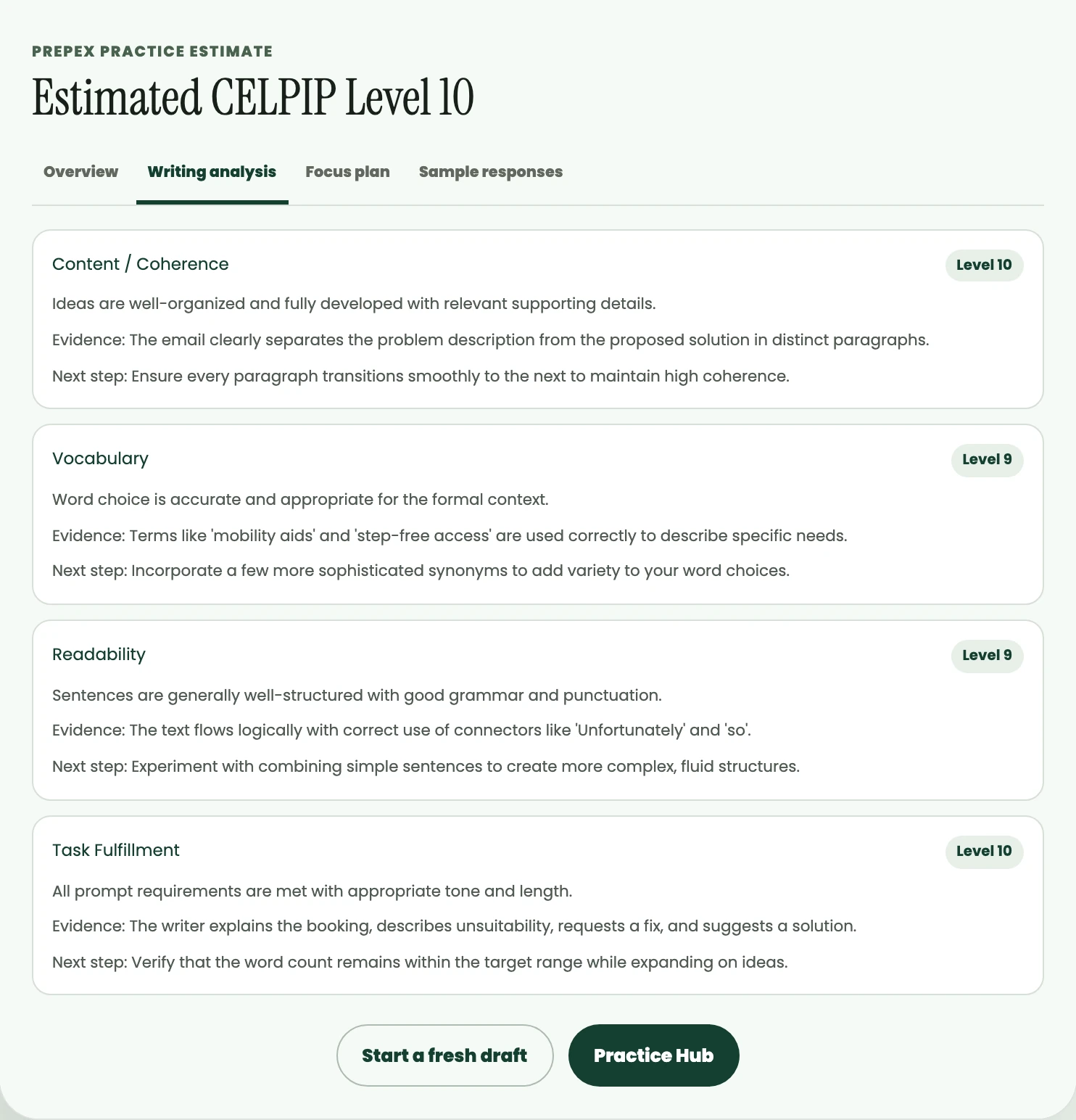 View full-size screenshot
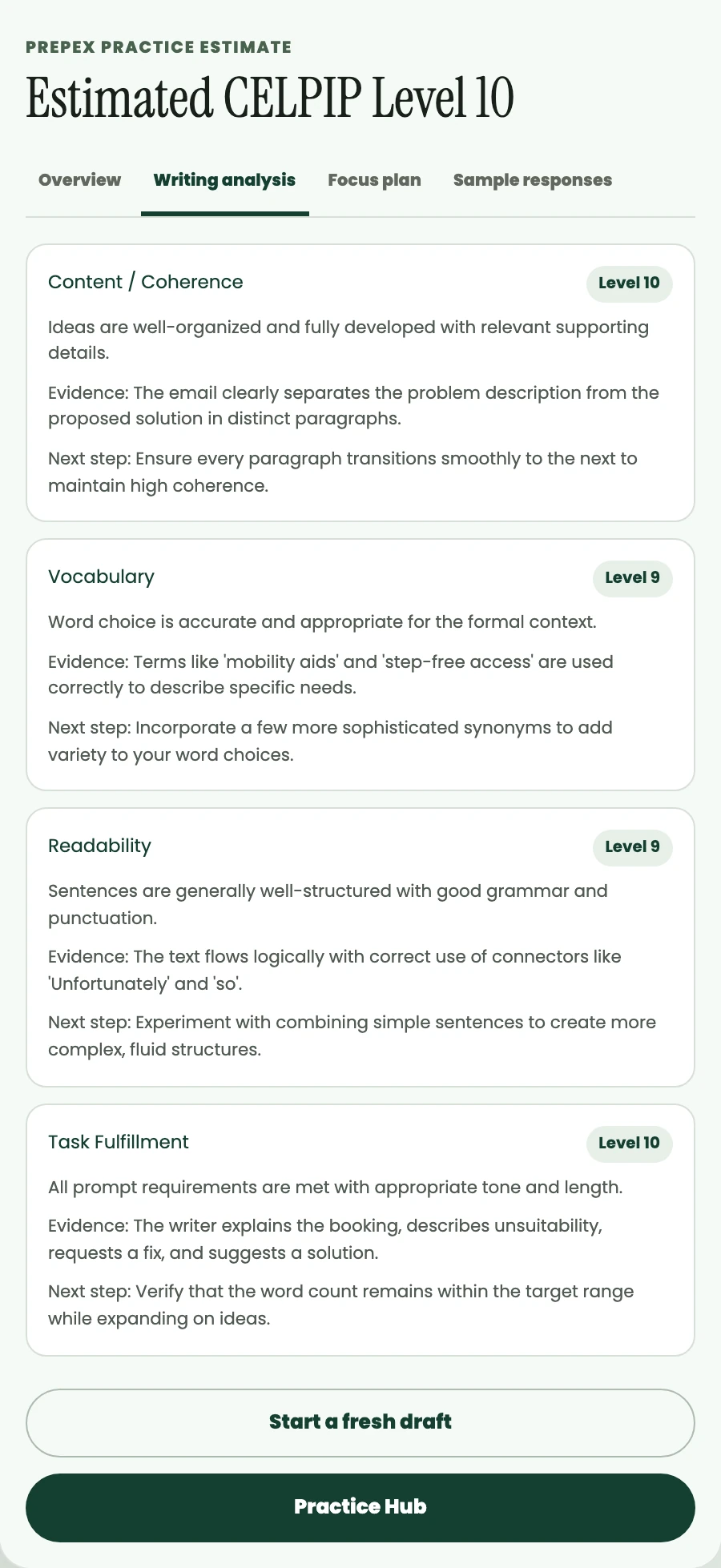 View full-size screenshot
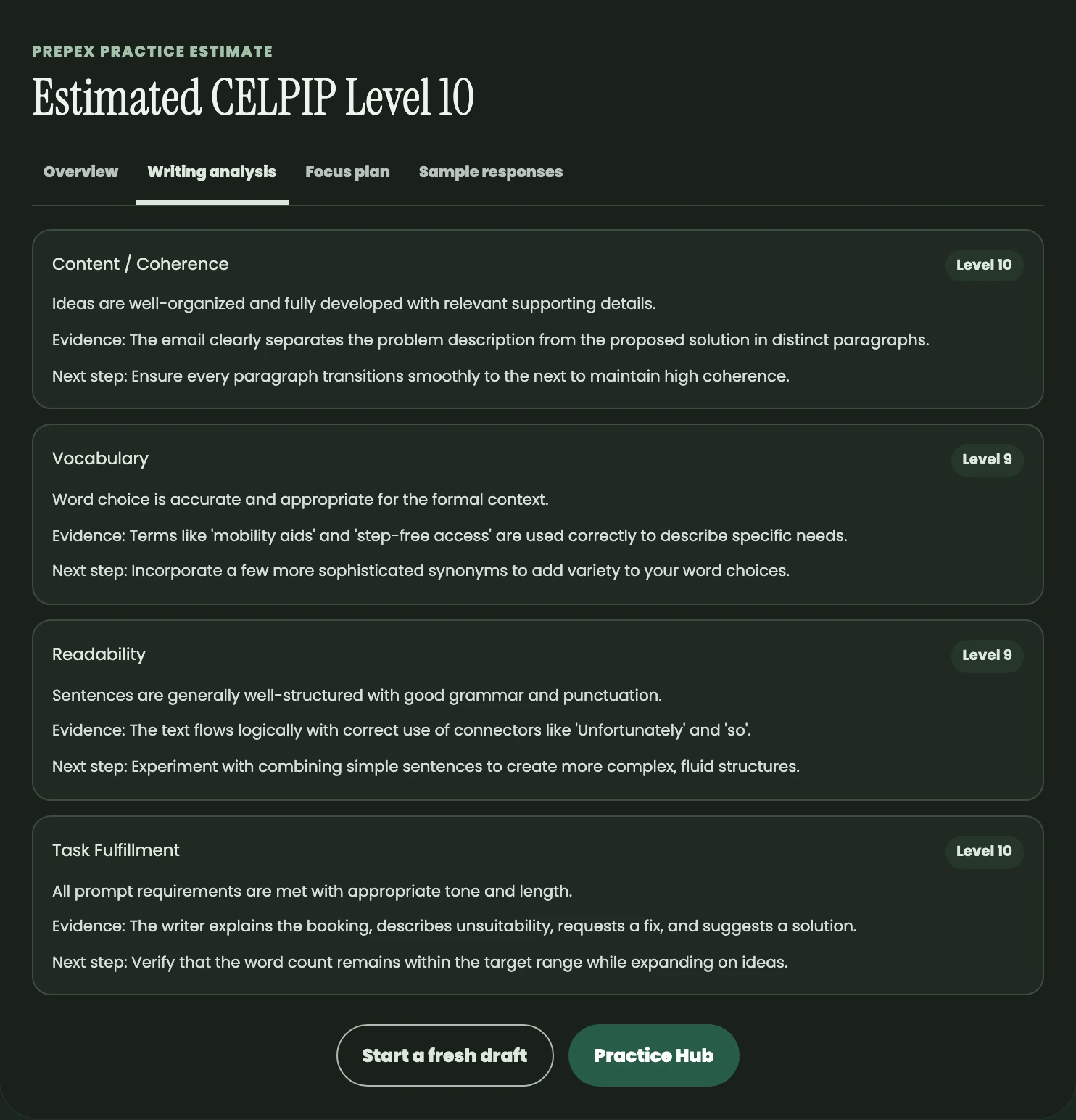 View full-size screenshot
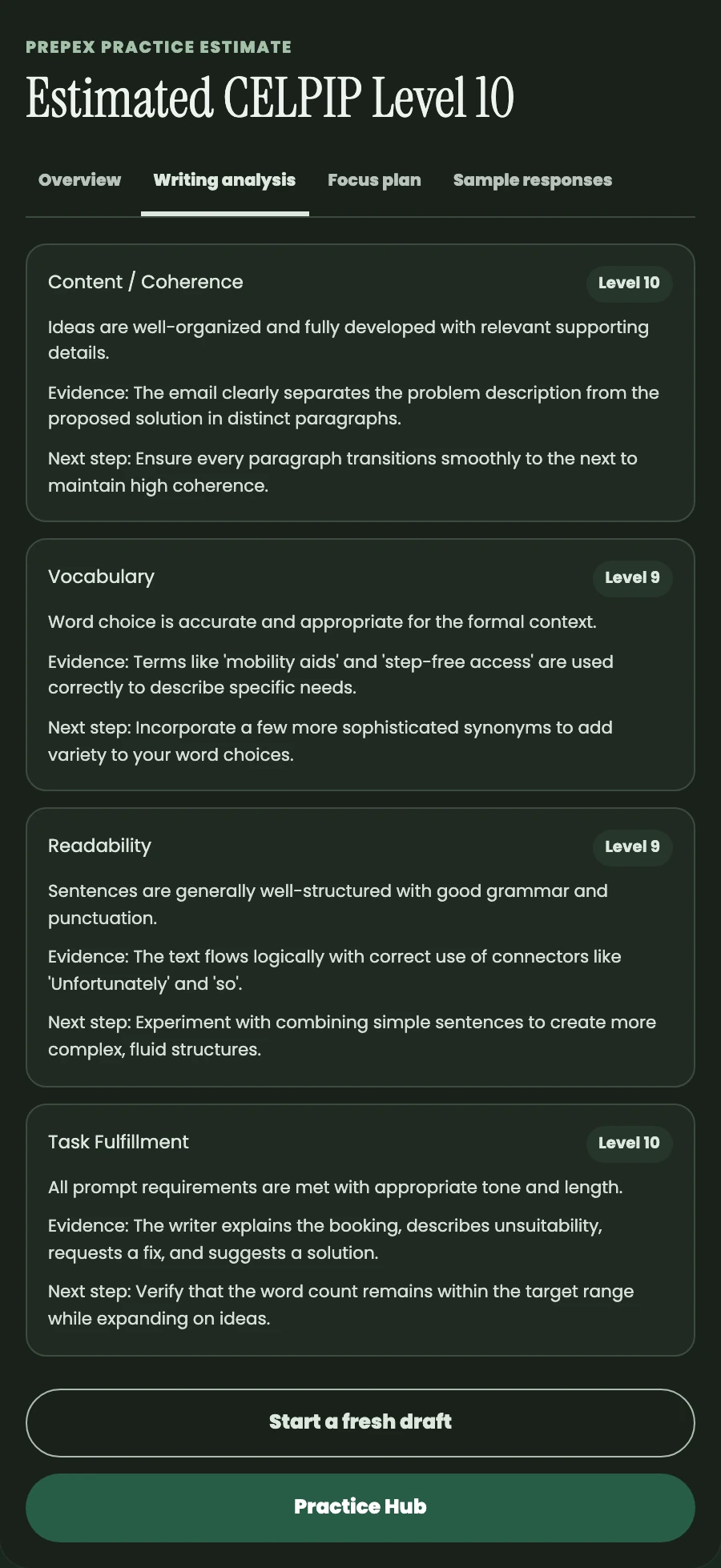 View full-size screenshot
Browse the mock testsChoose a full CELPIP-General mock and check its access label.
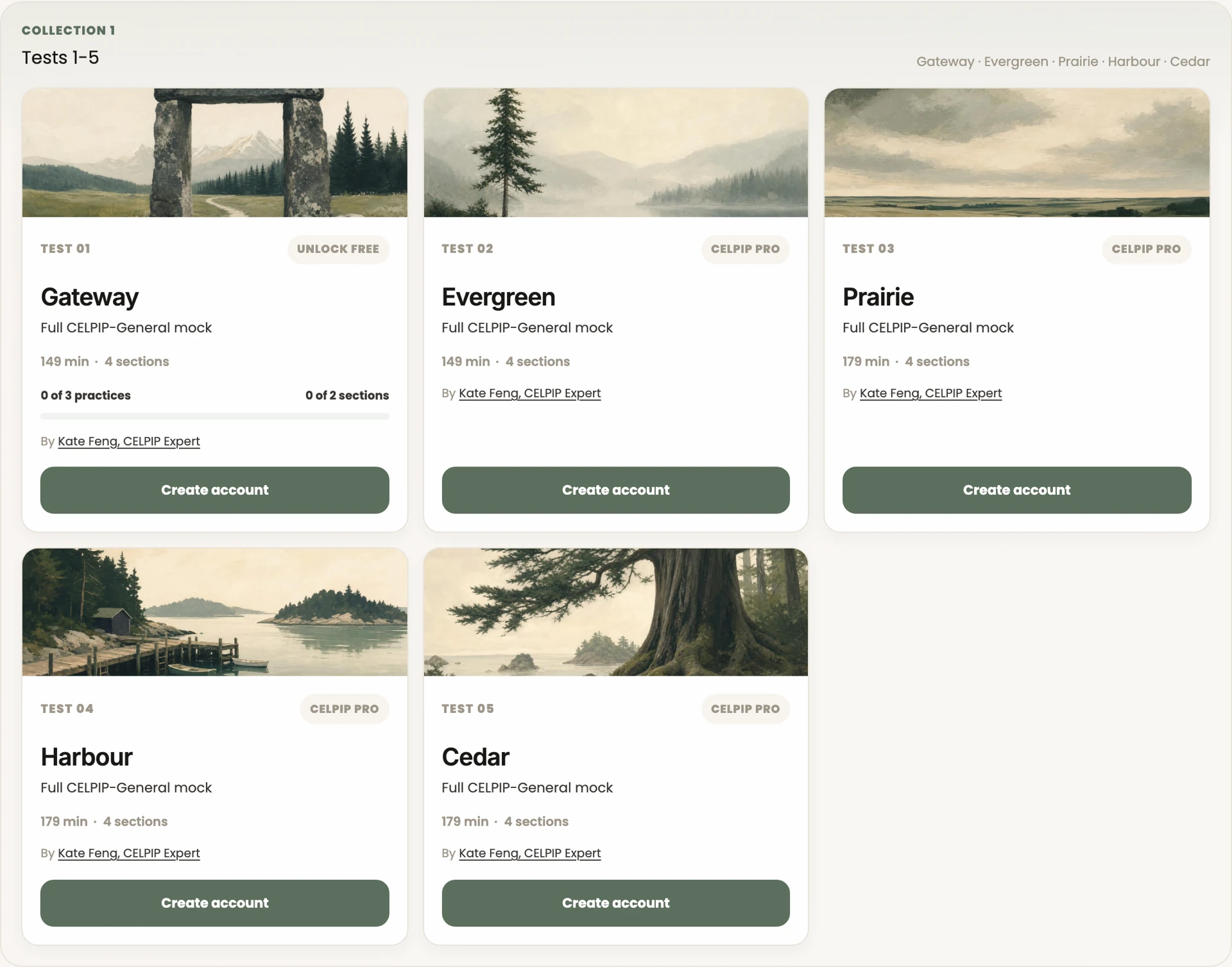 View full-size screenshot
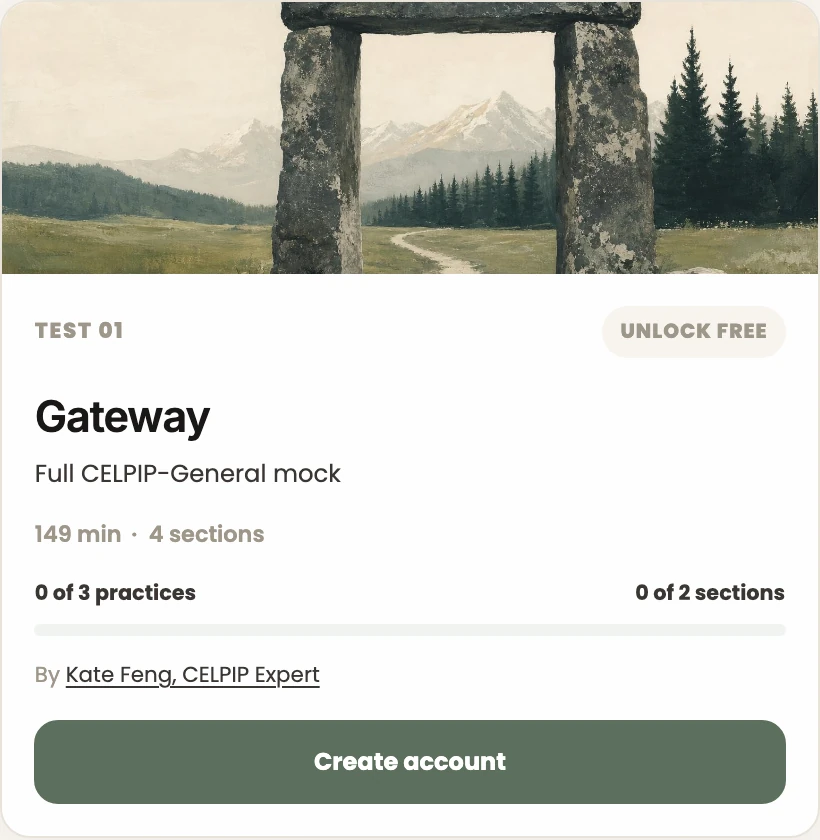 View full-size screenshot
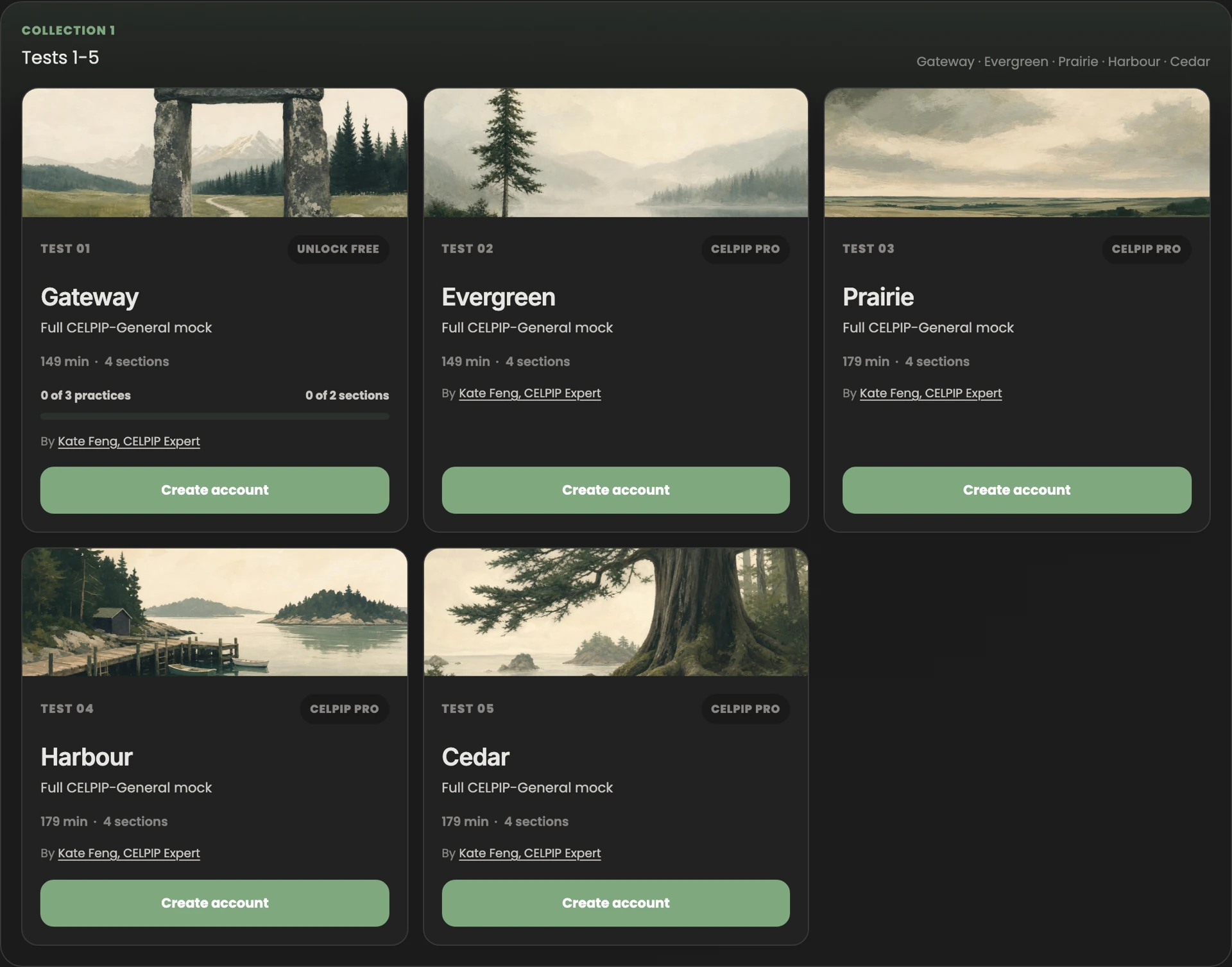 View full-size screenshot
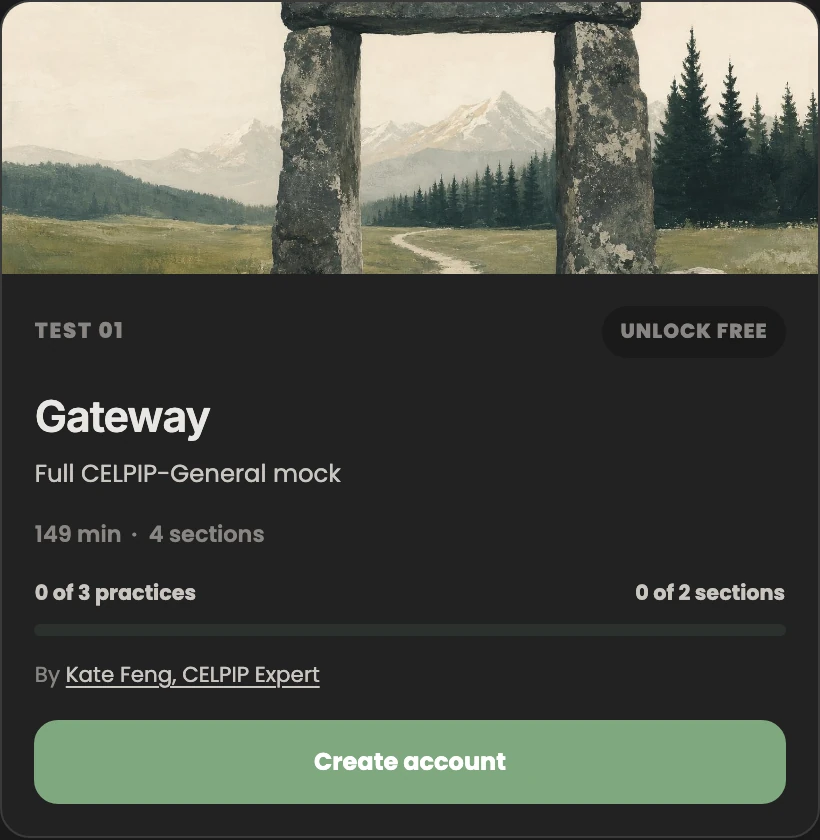 View full-size screenshot
Product demo · Captured November 17, 2026 · No learner information shown
Keep exploring
More from the journal