The PrepEx Journal
CELPIP Speaking Tips: How to Get 9, Task by Task
To move CELPIP Speaking from 8 to 9, support every idea with a reason and a specific example, speak to the person the task names in a tone that suits them, and keep delivery steady with few restarts; accent isn't assessed. Level 8 was the most common Speaking result in CELPIP's 2025 Data Report (24.4%), and 34.9% of results were 9 or higher.

On this page
To move CELPIP Speaking from 8 to 9, support every idea with a reason and a specific example, speak to the person the task names in a tone that suits them, and keep your delivery steady with few restarts or long pauses; your accent isn't assessed. Level 8 was the most common Speaking result in CELPIP's 2025 Data Report (24.4%), and 34.9% of results were 9 or higher. PrepEx grades one recorded Speaking task a day free with no account, with a practice level estimate and feedback on Listenability and the other three rating dimensions.
See which Speaking dimension is keeping you at 8
Record a CELPIP Speaking task with the real preparation and speaking times: one free AI grade a day, no account needed. The feedback covers Content/Coherence, Vocabulary, Listenability and Task Fulfillment, and names what to work on first.
Facts checked on 27 November 2026 against CELPIP's results, Test Day, policies and FAQ pages, Level Descriptors, 2025 Data Report, Speaking study pack, blog and podcast, and IRCC's CRS criteria. The sample prompt and answers are original PrepEx examples. This is general information, not immigration advice.
What separates 8, 9 and 10 in CELPIP Speaking?
Three to five trained raters score your Speaking independently on four dimensions: Content/Coherence, Vocabulary, Listenability and Task Fulfillment. Their ratings become one CELPIP level, and from 3 to 12 that level is the same-numbered CLB.
| Dimension | Level 8 | Level 9 | Level 10 |
|---|---|---|---|
| Content/Coherence | Concrete and some abstract information, supported with moderately complex reasons | Information and ideas supported with moderately complex reasons | Ideas developed with clear descriptions or reasons, in moderately demanding non-routine situations |
| Vocabulary | Common words and some context-specific vocabulary | Common and context-specific vocabulary | A range of concrete and abstract language |
| Listenability | Some control of complex grammar; mostly fluent; very few self-corrections, repetitions or inappropriate pauses | Some control of complex grammar; mostly fluent | Good control of a broad range of complex grammatical structures |
| Task Fulfillment | Style and tone adjusted to some audiences and situations | Adjusted to a range of audiences and situations, including peers and authority figures | Adjusted to a broad range of audiences |
The delivery wording for 8 and 9 is almost identical. The step to 9 sits in the other rows: reasons behind every idea, the vocabulary of the situation, and a tone that fits more kinds of listener, including a manager or a landlord.
In CELPIP's 2025 Data Report, 18.3% of CELPIP-General Speaking results were 7, 24.4% were exactly 8 and 34.9% were 9 or higher. The CELPIP Speaking score chart maps levels to CLB, and CLB 9 in CELPIP covers what 9 is worth. If another skill is stuck too, see how to get 9 in CELPIP when you're stuck at 7 or 8, or the CELPIP Writing tips for the other rated skill.
What each CELPIP Speaking task needs for a 9
The Speaking section has eight tasks and takes about 15 minutes. The task names and times are CELPIP's; the last two columns are PrepEx's notes. The CELPIP Speaking test guide explains the format, and CELPIP Speaking sample answers has full responses for every task.
| Task | Prepare / speak | What often holds it at 8 | What a 9 sounds like |
|---|---|---|---|
| 1. Giving Advice | 30 s / 90 s | Broad tips ("prepare well") with no reason tied to the person's problem | At least three suggestions, as CELPIP's study pack asks, each with a practical reason |
| 2. Talking about a Personal Experience | 30 s / 60 s | A list of events with a lesson added at the end | One event, concrete details, the moment it changed, how it felt |
| 3. Describing a Scene | 30 s / 60 s | Objects named in random order | A route through the picture, what people are doing, exact nouns and positions, as if the listener can't see it |
| 4. Making Predictions | 30 s / 60 s | Guesses with no clue from the picture | Two or three likely outcomes from the Task 3 picture, each tied to something visible |
| 5. Comparing and Persuading | 60 s choice, then 60 s / 60 s | Praising your choice and dismissing the other person's | Matched comparisons with their option on the facts shown, said to that person, with a clear recommendation |
| 6. Dealing with a Difficult Situation | 60 s / 60 s | Repeated apologies; the decision never stated plainly | The decision early, the reason, their needs acknowledged, a realistic alternative |
| 7. Expressing Opinions | 30 s / 90 s | One reason restated in new words | A clear position, two developed reasons, one counterpoint answered |
| 8. Describing an Unusual Situation | 30 s / 60 s | "It's strange" with no description | Enough detail (size, shape, colour, purpose) that a listener could picture it, then what the prompt asks |
12 CELPIP Speaking tips for getting from 8 to 9
1. Plan in keywords, not sentences
You get pen and notepaper at the test centre. In the preparation time, write your decision and two reasons as four or five words. Full sentences read aloud sound flat.
2. Use the time without running past it
Task Fulfillment includes completeness and length, so stopping at 50 seconds of a 90-second task shows up, and anything you haven't said when the time runs out can't be rated. Practise with the real times until your last sentence lands with a few seconds left.
3. Give each point a reason and an example
Raters look at the number and quality of your ideas and their supporting details. A planning pattern for most tasks is point, reason, example: "I'd take the earlier bus, because the later one often gets in after the doors open. Last month I missed the start twice." Two points like this fill 60 seconds; the 90-second tasks have room for three.
4. Talk to the person the task names
Use their name if the prompt gives one, say "you", and match the tone: warm with a friend, considerate but firm when you refuse someone, polite and direct with a manager. The level 9 descriptor adds speaking with peers or authority figures.
5. Use the words of the situation
Level 8's descriptor says "some context-specific vocabulary"; level 9's drops the "some". With a landlord that means "lease", "notice" and "repair request"; at a gym, "drop-in" and "off-peak". Precise everyday words do this better than rare ones.
6. In Task 5, give the two stages different jobs
The first minute is a silent choice: pick the option you can argue for most concretely and note two or three of its facts. The other person's option only appears in stage 2, so use that preparation minute to compare your choice with theirs on two or three points, such as purpose, time and travel. The option you turned down isn't part of the comparison.
7. Make the picture tasks specific
In Tasks 3 and 8, describe the picture as if your listener can't see it. "A man in a yellow raincoat is lifting a canoe off a car roof" gives them one; "a man is doing something with a boat" doesn't.
8. Cut fillers and restarts
Listenability covers pauses, interjections and self-correction, and the level 8 descriptor already expects very few. Replace "um" with a short silent pause. When a sentence goes wrong, finish it simply instead of starting again.
9. Keep a steady pace
Rushing adds restarts. Pause at the end of an idea, not mid-phrase, and if you keep running out of time, cut a point rather than speed up.
10. Prepare for the test centre
CELPIP's Test Day page says you may hear other test takers while you record, so practise sometimes with background noise. If your headset or microphone fails, tell the test centre staff; CELPIP's policies also say test-day issues must be reported through your CELPIP Account within 24 hours.
11. Record, transcribe and score yourself
CELPIP's own advice is to note one thing you did well and one to improve, then record a revised response and compare the two. Listen once, then transcribe it and use the check below. In the PrepEx CELPIP Practice Hub, signed in, every attempt is saved with its recording, transcript and feedback, so you can compare the same task type week by week.
A one-minute self-check for any Speaking recording
Content/Coherence: Did each point have a reason and a specific example?
Vocabulary: Did you use the words of the situation, or did "good", "nice" and "thing" do the work?
Listenability: How many fillers and restarts? Where did you stop mid-phrase?
Task Fulfillment: Did you do everything asked, speak to the right person in a fitting tone, and finish inside the time?
12. Don't memorize answers
CELPIP's Test Day page says answers that aren't original or spontaneous can lead to a cancelled score, and a memorized opening rarely fits the prompt. Keep the planning patterns, choose the words fresh, and use CELPIP templates only as structures to adapt.
Check one of your own recordings against all four rating dimensions. Grade my answer free
CELPIP Speaking Task 5 example: an 8-style and a 9-style answer
An original PrepEx prompt, with two answers written to show the features that separate an 8 from a 9; CELPIP hasn't scored either. Either option can be argued well; both answers take the cooking class.
PrepEx Task 5 prompt, stage 1 (60 seconds, silent choice). Your manager has asked you to choose an activity for your department's team-building afternoon in March. Choose one option.
Option A: a cooking class at a community kitchen, a ten-minute walk from the office, 1:00 to 3:30 p.m. Small groups each cook one course of a three-course meal, then everyone eats together. Dietary needs are arranged in advance.
Option B: an escape room downtown, a 30-minute subway ride away, 2:00 to 3:00 p.m. Teams of five solve puzzles against the clock.
Stage 2 (60 seconds to prepare, 60 seconds to speak). Suppose you chose the cooking class. Your manager, Priya, has found another option she prefers: a guest speaker on managing stress at work, in the office boardroom from 1:30 to 2:30 p.m., with coffee afterward. Persuade Priya that your choice is better.
8-style answer (97 words, about 45 seconds)
"Hi Priya. I know you like the guest speaker idea, but I think the cooking class is better for our team. First, the cooking class is more fun. Everybody can work together and talk, so it's good for team building. With the speaker, we just sit and listen for one hour, and some people might get bored. Second, the kitchen is close to the office, so it's easy to go there. Also, after the class we can eat together, which is really nice. So I think the cooking class is better, and I hope you agree with me."
9-style answer (128 words, about 60 seconds)
"Priya, I understand why you like the guest speaker: it's in our own boardroom and takes only an hour. But this afternoon is set aside for team building, and at a talk we'd mostly sit and listen. At the cooking class, each small group cooks one course of the meal, so people have to plan together and share the work. The class runs longer, until three-thirty, but we have the whole afternoon, and the kitchen is just a ten-minute walk away. It also ends with a meal we've made together rather than coffee, and because dietary needs are arranged in advance, nobody's left out. A talk on stress would be useful, but it could fit into any ordinary afternoon. If you agree, I'll book the class this week."
| Dimension | 8-style answer | 9-style answer |
|---|---|---|
| Content/Coherence | Two general reasons ("more fun", "easy to go there"); the travel point actually favours Priya's option, which needs no travel at all | One main argument tied to the afternoon's purpose, backed by how the class works, then time, travel and the meal, each compared with the talk |
| Vocabulary | Fun, good, nice, easy | Set aside for team building, cooks one course, share the work, dietary needs, left out |
| Listenability | Short sentences chained with "so" and "also" | Contrast and cause clauses ("runs longer … but", "because dietary needs are arranged") in sentences short enough to say without restarting |
| Task Fulfillment | Dismisses Priya's option ("some people might get bored") and stops about 15 seconds early | Speaks to Priya as a manager: grants what's good about her option, answers it, uses the minute and ends with a next step she can approve |
A transcript can't show rhythm or pronunciation, so record both answers at your natural pace; the 9-style one should take about a minute. Then try the same moves on PrepEx's Task 5 practice page, which runs the silent choice and the reveal in order. Worked pairs with audio for four other tasks are in CELPIP Speaking 8 to 9: worked audio examples.
How to get from 9 to 10 in CELPIP Speaking
In CELPIP's 2025 Data Report, 20.3% of Speaking results were 10 or higher. The level 10 descriptor adds non-routine situations, a range of concrete and abstract language, good control of a broad range of complex structures and a broad range of audiences. In practice:
- Add the general point. After a concrete reason, say what it shows more widely: "each group depends on the others' courses, which is how our projects work too."
- Answer the other side. In Tasks 5, 6 and 7, name the strongest point against you and answer it.
- Let grammar range come from the content. Conditionals suit Tasks 4 and 5, concession suits Task 7, polite softeners suit Task 6. Forced structures bring restarts.
- Shift register. A friend in Task 1 and a manager in Task 5 should sound different.
For Express Entry, CLB 9 to 10 adds 3 core CRS points per ability (31 to 34 for a single applicant), against 8 for 8 to 9, and CLB 11 and 12 add nothing more. CLB 10 in CELPIP covers when the extra level is worth the effort.
Retake, re-evaluate or practise first?
There's no Speaking-only retake: CELPIP doesn't offer single components of the test, and it can't combine scores from two separate tests (the CELPIP retake policy also covers how soon you can sit again). If one Speaking result came back a level below your usual, CELPIP re-evaluation can be requested within six months of the test date, and what test takers report after re-evaluation shows how often Speaking changes.
If you've had 8 several times, a retake without changes tends to show the raters the same evidence. The CELPIP retake guide covers the decision, and if Speaking fell rather than stalled, read why a CELPIP score can go down. A free PrepEx account also opens one full-length CELPIP practice test, with an overall level, after three graded sessions in at least two sections.
Record a fresh Speaking task and see which dimension to fix first. Record a task free
CELPIP Speaking questions
How do I get CLB 9 in CELPIP Speaking?
You need a CELPIP Speaking level of 9, because CELPIP levels 3 to 12 equal the same CLB number. In CELPIP's descriptors, the step from 8 to 9 is mainly about supporting every idea with reasons, using the vocabulary of the situation and adjusting your tone to different listeners, including authority figures.
Is it hard to get 9 in CELPIP Speaking?
It's a high bar that about a third of results clear: 34.9% of CELPIP-General Speaking results in CELPIP's 2025 Data Report were 9 or higher, and 8 was the most common level at 24.4%. Test takers whose first language is English averaged 9.17 in Speaking that year.
Is CELPIP Speaking checked by AI?
No CELPIP page says AI scores Speaking. CELPIP's FAQ describes an AI-human hybrid system for Writing, while its results page says each Speaking performance is rated by three to five raters working independently.
Does my accent affect my CELPIP Speaking score?
No. CELPIP says the test does not evaluate your accent. Raters do assess how easy you are to follow under Listenability: rhythm, pronunciation and intonation, pauses and self-corrections, and grammar.
What happens if I run out of time in a CELPIP Speaking task?
Whatever you haven't said when the time ends can't be rated, and Task Fulfillment covers completeness and length, so a point cut off mid-sentence costs more than a short silence at the end. If you often run over, plan one point fewer and practise with the real timer.
Can I take notes in CELPIP Speaking?
Yes. CELPIP gives you pen and notepaper at the test centre. Use the preparation time for a few keywords, such as your decision and two reasons, rather than full sentences you'd end up reading aloud.
Which Speaking dimension should I fix first?
The one that scores lowest across several recordings. Rate a recent recording on each of the four dimensions separately against CELPIP's level descriptors, or use PrepEx's free Speaking task pages, which grade one response a day with no account and give a level and next step for each dimension.
How can I practise CELPIP Speaking at home for free?
Record yourself with the real times and score the playback on the four dimensions. For outside feedback, PrepEx gives one free AI grade a day on its Speaking task pages, and a free account adds two graded practice sessions a day across all four skills.
Sources we checked
- CELPIP: Test Results — three to five independent Speaking raters, the four rating dimensions and their factors, re-evaluation within six months of the test date
- CELPIP blog: CLB Scores and CELPIP Results — CELPIP levels 3 to 12 match the same-numbered CLB level
- CELPIP Level Descriptors (May 2026) — Speaking descriptors for levels 8, 9 and 10
- CELPIP 2025 Data Report — Speaking level shares (24.4% at 8, 18.3% at 7, 34.9% at 9 or higher, 20.3% at 10 or higher), the 7.94 mean and the 9.17 mean for English as a first language
- CELPIP Speaking Pro Target 9 Study Pack (2026) — the eight tasks, their names and timings, Task 5's silent choice and reveal, Task 1's three or more suggestions
- CELPIP: Test Day Information — pen and notepaper, hearing other test takers, and a cancelled score for answers that aren't original or spontaneous
- CELPIP: Policies and Forms — test-day issues reported through the CELPIP Account within 24 hours
- CELPIP: Contact Us and FAQ — AI-human hybrid scoring described for Writing only
- CELPIP blog: Busting CELPIP Myths — the test does not evaluate your accent
- CELPIP blog: From CLB Level 7 to Level 9 — one thing done well and one to improve; record a revised response and compare
- The Official CELPIP Podcast, Episode 25 — no single components; scores from two tests can't be combined
- IRCC: Comprehensive Ranking System criteria — core language points per ability at CLB 8, 9 and 10 or more
See the practice experience.
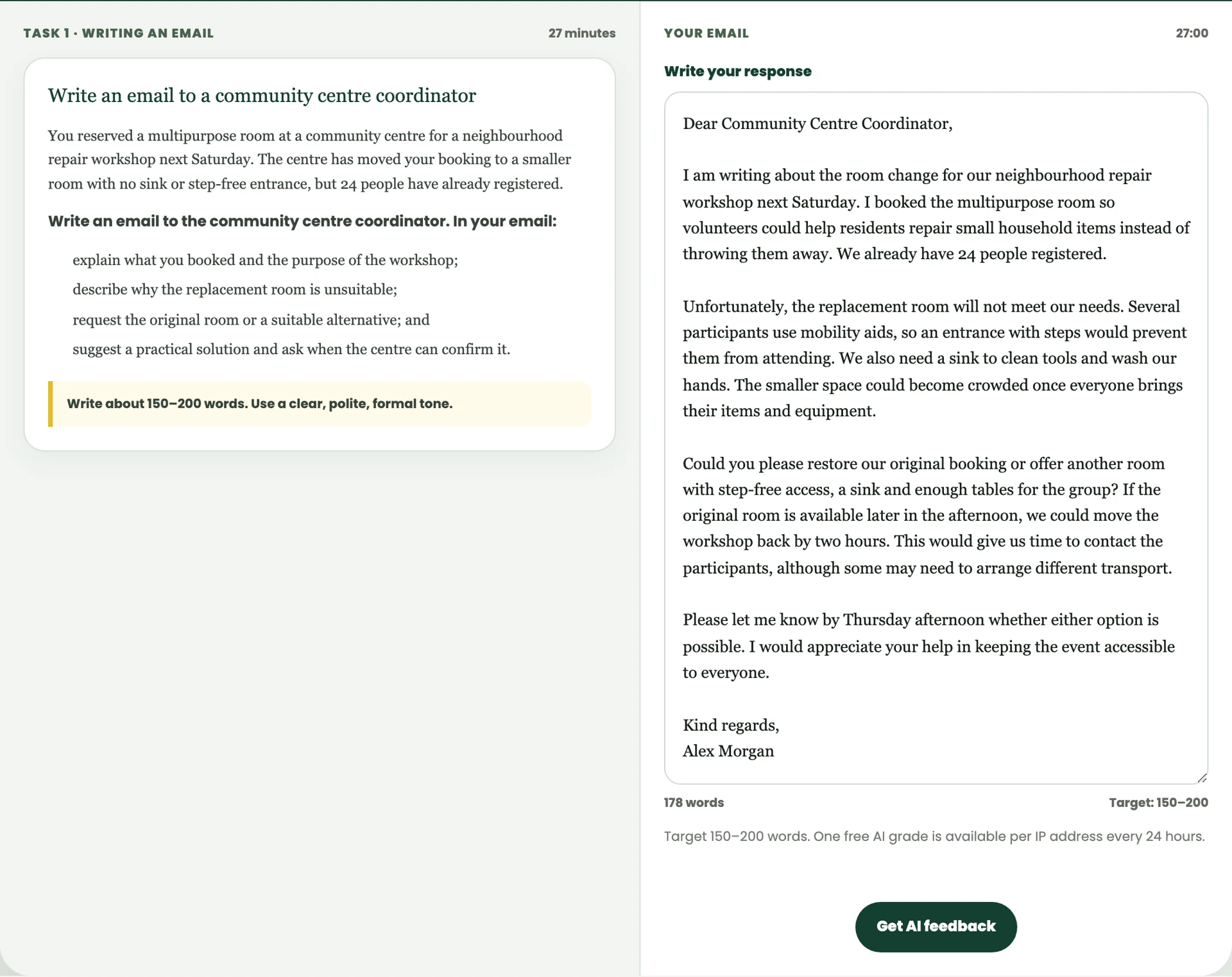
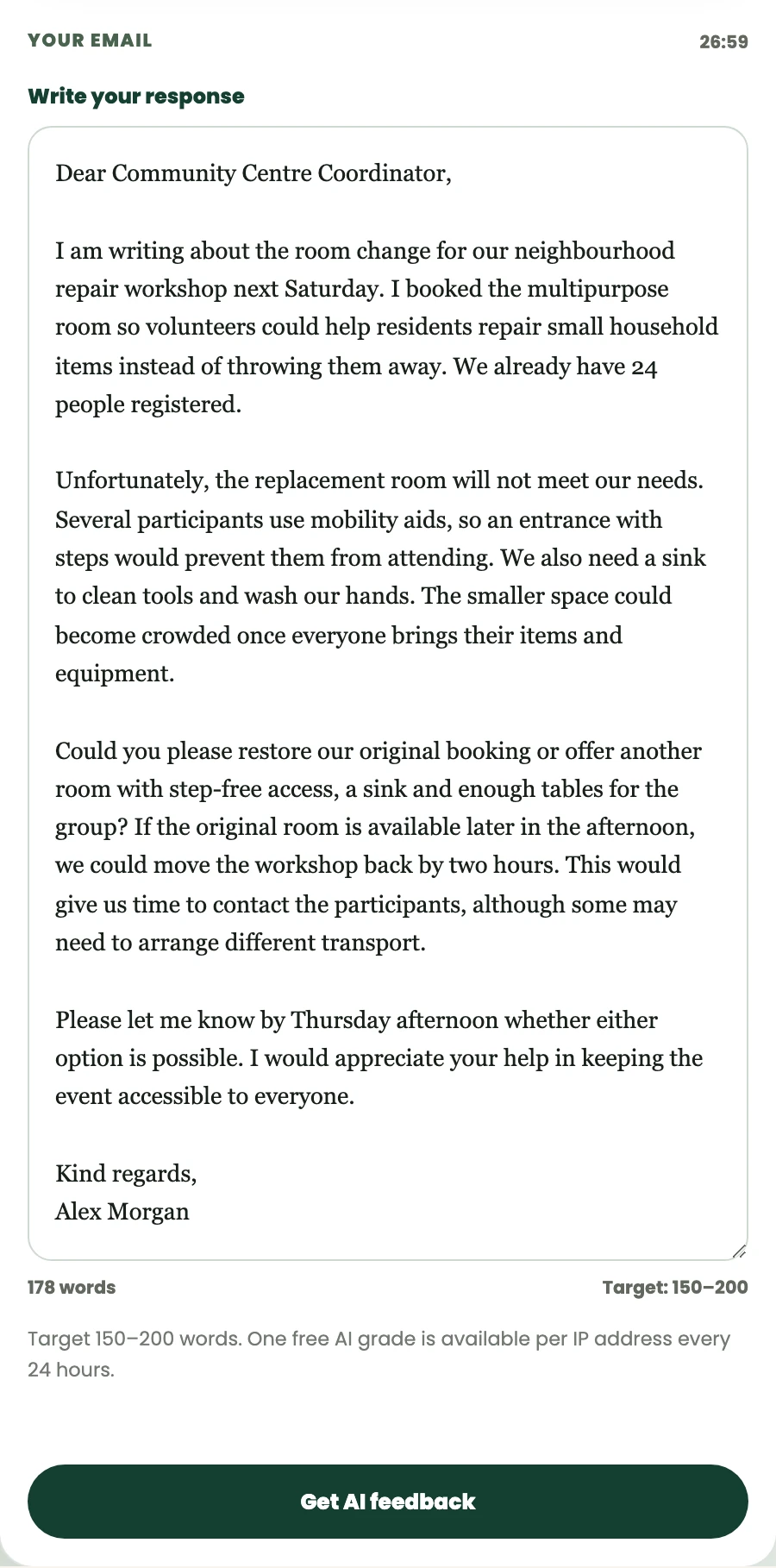
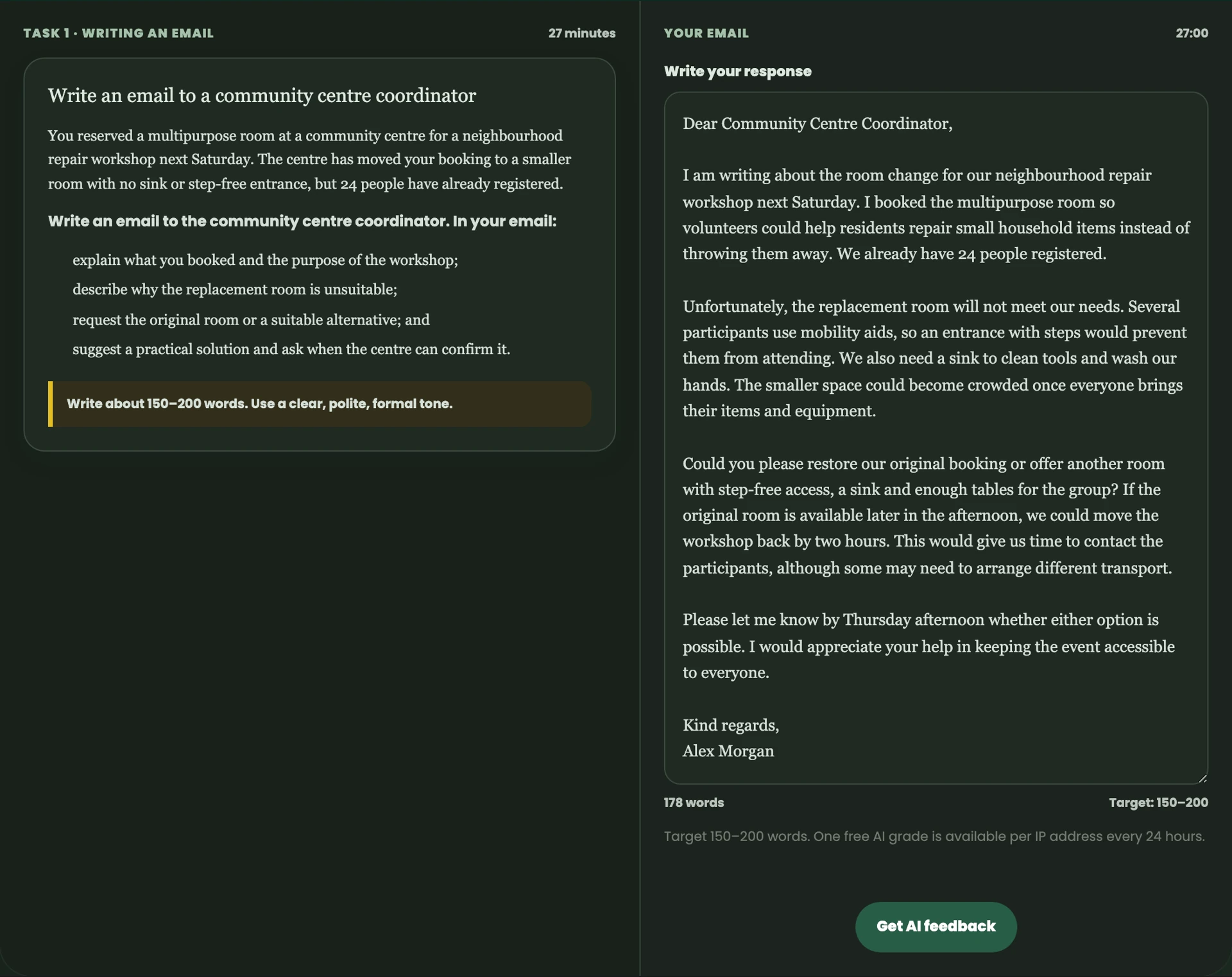
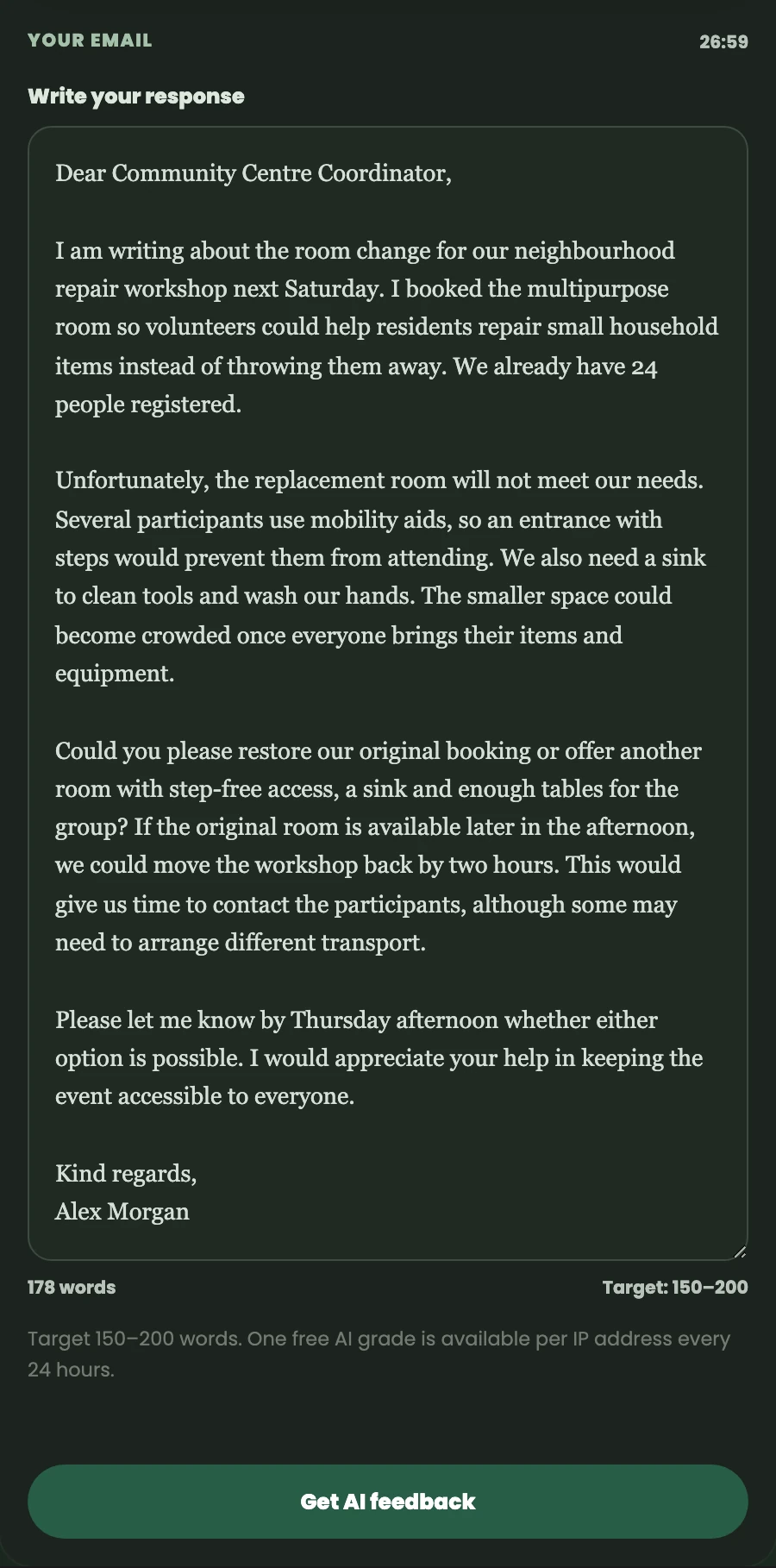
Real PrepEx screens with a fictional answer written for this product demo and the feedback PrepEx returned. Open a view, then select its image to read it at full size.
Complete a practice taskWrite an email with the prompt, timer and word count beside you.
 View full-size screenshot
 View full-size screenshot
 View full-size screenshot
 View full-size screenshot
Read your feedbackSee the practice estimate and what worked in your response.
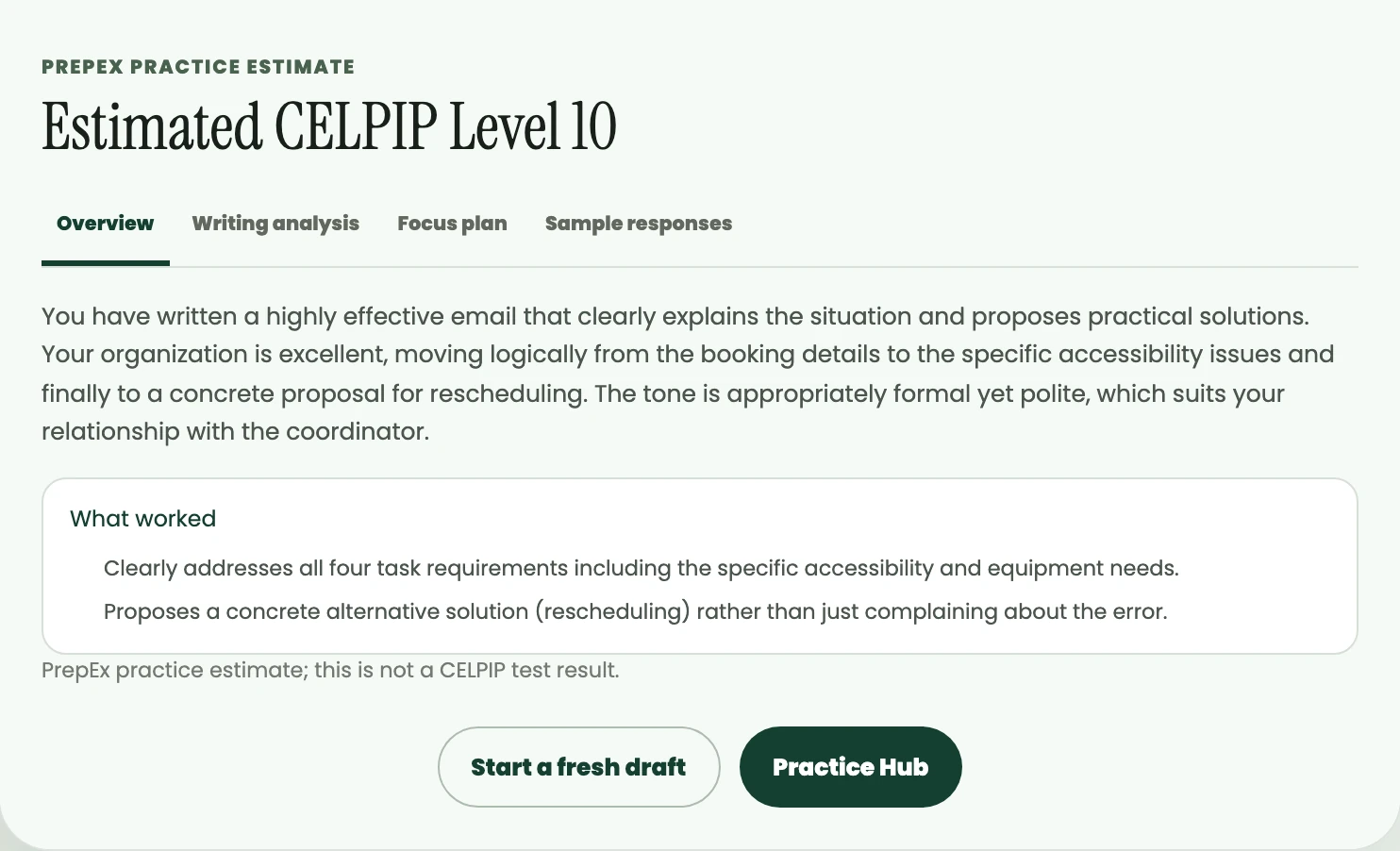 View full-size screenshot
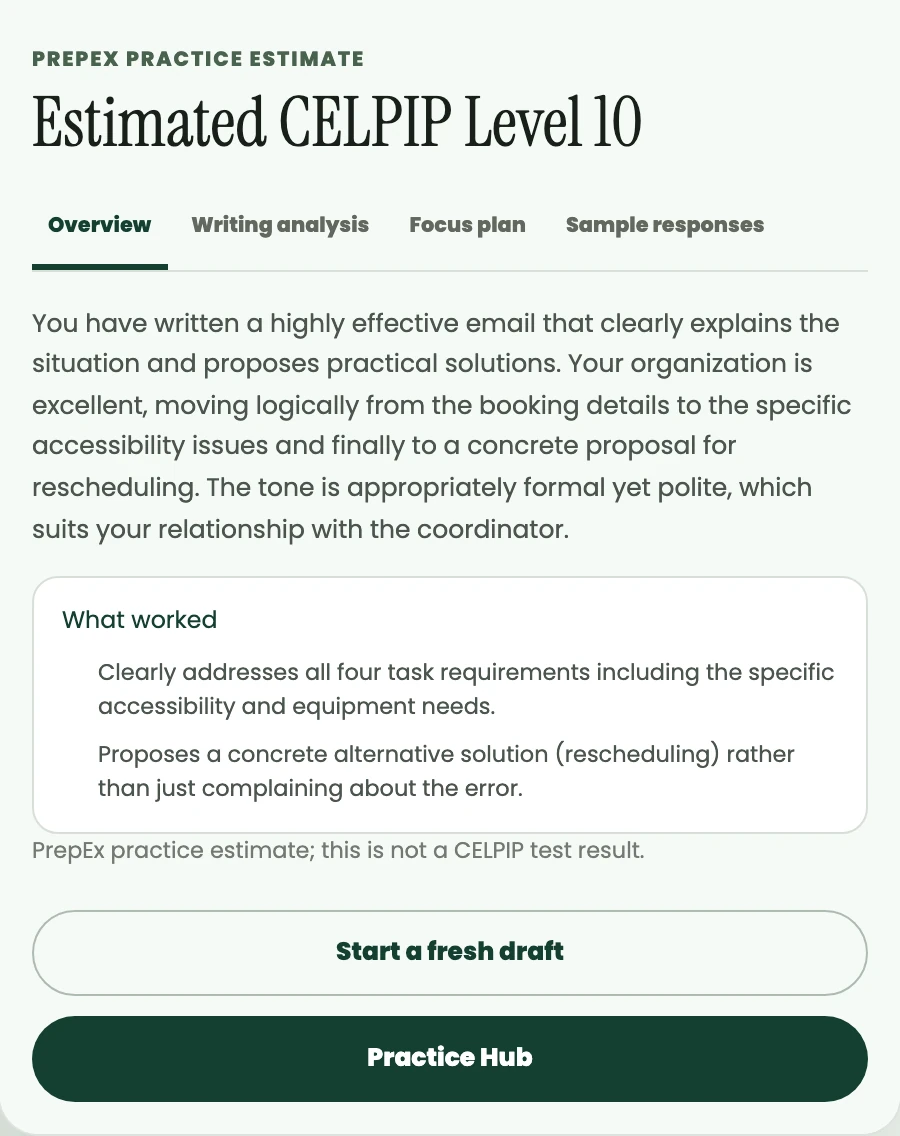 View full-size screenshot
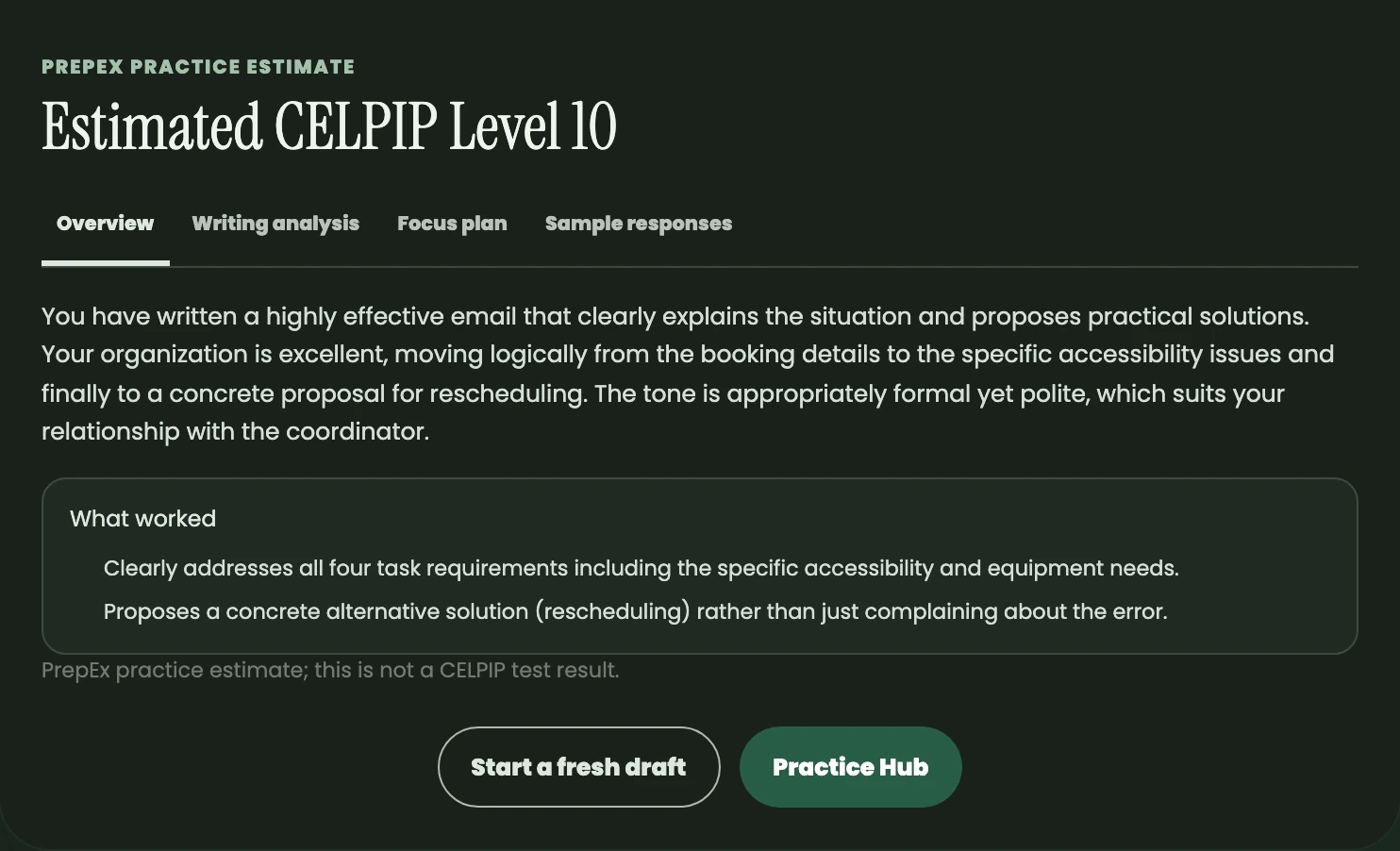 View full-size screenshot
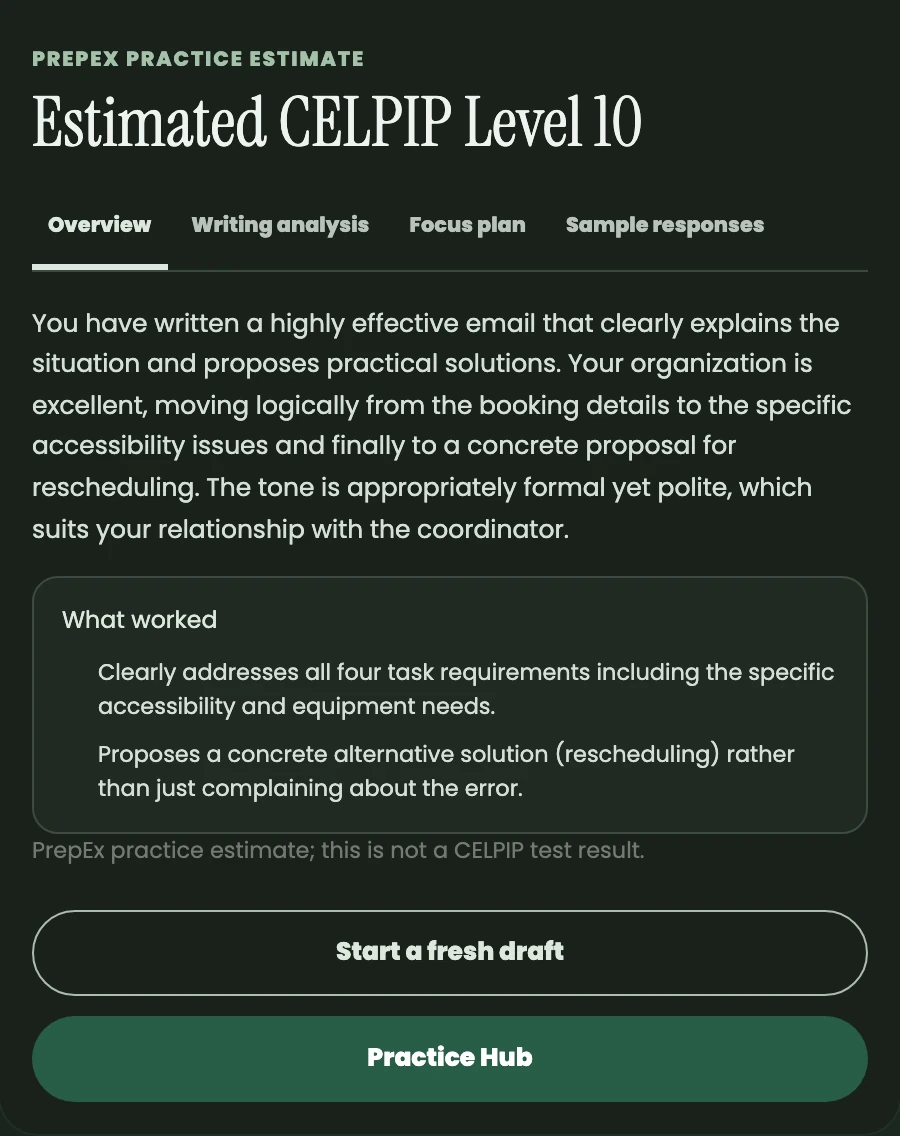 View full-size screenshot
Find your next improvementExplore evidence and next steps across all four Writing criteria.
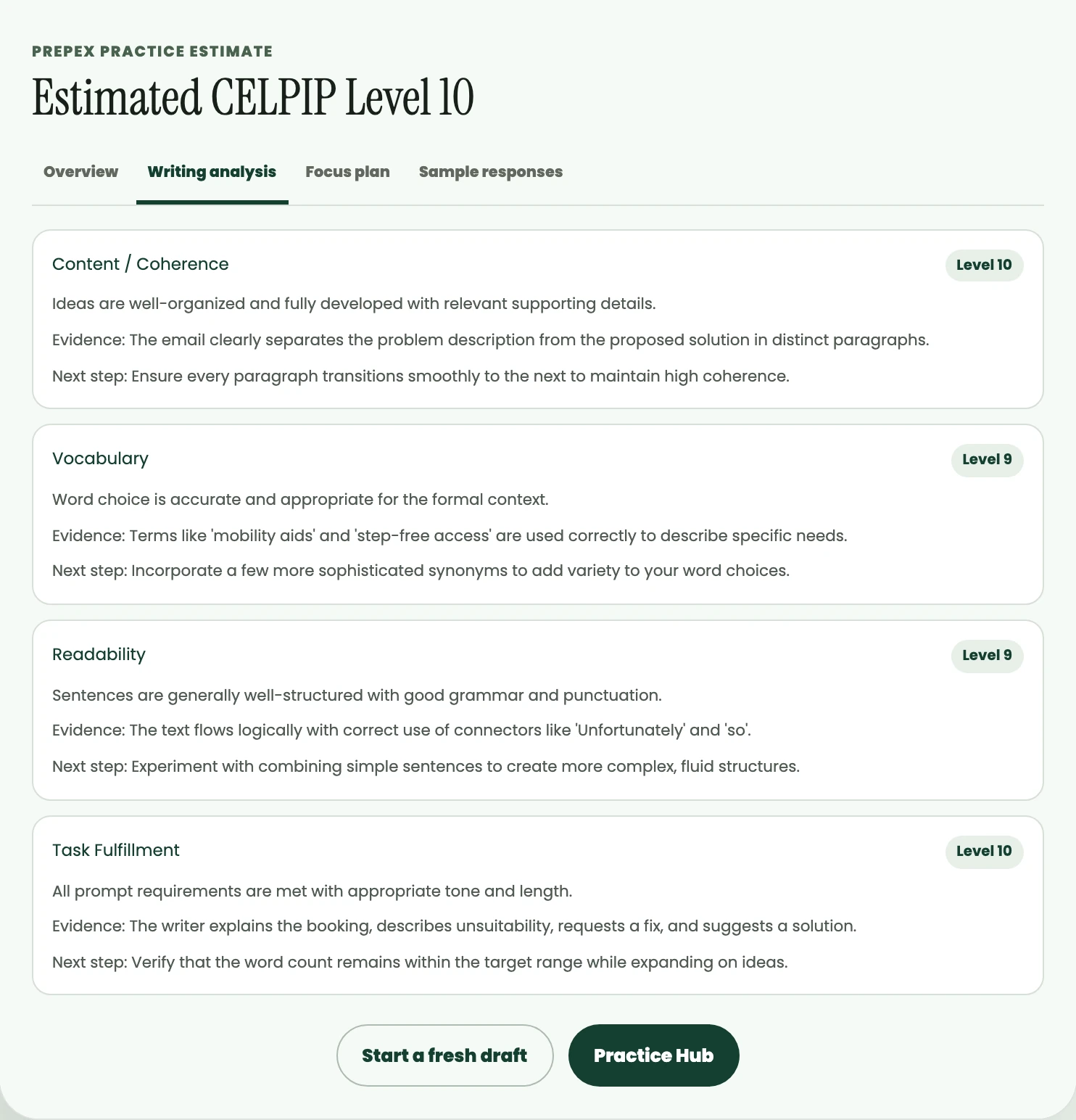 View full-size screenshot
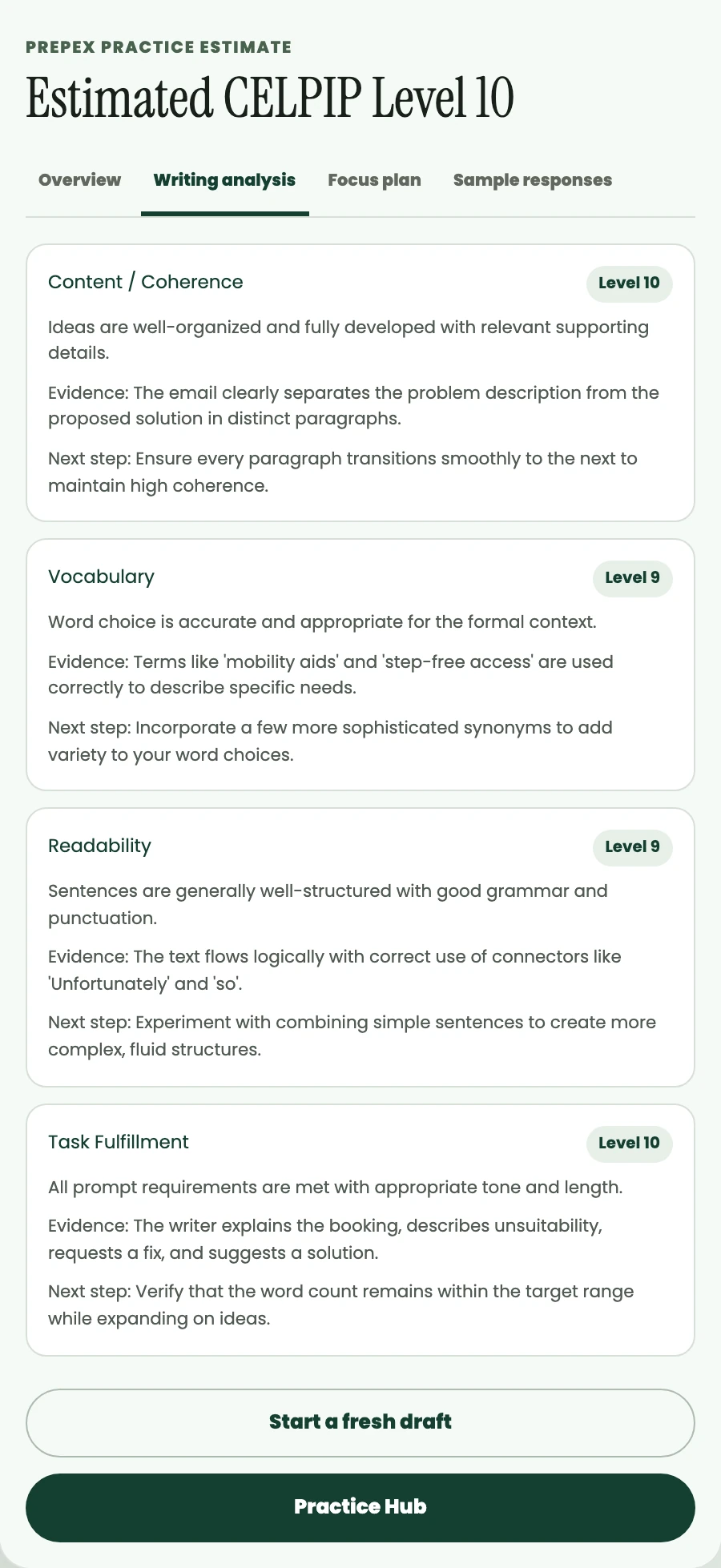 View full-size screenshot
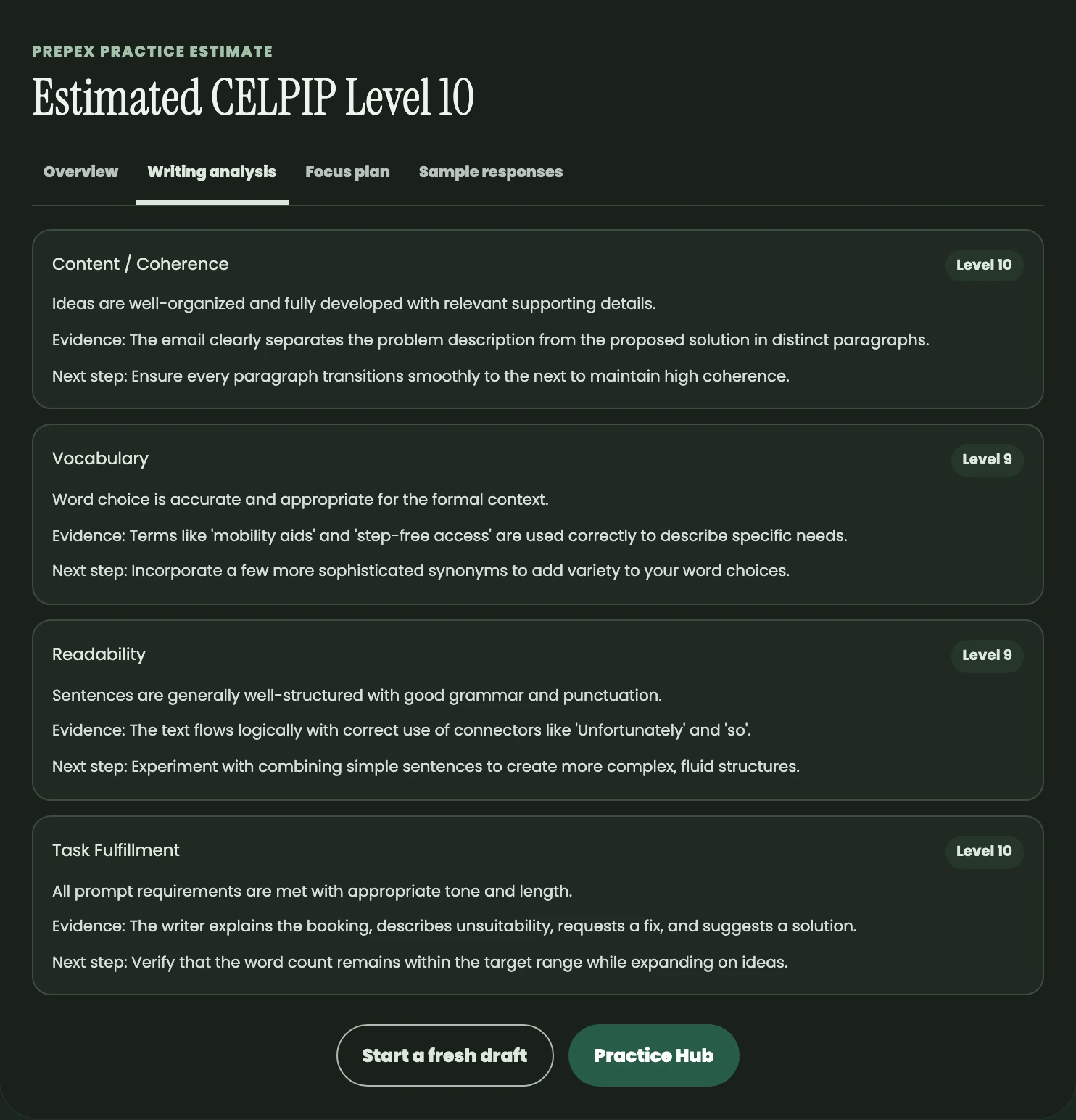 View full-size screenshot
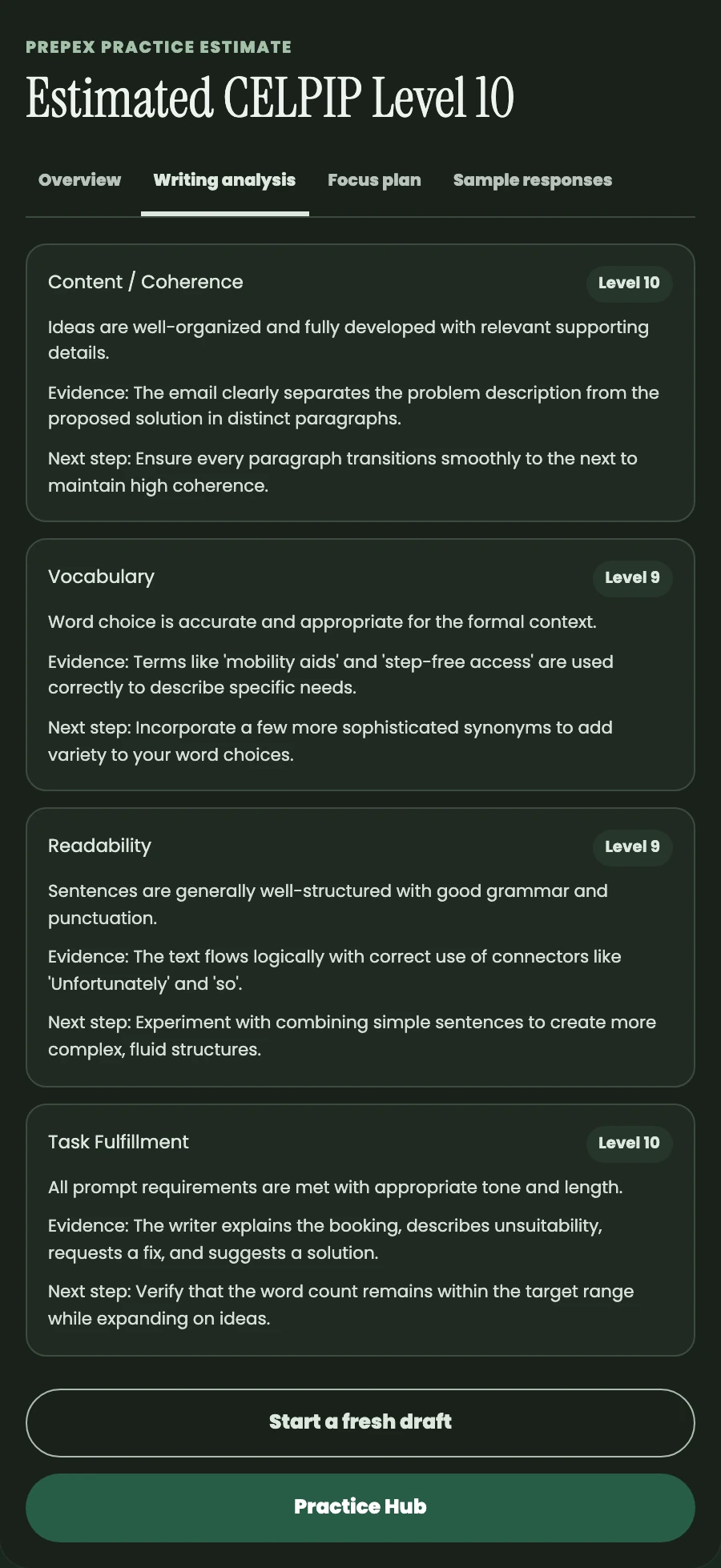 View full-size screenshot
Browse the mock testsChoose a full CELPIP-General mock and check its access label.
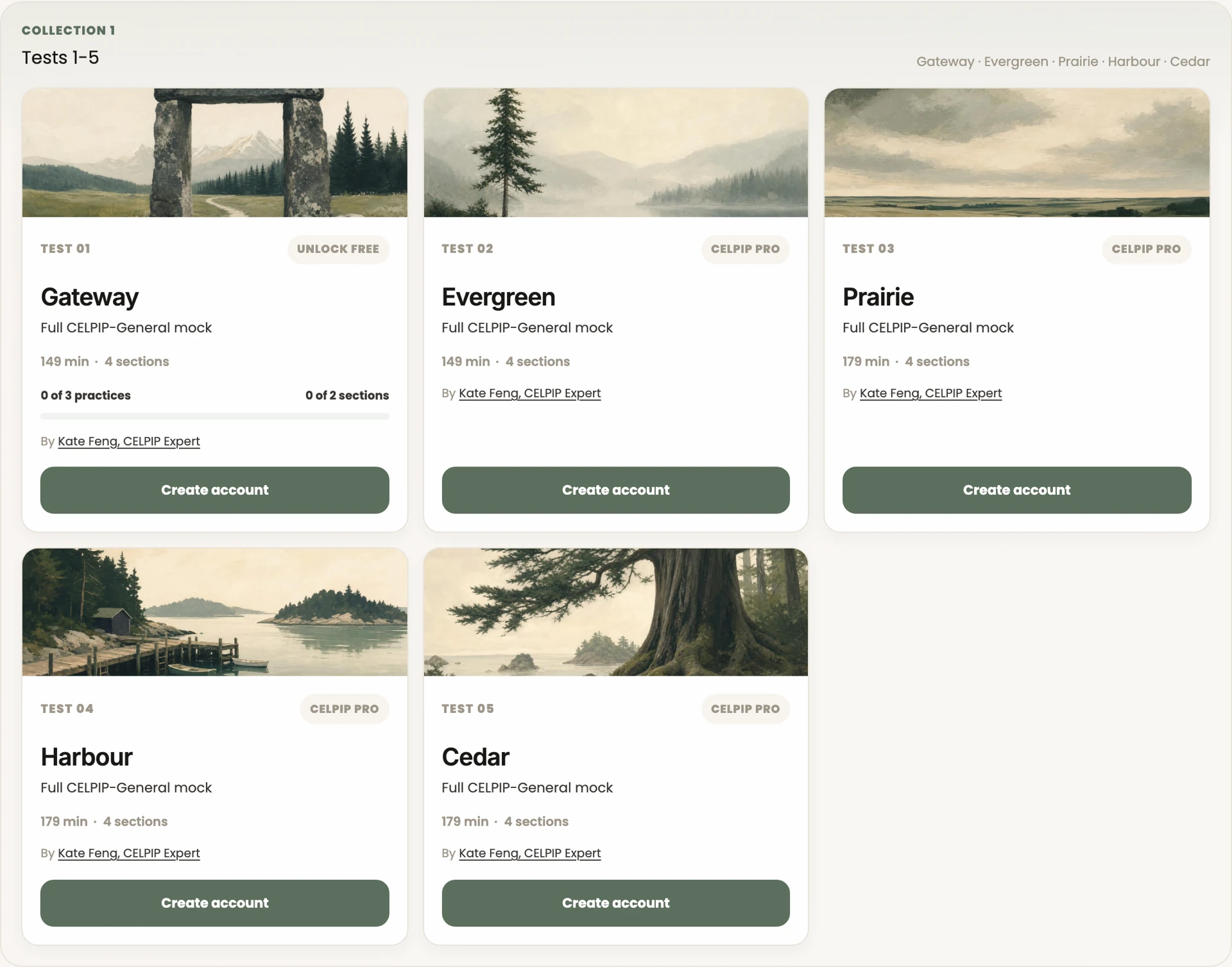 View full-size screenshot
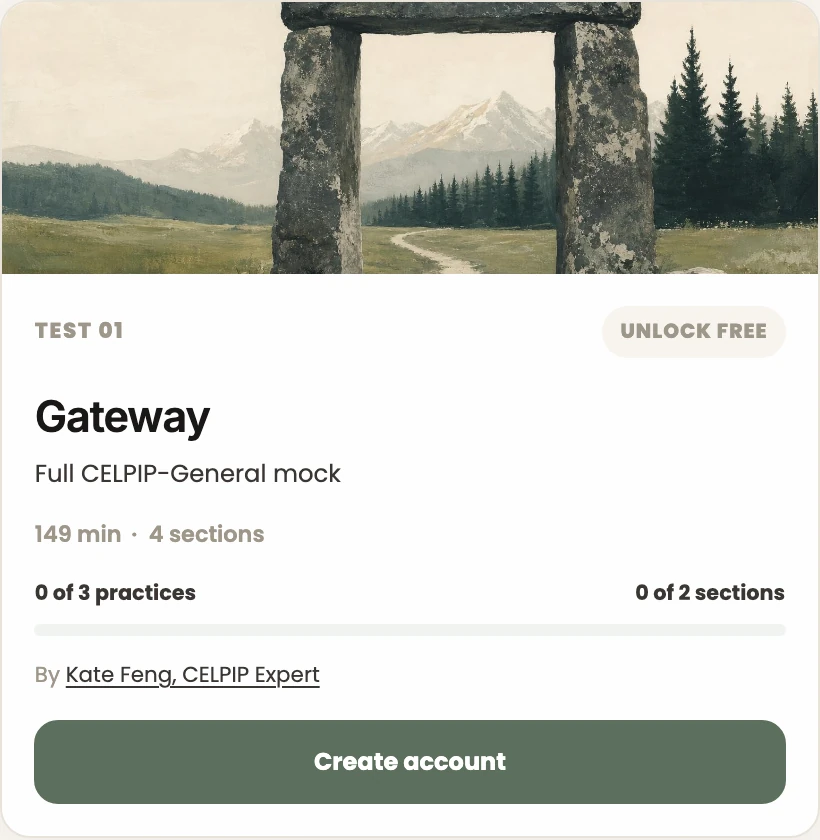 View full-size screenshot
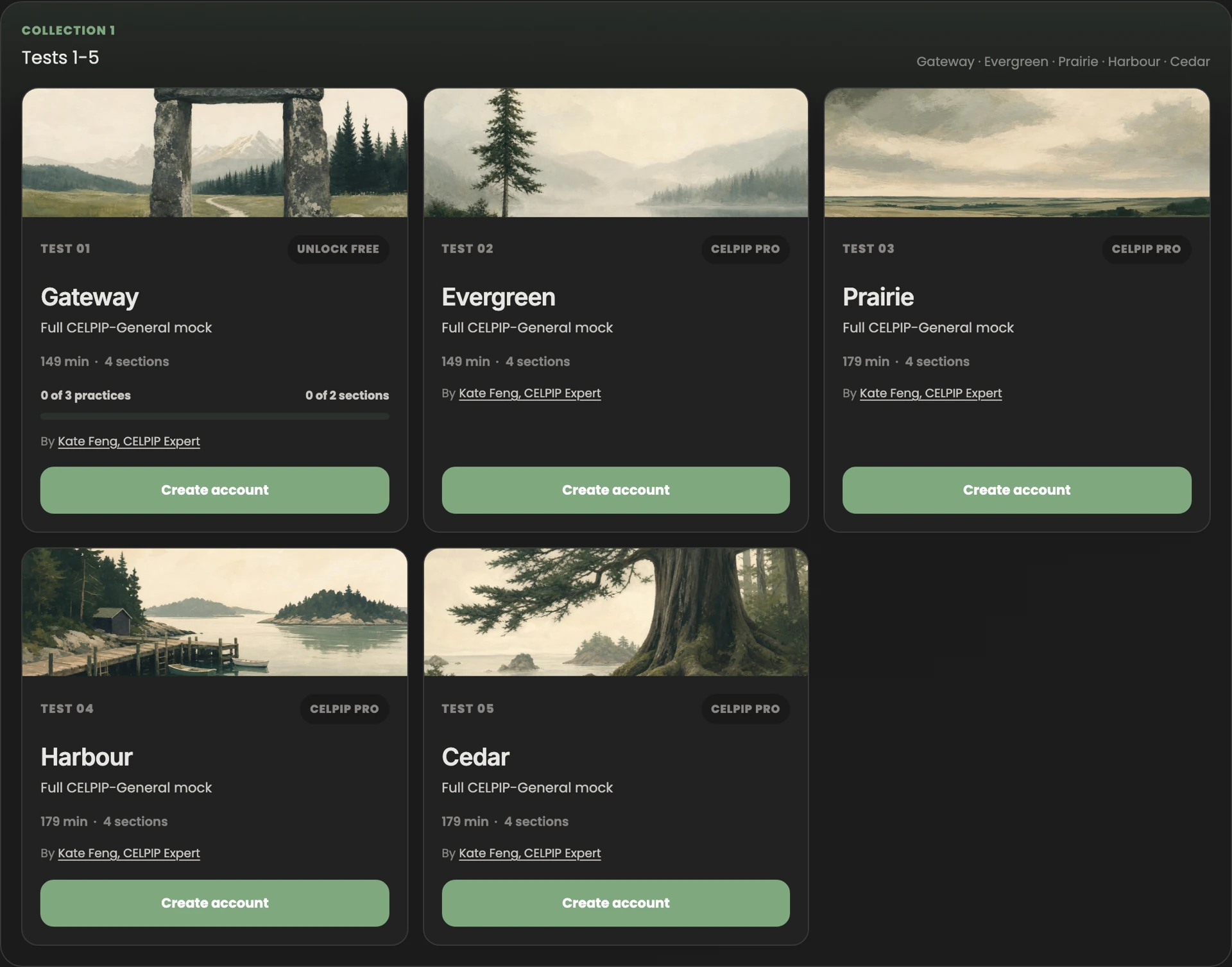 View full-size screenshot
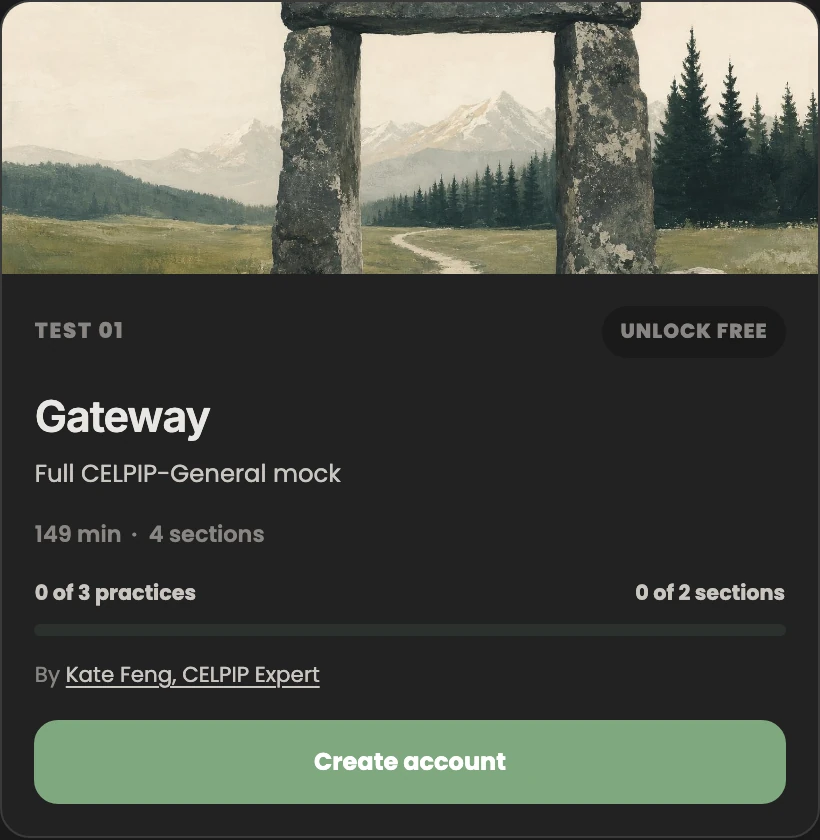 View full-size screenshot
Product demo · Captured November 17, 2026 · No learner information shown
Keep exploring
More from the journal