The PrepEx Journal
Why Did My CELPIP Score Go Down? (Or Stay Exactly the Same)
A lower or identical CELPIP score on a retake usually reflects a different test form, a weaker day or one task that missed a requirement, not a harder test. CELPIP's Score Guide says performance varies between sittings and every score carries a small measurement error, and CELPIP says it adjusts for small differences in difficulty between test versions.

On this page
A CELPIP score can drop, or come back exactly the same, on a retake because results vary between sittings: CELPIP's Score Guide says test versions differ, individual performance varies, fatigue, anxiety or illness can affect results, and every score carries a small measurement error. A one-level move either way is common and isn't evidence that the test got harder. Before you book again, check the skill that fell on a fresh task: PrepEx grades one Writing or Speaking task a day free with no account, and a free account adds two graded sessions a day.
Find out whether the drop was one bad day or a real gap
Grade one Writing or Speaking task a day free for a practice level estimate and feedback on all four rating dimensions. After three graded sessions in at least two sections, a free full-length practice test gives you an overall level.
Facts checked on 27 November 2026 against CELPIP's results, policy, Test Day and country pages, Score Guide, Data Reports, Level Descriptors, study packs and podcast, and IRCC's Express Entry and CRS pages. This is general information, not immigration advice.
Why did my CELPIP score go down?
Mostly because your second sitting was a different test on a different day. CELPIP uses many test forms (versions of the test) and gives different forms to different test takers, even in the same session.
A harder version shouldn't cost you a level on its own. For Listening and Reading, CELPIP says forms can differ slightly in difficulty and that its scoring removes that difference when correct answers are turned into levels, which is why "a raw score of 30 will not have the same meaning across different forms," in CELPIP's words. In Writing and Speaking, every answer is rated on the same four dimensions whatever the prompt. Each test also includes new trial questions that look like scored ones but don't count, so the part that rattled you may not have been scored at all.
Then there's the day itself. CELPIP's Score Guide says a person's performance varies from one administration to another, that "test scores always contain a small amount of measurement error," and that temporary factors such as fatigue, anxiety or illness may affect results. A short night, a cold or other test takers speaking nearby (CELPIP's Test Day page says you may hear them) can be enough. If your English sits near the line between 8 and 9, two sittings can land on different sides of it without your English changing.
Why each CELPIP skill can drop
Listening and Reading are scored by computer: each of the 38 questions is right or wrong, a blank counts as wrong, and no points are taken off for wrong answers. Writing and Speaking are rated by several independent raters on Content/Coherence, Vocabulary, Readability or Listenability, and Task Fulfillment (more in how CELPIP is scored).
| Skill | What often pulls it down on one sitting | How small the margin is | Read next |
|---|---|---|---|
| Listening | Part types you find hard; a lapse in the 30-second answer windows of Parts 1 to 3; concentration fading in Part 5 (the video discussion) and Part 6 (viewpoints) | Level 9 is roughly 33–35 correct out of 38, level 8 roughly 30–33 | Listening tips for 9 |
| Reading | Running short of time in Part 4, the last part, which carries 10 of the 38 questions; Part 3 statements where "Not stated in the text" is the answer; unfamiliar topics | Level 8 is roughly 28–31 correct, level 7 roughly 24–28 | Reading tips for 9 |
| Writing | A point in the task answered thinly or skipped; far under or over the suggested 150–200 words; a tone that doesn't fit the reader; memorized sentences | One missed requirement lowers Task Fulfillment, which covers relevance, completeness, tone and word count | Writing tips for 9 |
| Speaking | Running out of time before the main point, or stopping far too early; drifting off the task; long pauses and restarts, often from forcing complex sentences; a memorized script | Task Fulfillment covers completeness and length; Listenability covers pauses and self-correction | Speaking tips for 9 |
The ranges come from CELPIP's approximate charts and overlap because the raw score for a level can vary slightly between tests, so two or three answers can decide it (see the CELPIP score chart).
In Writing and Speaking the cause is usually inside one task. A former CELPIP Writing rater said on CELPIP's podcast that responses far under or over the word count are penalized even when they're well written. Memorized sentences carry a risk of their own, since CELPIP can cancel a score for answers that aren't original or spontaneous (see CELPIP templates). CELPIP doesn't assess accent, so a lower Speaking level more often comes from an unfinished point, restarts or drifting off the task.
Is it normal to get the identical CELPIP score again?
Yes, and it isn't a glitch. CELPIP's online system assigns tests to raters at random and keeps test takers anonymous. Raters work independently, can't see each other's ratings and don't know what score you're hoping for. When ratings disagree, a benchmark rater who hasn't seen the first ratings is assigned automatically.
The same level twice usually means the raters saw the same evidence twice, and level 8 is crowded: it was the most common Writing result in CELPIP's 2025 Data Report (36.1% of results) and the most common Speaking level (24.4%). CELPIP's descriptors say a Writing 9 supports key ideas with relevant facts, descriptions or details, chooses words that give accurate details, and controls a range of complex and diverse structures. If your emails still develop each point the way they did last time, the level stays. The worked revisions in CELPIP Writing 8 to 9 and Speaking 8 to 9 show the change.
Writing 8 is also the result that repeats most often in the score histories test takers share publicly. How to get 9 in CELPIP when you're stuck at 7 or 8 has a diagnostic for breaking that loop.
Why does one CELPIP skill improve while another drops?
Each skill varies on its own, and with no single-skill retake, every sitting re-scores all four.
In score histories that test takers shared publicly between January 2024 and November 2026, which PrepEx reviewed by hand, 60% of attempt-to-attempt changes had at least one skill up and another down. Only 13% were all down or unchanged. A skill that started at 7 usually went up next time, while Writing or Speaking that started at 9 went down more often than up (about 44% down, a fifth to a quarter up), partly because a result at the top of your usual range has more room to fall. People tend to post when they're stuck or when they break through, so read these as reported patterns, not odds.
Weeks spent on Writing can also leave Listening and Reading unpractised. Keep a timed part such as a Reading Part 3 practice set in every week. For 9 in all four on one report, see how to work toward CLB 9.
Has CELPIP become harder?
CELPIP's own data doesn't show that, and CELPIP says it adjusts Listening and Reading levels for small differences in difficulty between test versions. Between its 2024 and 2025 Data Reports, only Writing shifted much.
| Skill | Average, 2024 | Average, 2025 | 9 or higher, 2024 | 9 or higher, 2025 |
|---|---|---|---|---|
| Listening | 8.22 | 8.33 | 52.0% | 53.2% |
| Reading | 7.21 | 7.27 | 33.3% | 33.0% |
| Writing | 7.91 | 7.87 | 29.8% | 24.1% |
| Speaking | 7.76 | 7.94 | 32.6% | 34.9% |
The 9-or-higher shares are summed from each report's level table. From the same tables, Writing at exactly 8 rose from 27.3% to 36.1% and Writing below 7 fell from 19.6% to 16.4%, so results bunched around 8 from both sides. The reports don't give a reason. They describe everyone who tested each year, not the same people retaking. If your earlier result is about two years old, the Score Guide adds that language ability can improve with use and study but may also diminish.
What to do after a lower CELPIP score
Read the report skill by skill: one level down in one skill is ordinary variation; two or more down in Writing or Speaking usually means a task went wrong.
Check whether an earlier report still meets your target
IRCC asks for one test report that shows all your results, and CELPIP can't combine scores from two tests. For Express Entry, results must be less than two years old when you create your profile and when you apply. If an earlier report meets your target and stays under two years old at both points, the lower result may not change your plan. IRCC's pages don't say how to choose between valid reports, and you can't mix skills from different reports; the CELPIP retake policy guide covers which result counts and how soon you can sit again.
Then work out what the drop costs. For a single applicant, CLB 9 earns 31 core CRS points per skill and CLB 8 earns 23, so a slip from 9 to 8 costs 8 points (7 with a spouse), plus any skill-transferability points that need 9 in all four. A drop that stays at 10 or above costs no core points. A drop below 7 matters most: Federal Skilled Worker and CEC TEER 0 or 1 applicants need CLB 7 in all four (tables in the CLB calculator and CELPIP scores for PR).
Consider a re-evaluation for one Writing or Speaking result
If Writing or Speaking came back one level below your usual and that level blocks your target, weigh a re-evaluation. You can request it within six months of the test date, results take about one to two weeks, and CELPIP said on its podcast that scores are not lowered on re-evaluation. Listening and Reading are computer rated and unlikely to change. Our CELPIP re-evaluation guide covers the process and the refund rules, and what test takers report about re-evaluation covers what tends to move.
If something went wrong on test day
An equipment fault or a disruption must be reported through your CELPIP account within 24 hours of the test; CELPIP takes no corrective action on issues reported later or after scores are released.
Diagnose before you rebook
The same preparation tends to buy the same result, and CELPIP recommends additional study before a retake. If practice scores you higher than the real test, see why the real CELPIP test can feel harder.
On PrepEx, take the skill that dropped on a task you haven't seen. One Speaking or Writing task a day, such as Speaking Task 1, giving advice, is graded free with no account, showing a practice level estimate, feedback on all four dimensions and what to work on first. Signed in, every attempt is saved, so you can compare attempts dimension by dimension and review saved mistakes.
See whether the skill that dropped is really below your usual level. Take a free CELPIP practice test
Leave enough time before the next sitting
CELPIP's policy and FAQ pages allow no more than one session within five calendar days, while its Canada country page says sessions must be at least four calendar days apart. Every country page outside Canada says at least 30 calendar days apart, so check the page for where you'll test. Results usually arrive within 2–4 business days (some CELPIP pages say 3–4; see CELPIP results). Kate Feng's CELPIP retake guide plans the weeks between attempts, and the CELPIP exam fee guide covers the cost of another sitting.
Test the skill that fell on a fresh task before you pay for another sitting. Find my weakest skill free
If your CELPIP score dropped or came back the same
Why did my CELPIP score go down on my second attempt?
Usually because the second sitting was a different form on a different day, not because the test got harder. CELPIP says performance varies between sittings and every score carries a small measurement error. In Writing and Speaking, a missed requirement or an answer far off the word range can also cost a level.
Is it normal to get the same CELPIP score again?
Yes. Raters work independently and don't know what score you're hoping for, so the same level twice usually means your answers showed the same strengths and gaps. Level 8 is the most crowded: 36.1% of CELPIP-General Writing results and 24.4% of Speaking results were exactly 8 in CELPIP's 2025 Data Report.
Does a harder test version lower my CELPIP score?
It shouldn't on its own. CELPIP says its Listening and Reading forms can differ slightly in difficulty and that its scoring removes that difference, so the same number of correct answers can mean a different level on different forms. Every test also includes unscored trial questions, so a part that felt hard may not have counted.
Has CELPIP become harder?
CELPIP's data doesn't show that: from 2024 to 2025, average Listening, Reading and Speaking levels rose slightly. In Writing, the share at 9 or higher fell from 29.8% to 24.1% and the share at exactly 8 rose from 27.3% to 36.1%; CELPIP hasn't said why.
Why did my CELPIP score drop by two levels?
A two-level drop is less common than a one-level move, but in score histories test takers share publicly it shows up in every skill, most often in Reading and Speaking. In Writing or Speaking it usually points to one task that went wrong, such as an answer cut off or a requirement missed.
Can the test centre affect my CELPIP score?
Not through the marking. CELPIP says Writing and Speaking responses are assigned to raters at random by an online system with test takers kept anonymous, and Listening and Reading are scored by computer. Conditions on the day can still matter, so report any test-day problem in your CELPIP account within 24 hours.
How do I find out which part of my Writing or Speaking caused the drop?
Write or record a fresh task under real timing and compare it with CELPIP's level descriptors. PrepEx grades one Writing or Speaking task a day free with no account, with a practice level estimate, feedback on each of the four dimensions and what to work on first.
Should I retake CELPIP straight away after a lower score?
Only if you know what went wrong and have fixed it. Spacing depends on where you test: in Canada, book five or more calendar days after your last test; every country page outside Canada requires at least 30 calendar days between sessions. PrepEx's free full-length practice test, which opens after three graded sessions in at least two sections, gives an overall level before you book.
Sources we checked
- CELPIP: Test Results — different forms for different test takers; scoring removes slight differences in form difficulty; unscored new items; approximate raw-score charts that may vary slightly by test; random, anonymous, independent rating and benchmark raters; re-evaluation within six months in about one to two weeks; results in 2–4 business days
- CELPIP Score Guide (January 2026) — performance varies between administrations; measurement error; temporary factors; ability can improve or diminish
- CELPIP 2025 Data Report — 2025 averages and share at each level by skill; no points deducted for wrong answers
- CELPIP 2024 Data Report — 2024 averages and share at each level by skill
- CELPIP Level Descriptors (May 2026) — what level 9 Writing asks for
- CELPIP: Policies and Forms — five-calendar-day retake rule; study before retaking; test-day issues reported within 24 hours
- CELPIP: Contact Us and FAQ — five-calendar-day retake rule
- CELPIP: Canada country page — sessions at least four calendar days apart; results in 3–4 business days
- CELPIP: India country page — an example of the country pages outside Canada that require sessions at least 30 calendar days apart
- CELPIP: Test Day Information — you may hear other test takers; answers that aren't original or spontaneous can lead to a cancelled score
- CELPIP Listening Pro Study Pack (2026) — the six Listening parts, the 30-second spoken questions in Parts 1 to 3, the Part 5 video discussion and Part 6 viewpoints
- CELPIP Reading Pro Study Pack (2026) — the four Reading parts, the "Not stated" option in Part 3 and the 10 questions in Part 4
- CELPIP Writing Pro Target 9 Study Pack (2026) — a suggested length of about 150–200 words for each Writing task
- The Official CELPIP Podcast, Episode 2: Busting CELPIP Myths — scores are not lowered on re-evaluation
- The Official CELPIP Podcast, Episode 11 — a former Writing rater on word-count penalties; raters don't know test takers' targets
- The Official CELPIP Podcast, Episode 25 — no single-component retake; separate tests can't be combined
- CELPIP blog: Busting CELPIP Myths — the test doesn't evaluate accent
- IRCC: Express Entry language test results — results under two years old; CLB 7 minimums
- IRCC: CRS criteria — core points per CLB level; skill transferability at CLB 9
- IRCC: Federal Skilled Workers language selection criteria — results on the same single test report
See the practice experience.
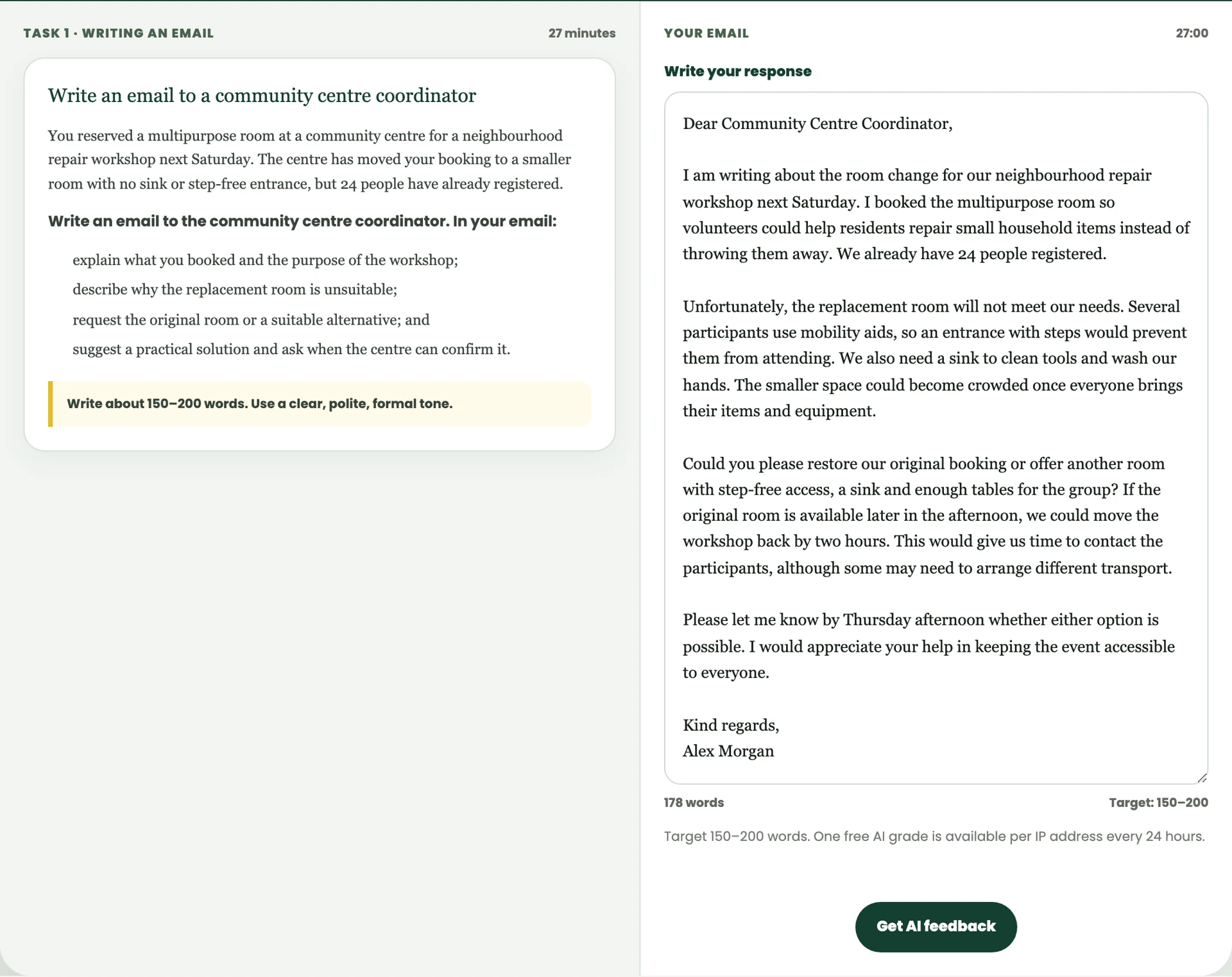
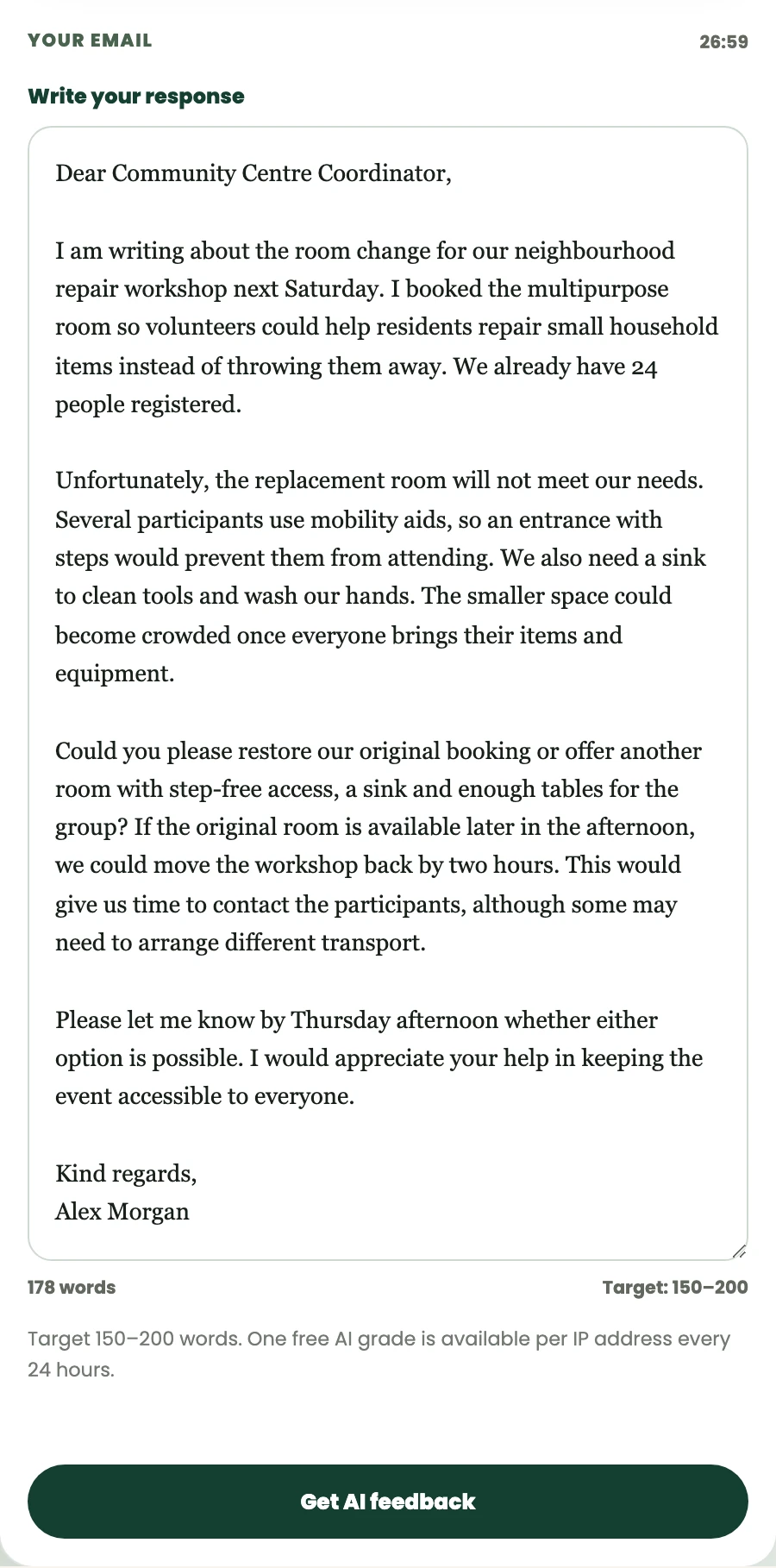
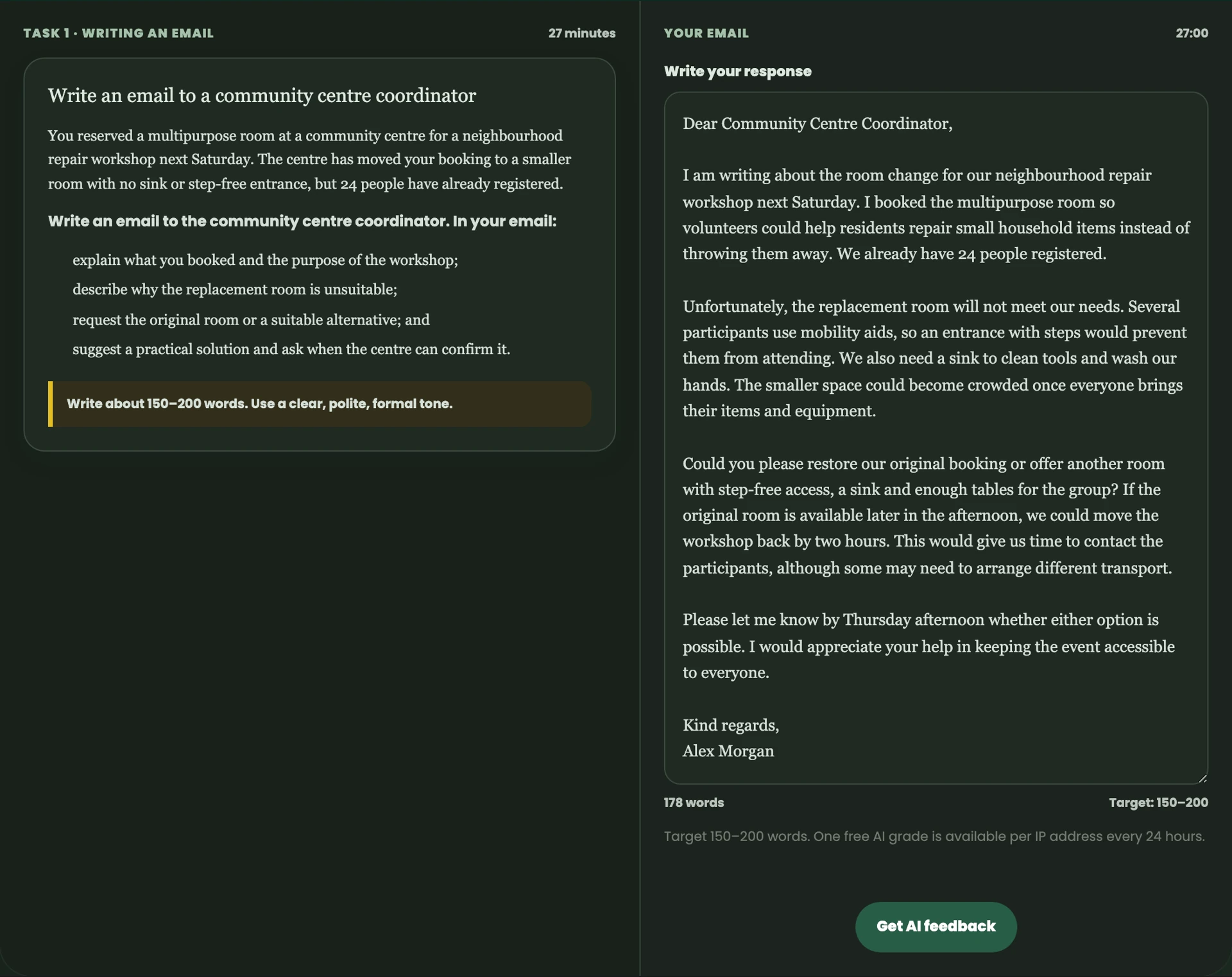
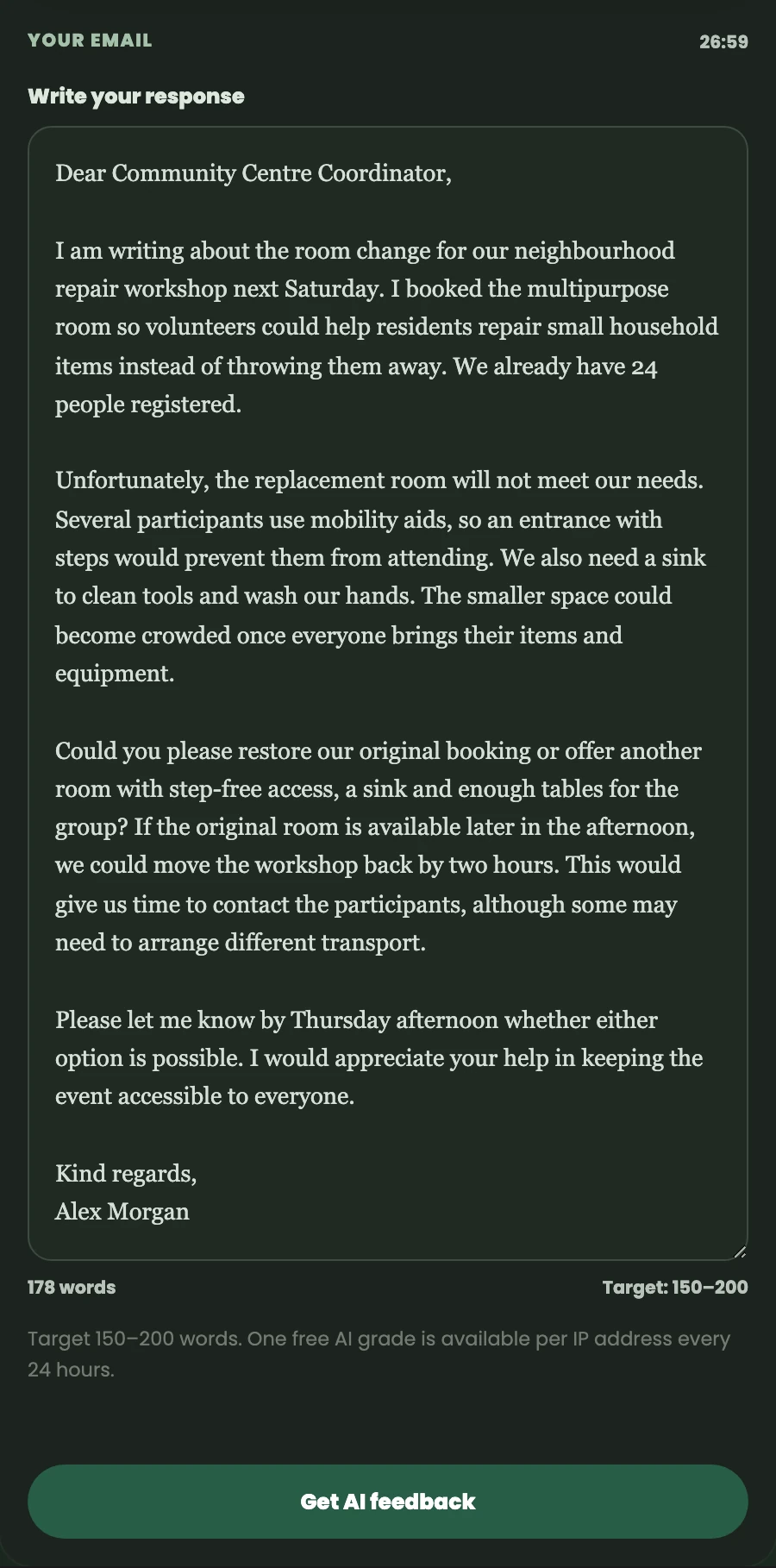
Real PrepEx screens with a fictional answer written for this product demo and the feedback PrepEx returned. Open a view, then select its image to read it at full size.
Complete a practice taskWrite an email with the prompt, timer and word count beside you.
 View full-size screenshot
 View full-size screenshot
 View full-size screenshot
 View full-size screenshot
Read your feedbackSee the practice estimate and what worked in your response.
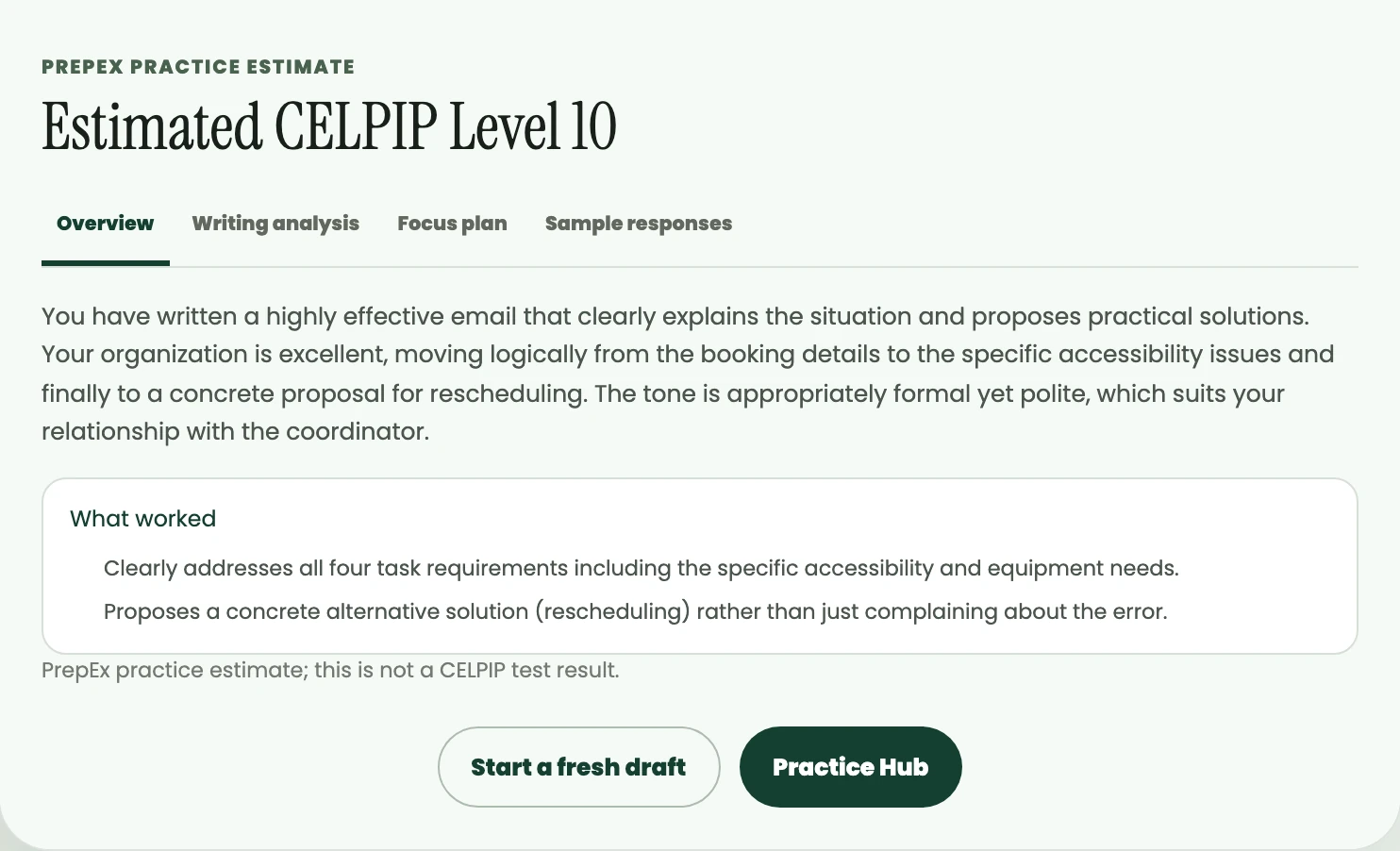 View full-size screenshot
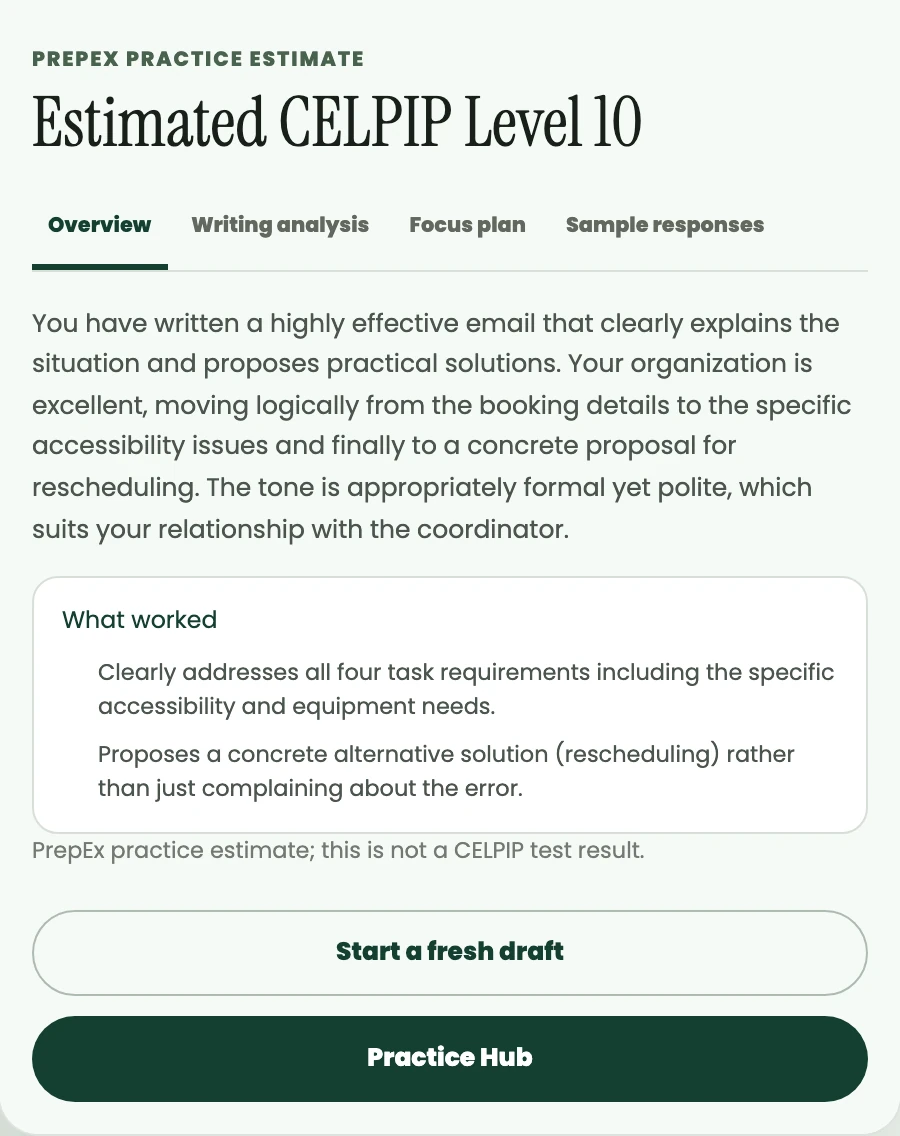 View full-size screenshot
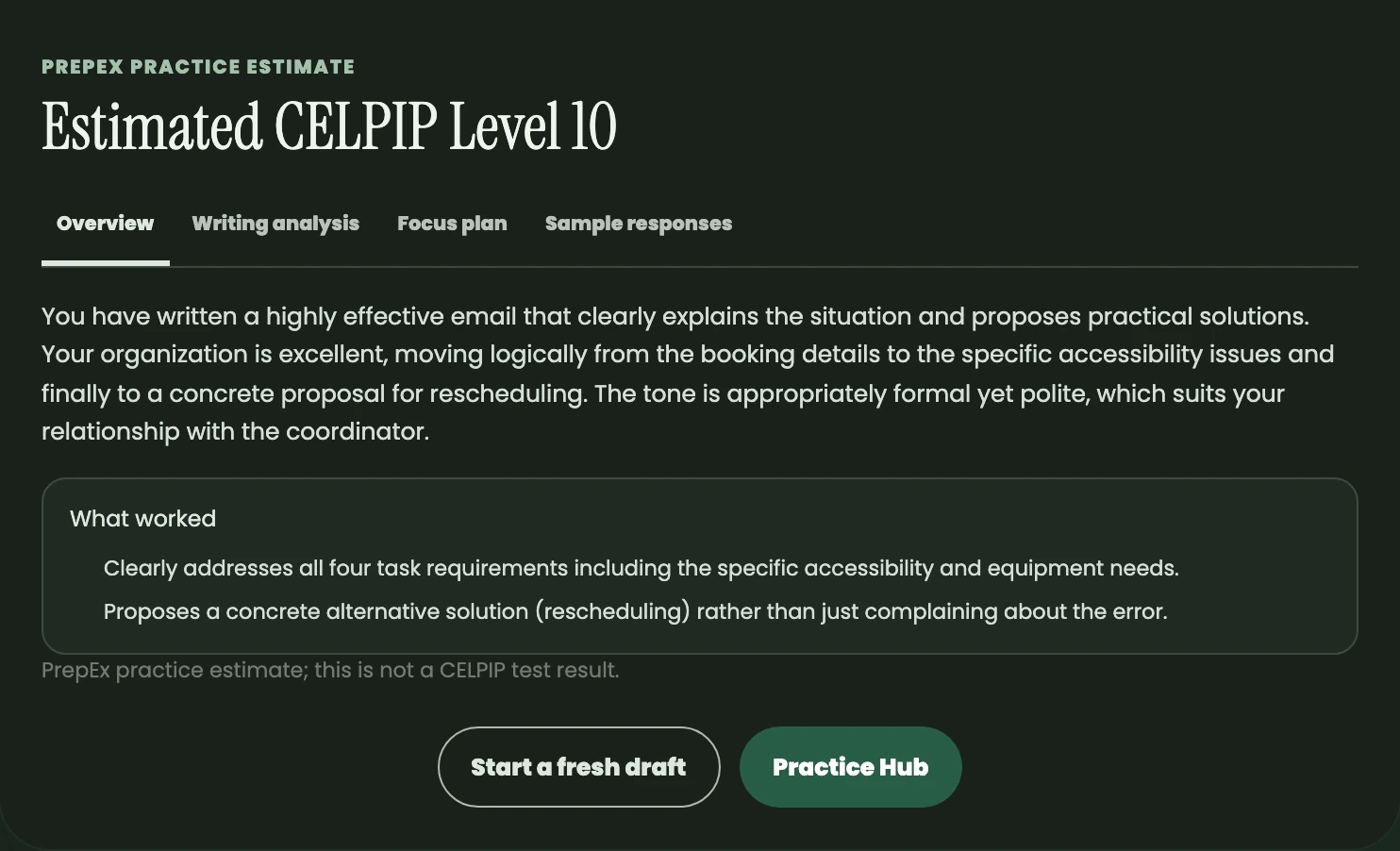 View full-size screenshot
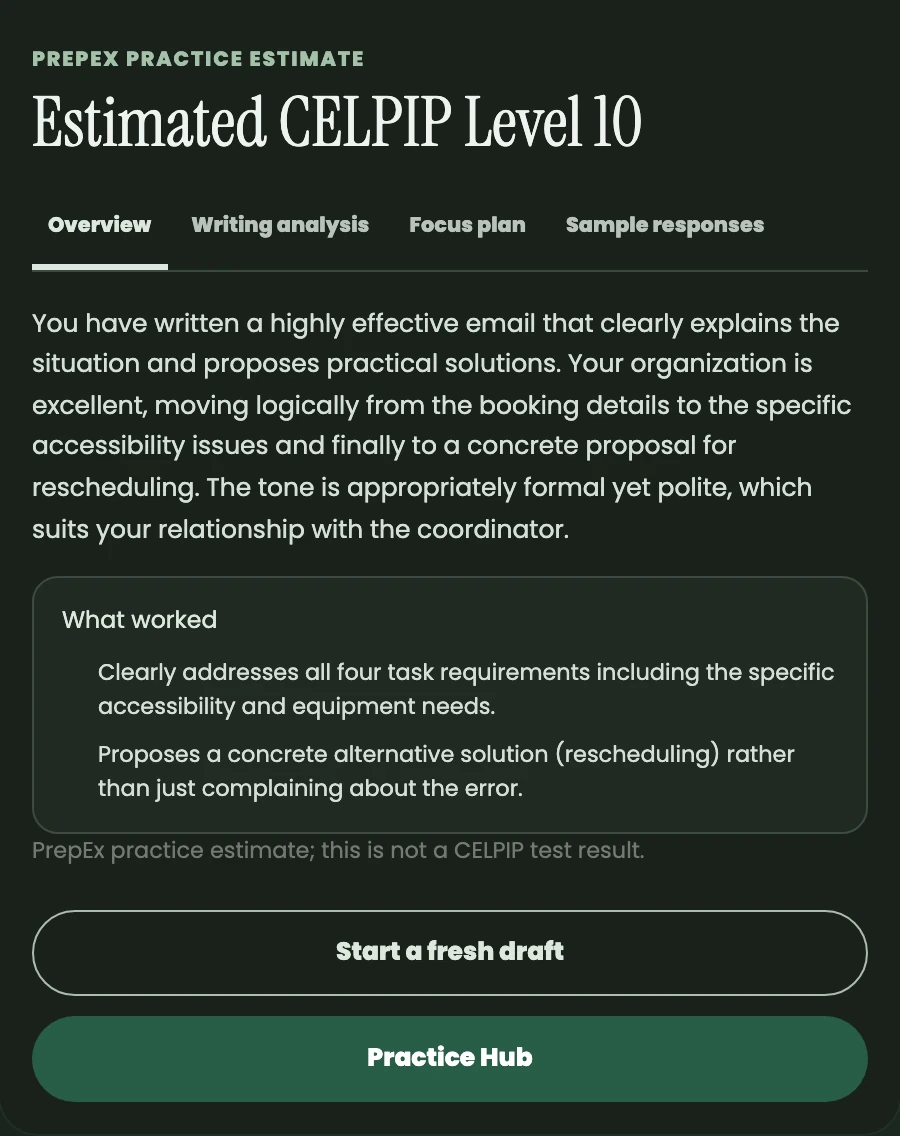 View full-size screenshot
Find your next improvementExplore evidence and next steps across all four Writing criteria.
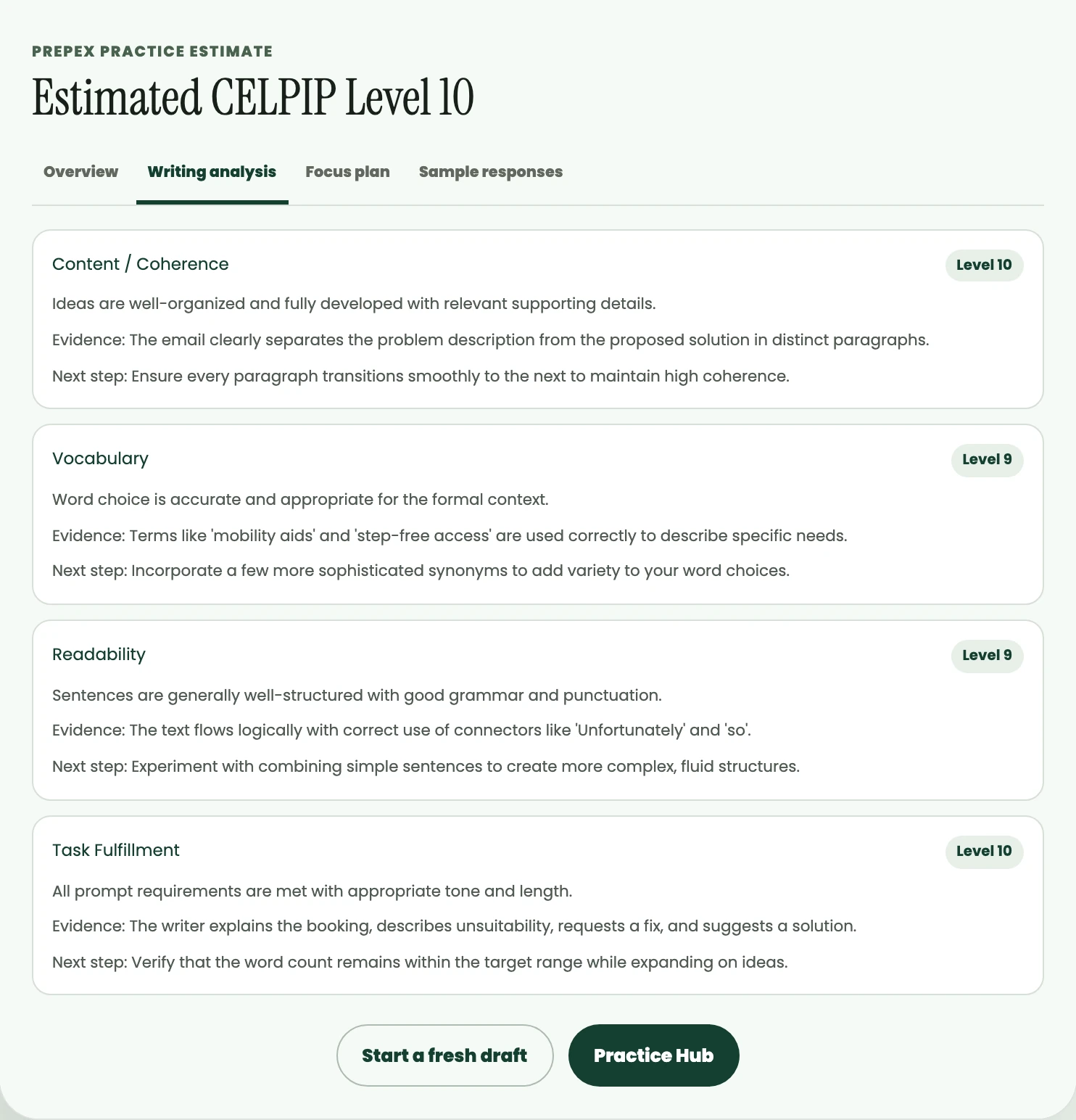 View full-size screenshot
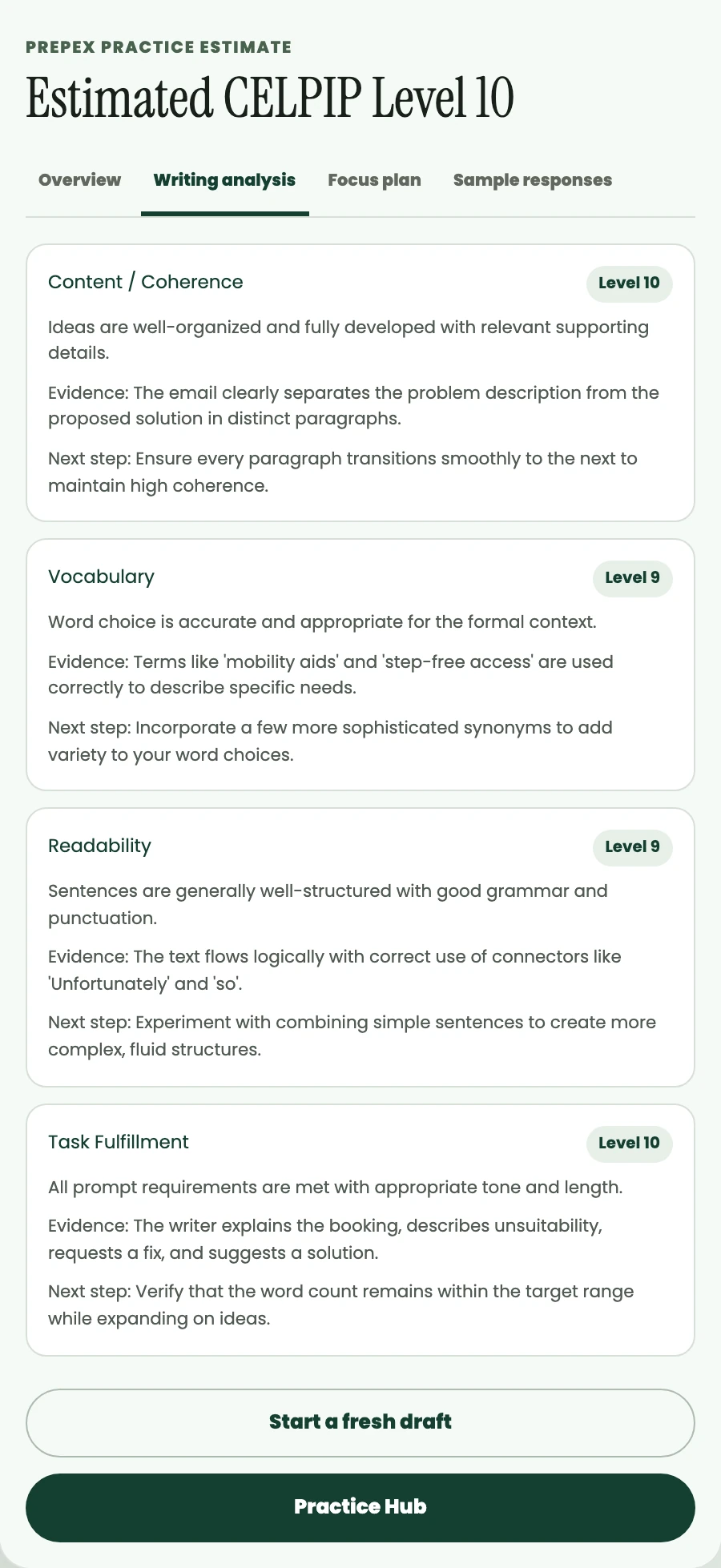 View full-size screenshot
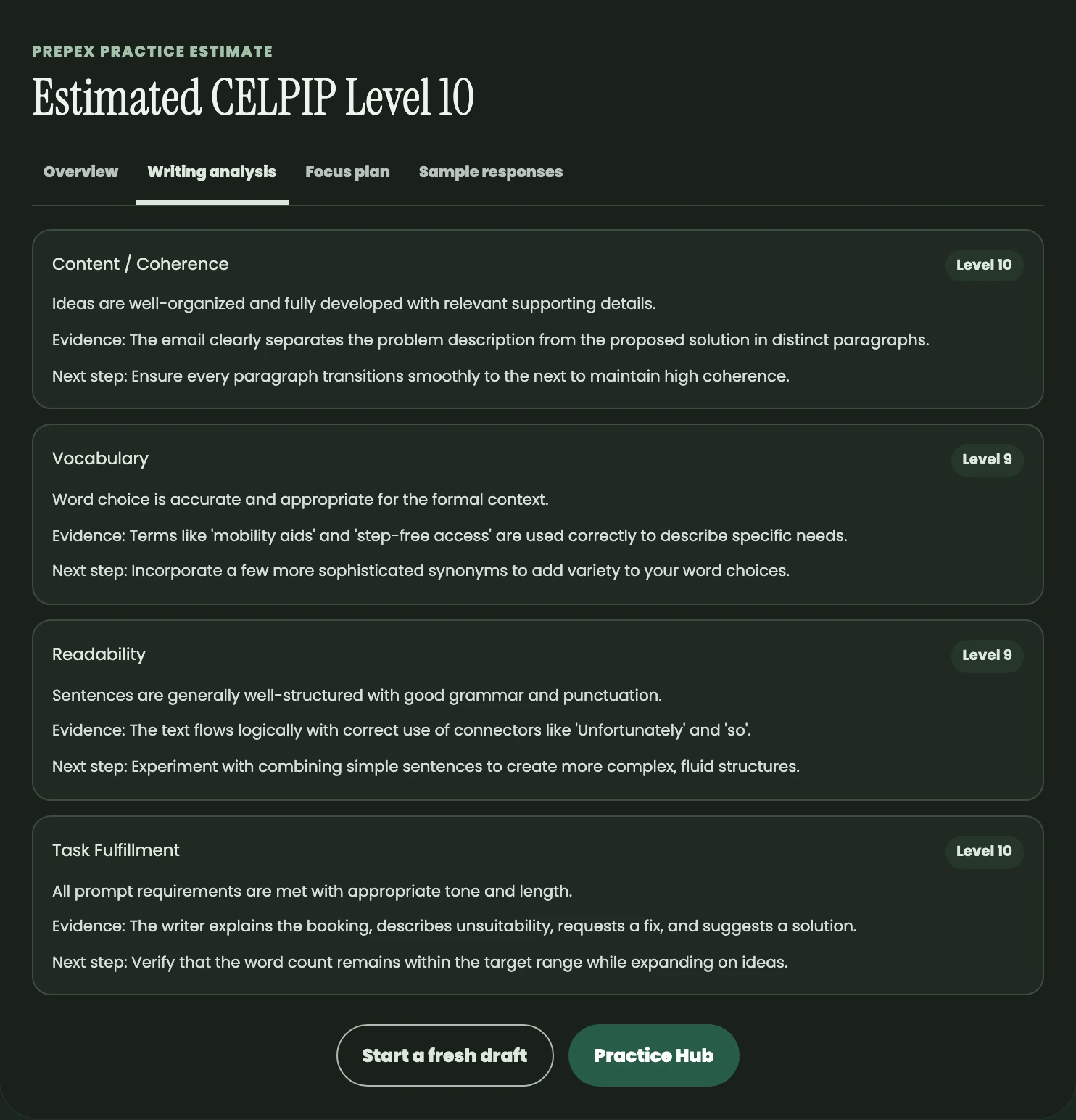 View full-size screenshot
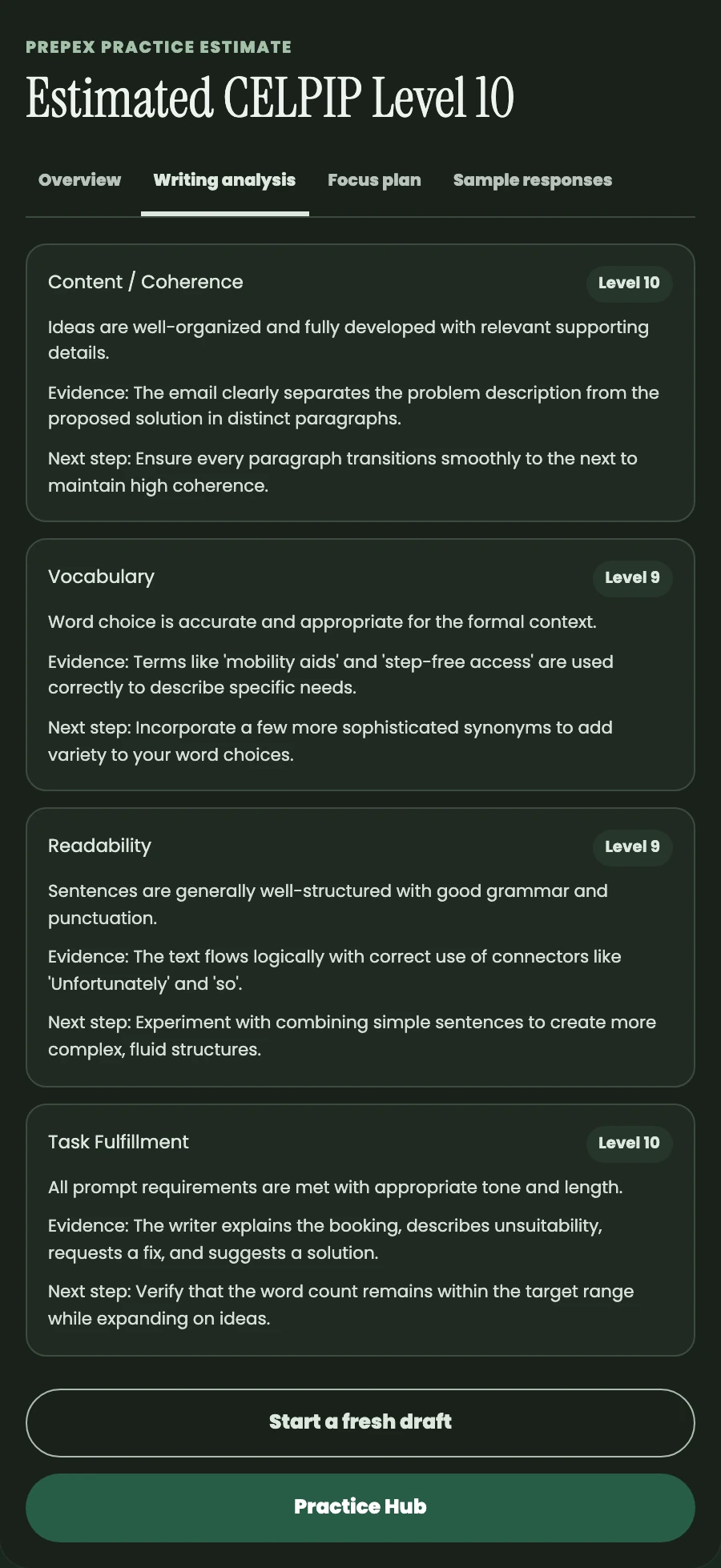 View full-size screenshot
Browse the mock testsChoose a full CELPIP-General mock and check its access label.
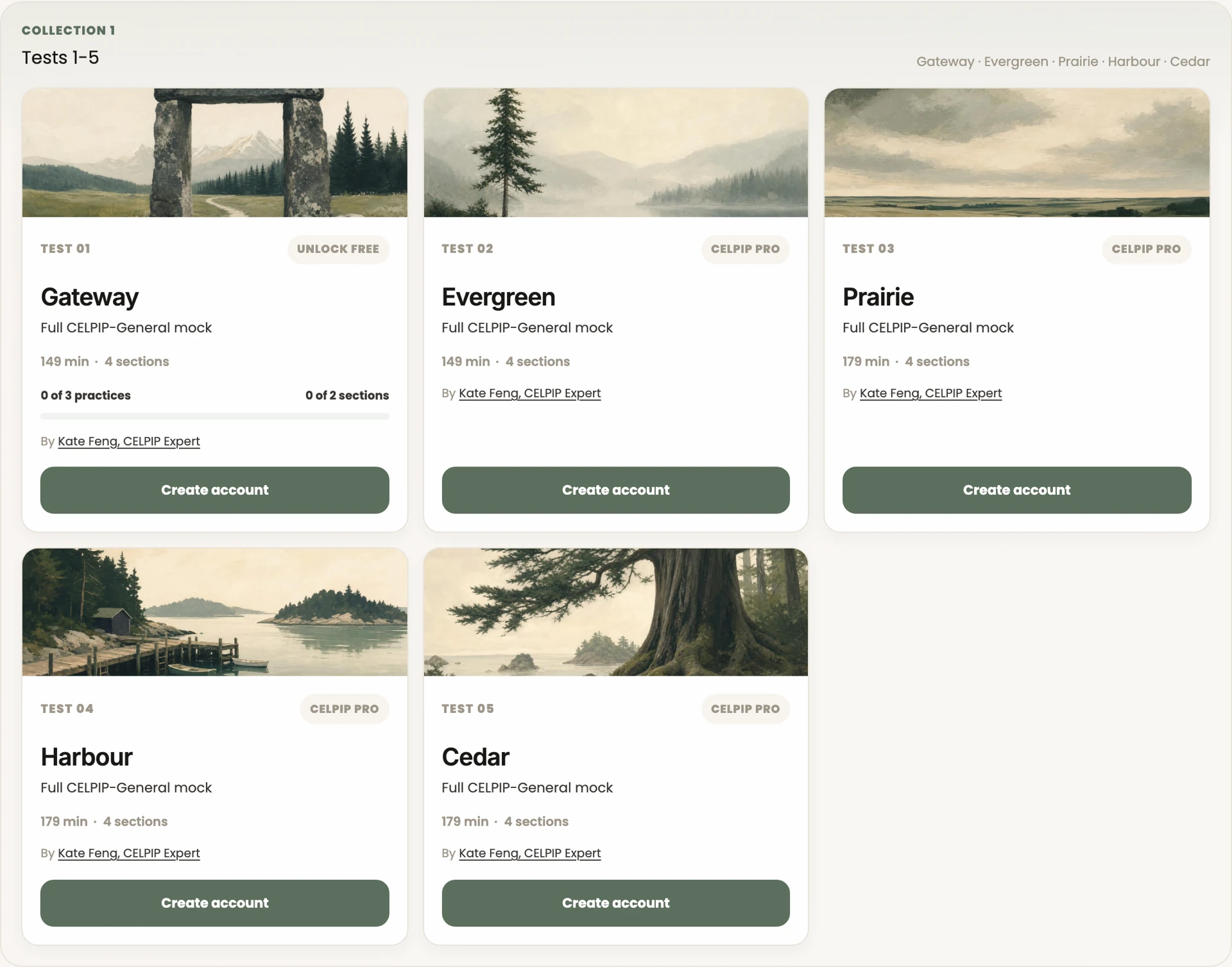 View full-size screenshot
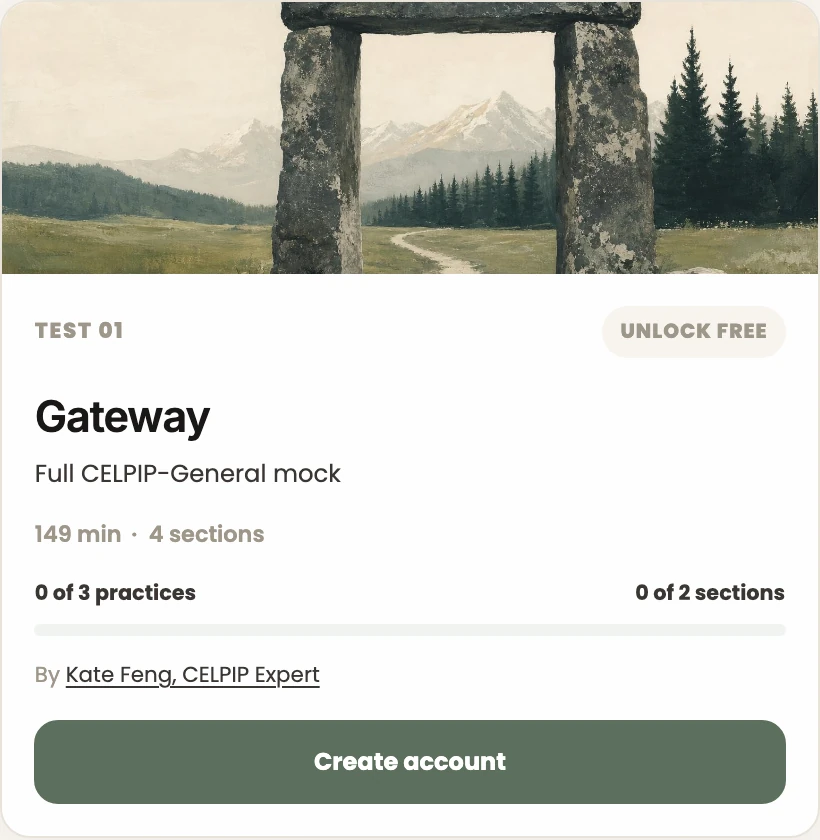 View full-size screenshot
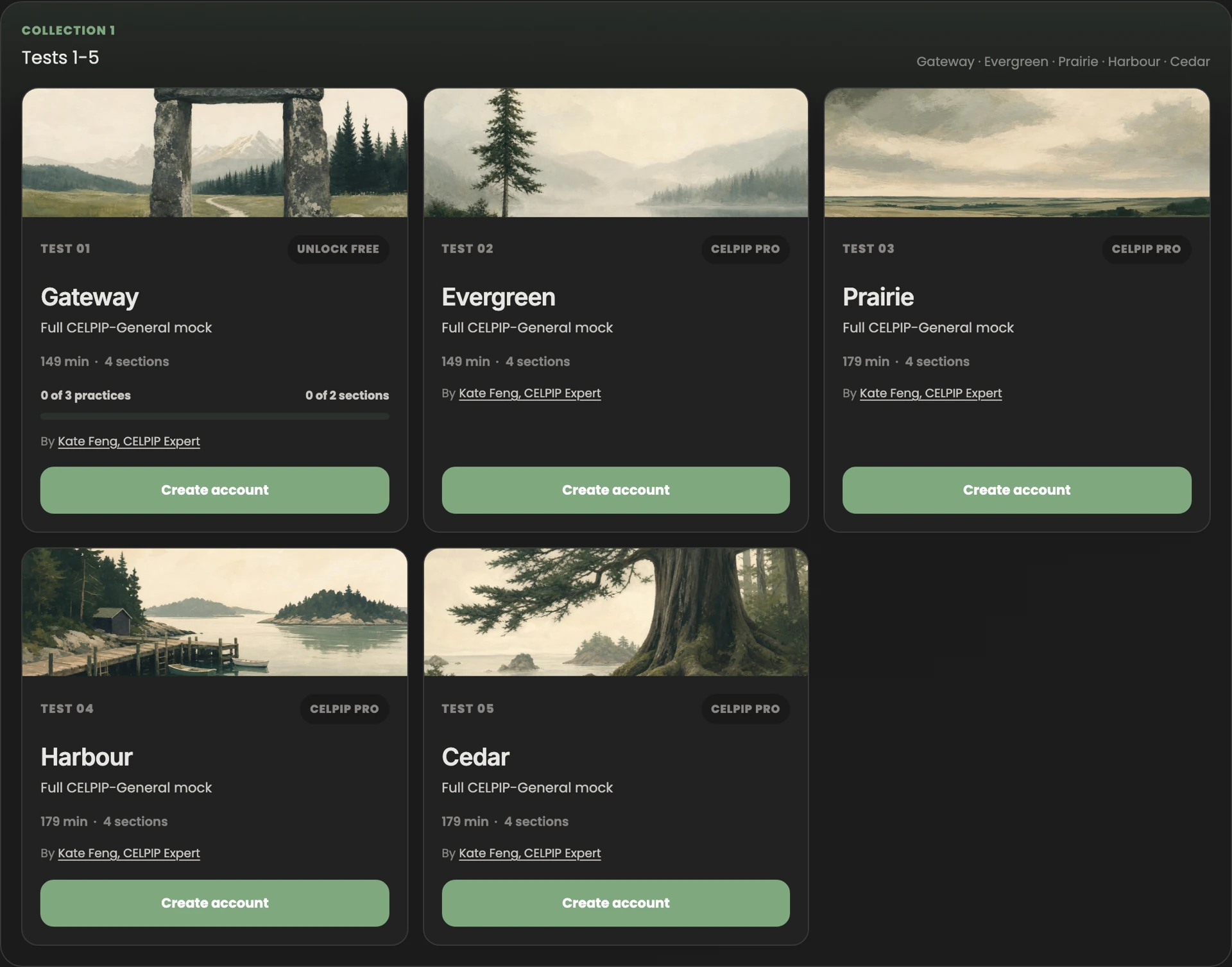 View full-size screenshot
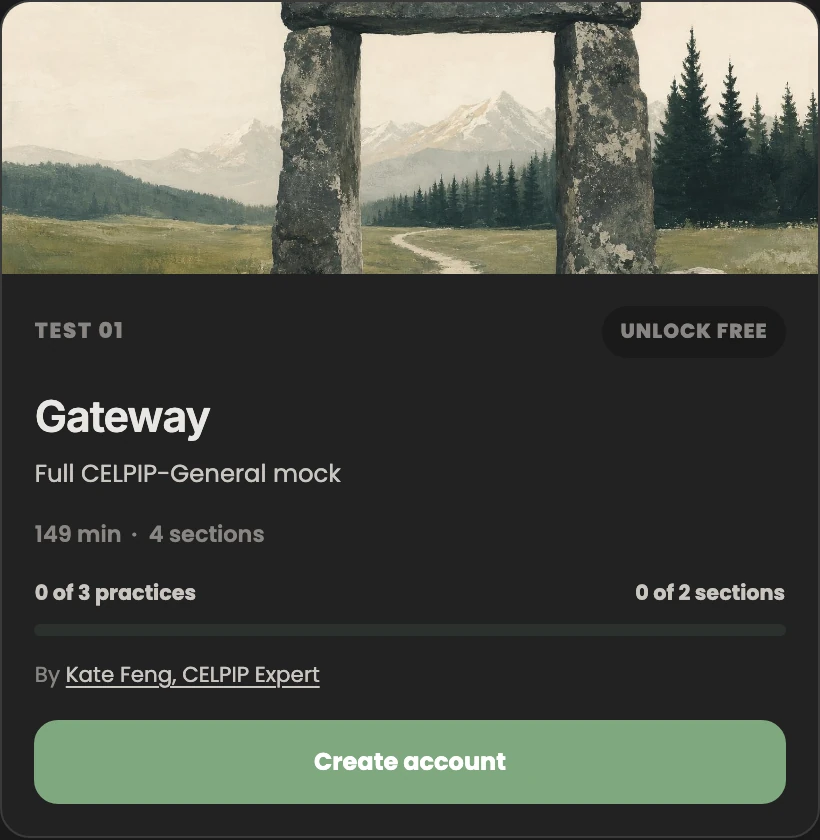 View full-size screenshot
Product demo · Captured November 17, 2026 · No learner information shown
Keep exploring
More from the journal