
Download the free DET practice questions PDF
The PrepEx booklet has 93 original practice questions for the 10 Duolingo English Test question types that work on paper. Every question has an answer, and every answer has a short explanation. Writing and speaking prompts come with model answers or answer plans.
You don’t need an account or an email address. The link opens the PDF directly, and it prints in black and white on A4 or Letter paper.
prepex-duolingo-english-test-practice-questions-2026.pdf · 23 pages · 1.1 MB
What’s in the PDF
- Read and Select: 51 words
- Fill in the Blanks: 16 sentences
- Read and Complete: 2 passages
- Interactive Reading: 12 questions in 2 sets
- Write About the Photo: 3 photos
- Interactive Writing: 2 two-part prompts
- Writing Sample: 2 prompts
- Speaking on paper: 5 prompts (Speak About the Photo, Read, Then Speak, Speaking Sample)
- Listening and Interactive Speaking: 3 online tasks
- Answer key: answers and explanations for all 115 scored items, plus model answers for every writing and speaking prompt
- Free grading: where to get each answer graded on PrepEx
Each section starts with the time the real test gives you, so you can practise against a phone timer. Interactive Reading is split across pages in the same order as the test: you answer Complete the Sentences before you turn the page and see the rest of the passage.
Which question types the PDF covers
The Duolingo English Test has 13 question types and takes about an hour. This PDF covers the 10 that can be practised on paper and links to online practice for the three that need audio or a live conversation. Speak About the Photo, Read, Then Speak and the Speaking Sample are printed as prompts that you answer aloud.
| Question type | On the test | Time | In this PDF |
|---|---|---|---|
| Read and Select | 15–18 words | 5 seconds each | Section 1 |
| Fill in the Blanks | 6–9 sentences | 20 seconds each | Section 2 |
| Read and Complete | 3–6 passages | 3 minutes each | Section 3 |
| Listen and Type | 6–9 sentences | 1 minute each | Online practice link |
| Interactive Reading | 2 sets of 6 questions | 7 or 8 minutes a set | Section 4 |
| Interactive Listening | 2 sets of 8–10 questions | 6:30, then 75 seconds | Online practice link |
| Write About the Photo | 3 photos | 1 minute each | Section 5 |
| Interactive Writing | 1 set of 2 questions | 5 minutes, then 3 minutes | Section 6 |
| Speak About the Photo | 1 photo | 20 seconds to prepare, 90 seconds | Section 8 |
| Read, Then Speak | 1 question | 20 seconds to prepare, 90 seconds | Section 8 |
| Interactive Speaking | 6–8 questions | 35 seconds each | Online practice link |
| Writing Sample | 1 question | 30 seconds to prepare, 5 minutes | Section 7 |
| Speaking Sample | 1 question | 30 seconds to prepare, 3 minutes | Section 8 |
Counts and timings checked against Duolingo’s Help Center and DET Question Guide (2026) on 25 November 2026.
Preview: practice questions with answers
Here are some of the questions from the PDF, with the same answers and explanations. Try each one before you open the answer.
Read and Select: real word or made up?
You get 5 seconds for each word on the test. Decide whether each one is a real English word.
- borrow
Answer
Real word. Real. To take something and give it back later, as in borrow a pen.
- prellow
Answer
Made up. Made up. The ending -llow appears in real words such as yellow and pillow, but prellow is not an English word.
- kitchen
Answer
Real word. Real. The room where food is cooked.
- mindock
Answer
Made up. Made up. It looks like a family name or a place name, but it is not an English word.
- honest
Answer
Real word. Real. Telling the truth, as in an honest answer.
- thirsty
Answer
Real word. Real. Needing something to drink.
- sheltip
Answer
Made up. Made up. It begins like shelter, but sheltip has no meaning in English.
- trasket
Answer
Made up. Made up. It rhymes with basket, but trasket is not an English word.
Fill in the Blanks
You get 20 seconds for each sentence. Each underscore stands for one missing letter.
- Could you turn the music down a little? I'm trying to conce______ on my homework.
Answer
concentrate (add ntrate). "Turn the music down" tells you that noise is the problem, and "trying to ___ on my homework" needs a verb that goes with on. To concentrate on something is to give it all your attention.
- When the lights went out, the children sat completely sil___ and listened to the storm.
Answer
silent (add ent). "Sat completely ___ and listened" describes children who make no sound so that they can hear. Silver and silken also start with sil and have six letters, but they describe things, not behavior.
- I overslept this morning, so I dressed hurr_____ and ran to the bus stop.
Answer
hurriedly (add iedly). "Overslept ... so" gives the reason, and "ran to the bus stop" shows the rush. After the verb dressed you need an adverb that says how, so the -ly form hurriedly fits.
Read and Complete: Baking with my grandfather
You get 3 minutes for the passage. Complete the 16 unfinished words; the small numbers match the answers.
Last winter, my grandfather taught me how to bake bread. He sho___1 me h__2 much fl___3 to u__4 and h__5 long t_6 knead t__7 dough. M_8 first lo__9 was fl__10 and ha__11, but h_12 said h__13 first o__14 had be__15 the sa__16. Now I bake bread for the whole family every Sunday.
Answers and explanations
- 1. showed (add wed). The first sentence says the grandfather taught the writer, so he showed them what to do. Showed is past tense like taught.
- 2. how (add ow). How much asks about an amount, and it is followed by flour, which you cannot count.
- 3. flour (add our). Bread is made from flour; much also tells you the noun is uncountable.
- 4. use (add se). "How much flour to ___" needs a base verb after to: to use.
- 5. how (add ow). How long asks about time, just as how much asked about amount.
- 6. to (add o). The pattern repeats: how much flour to use, how long to knead.
- 7. the (add he). The dough is the particular dough they are making, so it takes the.
- 8. My (add y). The sentence begins with the writer's own attempt: My first loaf (capital M because it starts the sentence).
- 9. loaf (add af). A loaf is one whole baked bread, which fits "my first ___".
- 10. flat (add at). Flat describes bread that did not rise.
- 11. hard (add rd). Hard joins flat with and: two words for the same failed loaf.
- 12. he (add e). He is the grandfather, the person who taught the writer.
- 13. his (add is). His first one means the grandfather's own first loaf.
- 14. one (add ne). One replaces loaf so the word is not repeated.
- 15. been (add en). Had been is the past perfect: the grandfather's loaf came before the writer's.
- 16. same (add me). The same means just like the writer's loaf: flat and hard.
Complete passage: Last winter, my grandfather taught me how to bake bread. He showed me how much flour to use and how long to knead the dough. My first loaf was flat and hard, but he said his first one had been the same. Now I bake bread for the whole family every Sunday.
Write About the Photo
You get 1 minute to describe the photo in writing.
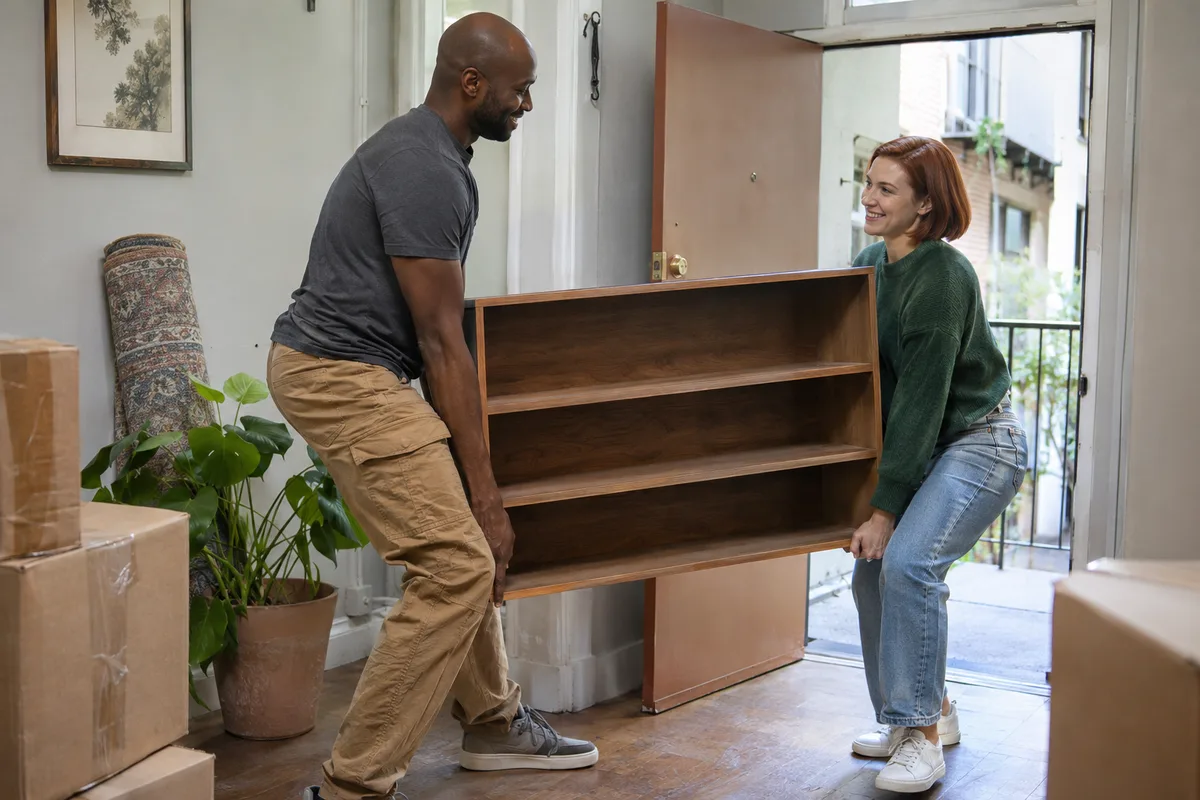
Model answer
A man and a woman are carrying an empty wooden bookcase through the doorway of an apartment. They hold one end each and smile at each other as they lift it. Cardboard boxes are piled against the wall on the left, next to a rolled-up rug and a large plant.
What makes it strong
- It opens with the main action and names the object exactly (an empty wooden bookcase).
- "One end each" explains how the two people work together.
- The last sentence moves to the background in a clear left-to-right order without guessing why they are moving.
Write your own description and get it graded free, no account needed.
Interactive Writing
You get 30 seconds to plan, 5 minutes for Part 1 and 3 minutes for Part 2.
Part 1: Should children be paid for helping with household chores? Explain your opinion with reasons and examples.
Part 2 (shown after Part 1): Apart from pocket money, how can parents teach children to manage money well? Give specific examples.
Model answers
Part 1. I don't think children should be paid for ordinary household chores like washing the dishes or making their beds. These jobs are part of living in a family, and everyone benefits from a clean, organized home. If children are paid for each task, they may start asking what they will get before they agree to help, even when a parent is sick or tired. When I was younger, my brother and I had a weekly list of chores, and nobody paid us. We still learned to cook simple meals and keep our room tidy, and I think we learned to notice when something needed doing. However, I can see a case for paying children for bigger jobs that go beyond normal family duties, such as washing the car or helping a neighbor in the garden. That way, they can still learn that extra work earns money.
Part 2. One effective way is to let children make small spending decisions on their own. For example, parents could give a child a fixed amount for a school trip and let them choose how to spend it. If they spend everything on the first day, they learn from the mistake. Parents can also show children how they plan the family's weekly shopping, comparing prices and sticking to a list. Seeing real decisions is more useful than hearing general advice.
What makes it strong
- The first sentence gives a clear position, so the reader knows the answer straight away.
- The personal example (a weekly list of chores) supports the reason instead of repeating it.
- "However, I can see a case for..." adds a limit to the opinion, which makes the argument more convincing.
- The follow-up answers a new question with two concrete methods and does not repeat the first answer.
How to use the PDF
- Time yourself. Use the time at the top of each section. Read and Select only works as practice if you keep to about 5 seconds a word.
- Answer everything before you check. Write answers on a separate sheet or on the lines in the PDF. For speaking prompts, record yourself on your phone.
- Read the explanations, not just the key. For each mistake, find the clue the explanation points to, then read the question again.
- Get your writing and speaking graded. Paper can’t tell you how your answer would score. Type or record one answer on PrepEx and compare the feedback with the model in the PDF.
- Move to timed practice online. When the formats feel familiar, use the Practice Hub or a full-length practice test with the real timing.
Listening and Interactive Speaking: practise online
Three question types depend on audio, so the PDF gives you a link and a QR code for each one instead of a printed version.
- Listen and Type. You hear a sentence and type exactly what you heard. You can play it up to three times and have 1 minute for each sentence. Practise Listen and Type online
- Interactive Listening. You hear a conversation on campus, complete sentences about it, choose the best replies as it continues, then write a summary. The first two parts share 6 minutes 30 seconds; the summary has 75 seconds. Practise Interactive Listening online
- Interactive Speaking. A character asks you 6 to 8 questions, one at a time, on two topics. You hear each question once and have 35 seconds to answer. Practise Interactive Speaking online
The DET Listening practice guide explains both listening tasks in more detail.
Questions about the PDF
Is there an official Duolingo English Test PDF?
Yes. Duolingo publishes a free DET Question Guide (2026) that shows each question type with its timing, scoring and tips, and a Practice Questions book (Volume 5, 2026) with paper-based questions, audio QR codes and answers. Neither contains questions from the certified test. This PrepEx PDF adds original practice questions with an explanation for every answer. The official PDFs are listed under References below.
Is this PDF free, and do I need to sign up?
It’s free, and you don’t need to sign up. The download button opens the PDF directly, without an account or an email address.
Can I practise listening from a PDF?
Not in a useful way. Listen and Type lets you play each sentence up to three times, Interactive Listening plays parts of the conversation only once, and Interactive Speaking asks its questions aloud. A printed transcript would turn these into reading tasks, so the PDF links to free online practice for all three.
Where can I get my writing checked?
On PrepEx. Write About the Photo, Interactive Writing and Writing Sample can be graded without an account, with two AI-graded answers a day. A free account gives you one free question in every question type, including speaking. DET Pro adds unlimited grading.
Are these real Duolingo English Test questions?
No. PrepEx Editorial wrote every question, answer and model response in the current formats. Duolingo says the certified test draws its questions from a very large pool, so practising the question types is more useful than memorizing questions.
How is this different from Duolingo’s free Practice Test?
Duolingo’s free online Practice Test adapts to your answers and ends with an estimated overall score range. This PDF is for slower, untimed or timed work on paper, with an explanation for every answer. Use both: the PDF to learn each question type, and timed online practice to check your level.
References
- Duolingo: DET Question Guide (2026), PDF: englishtest-static.duolingo.com
- Duolingo: DET Practice Questions, Volume 5 (2026), PDF: englishtest-static.duolingo.com
- Duolingo Help Center: Test Structure: testcenter.zendesk.com
- Duolingo Help Center: The Practice Test: testcenter.zendesk.com
- Duolingo Help Center: What is the Sample Test?: testcenter.zendesk.com
- PrepEx Journal: Duolingo English Test sample questions, one of each type
Checked on 25 November 2026 by PrepEx Editorial. Every question, answer and model response in the PDF and on this page is original PrepEx Editorial material. The photos are PrepEx images. PrepEx is a member of the Duolingo English Test Global Partner Network.