The PrepEx Journal
IELTS Syllabus 2026 and Exam Pattern: Academic and General Training, Section by Section
The IELTS syllabus is four sections in 2 hours 45 minutes: Listening (about 30 minutes, 40 questions), Reading (60 minutes, 40 questions), Writing (60 minutes, two tasks) and Speaking (11–14 minutes, three parts). Academic and General Training differ only in the Reading texts and Writing Task 1, and the format hasn't changed in 2026.
On this page
The IELTS syllabus and exam pattern for 2026 is four sections: Listening (about 30 minutes, 40 questions), Reading (60 minutes, 40 questions), Writing (60 minutes, two tasks) and Speaking (11–14 minutes, three parts), 2 hours 45 minutes in total. PrepEx's free IELTS diagnostic checks all four skills in about 15 minutes and shows which skill to work on first. Academic and General Training share the same Listening and Speaking; only the Reading texts and Writing Task 1 differ.
See where you stand in all four sections, free
The diagnostic has 10 Listening questions, a short Reading extract, a 50–80 word written opinion and three recorded Speaking answers. You get a practice band range for each skill and overall, plus the one skill to fix first.
Facts checked on 27 November 2026 against the Academic and General Training format pages and the IELTS Guide for test takers (2026 edition) on ielts.org, IDP's computer-delivered and test-day pages, and Cambridge University Press & Assessment's IELTS pages.
What is the IELTS exam pattern?
The IELTS exam pattern is four sections in a format that's the same in every country: Listening, Reading, Writing and Speaking. Listening, Reading and Writing are taken one after another with no breaks, and Speaking is a separate interview with an examiner. The whole test takes 2 hours 45 minutes.
| Section | Time | Parts | Questions or tasks | Task types | Academic vs General Training |
|---|---|---|---|---|---|
| Listening | About 30 minutes (30–34 on computer, with 2 minutes to check) | 4 parts | 40 questions | 6 types, from multiple choice to map labelling | Same test |
| Reading | 60 minutes, no extra transfer time | 3 sections | 40 questions | 11 types, from True/False/Not Given to matching headings | Different texts |
| Writing | 60 minutes | 2 tasks | Task 1: 150+ words; Task 2: 250+ words | Task 1 report or letter; Task 2 essay | Task 1 differs |
| Speaking | 11–14 minutes | 3 parts | Interview with an examiner | Short questions, a 2-minute talk, a discussion | Same test |
| Total | 2 hours 45 minutes | 4 sections | 80 marked questions, 2 writing tasks, 1 interview | All compulsory | Same scoring |
For IELTS, "syllabus" and "exam pattern" mean the same thing: the format of each section, its question types and the marking criteria. There are no set books or topics. The official version is free on ielts.org as a format page for each section and a short PDF, the IELTS Guide for test takers, both linked at the end of this page.
Is the IELTS syllabus the same for Academic and General Training?
Only half of the IELTS syllabus is the same: Listening and Speaking are identical in Academic and General Training; Reading uses different texts and Writing Task 1 is a different task. Task 2 is an essay in both, and both use the same 0–9 band scale.
| Section | IELTS Academic | IELTS General Training |
|---|---|---|
| Listening | Identical: 4 parts, 40 questions | |
| Reading texts | 3 long texts (2,150–2,750 words in all) from books, journals, magazines, newspapers and online sources | 5 or 6 texts: everyday notices and adverts, two work texts, then one longer general-interest text |
| Writing Task 1 | Describe a graph, table, chart or diagram in at least 150 words | A personal, semi-formal or formal letter of at least 150 words, covering three bullet points |
| Writing Task 2 | An essay of at least 250 words on a point of view, argument or problem | |
| Speaking | Identical: 3 parts, 11–14 minutes | |
| Reading marks for band 7 (IELTS's published average) | About 30 out of 40 | 34–35 correct (IELTS's own average is 35) |
Neither version is "better": General Training texts are more familiar, so the same Reading band needs more correct answers. Book the one your university, employer or visa route names; our Academic vs General Training guide walks through that choice.
IELTS Listening syllabus: 4 parts, 40 questions
IELTS Listening has four recordings with 10 questions each, 40 in total, and takes about 30 minutes. You hear each recording once, and the questions follow the order of the recording. Academic and General Training take exactly the same Listening test.
| Part | Who speaks | Setting | Example |
|---|---|---|---|
| Part 1 | Two people in conversation | Everyday social | Arranging travel or accommodation |
| Part 2 | One main speaker | Everyday social | A talk about local facilities |
| Part 3 | Two main speakers, sometimes with a tutor (up to four people) | Education or training | Students discussing an assignment |
| Part 4 | One speaker | Academic | A university lecture |
The official list has six question types:
- Multiple choice: one answer, or two or more from a longer list.
- Matching: link items to a list of options.
- Plan, map or diagram labelling: choose labels from a list.
- Form, note, table or flow-chart completion: fill gaps with words you hear.
- Sentence completion.
- Short-answer questions.
On computer you get reading time before each part, review time after it and 2 minutes at the end to check, so the section runs 30–34 minutes. The 10-minute transfer time in older guides belonged to the paper test. Each correct answer earns one mark. Spelling counts, British and American spellings are both accepted, and capitals or lower case make no difference. If the instruction says NO MORE THAN TWO WORDS AND/OR A NUMBER, a three-word answer is wrong even when the words are right.
The Listening mistakes we see most in PrepEx practice are going over the word limit, dropping a plural "s", and missing the next answer while still thinking about the last one. The IELTS Listening band score chart converts marks into bands.
IELTS Reading syllabus: question types for Academic and General Training
IELTS Reading is 60 minutes, three sections and 40 questions, one mark each, with no extra transfer time. Both versions use the same 11 question types: IDP lists all 11 for General Training, and ielts.org's General Training page groups them under eight headings.
| Question type | What you do | Academic | General Training |
|---|---|---|---|
| Multiple choice | Pick one answer, or several from a list | Yes | Yes |
| True / False / Not Given | Decide whether statements agree with the information | Yes | Yes |
| Yes / No / Not Given | Decide whether statements agree with the writer's views | Yes | Yes (IDP's list; not a separate heading on ielts.org) |
| Matching information | Find the paragraph that contains a detail | Yes | Yes |
| Matching headings | Match a heading to each paragraph's main idea | Yes | Yes |
| Matching features | Match statements to people, places or other features | Yes | Yes |
| Matching sentence endings | Choose the ending that completes each sentence | Yes | Yes (IDP's list; not a separate heading on ielts.org) |
| Sentence completion | Fill gaps with words from the text | Yes | Yes |
| Summary, note, table or flow-chart completion | Fill gaps with words from the text or from a box | Yes | Yes |
| Diagram label completion | Label a diagram described in the text | Yes | Yes |
| Short-answer questions | Answer questions with words from the text | Yes | Yes |
Answer order depends on the type. Multiple choice, sentence completion and short-answer questions follow the order of the text, and so do the sentence beginnings in matching endings. Summary, table, flow-chart and diagram answers may not, though they usually come from one part of the text. Matching information and features can send you anywhere in the passage. Word limits work as in Listening, and spelling or grammar mistakes in an answer lose the mark.
General Training learners should practise all 11, with extra time on True/False/Not Given and the completion tasks. In PrepEx Reading practice, most lost marks come from choosing False when the text simply doesn't say, and from answering with what you already know about the topic. Two expert-written passages are free in PrepEx's Reading practice and are scored as soon as you submit. The IELTS Reading band score chart has both conversions.
IELTS Writing syllabus: Task 1 and Task 2 requirements
IELTS Writing gives you 60 minutes for two tasks: Task 1 needs at least 150 words in about 20 minutes, and Task 2 at least 250 words in about 40 minutes. Task 2 counts twice as much as Task 1 towards your Writing band.
| Requirement | Task 1 | Task 2 |
|---|---|---|
| Academic | Describe a graph, table, chart or diagram (an object, device, process or event) in your own words | Essay responding to a point of view, argument or problem |
| General Training | Letter responding to a situation, personal, semi-formal or formal, covering three bullet points | Essay responding to a point of view, argument or problem; examples can come from your own experience |
| Minimum length | 150 words | 250 words |
| Suggested time | About 20 minutes | About 40 minutes |
| Share of the Writing band | One third | Two thirds |
- Full sentences only. Notes and bullet points are penalised; IELTS wants connected text.
- Answer the question set. Off-topic writing is penalised, copied text severely, and a totally memorised answer can get band 0.
- Short answers lose marks indirectly. There's no automatic deduction under 150 or 250 words, but a short answer rarely shows enough to reach the higher bands.
- Four criteria, equal weight: Task Achievement (Task 1) or Task Response (Task 2), Coherence and Cohesion, Lexical Resource, and Grammatical Range and Accuracy.
On computer you type your answers. In selected countries, including India, you can book IELTS on computer with Writing on Paper and write by hand in pen instead; the tasks, timing and marking are the same.
Example: one way to split the 60 minutes
Minutes 0–10: read Task 2, choose a position, plan four paragraphs. 10–30: write 270–300 words. 30–40: proofread and check every part of the question is answered, the split ielts.org suggests. 40–43: find the Task 1 overview (Academic) or the three bullet points (General Training). 43–57: write about 170 words. 57–60: check spelling and word count.
When we mark practice Writing on PrepEx, the commonest Task 1 problems are a missing overview in Academic reports and a skipped bullet point in General Training letters. In Task 2 it's answering only half of a two-part question. For the letter, see our General Training Task 1 letter guide.
IELTS Speaking syllabus: Parts 1, 2 and 3
IELTS Speaking is an 11–14 minute recorded interview with an examiner, in three parts. It's the same for Academic and General Training: face to face at a test centre, or by video call in IELTS Online.
| Part | Time | What happens |
|---|---|---|
| Part 1: introduction and interview | 4–5 minutes | An ID check, then questions on familiar topics such as home, family, work, studies and interests |
| Part 2: long turn | 3–4 minutes | A task card, 1 minute to make notes, then talk for 2 minutes until the examiner stops you, then one or two follow-up questions |
| Part 3: discussion | 4–5 minutes | More general, abstract questions linked to the Part 2 topic |
Examiners mark four criteria with equal weight: Fluency and Coherence, Lexical Resource, Grammatical Range and Accuracy, and Pronunciation. In PrepEx Speaking practice the two habits that hold scores down are rehearsed Part 1 answers that don't quite fit the question, and stopping a Part 2 talk after about a minute. PrepEx's free Speaking mock test runs timed Parts 1–3 in your browser, and the recording stays on your device. For practice questions by theme, see IELTS Speaking topics.
IELTS test day: order of sections and total duration
The IELTS test takes 2 hours 45 minutes. Listening, Reading and Writing are taken on the same day, one after another with no breaks, normally in that order. Speaking may be on the same day or up to a week before or after, and your booking confirmation gives the time.
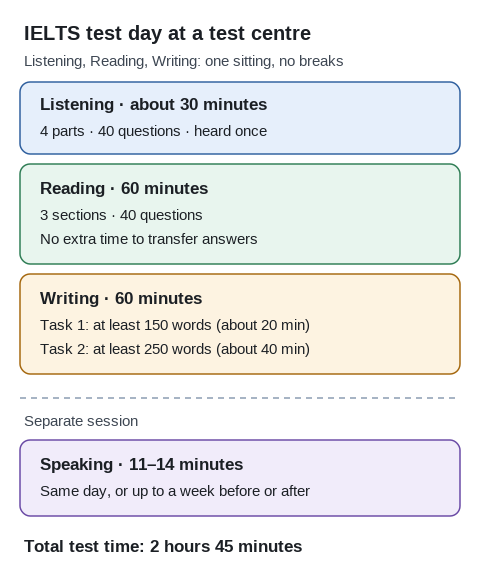
Bring the same passport or ID you booked with. Phones and smartwatches stay outside the room, and on computer the centre gives you pencils and paper for notes. Fees differ by country and test type; our IELTS exam fee guide lists them.
Computer, Writing on Paper or IELTS Online: does the pattern change?
No. IELTS on computer, IELTS on computer with Writing on Paper and IELTS Online use the same format, questions and scoring. Paper-based IELTS ended from mid-2026; in India the last paper tests were in August 2026.
| Option | Where and which test | How you answer | Results |
|---|---|---|---|
| IELTS on computer | Test centre; Academic, General Training and IELTS for UKVI | Listening, Reading and Writing on screen; Speaking face to face | 1–5 days |
| IELTS on computer with Writing on Paper | Test centre in selected countries; Academic and General Training, not UKVI | As above, but Writing handwritten in pen | Within 5 days |
| IELTS Online | At home in some countries; Academic only | On screen; Speaking by video call, usually before the other sections | 6–8 days |
IELTS for UKVI has the same content, format and scoring as Academic or General Training, with extra security at approved centres. Country-by-country end dates for paper tests are in our guide to IELTS changes in 2026.
How is IELTS scored?
Each section gets a band from 0 to 9, in whole or half bands, and your overall band is the average of the four, rounded to the nearest half band. An average ending in .25 rounds up to the next half band, and one ending in .75 rounds up to the next whole band.
Listening and Reading give one mark per correct answer, out of 40, and the total converts to a band. Writing scores each task on its four criteria, with Task 2 counting double. Speaking is the average of its four criteria. The marks below are IELTS's published averages; the exact number varies slightly between test versions.
| Band | Listening | Academic Reading | General Training Reading |
|---|---|---|---|
| 5 | 16 | 15 | 23 |
| 6 | 23 | 23 | 30 |
| 7 | 30 | 30 | 35 (34 can be enough) |
| 8 | 35 | 35 | Not published |
Example: two overall bands
Listening 7.0, Reading 7.0, Writing 6.5, Speaking 6.5 adds up to 27, an average of 6.75, so the overall band is 7.0. Listening 6.5, Reading 6.0, Writing 6.0, Speaking 6.0 averages 6.125, which rounds down to 6.0.
The IELTS band score calculator does this for you and converts Listening and Reading marks. Our guide to how IELTS band scores are rounded covers the edge cases.
What is not in the IELTS syllabus?
IELTS has no separate grammar or vocabulary paper, no fixed topic list, no negative marking and no pass mark.
- No grammar or vocabulary section. Both are two of the four criteria in Writing and Speaking, and spelling and word form count in Listening and Reading answers.
- No topic list or set books. IELTS doesn't publish topics. Texts are of general interest, Academic Reading explains any technical terms, and Speaking starts with familiar subjects.
- No negative marking. A wrong answer in Listening or Reading scores zero, the same as a blank, so answer every question.
- No pass or fail. You get band scores, and each university, employer or visa route sets its own minimum, often for each skill as well as overall.
- No choice of questions. Every Listening and Reading question and both Writing tasks are compulsory.
How to cover the IELTS syllabus in 4 or 8 weeks
Four weeks at about 90 minutes a day is enough to learn every question type and fix one weak area; eight weeks lets you work on two weak skills properly. Start with a baseline and practise all four skills every week.
| Week | Listening and Reading | Writing | Speaking |
|---|---|---|---|
| 1 | Take a baseline test; learn the six Listening types and all 11 Reading types | Read the task rules; write one Task 1 and one Task 2 without a timer | Record Part 1 answers on five familiar topics and listen back |
| 2 | One timed Listening part and one Reading passage a day; log each wrong answer by question type | Two Task 2 essays in 40 minutes each; check them against the four criteria | Part 2 every day: 1 minute of notes, 2 minutes of speaking |
| 3 | Drill your two weakest question types from the log | Task 1 overviews (Academic) or all three bullet points (General Training) | Part 3: give a reason and an example in every answer |
| 4 | One full timed Listening and Reading test, then review every error | Two full 60-minute Writing sessions | A full Parts 1–3 mock with timing |
Free PrepEx tools cover the baseline and daily drills: the diagnostic for the baseline, two scored submissions a day in the Practice Hub, and the timed Speaking mock. IELTS Pro adds unlimited scored practice in all four skills and full-length IELTS Academic practice tests with section timing for week 4. If you're taking General Training, use it for Listening, Task 2 and Speaking, and add official General Training Reading samples and letter practice.
IELTS syllabus and exam pattern FAQ
Is the IELTS syllabus the same for Academic and General Training?
Listening and Speaking are identical. Reading uses three long academic passages in Academic, and everyday, workplace and general-interest texts in General Training. Writing Task 1 is a chart or diagram report in Academic and a letter in General Training. Task 2 is an essay in both, and both use the same 0–9 band scale.
Has the IELTS exam pattern changed in 2026?
No. The IELTS format hasn't changed in 2026: the sections, question types and scoring are the same, and nothing official says the test is harder. On computer, Listening ends with 2 minutes to check instead of 10 minutes to transfer answers. The change is delivery. Paper-based IELTS ended from mid-2026, so you take it on computer, with Writing on Paper in selected countries or IELTS Online for Academic at home.
Is there negative marking in IELTS?
No. In Listening and Reading each correct answer earns one mark and a wrong answer earns nothing, so a guess can't cost you anything; never leave a blank. You still lose the mark for a misspelled answer or one over the word limit. Writing and Speaking are marked against criteria instead.
How many questions are in the IELTS exam?
Listening and Reading have 40 questions each, 80 marked questions in all. Writing has two tasks of at least 150 and 250 words. Speaking has three parts with no fixed number of questions: short questions in Part 1, one task card in Part 2 and a discussion in Part 3. The numbers are the same for Academic and General Training.
How long is the IELTS exam?
The IELTS exam takes 2 hours 45 minutes: Listening about 30 minutes (30–34 on computer), Reading 60 minutes, Writing 60 minutes and Speaking 11–14 minutes. The first three run back to back with no breaks. Speaking can be on the same day or up to a week before or after.
Is there an official IELTS syllabus PDF?
IELTS doesn't publish a document called a syllabus. The closest official PDF is the free IELTS Guide for test takers on ielts.org, which covers the four sections, timings and results, and the official format page for each section lists every question type with its rules. Both are linked at the end of this page.
Is the IELTS syllabus different in India, Pakistan, Bangladesh or Nepal?
No. IELTS has one format worldwide, so the syllabus, timings and scoring are the same in every country. What varies is how you take it. In India the last paper-based tests were in August 2026, and you now choose IELTS on computer, with or without Writing on Paper. Your country's IDP or British Council page lists the options.
Is there an age limit for IELTS?
IDP, one of the organisations that runs IELTS, says there is no age limit. It recommends taking IELTS from age 16, mainly because results are usually accepted for two years and an early score may expire before you need it. Rules for younger test takers vary by country and centre, so check with your centre before you book.
How many times can you take IELTS?
As many times as you like. IELTS has no limit on attempts and no compulsory waiting period, so you can book again as soon as a date is free. If you missed your target in one skill, IELTS One Skill Retake lets you retake that section within 60 days of an IELTS on computer test, once per test; check that the organisation you're applying to accepts it. Before you rebook, PrepEx's free diagnostic shows which skill to work on first.
What books cover the IELTS syllabus?
The numbered Cambridge IELTS books from Cambridge University Press & Assessment contain complete practice tests in the official format (IELTS 21 Academic, published in July 2026, has four), and The Official Cambridge Guide to IELTS explains how to tackle each part of the exam for both Academic and General Training. Between books, PrepEx's free diagnostic and Practice Hub samples score your answers instantly.
Sources
- IELTS Guide for test takers, PDF (IELTS), checked 27 November 2026
- IELTS Academic test (IELTS), checked 27 November 2026
- IELTS General Training test (IELTS), checked 27 November 2026
- IELTS Academic: Listening test format (IELTS), checked 27 November 2026
- IELTS General Training: Listening test format (IELTS), checked 27 November 2026
- IELTS Academic: Reading test format (IELTS), checked 27 November 2026
- IELTS General Training: Reading test format (IELTS), checked 27 November 2026
- IELTS Academic: Writing test format (IELTS), checked 27 November 2026
- IELTS General Training: Writing test format (IELTS), checked 27 November 2026
- 10 steps to writing high-scoring IELTS essays (IELTS), checked 27 November 2026
- IELTS Academic: Speaking test format (IELTS), checked 27 November 2026
- IELTS scoring in detail (IELTS), checked 27 November 2026
- IELTS Writing band descriptors, May 2023, PDF (IELTS), checked 27 November 2026
- IELTS One Skill Retake (IELTS), checked 27 November 2026
- Ways to take IELTS (IELTS), checked 27 November 2026
- Important update to IELTS test delivery from mid-2026 (IELTS), checked 27 November 2026
- IELTS on computer test format (IDP), checked 27 November 2026
- IELTS Listening on computer (IDP Nepal), checked 27 November 2026
- IELTS Reading band scores (IDP Pakistan), checked 27 November 2026
- IELTS Reading common mistakes (IDP Nepal), checked 27 November 2026
- Question types in the General Training Reading test (IDP Pakistan), checked 27 November 2026
- IELTS test day (IDP Pakistan), checked 27 November 2026
- IELTS Academic for UKVI (IDP Hong Kong), checked 27 November 2026
- How many times can you take IELTS? (IDP Philippines), checked 27 November 2026
- How old can you be to take the IELTS test? (IDP Vietnam), checked 27 November 2026
- IELTS 21 Academic and The Official Cambridge Guide to IELTS product pages (Cambridge University Press & Assessment shop), checked 27 November 2026
- IELTS results (Cambridge University Press & Assessment), checked 27 November 2026
- IELTS Academic frequently asked questions, PDF (Cambridge University Press & Assessment), checked 27 November 2026
Keep exploring
More from the journal