The PrepEx Journal
IELTS Listening Band Score Chart 2026: Raw Score to Band (Out of 40)
IELTS Listening is marked out of 40, one mark per correct answer: 30–31 correct is band 7, 26–29 is 6.5, 23–25 is 6, 35–36 is 8 and 39–40 is 9, for Academic and General Training alike. The full chart, how many mistakes each band allows, the marking rules and the 2026 computer timing.

On this page
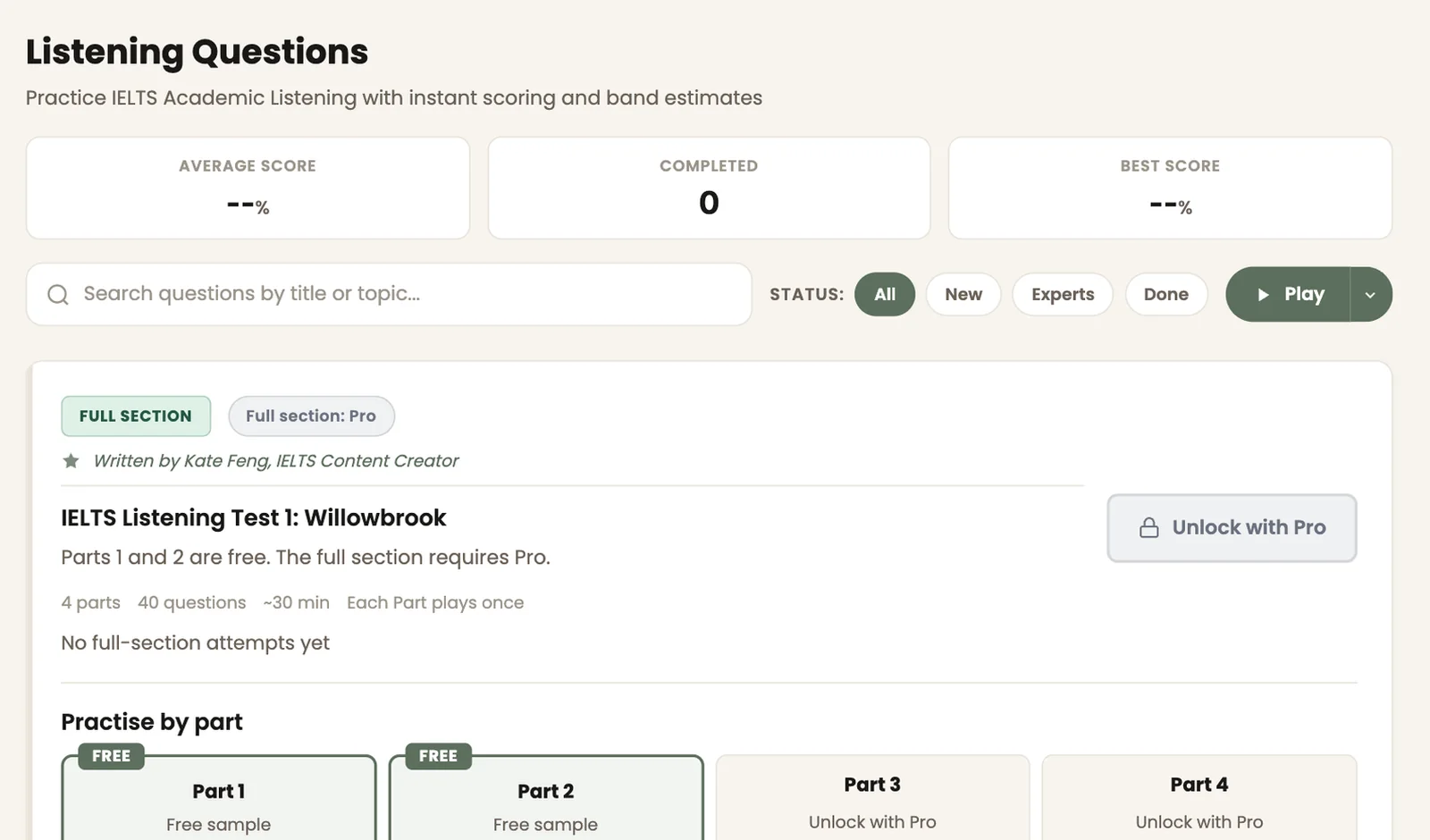
IELTS Listening is marked out of 40, one mark per correct answer, and Academic and General Training use the same chart to turn that score into a band: 30–31 correct is band 7, 26–29 is 6.5, 23–25 is 6, 35–36 is 8 and 39–40 is 9. PrepEx's free Willowbrook Listening practice (Parts 1 and 2) scores your answers instantly and gives you a practice band, so you can see where you are on this chart today.
Check your Listening band free
Answer the two free Willowbrook parts and get your score with feedback on each question. Already have a score out of 40 from another test? Type it into the band calculator and add your other three skills to see your overall band.
Facts checked on 27 November 2026 against the IELTS scoring and Listening format pages on ielts.org, IDP IELTS's Listening score and test-day pages, and the British Council's IELTS assessment pages.
IELTS Listening band score chart 2026 (raw score out of 40)
The IELTS Listening band score chart turns your correct answers out of 40 into a band: 39–40 is band 9, 35–36 is 8, 30–31 is 7, 23–25 is 6 and 16–17 is 5. The full chart below is the one IDP IELTS publishes, and the British Council's chart gives the same ranges for bands 5, 6, 7, 8 and 9.
| Correct answers (out of 40) | Listening band | Questions missed or left blank |
|---|---|---|
| 39–40 | 9.0 | 0–1 |
| 37–38 | 8.5 | 2–3 |
| 35–36 | 8.0 | 4–5 |
| 32–34 | 7.5 | 6–8 |
| 30–31 | 7.0 | 9–10 |
| 26–29 | 6.5 | 11–14 |
| 23–25 | 6.0 | 15–17 |
| 18–22 | 5.5 | 18–22 |
| 16–17 | 5.0 | 23–24 |
| 13–15 | 4.5 | 25–27 |
| 11–12 | 4.0 | 28–29 |
IELTS labels the whole bands 9 Expert user, 8 Very good user, 7 Good user, 6 Competent user, 5 Modest user and 4 Limited user.
IELTS describes these numbers as the average marks needed for each band. Its scoring page says the precise number of marks for a band varies slightly from one test version to another, and IDP puts this down to the different questions used on different occasions. So 30 is the usual start of band 7, but the exact line on your test version can differ slightly.
Two more things the chart doesn't show. The Listening chart stops at band 4 (11–12 correct); PrepEx's calculator shows anything lower as below band 4.0. And bands are reported only in whole and half steps, such as 6.5 or 7.0, never 6.75.
How many correct answers do you need for band 6, 6.5, 7, 7.5 or 8 in IELTS Listening?
In IELTS Listening you need about 23 correct answers out of 40 for band 6, 26 for 6.5, 30 for 7, 32 for 7.5 and 35 for band 8. Turned around, band 7 allows roughly ten mistakes and band 8 allows five.
| Target Listening band | Correct answers needed | Most you can miss | Share of answers right |
|---|---|---|---|
| 5.5 | 18 | 22 | 45% |
| 6.0 | 23 | 17 | 58% |
| 6.5 | 26 | 14 | 65% |
| 7.0 | 30 | 10 | 75% |
| 7.5 | 32 | 8 | 80% |
| 8.0 | 35 | 5 | 88% |
| 8.5 | 37 | 3 | 93% |
| 9.0 | 39 | 1 | 98% |
A wrong answer and an empty box both score zero, and nothing is taken off for guessing: your band comes from the total you get right. IDP's own advice is to answer every question, because a blank can never earn the mark.
The bands aren't the same width. Band 6.5 covers four scores (26 to 29), so you can go from 26 to 29 correct without your band moving, then move up half a band with the next answer. Bands 8, 8.5 and 9 cover only two scores each. If your practice scores sit at 28 or 29, you are one or two answers from band 7, and those answers are usually easier to find than they look (see where marks are lost).
Is the IELTS Listening score the same for Academic and General Training?
Yes, the IELTS Listening band score is the same for Academic and General Training, because both take the same Listening test. The general IELTS Listening score and the academic IELTS Listening score come from one chart: 30 correct is band 7 in both. IELTS says the Listening and Speaking sections are the same in the two tests, and the British Council says the Listening marking applies equally to both.
Reading is where the two tests split. Academic and General Training Reading use different texts and different conversion tables, and General Training Reading needs more correct answers for the same band. If you also want your Reading band, use our IELTS Reading band score chart for the right version.
How is IELTS Listening marked?
Each of the 40 Listening questions is worth one mark, and an answer only gets that mark if it matches the recording, is spelt correctly and stays within the word limit. The test has four parts of ten questions, you hear each recording once, and the questions follow the order of the information in the recording. Our IELTS syllabus and exam pattern guide sets out the format of all four skills.
- Spelling counts. A misspelt word is marked wrong, even if you understood it. IDP's example is a word heard correctly and written with a letter missing.
- British and American spellings are both accepted. "Colour" and "color" both score. The British Council and IDP both suggest keeping to one style.
- Capital letters are allowed. The British Council says you're fully permitted to write all Listening and Reading answers in block capitals.
- The word limit is strict. Instructions such as NO MORE THAN TWO WORDS AND/OR A NUMBER change from task to task, and writing more than the limit loses the mark. A hyphenated word such as "check-in" counts as one word, and contracted forms such as "they're" aren't tested.
- Numbers can be digits or words. "320" and "three hundred and twenty" both count as a number.
- Singular and plural matter. IDP lists writing "cat" when the answer was "cats" among the small slips that cost a mark.
- Write the words you hear. For gap-fills, IELTS says you don't have to change the words in the recording in any way, so write what the speaker says rather than rephrasing it.
Here is one original gap-fill and how five different answers to it would be marked.
Instruction: Write ONE WORD ONLY. Gap: Bring a ______ for the locker. Speaker: "On your first day, please bring a padlock for your locker."
| Answer written | Mark | Why |
|---|---|---|
| padlock | 1 | The word from the recording, one word |
| PADLOCK | 1 | Block capitals are allowed |
| a padlock | 0 | Two words, so over the limit |
| padlocks | 0 | The speaker means one padlock, and "a ___" needs a singular noun |
| padlok | 0 | Misspelt |
The same rules work for numbers and spelling variants. If the instruction is ONE WORD AND/OR A NUMBER and the gap is "The tour lasts ___ minutes" and the speaker says ninety, both "90" and "ninety" score, and "ninty" doesn't. If the answer is a theatre, "theatre" and "theater" both score.
How long is the IELTS Listening test on computer in 2026?
IELTS Listening on computer takes about 30 to 34 minutes in 2026: about 30 minutes of recordings and questions, review time after each part and 2 minutes at the end to check your answers, with no 10-minute transfer time. You also get time to read the questions before each part.
The 10 minutes of transfer time you may have read about belonged to the paper test, where you wrote on the question paper and copied your answers onto an answer sheet at the end. On 5 March 2026 IELTS announced that it would stop offering paper-based IELTS from mid-2026, with dates that varied by country, and that all tests would be delivered on computer. Even if you choose Writing on Paper, Listening is on screen.
| Detail | Paper test (ended from mid-2026) | Computer test (2026) |
|---|---|---|
| Recordings and questions | About 30 minutes | About 30 minutes |
| Time at the end | 10 minutes to transfer answers to the answer sheet | 2 minutes to check answers |
| Where answers go | Question paper, then answer sheet | Typed straight into the answer boxes |
| Total section time | About 40 minutes | About 30–34 minutes |
The questions, scoring and band chart didn't change with the move to computer. What changes is your routine. Type each answer as you hear it, because there's no spare time at the end to rebuild answers from notes. Use the 2 minutes for a spelling and empty-box check. IDP warns that typing slips count as spelling mistakes, so "teh" for "the" costs the mark just as a handwritten error would. The British Council lists highlighting and note-taking tools on the computer test. Our guide to IELTS on computer has a practice routine for the screen.
Worked examples: from raw score to Listening band
In IELTS Listening, 29 out of 40 is band 6.5, 30 is band 7.0, 34 is band 7.5 and 25 is band 6.0. The examples below are original illustrations of how one answer moves you across a band line, not results from real tests.
29 out of 40. On the chart 29 is band 6.5, the top of the 26–29 range. One more correct answer, 30, is band 7.0.
Say the 29 came from Part 1: 9, Part 2: 8, Part 3: 6, Part 4: 6. The Part 1 miss was "Wensday" for Wednesday. Fixing that one spelling would have meant 30 and band 7, without understanding a single extra sentence.
34 out of 40. 34 is band 7.5, the top of the 32–34 range; 35 is band 8.0. At this level the misses are usually in Part 3 multiple choice and the Part 4 lecture, so the work is on following an argument, not on form-filling.
25 out of 40. 25 is band 6.0, and 26 is 6.5. As the next section shows, that one answer can also move your overall band.
How does your Listening band affect your overall IELTS band?
Your Listening band counts for a quarter of your overall IELTS band: IELTS adds the Listening, Reading, Writing and Speaking bands, divides by four and rounds to the nearest half band. An average ending in .25 rounds up to the next half band, and one ending in .75 rounds up to the next whole band.
| Listening correct | Listening band | Total of four bands | Average | Overall band |
|---|---|---|---|---|
| 25 / 40 | 6.0 | 24.5 | 6.125 | 6.0 |
| 26 / 40 | 6.5 | 25.0 | 6.25 | 6.5 |
Here one extra Listening answer lifts the overall result from 6.0 to 6.5. That's why Listening is often the easiest place to find half a band: the marks are objective, and the lost ones are usually visible when you check your answers.
The overall band isn't the only number that matters. Many universities and visa routes also set a minimum for each skill, so a strong overall can still miss a Listening requirement. Our guide to how IELTS band scores are calculated and rounded works through more cases, and what counts as a good IELTS score covers typical requirements. To try your own numbers, the IELTS band score calculator converts a Listening score out of 40 and works out the overall band.
Where IELTS Listening marks are usually lost, and what to practise
Many IELTS Listening marks are lost to spelling, plurals, word limits and distractors rather than to not understanding the recording. These are the patterns that come up most often in the Listening practice answers PrepEx marks.
| Where | The slip | What to practise |
|---|---|---|
| Part 1 forms | Names spelt letter by letter, numbers such as fifteen and fifty, phone numbers and dates | Letter and number dictation, especially letters that sound alike (A, E and I; G and J; M and N) |
| Any gap-fill | Common words heard correctly and spelt wrongly: accommodation, environment, Wednesday, February | A personal spelling list built from every practice test, rewritten until it's automatic |
| Any gap-fill | A missing plural -s or the wrong word form | Reading the words around the gap before you listen: "a", "many" and "two" tell you singular or plural |
| Any gap-fill | Going over the word limit by adding "a", "the" or a second noun | Underlining the word limit for every set of questions, because it changes |
| Parts 1 and 3 | Writing the first thing you hear when the speaker then corrects it ("Tuesday, sorry, Thursday") | Waiting until the speaker finishes the point before you commit |
| Part 2 maps | Losing your place or confusing left and right after a turn | Map tasks with the starting point and direction marked before the audio begins |
| Part 4 lecture | Missing one answer and then losing the next two while searching | Following signpost words such as "firstly" and "on the other hand", and moving on when an answer has gone |
| On computer | Typos and answers typed into the wrong box | Typing practice tests on screen and using the final 2 minutes for a spelling scan |
Parts 1 and 2 deal with everyday situations; Part 3 is a conversation in an education or training setting and Part 4 is a talk on an academic subject. IDP notes that the difficulty rises through the test, which is why the band 7 to 8 work happens mostly in Parts 3 and 4. For map questions, our IELTS Listening map labelling guide covers directions, and the IELTS Listening practice guide deals with notes, distractors and answer checks.
The habit that moves scores fastest is a mistake log. After each practice section, write down every lost mark with its part, question type and reason: spelling, plural, word limit, distractor or not heard. After three or four sections, the log tells you which of these to practise. For a plan that covers all four skills, see how to get band 7 in IELTS. If you don't have a starting score yet, the free IELTS diagnostic takes about 15 minutes across all four skills and starts with 10 Listening questions you can begin without an account. For a full score out of 40 to read against this chart, IELTS Pro includes full-length Listening sections with timing and score review; Listening is the same in both tests, so they suit General Training candidates too. Our guide to free IELTS mock tests online covers other ways to get a full timed score.
IELTS Listening band score FAQ
Is 30 out of 40 a 7 in IELTS Listening?
Yes. On the published IELTS Listening chart, 30 or 31 correct answers out of 40 is band 7.0, and the chart is the same for Academic and General Training. 29 is band 6.5 and 32 is band 7.5. IELTS says the exact number of marks for each band can vary slightly between test versions, so 30 is the usual start of band 7 rather than a line fixed on every test.
How many mistakes can you make for band 7 in IELTS Listening?
About ten. Band 7 usually starts at 30 correct answers out of 40, so you can miss up to ten questions, and a blank counts as a miss. For band 8 (35 correct) you can miss about five, for band 6.5 (26 correct) about fourteen, and for band 6 (23 correct) about seventeen. Nothing is deducted for a wrong answer, so always write something in every box.
What band is 29 out of 40 in IELTS Listening?
29 out of 40 is band 6.5 in IELTS Listening, at the top of the 26–29 range, and 30 is usually band 7.0. A 29 often hides a misspelt word, a missing plural or an answer over the word limit, which are the easiest marks to win back. PrepEx's free Willowbrook Listening practice gives feedback on each question, so you can see exactly which marks you lost and why.
Is the IELTS Listening band score the same for Academic and General Training?
Yes. Academic and General Training candidates take the same IELTS Listening test, with the same 40 questions and the same raw-score chart, so 30 correct answers is band 7 in both. Only Reading and Writing differ between the two tests. General Training Reading has its own conversion table and needs more correct answers than Academic Reading for the same band.
How many correct answers do you need for band 8 in IELTS Listening?
You need about 35 correct answers out of 40 for band 8.0 in IELTS Listening, which means missing no more than five questions. 37 correct is usually band 8.5 and 39 is band 9.0. Because each of these bands covers only two raw scores, a single spelling mistake or plural can be the difference between 8.0 and 8.5.
Does spelling count in IELTS Listening?
Yes. In IELTS Listening a misspelt answer is marked wrong, even if you heard and understood the word, and on the computer test a typing slip counts as a spelling mistake. British and American spellings are both accepted, so "colour" and "color" both score, as long as the word is spelt correctly. IDP and the British Council suggest keeping to one spelling style.
Can I write IELTS Listening answers in capital letters?
Yes. The British Council says you are fully permitted to write all IELTS Listening and Reading answers in block capitals, for example a place name or a date, and recommends it because it avoids penalties from unclear handwriting or names written in lower case. If you write in lower case, start names and places with a capital. Spelling, the word limit and singular or plural still have to be right.
Is there negative marking in IELTS Listening?
No. IELTS Listening gives one mark for each correct answer and your band comes from the total you get right, so a wrong answer costs nothing more than an empty box. IDP's advice is to answer every question, because a blank answer can never earn the mark. If you are unsure, write your best guess within the word limit and move on.
Do you get 10 minutes to transfer answers in IELTS Listening on computer?
No. The 10 minutes of transfer time belonged to the paper test, which IELTS stopped offering from mid-2026. On the computer test you type answers straight into the boxes while you listen, you get time to review after each part, and you have 2 minutes at the end to check your answers. The whole section takes roughly 30 to 34 minutes.
How can I check my IELTS Listening band for free?
PrepEx's free Willowbrook Listening practice (Parts 1 and 2) scores your answers instantly with feedback on each question, and the free IELTS diagnostic includes 10 Listening questions and shows a band range for each skill. A free account includes two scored submissions a day, shared across the four skills. If you already have a score out of 40, the IELTS band score calculator converts it.
Sources
- IELTS scoring in detail: band scores explained (IELTS), checked 27 November 2026
- IELTS Academic: Listening test format (IELTS), checked 27 November 2026
- IELTS General Training: Listening test format (IELTS), checked 27 November 2026
- IELTS test types (IELTS), checked 27 November 2026
- Updates to IELTS test delivery, 5 March 2026 (IELTS), checked 27 November 2026
- IELTS Listening band scores (IDP IELTS), checked 27 November 2026
- IELTS on computer test format (IDP IELTS), checked 27 November 2026
- IELTS Listening test: pocket guide (IDP IELTS), checked 27 November 2026
- IELTS Listening tips to avoid common mistakes (IDP IELTS), checked 27 November 2026
- How to improve your spelling in the IELTS test (IDP IELTS), checked 27 November 2026
- IELTS assessment criteria and band score descriptors (British Council), checked 27 November 2026
- Is IELTS British or American? Spelling and accent rules (British Council), checked 27 November 2026
- Capital letters in English, with IELTS tips (British Council), checked 27 November 2026
- Free IELTS Listening practice tests (British Council), checked 27 November 2026
- IELTS on computer (British Council), checked 27 November 2026
Keep exploring
More from the journal