The PrepEx Journal
IELTS Reading Band Score Chart 2026: Academic and General Training (Out of 40)
IELTS Reading is marked out of 40 and converted to a band. Academic Reading band 7 needs about 30 correct answers and band 6 about 23; General Training needs more, about 34 for band 7 and 30 for band 6, because its texts are easier. Both charts, the marks needed for bands 6–8, marking rules and timing.

On this page
Your IELTS Reading band score depends on how many of the 40 questions you answer correctly: 30–32 is band 7 in Academic Reading and 34–35 in General Training, while band 6 is 23–26 and 30–31. PrepEx's free Reading practice scores Folio Passages 1 and 2 instantly, so you can see how many marks you're dropping and why. The cut-off can move by a mark between test versions, so aim above the lowest number.
Check your Reading band free
Answer two scored Reading passages, or type your correct answers out of 40 into the band score calculator and pick Academic or General Training.
Facts checked on 27 November 2026 against IELTS's scoring and Reading format pages on ielts.org, IDP's Reading band score charts, the British Council's IELTS assessment page and the IELTS test-taker FAQs published by Cambridge University Press & Assessment.
IELTS Reading band score chart 2026: Academic and General Training
The IELTS Reading band score chart converts your correct answers out of 40 into a band: in Academic Reading, 39–40 is band 9, 35–36 is band 8, 30–32 is band 7 and 23–26 is band 6. General Training uses a different chart that needs more correct answers for every band. Here are the two side by side, as IDP and the British Council publish them.
| Reading band | Academic Reading (correct out of 40) | General Training Reading (correct out of 40) | Skill level |
|---|---|---|---|
| 9 | 39–40 | 40 | Expert user |
| 8.5 | 37–38 | 39 | – |
| 8 | 35–36 | 37–38 | Very good user |
| 7.5 | 33–34 | 36 | – |
| 7 | 30–32 | 34–35 | Good user |
| 6.5 | 27–29 | 32–33 | – |
| 6 | 23–26 | 30–31 | Competent user |
| 5.5 | 19–22 | 27–29 | – |
| 5 | 15–18 | 23–26 | Modest user |
| 4.5 | 13–14 | 19–22 | – |
| 4 | 10–12 | 15–18 | Limited user |
Scores below the band 4.0 row show as below band 4.0 in PrepEx's calculator.
These are average conversions, not fixed cut-offs. IELTS says the precise number of marks needed for each band varies slightly from one test version to another; IDP puts this down to differences in the texts. IELTS's own scoring page gives a shorter list of average marks: for Academic, 15 for band 5, 23 for band 6, 30 for band 7 and 35 for band 8; for General Training, 15 for band 4, 23 for band 5, 30 for band 6 and 35 for band 7. Each of those is the lowest mark in the chart's range except General Training band 7: IELTS gives 35, while the IDP and British Council charts start band 7 at 34. So 34 can give band 7 in General Training, but 35 is the safer target.
Your Reading result is reported in whole or half bands and counts for a quarter of your overall band, which is the average of the four skills. Listening has its own chart: see the IELTS Listening band score chart.
How many correct answers do you need for band 6, 6.5, 7, 7.5 and 8 in IELTS Reading?
For band 7 in IELTS Reading you need about 30 correct answers out of 40 in Academic and about 34 in General Training. The gap is widest at bands 5 and 5.5 (eight answers) and narrows as the band rises: seven at band 6, four at band 7 and one at band 9.
| Target band | Academic: correct needed | Academic: questions you can miss | General Training: correct needed | General Training: questions you can miss | Extra correct answers General Training needs |
|---|---|---|---|---|---|
| 5.5 | 19 | 21 | 27 | 13 | 8 |
| 6 | 23 | 17 | 30 | 10 | 7 |
| 6.5 | 27 | 13 | 32 | 8 | 5 |
| 7 | 30 | 10 | 34 | 6 | 4 |
| 7.5 | 33 | 7 | 36 | 4 | 3 |
| 8 | 35 | 5 | 37 | 3 | 2 |
| 8.5 | 37 | 3 | 39 | 1 | 2 |
| 9 | 39 | 1 | 40 | 0 | 1 |
"Questions you can miss" counts wrong and blank answers together, because both score zero. At Academic band 7 you can drop ten questions across the whole paper, roughly three per passage. At General Training band 7 you can drop six, two per section.
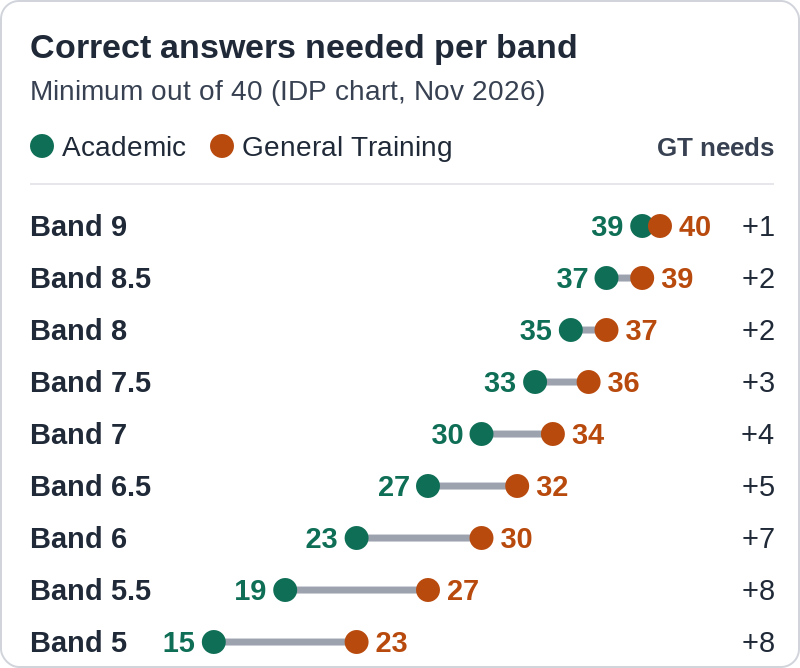
Why does General Training Reading need more correct answers?
General Training Reading needs more correct answers because its texts are usually easier to read. IELTS grades Academic and General Training Reading on the same 9-band scale, and it says Academic texts may have more difficult vocabulary or a more complex style. So to reach the same band, a General Training reader normally has to answer more questions correctly.
Compare what you read in each test. General Training Section 1 is everyday material such as notices, advertisements and timetables. Section 2 is about work: job descriptions, contracts and training materials. Only Section 3 is a longer general-interest text. Academic gives you three long texts from books, journals, magazines and newspapers, and at least one of them develops a detailed logical argument. Finding a closing time in a timetable is a smaller reading task than following an argument through a long article, so General Training sets the marks higher for the same band.
The higher numbers aren't a penalty. A band 7 describes the same level of reading on both tests; General Training asks you to show it with less room for error. That changes how you prepare. In General Training, a couple of careless slips on the shorter Section 1 and 2 texts can cost a whole half band, because band 7 leaves you only six questions to spare. In Academic, band 7 leaves you ten.
You can't pick the module to get an easier Reading chart: the university, employer or immigration authority you're applying to decides which one you need. Our guide to IELTS Academic vs General Training explains who asks for which.
IELTS Reading format: 60 minutes, 3 sections, 40 questions
IELTS Reading lasts 60 minutes and has three sections with 40 questions in total, in both Academic and General Training; the texts are what differ. IELTS stopped offering paper-based tests from mid-2026, on dates that vary by country, so Reading is now taken on computer: you choose or type each answer on screen. There's no extra time at the end, so answer as you go.
| Feature | Academic Reading | General Training Reading |
|---|---|---|
| Time | 60 minutes | 60 minutes |
| Sections | 3, one long text each | 3, of increasing difficulty |
| Questions | 40 | 40 (the IELTS FAQ gives 14 in Section 1 and 13 each in Sections 2 and 3) |
| Texts | Books, journals, magazines, newspapers and online sources written for a non-specialist reader; at least one text has a detailed logical argument; may include diagrams or graphs | Section 1: two or three short texts or several shorter ones (notices, adverts, timetables). Section 2: two work texts. Section 3: one longer, more complex general-interest text |
| Total text length | 2,150–2,750 words | 2,150–2,375 words |
| Question types | 11 types: multiple choice; True/False/Not Given; Yes/No/Not Given; matching information, headings, features and sentence endings; sentence, summary, note, table and flow-chart completion; diagram labels; short answers | The same 11 types: multiple choice; True/False/Not Given; Yes/No/Not Given; matching information, headings, features and sentence endings; sentence, summary, note, table and flow-chart completion; diagram labels; short answers (IDP's list; ielts.org groups them under eight headings, without separate Yes/No/Not Given or sentence-endings headings) |
| Marking | 1 mark per correct answer, converted to a band | 1 mark per correct answer, converted to a band |
If most of your practice so far has been in printed books, do some of it on screen before test day. Our guide to IELTS on computer covers what's different, and the IELTS syllabus and exam pattern shows how Reading fits with the other three skills.
How is IELTS Reading marked?
IELTS Reading is marked one mark per correct answer, with nothing taken away for a wrong answer; a blank and a wrong answer both score zero, so always guess. A written answer only counts if it's spelt correctly, stays within the word limit and fits the gap.
| Rule | What it means | Example |
|---|---|---|
| One mark per question | 40 questions, 40 marks. Wrong and blank answers score the same: zero. | Guessing the last two questions can only add marks. |
| Spelling counts | A misspelt word is marked wrong, even if you found the right place in the text. British and American spellings are both accepted. | "accommodation" scores; "accomodation" doesn't. "colour" and "color" both score. |
| Word limit | Writing more words than the instructions allow loses the mark. Hyphenated words count as one word. Contractions such as "they're" aren't tested. | NO MORE THAN TWO WORDS, text says "a narrow wooden footbridge": "footbridge" or "wooden footbridge" fits; "narrow wooden footbridge" is three words and loses the mark. |
| Numbers | Numbers can be written as figures or words. "AND/OR A NUMBER" lets you add one. | "15" and "fifteen" are both fine. |
| Word form | Where you write words, the answer has to fit the sentence, so copy the form the gap needs. | Text: "Volunteers planted oak saplings along the path." Gap: "Volunteers planted oak ______ along the path." "saplings" scores; "sapling" doesn't. |
| One answer only | Giving two answers where one is required gets no mark, even if one of them is right. | "saplings/trees" scores zero. |
| True/False/Not Given | On computer you choose True, False or Not Given from the options on screen. Paper answer sheets asked you to write TRUE, FALSE or NOT GIVEN. | On a paper practice test, write the full word. |
Most marks lost to these rules have nothing to do with understanding the text. In PrepEx Reading practice, the slips we see most often are a correct word copied in the wrong form (singular for plural), a third word added to a two-word answer, and Not Given chosen for a statement the passage actually contradicts. The last one is a reading problem rather than a copying one; our True, False, Not Given guide works through it with examples.
Worked examples: from correct answers to a Reading band
To convert a Reading raw score, count your correct answers out of 40 and find that number in your module's column of the chart. These four examples are original illustrations.
Example 1: Academic, 31 correct. Passage 1: 12 of 13. Passage 2: 11 of 13. Passage 3: 8 of 14. Total 31, which is in the 30–32 range, so the Reading band is 7. Two more correct answers (33) would make it 7.5, and Passage 3, where six marks went, is the obvious place to find them.
Example 2: General Training, 31 correct. The same raw score in General Training falls in the 30–31 range, which is band 6. Band 7 needs 34, so this reader needs three more correct answers, about one per section.
Example 3: Academic, 30 found but two misspelt. The reader finds 30 correct answers in the text but types "enviroment" and "goverment". Those two are marked wrong, the score is 28, and the band drops from 7 to 6.5.
Example 4: what half a band in Reading does to the overall band. Listening 7, Reading 6.5, Writing 6.5, Speaking 7: the average is 6.75, which rounds up to overall 7. With Reading at 6 instead, the average is 6.625, which rounds down to 6.5. One or two Reading marks can decide the overall result. Our guide to how IELTS band scores are calculated explains the rounding.
How much time should you spend on each IELTS Reading passage?
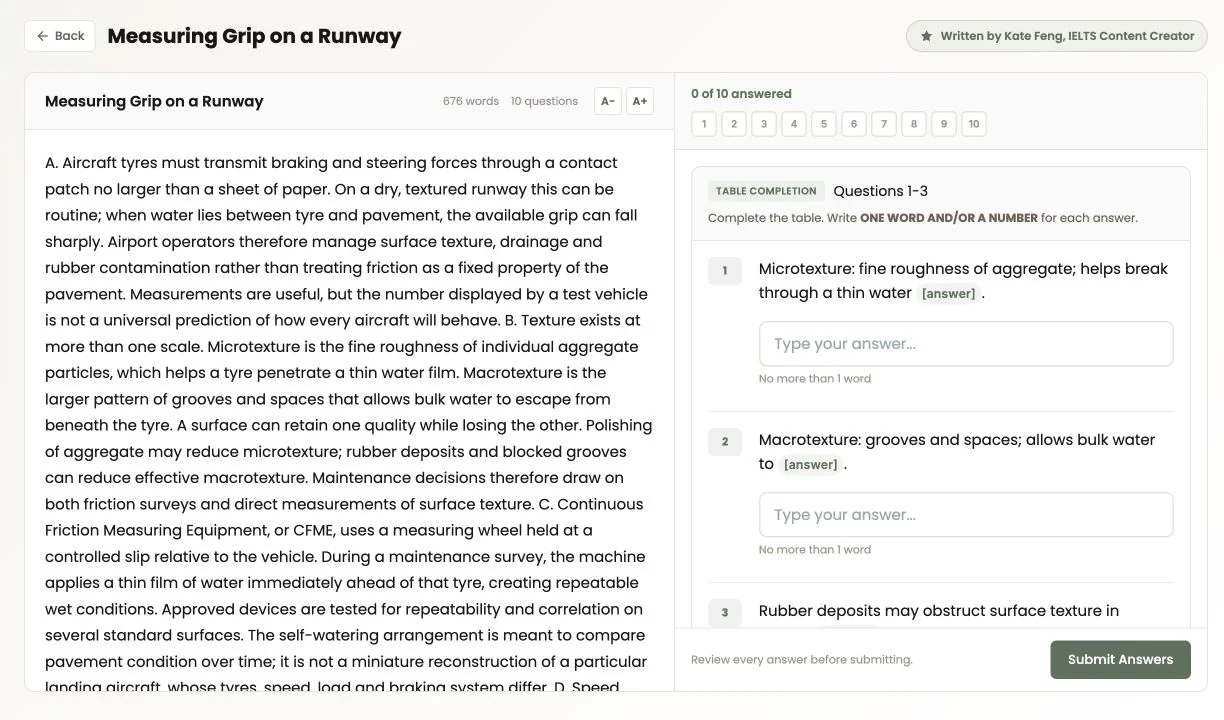
Spend about 20 minutes on each Academic Reading passage; that's the advice in IELTS's Academic FAQ for three texts in 60 minutes. In General Training, save the most time for Section 3: the General Training FAQ says it's usually more difficult than Sections 1 and 2, even though it has fewer questions than Section 1.
| Module | Passage or Section 1 | Passage or Section 2 | Passage or Section 3 | Clock check |
|---|---|---|---|---|
| Academic | 20 minutes | 20 minutes | 20 minutes | Move on at 20 and 40 minutes, finished or not |
| General Training | 15 minutes | 20 minutes | 25 minutes | Start Section 3 by 35 minutes |
Three habits keep the plan intact. Don't reread the whole passage for each question set: multiple choice, sentence completion and short-answer questions follow the order of the text, so carry on from where the last answer was. Summary, note, table and flow-chart completion may not follow the order, though the answers usually come from one part of the text. And if a question takes more than a minute or two, give your best answer, note the number and come back at the end. With two minutes left, fill every blank.
How to raise your IELTS Reading score by half a band
Half a band in Academic Reading is two to four more correct answers; in General Training from band 6 upwards it's one or two. You don't need to read faster across the board. You need to find where your few lost marks come from and stop losing them.
- Count lost marks by question type. After each practice test, list your wrong answers as True/False/Not Given, matching headings, completion and so on. Two or three types often account for most of them.
- Fix the copying errors first. Spelling, plurals and word limits cost marks you'd already earned by finding the answer. Check each written answer against the text before you move on.
- Work on your weakest type. For Not Given, go back to the True, False, Not Given guide linked above. If you mix up the two matching tasks, read matching headings vs matching information.
- Find the evidence for every wrong answer. Locate the sentence that gives the right answer and say why yours didn't fit. Our IELTS Reading practice guide has a review routine for this.
- Do one full timed paper on screen each week. Untimed passages show what you understand; a timed paper shows whether you can do it in 60 minutes.
PrepEx's free Reading practice gives you Folio Passages 1 and 2 with expert-written questions, scored instantly with feedback on each answer. Free accounts get two scored submissions a day, shared across the four skills. IELTS Pro adds unlimited practice and full-length IELTS Academic practice tests with section timing and score review. The full mocks are Academic. If you're taking General Training, use the passages for question-type practice and convert your full-paper scores with the General Training setting in the band score calculator.
IELTS Reading score FAQ
How many correct answers do you need for band 7 in IELTS Reading?
About 30 out of 40 in Academic Reading and 34–35 out of 40 in General Training (IELTS's own scoring page gives 35, so aim for 35). In the IDP and British Council charts, band 7 covers 30–32 correct answers in Academic and 34–35 in General Training. IELTS says the exact marks vary slightly between test versions, so aim for two or three above the minimum in practice. PrepEx's band score calculator converts any raw score for either module.
Is 30 out of 40 band 7 in IELTS Reading?
In Academic Reading, yes: 30 correct answers is the bottom of the band 7 range, which runs from 30 to 32. In General Training, 30 out of 40 is band 6, because General Training needs more correct answers for each band; band 7 starts at 34. As conversions can move slightly between test versions, 30 in Academic is a borderline 7 rather than a safe one.
What band is 35 out of 40 in IELTS Reading?
35 out of 40 is band 8 in Academic Reading, where band 8 covers 35–36, and band 7 in General Training, where band 7 covers 34–35. IELTS's own scoring page lists 35 as the average mark for Academic band 8 and General Training band 7. One more correct answer in General Training, 36, would give band 7.5.
What band is 25 out of 40 in IELTS Reading?
25 out of 40 is band 6 in Academic Reading, where band 6 covers 23–26, and band 5 in General Training, where band 5 also covers 23–26. To reach band 6 in General Training you need 30 correct answers, and for Academic band 6.5 you need 27, so this score is two marks short of the next Academic band.
Why is General Training Reading scored harder?
Because its texts are easier. IELTS grades Academic and General Training Reading on the same band scale and says Academic texts can have harder vocabulary and a more complex style. To make a band mean the same level of reading in both, General Training asks for more correct answers: about 30 for band 6, compared with 23 in Academic. The band means the same; each mistake costs more.
Do you lose marks for wrong answers in IELTS Reading?
No. Each correct answer earns one mark and a wrong answer earns nothing, exactly like a blank. Nothing is deducted, so never leave a question empty. If time is running out, give your best answer to every remaining question: a guess can only add to your score, and a blank never will. There is no extra time after the 60 minutes to go back and fill gaps.
Does spelling count in IELTS Reading?
Yes. A misspelt answer is marked wrong, even if you found the right part of the text. Every word you need is in the passage, so copy it carefully, keep the singular or plural form the sentence needs and check it against the text before moving on. British and American spellings are both accepted, so "organise" and "organize" both score.
Can I write T instead of TRUE in IELTS Reading?
On computer, which is how IELTS Reading is now taken, you choose True, False or Not Given from the options on screen, so you never write T or TRUE yourself. Our True, False, Not Given guide covers the paper answer-sheet rule and how to tell False from Not Given.
Where can I practise IELTS Reading free with a score?
PrepEx's Practice Hub has two free Reading passages, Folio Passages 1 and 2. Create a free account, answer the questions and your answers are scored instantly with feedback. Free accounts get two scored submissions a day across all four skills, reset at midnight UTC. IELTS Pro adds full-length timed Academic practice tests with score review.
Sources
- IELTS scoring in detail: band scores explained (IELTS), checked 27 November 2026
- IELTS Academic: Reading test format (IELTS), checked 27 November 2026
- IELTS General Training: Reading test format (IELTS), checked 27 November 2026
- IELTS Reading band scores (IDP IELTS), checked 27 November 2026
- Question types in the General Training Reading test (IDP IELTS), checked 27 November 2026
- How is IELTS assessed? Scoring and band descriptors (British Council), checked 27 November 2026
- British or American English in the IELTS test? (British Council), checked 27 November 2026
- IELTS Frequently Asked Questions: Academic module (IELTS / Cambridge University Press & Assessment), checked 27 November 2026
- IELTS Frequently Asked Questions: General Training module (IELTS / Cambridge University Press & Assessment), checked 27 November 2026
- IELTS Academic Reading sample tasks (IELTS), checked 27 November 2026
- Updates to IELTS test delivery (IELTS), checked 27 November 2026
Keep exploring
More from the journal