The PrepEx Journal
IELTS Speaking Topics 2026: Part 1, 2 and 3 Questions by Topic (With Sample Answers)
IELTS Speaking topics are everyday subjects: familiar questions about home, work, studies and hobbies in Part 1, one cue card about a person, place, object, event or experience in Part 2, and a linked discussion in Part 3. Here are 30 Part 1 topics, 18 cue cards and matching Part 3 questions written by PrepEx, with three band 9 standard answers.
On this page
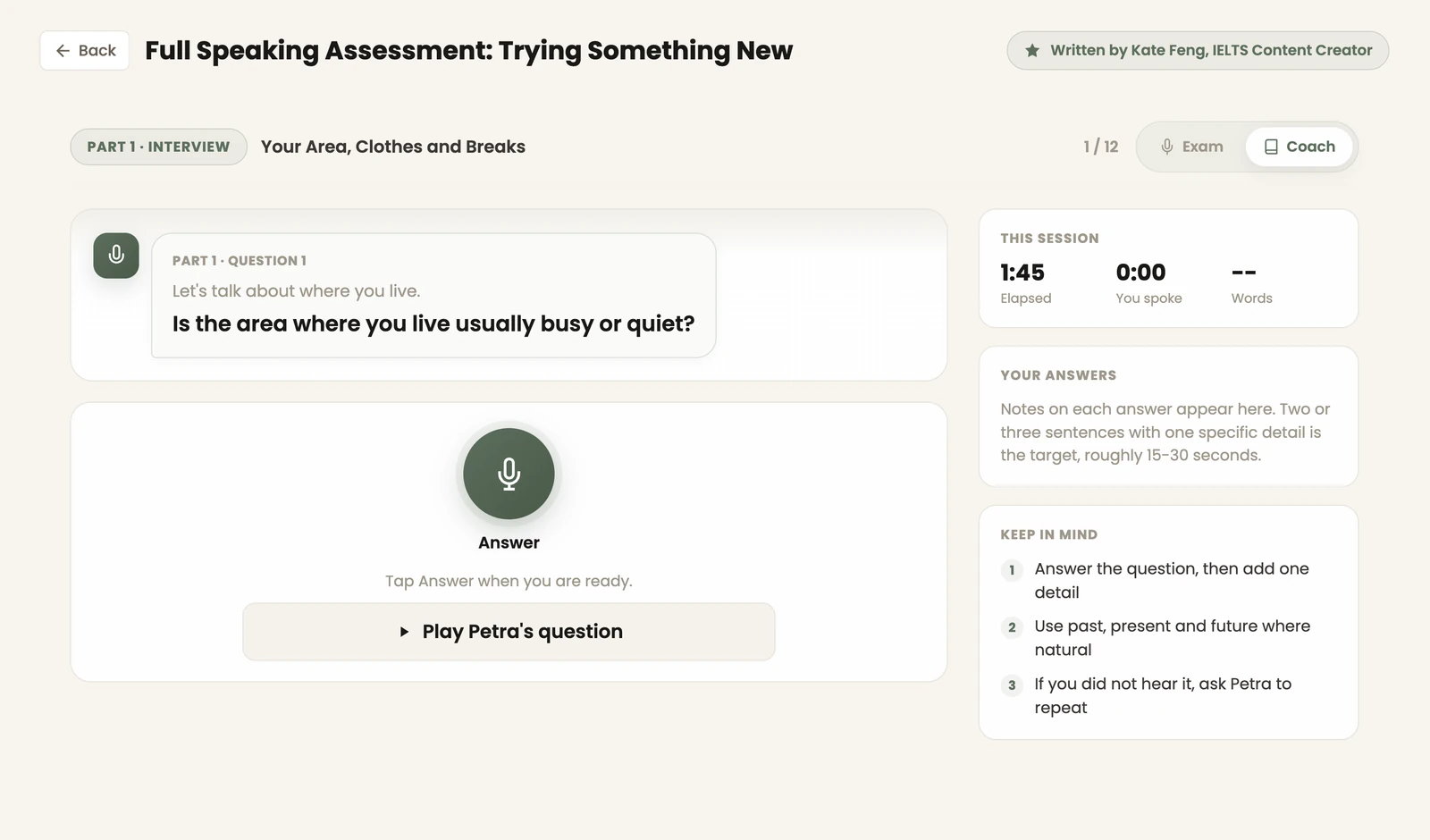
IELTS Speaking topics are everyday subjects: Part 1 asks about familiar things such as home, work, studies and hobbies, Part 2 gives you one cue card about a person, place, object, event or experience, and Part 3 discusses wider issues linked to that card. PrepEx's IELTS team wrote the questions for the 30 Part 1 topics, 18 cue cards and Part 3 themes below. PrepEx's free Speaking practice scores a recorded answer to its Part 1 set (Morning Routines) or Part 2 card (A Public Place That Brings People Together).
Get a Speaking answer scored free
Record an answer to the free Part 1 set or Part 2 card in the PrepEx Practice Hub and get a band estimate for fluency, vocabulary, grammar and pronunciation, scored from your recording. Or run all three parts against the clock in the free timed mock.
Facts checked on 27 November 2026 against IELTS's Speaking test format pages, its sample Speaking tasks and Speaking band descriptors, and IDP IELTS guidance on unclear questions, Part 2 topics and memorised answers.
How do IELTS Speaking topics work?
IELTS Speaking topics are chosen for you: Part 1 asks short questions on familiar topics, Part 2 gives you one cue card at random, and Part 3 discusses wider issues linked to that card, in an 11–14 minute recorded interview. The Speaking test is the same for IELTS Academic and General Training.
| Part | Time | What the topic is | What you do |
|---|---|---|---|
| Part 1: introduction and interview | 4–5 minutes | Familiar topics such as home, family, work, studies or interests | Answer short questions about yourself and your life |
| Part 2: long turn | 3–4 minutes, including 1 minute to prepare | One topic on a task card, with the points to include and one aspect to explain | Make notes for 1 minute, talk for 2 minutes until the examiner stops you; they may ask one or two short questions |
| Part 3: discussion | 4–5 minutes | Wider, more abstract issues related to the Part 2 topic | Give and justify opinions, compare and speculate |
| Whole test | 11–14 minutes | Everyday and general subjects | Face-to-face interview with an examiner, recorded |
What that means for your preparation:
- The examiner works from a script. IELTS's published sample test shows an "examiner frame": Part 1 questions grouped under short topic headings ("Let's talk about…"), a task card with one or two rounding-off questions for Part 2, and Part 3 questions grouped into themes. Expect several questions on each topic, not a conversation you can steer.
- You can't choose or swap the topic. IELTS describes the Part 2 card as given at random, and IDP says you are not allowed to change it. If a card doesn't fit your life, change the angle: a card about a pet you've owned can become a pet a friend or relative keeps.
- Part 3 grows out of Part 2. In IELTS's sample test, the Part 1 topics have nothing to do with the card, while Part 3 takes the card's subject into wider questions.
- Asking for a repeat costs nothing. IDP says you don't lose marks if you ask the examiner to repeat a question. In Part 1 the examiner can only repeat it; in Part 3 they can rephrase it.
None of this changed in 2026. The 2026 IELTS changes were about how the test is delivered, not the three-part Speaking format. Test-day advice and a daily routine are in the IELTS Speaking practice guide, and the IELTS syllabus and exam pattern shows how Speaking fits with the other three sections.
IELTS Speaking Part 1 topics: 30 everyday topics with questions
IELTS Speaking Part 1 topics are familiar subjects you can talk about without preparation. IELTS names home, family, work, studies and interests as examples, and an IELTS article for teachers adds holidays, films, hobbies, food, friends and sport. Each topic below has original practice questions written by PrepEx. Answer directly, then add a reason, an example or a contrast.
Home, work and study
- Work: What does a normal working day look like for you? Which part of your job would you happily hand to someone else? Would you like to be doing the same job in ten years?
- Studies: What are you studying at the moment? Which subject takes up most of your week? Do you study better early in the morning or late at night?
- Your home: Do you live with other people or on your own? Which room in your home gets the most light? What would you add to it if you had more space?
- Your hometown: What is your hometown known for? How has the centre changed since you were a child? Do young people tend to stay there or move away?
- Neighbours: Do you know the people who live next door? How do neighbours help each other where you live? Is it common in your country to invite neighbours round for a meal?
Daily life
- Sleep: How many hours of sleep do you need to feel like yourself? Do you ever nap during the day? What helps you get to sleep?
- Getting around: How do you usually get to work or class? Would you feel safe cycling in your city? Has public transport improved where you live?
- Weekends: What did you do last weekend? Do you plan your weekends or decide on the day? Do your weekends feel long enough?
- Being on time: Are you usually early, on time or a little late? How do you remember appointments? Does it bother you when other people are late?
- Clothes: What do you usually wear on a weekday? Do you have a favourite piece of clothing? Have you ever had to wear a uniform?
People and social life
- Family: Who in your family are you most like? How often does your family eat together? What do you usually do when your relatives get together?
- Friends: How did you meet your closest friend? Do you prefer going out in a big group or with one or two friends? How do you keep in touch with friends who live far away?
- School days: Which teacher do you remember best? What did you do during breaks at primary school? Do you still see anyone you went to school with?
- Birthdays and celebrations: How do you usually spend your birthday? Which festival do you look forward to most? Did you have birthday parties as a child?
- Gifts: What is the best present you have ever received? Do you find it easy to choose gifts for people? Do you prefer giving presents or receiving them?
Free time
- Hobbies: What do you do on a free evening? Is there a hobby you've given up? Do you have the same interests as you did as a child?
- Sport and exercise: Do you prefer watching sport or playing it? Which sport is most popular in your country? Did you enjoy PE lessons at school?
- Films and TV: What was the last film you watched all the way through? Who do you usually watch films with? Do you ever watch the same film twice?
- Books and reading: How often do you finish a book you start? Where do you usually read? Do you prefer stories or books about real events?
- Music and singing: Do you ever sing when you're on your own? What do you listen to while you work or study? Have you been to a live concert?
Food, shopping and technology
- Eating out: How often do you eat out? What do you order when you try a new restaurant? Who do you usually eat out with?
- Tea and coffee: Are you more of a tea or a coffee drinker? Where do you have your first drink of the day? Is there a café you go to regularly?
- Shopping: Do you enjoy shopping, or is it just a job to get done? Do you make a list before you go? What was the last thing you bought that you didn't really need?
- Phones and apps: Which app do you open first in the morning? Do you ever switch your phone off? When did you get your first phone?
- Clocks and watches: Do you wear a watch? How do you usually check the time? Is there a clock in your home that you look at every day?
Places and nature
- Travel and holidays: Where did you go on your last trip? Do you plan trips carefully or decide as you go? Is there a place you would like to go back to?
- Parks and the outdoors: How far is the nearest park from your home? What do people do in parks where you live? Did you spend much time in parks as a child?
- Seasons: Which season do you like best where you live? Does your routine change in summer? Is there a time of year you find difficult?
- Animals and pets: Did you have a pet when you were growing up? Which animals do you see most often where you live? Are pets popular in your country?
- Art and museums: When did you last go to a museum? Have you tried drawing or painting since you left school? Do you have any pictures on the walls at home?
Practise the way the examiner works: two topics, every question aloud, no notes. PrepEx's free Part 1 set, Morning Routines, scores your recorded answers with feedback on all four criteria. For worked answers on six more topics, open the IELTS Speaking Part 1 questions with sample answers.
IELTS Speaking Part 2 topics: 18 cue card topics by type
IELTS Speaking Part 2 topics come on a cue card (IELTS calls it a task card), which asks you to describe one thing, lists the points to include and ends with one aspect to explain. You get one minute to make notes with the pencil and paper the examiner gives you, then talk until the examiner stops you, at two minutes. "IELTS Speaking task 2 topics" means the same thing: Part 2.
The 18 original cue cards below are grouped by what they ask you to describe. Have one real example ready for each type and an unseen card won't leave you starting from nothing.
A person
Describe a time someone's skill at their work saved you time or trouble.
You should say:
who the person was
what their work was
what they did for you
and explain what made them so good at it.
Describe someone much older than you whom you got to know as an adult.
You should say:
who the person is
how you met
what you usually talk about
and explain why you enjoy their company.
Describe someone who gave you an honest opinion you did not want to hear.
You should say:
who the person is
what the opinion was about
how you reacted at the time
and explain how you feel about it now.
A place
Describe an old building in your area that is now used for something different.
You should say:
where it is
what it used to be
what it is used for now
and explain whether you think the change was a good idea.
Describe a place you saw online before you visited it.
You should say:
where it is
where you first saw it
what it was like in person
and explain whether it lived up to the pictures.
Describe a place in your area that is busiest early in the morning.
You should say:
where it is
who goes there
what happens there
and explain why it is busy at that time.
An object
Describe something you bought second-hand.
You should say:
what it is
where you found it
what condition it was in
and explain whether you would buy one new next time.
Describe a piece of equipment shared by the people in your building or street.
You should say:
what it is
who uses it
how people take turns
and explain whether sharing it works well.
Describe a handmade object that you own or have seen.
You should say:
what it is
who made it
what it looks like
and explain why you like it.
An event
Describe a celebration that was smaller than usual.
You should say:
what was being celebrated
why it was small
who was there
and explain whether you preferred it to a bigger one.
Describe a time a street or square near you was closed for an event.
You should say:
where it was
what the event was
what people did there
and explain how local people felt about it.
An experience
Describe a time you gave up on a plan halfway through.
You should say:
what the plan was
where you were
why you stopped
and explain whether it was the right decision.
Describe a time when something went wrong but ended well.
You should say:
what happened
where you were
what you did about it
and explain why it ended well.
Describe a time you had to pass on news to a group of people.
You should say:
what the news was
who you told
how you told them
and explain how they reacted.
An activity or hobby
Describe a sport or exercise that you would only do with other people.
You should say:
what it is
who you do it with
how often you meet
and explain why you would not do it alone.
Describe something you did outdoors when the weather was bad.
You should say:
what you did
where you were
why you went out anyway
and explain whether you enjoyed it.
Media and technology
Describe a feature of your phone that you only started using recently.
You should say:
what the feature is
how you found out about it
what you use it for
and explain why you did not use it before.
Describe a poster or sign in your area that catches people's attention.
You should say:
where it is
what it shows or says
who it is aimed at
and explain why people notice it.
Use the minute for notes, not sentences, and plan the "explain" line first: it gives you the most to say. The free Part 2 card in the Practice Hub, A Public Place That Brings People Together, runs the one-minute preparation and two-minute talk, then scores the recording. More cards with one-minute plans and sample answers are on the IELTS Speaking Part 2 cue cards page.
IELTS Speaking Part 3 topics and discussion questions
IELTS Speaking Part 3 topics grow out of the Part 2 card: for 4–5 minutes the examiner moves from your own experience to wider issues and asks you to explain, compare and justify your views. The table pairs each cue card above with a discussion theme and original questions written by PrepEx.
| Part 2 cue card | Part 3 theme | Discussion questions |
|---|---|---|
| Someone whose skill at work saved you trouble | Work and skill | What makes some jobs more respected than others? Is experience worth more than qualifications? |
| Someone much older you got to know as an adult | Generations | What can younger people learn from older people? Is it easier to grow old now than it was fifty years ago? Who should look after elderly people: their families or the state? |
| An honest opinion you did not want to hear | Honesty and feedback | Is it always better to tell people the truth about their work? Why do some people find criticism hard to accept? Should managers give feedback in private or in front of the team? |
| An old building with a new use | Buildings and cities | Why do new buildings in different cities often look alike? Does the design of a building affect how people feel inside it? Should historic buildings be turned into shops or flats? |
| A place you saw online before visiting | Tourism and expectations | How do photos on social media change what tourists expect? Is tourism good for small towns? |
| A place that is busiest early in the morning | Cities at different times of day | Why do some cities feel busy at all hours? Should shops and public services open earlier or later than they do now? Do people work better early in the day or late? |
| Something you bought second-hand | Buying and owning | Is it better to buy cheap things often or expensive things that last? Why are some people unwilling to buy things second-hand? Why do people find it hard to throw things away? |
| Shared equipment in your building or street | Sharing | Why do some people dislike borrowing things? Is it better to borrow, rent or buy things you only need now and then? |
| A handmade object | Crafts and traditional skills | Why do people value handmade things? Should schools teach traditional crafts? |
| A celebration that was smaller than usual | Celebrations and traditions | Have celebrations become too commercial? Why do families keep traditions that younger members find old-fashioned? |
| A street or square closed for an event | Public events and crowds | Should local councils pay for free public events? What problems do large crowds cause in a city? |
| A plan you gave up halfway through | Plans and giving up | Is giving up ever the sensible choice? Do people make better decisions when they have more time? Should young adults make big decisions alone or with their parents? |
| Something that went wrong but ended well | Mistakes and learning | Are mistakes useful for children? Why do some people find it hard to admit a mistake at work? |
| Passing on news to a group | News and communication | How do people in your country usually share important personal news? Is it better to hear bad news face to face? |
| A sport or exercise you only do with others | Health and lifestyle | Why do people start exercise plans and then give up? Do people exercise more when they do it in a group? Are people healthier now than in your grandparents' time? |
| Going outdoors in bad weather | The outdoors and weather | How does the weather affect the way people live in your country? Should children be allowed to take more risks when they play outside? Do people spend less time outdoors than they used to? |
| A phone feature you started using recently | Technology in daily life | Do people rely too much on apps for simple decisions? Why do people use only a few features of the technology they own? Should there be limits on how long children spend on screens? |
| A poster or sign that catches attention | Advertising and public messages | Should advertising aimed at children be banned? Do people trust adverts less than they used to? Is there too much advertising in public places? |
A useful shape for a Part 3 answer is an opinion, the reason, an example, and then a limit or comparison ("…although that depends on…"). Follow the question rather than the formula, and talk about people in general: the examiner has already heard your own story in Part 2. For more Part 3 practice with worked answers, see the IELTS Speaking Part 3 questions.
IELTS Speaking topics with answers: three band 9 standard samples
These three model answers, one for each part, were written to the IELTS band 9 descriptors using questions from the lists above. Read each for what it does, then answer the same question about your own life.
Part 1 sample answer: sleep
Examiner: Do you ever nap during the day?
Answer: "Not on purpose, no. If I sleep in the afternoon, I wake up feeling groggy and then I can't get to sleep at night, so it isn't really worth it. The one exception is long train journeys. I'll nod off almost as soon as we leave the station, which is a bit annoying, because I usually miss the best part of the view."
63 words, about 25 seconds spoken.
- Fluency and coherence: it answers in the first four words, then gives a reason and an exception, marked by "The one exception is…" rather than a stock linker.
- Lexical resource: "groggy" and "nod off" are precise, everyday words for this topic, not idioms added for show.
- Grammatical range and accuracy: a conditional, "I'll" for a habit and a relative clause, each because the meaning needs it.
- Length: it stops after one developed point; the examiner has more to ask.
Part 2 sample answer: someone much older you got to know as an adult
Cue card: Describe someone much older than you whom you got to know as an adult. You should say who the person is, how you met, what you usually talk about, and explain why you enjoy their company.
"I'd like to talk about a man called Tomasz, who lives two floors below me. He must be in his late seventies, and he spent most of his working life as a train driver, mainly on night routes carrying freight. We met because the lift in our building breaks down fairly often, and one evening he was struggling up the stairs with his shopping, so I carried it for him. Since then we've got into the habit of chatting whenever we bump into each other in the entrance hall, and every couple of weeks I'll sit with him for half an hour or so.
What we talk about varies a lot. Sometimes it's very ordinary, like the cost of vegetables or whether anyone is ever going to fix that lift. But my favourite conversations are about his old job. He remembers the routes in amazing detail: which stations had a café open at three in the morning, where the line ran right along the coast. He also asks me a lot about my work in software, and he's genuinely curious, which I didn't expect. He once asked me what 'the cloud' actually is, and halfway through explaining it I realised I didn't understand it as well as I thought.
As for why I enjoy his company, I think it's partly that he's never in a hurry. Most of my conversations during the week are squeezed in between other things, whereas with him nobody is checking a phone. And he puts my own problems into perspective. He's had a hard few years, and his eyesight isn't what it was, but he still finds new things to be interested in. I always come away from those chats calmer than when I went in."
291 words, about two minutes at a relaxed pace. The examiner would stop the talk at two minutes, wherever you are.
- Task coverage: every point on the card is answered in order, and the "explain" point gets a whole section.
- Fluency and coherence: "What we talk about varies a lot" and "As for why I enjoy his company" move the talk on without numbering points, and each section is built on specific details.
- Lexical resource: "got into the habit", "bump into each other" and "puts my own problems into perspective" are natural collocations, used once each, where they fit.
- Grammatical range and accuracy: deduction ("He must be in his late seventies"), present perfect for a habit that continues ("we've got into the habit"), "I'll" for something done regularly, and a contrast with "whereas".
- Pronunciation: said aloud, the answer needs stress on the contrasts ("nobody is checking a phone") and short pauses between sections. IDP points out that pronunciation is worth a quarter of the score.
Part 3 sample answer: generations
Examiner: What can younger people learn from older people?
Answer: "Quite a lot, though maybe not what people usually assume. The obvious answer is practical knowledge, like how to cook something properly or fix things around the house, and that's true, but a lot of that is on video now anyway. What's harder to find online is perspective. Someone who has lived through a few economic crises, for example, tends to be less panicked by bad news, and that kind of calm is something you only really pick up by spending time with them. I'd add that it works both ways, though. Older people often learn just as much from the young, especially about technology, so the best arrangements are the ones where both sides feel they're contributing something."
119 words, about 50 seconds spoken.
- Fluency and coherence: a position, a concession ("and that's true, but…"), the main point, an example and a final qualification, each easy to follow.
- Lexical resource: "perspective", "panicked by bad news" and "pick up" are precise, with nothing there to show off.
- Grammatical range and accuracy: a cleft sentence ("What's harder to find online is…"), a relative clause and a hedged general claim ("tends to be").
- Part 3 skill: it talks about people in general and doesn't retell the Part 2 story about Tomasz. The opposite view, that older people's advice can date quickly, would work just as well if developed this clearly.
IELTS Pro gives you a Band 9 version of each Speaking answer you record, so you can compare your own ideas with a stronger version of the same answer.
Are there latest or current IELTS Speaking topics for 2026?
There is no official list of latest, current, new or recent IELTS Speaking topics for 2026. IELTS publishes the test format, sample tasks and band descriptors, but not the questions examiners are using or a timetable for changing them.
Lists dated by month or by a window such as "September to December 2026" are put together by teachers and websites, often from what candidates report after their test. They can be useful practice, because a remembered card belongs to a familiar type, but they can't tell you what you will be asked.
What you can count on in 2026 is the structure: familiar topics in Part 1, one card in Part 2, a linked discussion in Part 3, 11–14 minutes in all. The lists on this page are common IELTS topics with original practice questions written by PrepEx, organised by type so that a new question on test day still feels familiar.
How to prepare IELTS Speaking topics without memorising answers
Prepare experiences, words and a way of developing an answer, not scripts. The IELTS Speaking band descriptors mention memorised language only at bands 1 to 3, IDP says examiners are well trained to spot memorised answers, and a rehearsed answer often fits the actual question badly. You are rated on your average performance across all three parts, so one polished answer can't carry the test.
- Collect ten real experiences. For each, note three concrete details: a name, a place, something that went wrong or surprised you.
- Map each experience to several cards by changing the focus (see the table below).
- Learn topic words as phrases you would actually say. "Commute", "rush hour" and "a packed train" are more useful together than a list of synonyms for "busy". The IELTS vocabulary list by topic is a starting point.
- Rotate Part 1 topics every day. Three topics, every question aloud, no notes.
- Time Part 2 properly. One minute of notes, two minutes of talk, recorded. Listen back for one thing only: long pauses, repetition or a skipped point.
- Practise the move to Part 3. After each card, answer two questions from its theme in the Part 3 table, and talk about people in general.
- Change the wording every time. If you can repeat an answer word for word, it has become a script. Keep the details and change the sentences.
| Experience in your bank | Cue cards it can answer | Shift the focus to |
|---|---|---|
| Helping an older neighbour when the lift broke | Someone much older you got to know as an adult; something that went wrong but ended well; an honest opinion you did not want to hear | The person; the problem and how it was solved; something blunt he once told you |
| A hiking weekend when the weather turned | Something you did outdoors in bad weather; a plan you gave up halfway through; a place you saw online before visiting | The day out; the moment you chose to turn back; the gap between the photos and the real place |
| Buying a second-hand bicycle | Something you bought second-hand; a sport or exercise you do with others; a phone feature you started using | The bike itself; the group rides; the route-planning feature on your phone |
| A cousin's small wedding | A celebration that was smaller than usual; passing on news to a group; a handmade object | The day; telling the family about the change of plan; a gift someone made |
Mistakes PrepEx sees in recorded answers
- Part 1 answers that stop at "Yes, I do" or run on for a minute. One developed point is enough.
- The same rehearsed first sentence for every cue card, often the card read back.
- The "explain" point squeezed into the last few seconds, when it's the part of the card with the most to say.
- Retelling the Part 2 story in Part 3 instead of talking about people in general.
- Idioms added for decoration, such as "over the moon" about a bus timetable. The higher bands describe idiomatic language that is accurate and well chosen, not idioms in quantity.
Practising with someone else? See how to find an IELTS speaking partner. To see what separates the bands in Speaking, read the IELTS Speaking band descriptors with marked samples; if 7 is your target, see how to get band 7 in IELTS.
IELTS Speaking topics FAQ
What are the most common IELTS Speaking topics?
The most common IELTS Speaking topics are everyday ones. Part 1 covers subjects such as home, family, work, studies, your hometown, free time, food, friends and travel. Part 2 cue cards ask you to describe a person, a place, an object, an event, an experience, an activity or something from the media or technology. Part 3 turns the card into wider questions about society.
What are IELTS cue card topics?
IELTS cue card topics are the Part 2 subjects printed on the task card: a person, a place, an object, an event, an experience, an activity, or something from media and technology. The card lists three points to cover and one to explain. You get one minute to prepare and talk for two minutes. PrepEx's free Part 2 card, A Public Place That Brings People Together, scores your recorded talk.
Do IELTS Speaking topics change every few months?
IELTS doesn't publish its Speaking questions or any schedule for changing them, so claims that topics change every few months, or lists for a window such as September to December 2026, don't come from IELTS. What stays fixed is the format: familiar topics in Part 1, one cue card in Part 2 and a linked discussion in Part 3. Preparing by topic type gets you ready for questions you haven't seen.
Do IELTS Speaking questions repeat?
Topics come round again because the test is built from familiar subjects, but you can't know which questions you will get. IELTS doesn't publish the questions in use, and you can't choose the topics. Memorising answers to a list found online is a gamble; practise each topic type with your own experiences instead.
Can I ask the examiner to change the topic?
No. IELTS describes the Part 2 card as given at random, and IDP says you are not allowed to ask for a different topic. If the card doesn't fit your life, adapt it: describe a friend's experience or something you would like to do, and still cover the card's points. You can ask the examiner to repeat a question, and in Part 3 to rephrase it, without losing marks.
How many questions are there in IELTS Speaking Part 1?
IELTS doesn't publish a fixed number. In its sample test, after the introduction and identity check, the examiner asks four questions on each of two topics, and the whole of Part 1 lasts 4–5 minutes. Short answers with one developed point suit this part better than long speeches.
Is IELTS Speaking task 2 the same as Part 2?
Yes. "Speaking task 2" is another name for Part 2, the long turn. You get a task card with a topic, the points to cover and one aspect to explain, plus one minute to prepare with pencil and paper. Then you talk for two minutes; the examiner stops you when the time is up and may ask one or two questions on the same topic.
Should I memorise IELTS Speaking answers from a PDF?
No. A memorised answer rarely fits the exact question, it tends to sound recited, and IDP says examiners are well trained to spot memorised answers. Use topic lists and sample answers to collect ideas and phrases, then answer in your own words, differently each time. IELTS Pro on PrepEx gives you a Band 9 version of each Speaking answer you record, a better model than someone else's script.
What if I don't know anything about a Part 3 topic?
Say what you think and explain why. IELTS says Part 3 assesses your ability to express and justify opinions, so you don't need expert facts. A reasoned view works: "I'm not an expert, but I'd imagine…" followed by a reason and an example. If the question itself is unclear, ask the examiner to rephrase it.
Where can I practise IELTS Speaking topics free with feedback?
PrepEx's free Practice Hub has a Speaking Part 1 set (Morning Routines) and a Part 2 cue card (A Public Place That Brings People Together), scored from your recording with feedback on fluency, vocabulary, grammar and pronunciation. A free account includes two scored submissions a day across all four skills. The free timed Speaking mock runs Parts 1–3 in your browser and keeps the recording on your device.
Sources
- IELTS Academic: Speaking test format (IELTS), checked 27 November 2026
- IELTS General Training: Speaking test format (IELTS), checked 27 November 2026
- IELTS test types: Academic and General Training (IELTS), checked 27 November 2026
- IELTS Speaking sample tasks (IELTS, PDF), checked 27 November 2026
- IELTS Speaking band descriptors (IELTS, PDF), checked 27 November 2026
- IELTS Speaking key assessment criteria (IELTS, PDF), checked 27 November 2026
- Demystifying the IELTS Speaking test (IELTS), checked 27 November 2026
- Three parts of IELTS Speaking, and what to look out for (IELTS), checked 27 November 2026
- Handling unclear questions in IELTS Speaking (IDP IELTS), checked 27 November 2026
- IELTS Speaking Part 2: How to speak confidently for 2 minutes (IDP IELTS), checked 27 November 2026
- Should I memorise IELTS answers or not? (IDP IELTS), checked 27 November 2026
Keep exploring
More from the journal