The PrepEx Journal
IELTS True, False, Not Given and Yes, No, Not Given: How to Tell Them Apart (With Practice)
TRUE means the passage gives the same information as the statement, FALSE means the passage contradicts it, and NOT GIVEN means it does neither. Yes, No, Not Given applies the same test to the writer's views. Two original Reading passages with explained answers, a decision table and the traps behind hard statements.

On this page
In IELTS Reading, TRUE means the passage gives the same information as the statement, FALSE means the passage contradicts it, and NOT GIVEN means the passage neither agrees with nor contradicts it. PrepEx's free Folio Reading Passage 1 starts with a TRUE/FALSE/NOT GIVEN group that is scored instantly, with an explanation for each answer. YES/NO/NOT GIVEN works the same way, except that you judge the writer's views or claims instead of facts.
Practise True, False, Not Given with instant marking
Folio Reading Passages 1 and 2 are free with a PrepEx account. Passage 1 opens with a TRUE/FALSE/NOT GIVEN group, the task this guide practises.
Start free Reading practice Turn a Reading score into a band
Facts checked on 27 November 2026 against the official IELTS Academic and General Training Reading format pages, IDP IELTS's guide to True, False and Not Given, Cambridge's IELTS Academic FAQs and IELTS's March 2026 notice on computer delivery.
What does True, False, Not Given mean in IELTS Reading?
True, False, Not Given is an IELTS Reading task that asks whether each of a set of statements agrees with the information in the passage. You choose one of three answers:
- TRUE: the passage gives the same information as the statement, usually in different words.
- FALSE: the passage contradicts the statement, so the statement cannot be right.
- NOT GIVEN: the passage neither agrees with nor contradicts the statement.
Yes, No, Not Given applies the same logic to the writer's views or claims:
- YES: the statement agrees with what the writer thinks or claims.
- NO: the statement contradicts the writer's view or claim.
- NOT GIVEN: the writer doesn't say what they think about it.
IELTS says True, False, Not Given tests recognising specific information and Yes, No, Not Given tests recognising opinions or ideas. IELTS lists both for Academic Reading; its General Training Reading page lists True, False, Not Given only. For both, IELTS warns you not to use what you already know about the topic.
| Check | True, False, Not Given | Yes, No, Not Given |
|---|---|---|
| The question | Do the statements agree with the information in the text? | Do the statements agree with the views or claims of the writer? |
| What you judge | Facts the passage states | What the writer thinks or claims |
| Usual kind of text | Descriptive or factual | Argument, opinion or review |
| Agrees / contradicts / neither | TRUE / FALSE / NOT GIVEN | YES / NO / NOT GIVEN |
What is the difference between False and Not Given?
The difference between False and Not Given is evidence: FALSE means words in the passage contradict the statement, while NOT GIVEN means the passage neither confirms nor contradicts it, usually because the point is missing or only partly covered. To check, ask whether the statement and the passage could both be true at the same time. If they couldn't, the answer is FALSE. If they could, but the passage doesn't confirm the statement, it's NOT GIVEN.
Say a passage tells you a bakery "opened in 1950". "The bakery opened before 1960" is TRUE. "The bakery opened in 1962" is FALSE, because it can't have opened in both years. "The bakery was the first in the town" is NOT GIVEN: the date tells you nothing about other bakeries.
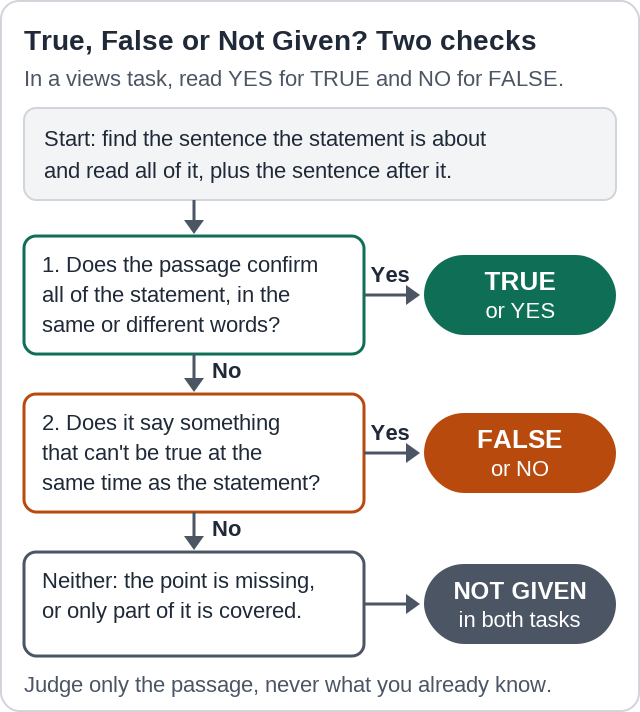
| What the passage does | Facts task | Views task |
|---|---|---|
| Says the same thing, in the same or different words | TRUE | YES |
| Says something that can't be true alongside the statement | FALSE | NO |
| Confirms one part of the statement and contradicts another | FALSE | NO |
| Confirms one part and says nothing about the other | NOT GIVEN | NOT GIVEN |
| Covers the topic but not the detail the statement adds, or nothing at all | NOT GIVEN | NOT GIVEN |
| Would need your own knowledge to settle it | NOT GIVEN | NOT GIVEN |
PrepEx's free IELTS Reading video lesson works through False versus Not Given examples from 26:52.
True, False, Not Given traps to check before you answer
Hard statements usually turn on one small word the passage doesn't support, so underline it before you choose. These are the distinctions PrepEx's IELTS team builds into its own TRUE/FALSE/NOT GIVEN items: scope, contradiction, missing information and the order of events.
| Trap | Statement | Passage | Answer and why |
|---|---|---|---|
| Qualifiers (all, most, some, only, usually) | Most visitors arrive by train. | Some visitors arrive by train. | NOT GIVEN: "some" doesn't tell you whether it's most. |
| Comparisons (longer, the first, the largest) | The new bridge is longer than the old one. | The new bridge is 400 metres long. | NOT GIVEN: the old bridge's length isn't given. |
| Dates and numbers | The survey began in 2019. | The results were published in 2019, two years after the survey began. | FALSE: it began in 2017. |
| Cause or only timing | The new timetable reduced delays. | Delays fell after the new timetable started, the same year the line got new trains. | NOT GIVEN: "after" gives only timing, and new trains arrived the same year. |
| Two claims in one | The factory closed in 1998 and became flats. | The factory closed in 1998. | NOT GIVEN: the second claim is missing. If the site became a car park, FALSE. |
| A matching word inside a negative | The plan was rejected. | The plan was not rejected outright; the council asked for changes. | FALSE: the matching word sits inside a denial. |
| Certainty | Tests have shown that the drug works in patients. | Early results suggest it may work, but it has not yet been tested on patients. | FALSE: "not yet been tested on patients" contradicts "tests have shown … in patients". |
| Synonyms | The library is closed on Sundays. | The library opens every day except Sunday. | TRUE: different words, same information. |
TRUE answers rarely repeat the passage's wording, so a paraphrase is no reason for doubt, while a word-for-word match still needs checking. Paragraph tasks cause similar mistakes; see matching headings vs matching information.
True, False, Not Given practice with answers
PrepEx wrote this short passage for this guide. Allow about eight minutes.
The tide clock at Port Ellery
For most of the nineteenth century, fishing crews in the small harbour of Port Ellery judged the tide by the marks cut into the old stone pier. That changed in 1878, when the harbour board installed a tide clock above the customs house. Instead of telling the time, its single hand showed how many hours remained until high water.
The clock was made by Ada Penhale, a local instrument maker who had previously repaired ships' compasses. Her design was not the first of its kind, but it was the first in the region to be driven by a float in the harbour rather than by clockwork, so it did not need resetting after storms.
Harbour board records show that fewer boats were damaged on the sandbar in the decade after the clock was installed. The board's reports also mention, however, that the channel was dredged in 1881, and they make no attempt to separate the effects of the two changes.
The clock was not universally popular. Some older crews continued to rely on the pier marks. By the 1920s, printed tide tables were cheap enough for most crews to carry, and the clock was kept running mainly for visitors. It was restored in 1994 and still works today, although its float now sits in a pipe rather than in open water.
Questions 1–8. Do the following statements agree with the information in the passage? Choose TRUE if the statement agrees with the information, FALSE if the statement contradicts the information, or NOT GIVEN if there is no information on this.
- Before 1878, Port Ellery's fishing crews used marks on the pier to estimate the tide.
- The tide clock showed both the time of day and the hours until high water.
- Ada Penhale had made tide clocks for other harbours before 1878.
- Port Ellery's clock was the first float-driven tide clock in the region.
- The tide clock was the main reason that fewer boats were damaged on the sandbar.
- The harbour channel was dredged before the tide clock was installed.
- All of Port Ellery's crews stopped using the pier marks once the clock was installed.
- The restored clock is still driven by a float.
Answers and explanations
1. TRUE. Crews "judged the tide by the marks cut into the old stone pier" until "that changed in 1878". Judged and estimate mean the same here.
2. FALSE. "Instead of telling the time" contradicts "the time of day". The second half of the statement is right, but one contradicted part makes the whole statement FALSE.
3. NOT GIVEN. Penhale "had previously repaired ships' compasses", which doesn't rule out making clocks, and "not the first of its kind" says other tide clocks existed, not who made them.
4. TRUE. It was "the first in the region to be driven by a float". "Not the first of its kind" looks like a contradiction, but it is about tide clocks in general; the statement makes the narrower claim.
5. NOT GIVEN. Damage fell after the clock arrived, but the channel was also dredged and the reports "make no attempt to separate the effects of the two changes". That is timing, not a cause, and nothing says the clock was not the main reason.
6. FALSE. The clock came in 1878 and the channel "was dredged in 1881", three years later. Both dates are there; the trap is their order.
7. FALSE. "Some older crews continued to rely on the pier marks" contradicts all crews stopping.
8. TRUE. The clock "still works today, although its float now sits in a pipe rather than in open water". Although introduces a change in where the float sits, not in what drives the clock. Reading "rather than" as a contradiction leads to FALSE.
Missed 3 or 5? If you can't point to words that confirm or contradict a statement, it is NOT GIVEN.
Yes, No, Not Given practice: the writer's views
In Yes, No, Not Given questions you judge what the writer thinks or claims, not what is true. A sensible statement is still NOT GIVEN if the writer gives no view on it.
Let the grass grow, but not everywhere
Every spring, the council in my city receives complaints that its parks look neglected, and every spring it sends the mowers out a little earlier. I think this is a mistake. Leaving large areas of grass uncut until late summer gives wildflowers time to set seed, and the insects that depend on them have somewhere to feed. A park is not less cared for simply because it is less tidy.
That does not mean every lawn should be abandoned. Sports pitches, picnic areas and path edges need regular cutting, and a strip of short grass along the front of a meadow tells passers-by that the length is deliberate rather than the result of a missed visit. I do not blame residents for complaining; without signals like these, long grass looks like neglect.
Supporters of reduced mowing often say that it saves councils a great deal of money. I doubt it. Fewer cuts do mean lower fuel and labour costs, but long grass must eventually be cut and removed, and that needs heavier machines. The real case for meadows is ecological, and it is weakened when campaigners rest it on savings that may never appear.
What persuades residents, in my experience, is not a leaflet but a visit in July, when a meadow is full of colour and movement. Councils that want public support should invite residents in then, rather than defend the policy in April.
Questions 9–15. Do the following statements agree with the views of the writer? Choose YES if the statement agrees with the writer's views, NO if it contradicts them, or NOT GIVEN if it is impossible to say what the writer thinks about this.
- The writer disapproves of the council's habit of mowing earlier each spring.
- The writer considers insects more important than wildflowers.
- The writer thinks some areas of a park should still be cut regularly.
- The writer criticises residents for complaining about long grass in parks.
- The writer accepts that mowing less often brings councils large savings.
- The writer believes the argument for meadows should rest mainly on their benefits for wildlife.
- The writer's council invites residents to see its meadows in July.
Answers and explanations
9. YES. "I think this is a mistake" follows the sentence about sending the mowers out earlier, and this refers back to it.
10. NOT GIVEN. The insects "depend on" the flowers, but the writer never ranks them. A comparison in the statement needs one in the passage.
11. YES. After "That does not mean every lawn should be abandoned", the writer says pitches, picnic areas and path edges "need regular cutting". Missing this qualification leads to NO.
12. NO. "A park is not less cared for simply because it is less tidy" makes YES tempting, because the writer rejects the complaint that the parks are neglected. But "I do not blame residents for complaining" contradicts criticising them.
13. NO. "I doubt it" answers the claim that reduced mowing saves "a great deal of money", and the savings "may never appear". The writer accepts that fuel and labour costs fall, which makes YES tempting, but not that the overall saving is large.
14. YES. "The real case for meadows is ecological", and it "is weakened" when campaigners rest it on savings. Ecological points back to the seeds and insects.
15. NOT GIVEN. The writer says councils "should invite residents in" and mentions "my experience", but never says whether their own council does it. A recommendation shows what the writer wants, not what has happened.
In PrepEx, YES/NO/NOT GIVEN appears in Folio Passage 3, part of the full Reading section with IELTS Pro.
Do True, False, Not Given answers come in order, and how long should they take?
Yes, within one group. IDP IELTS's guide to the task says the information in the passage follows the order of the statements, so the evidence for statement 4 comes after the evidence for statement 3. A new group can send you back to the start of the passage, and summary and table completion need not follow the text's order.
Academic Reading gives you 60 minutes for three sections and 40 questions, with 2,150 to 2,750 words of text; our IELTS syllabus and exam pattern guide covers the other sections. IELTS lists the number of questions of each type as variable. IELTS's Academic FAQ suggests about 20 minutes per passage, which leaves roughly a minute per statement once you know which paragraph to read:
- Underline the words that could make the statement wrong: names, numbers, dates, qualifiers, comparisons, causes.
- Scan for a name, number or unusual word, then read that sentence and the one after it.
- Apply the two checks: same information is TRUE, a contradiction is FALSE, anything else is NOT GIVEN.
- If you can't find the point between the evidence for the statements either side, it is probably NOT GIVEN: choose it and move on.
Each correct answer earns one mark, so answer every statement. Our IELTS Reading band score chart shows how marks out of 40 become a band, the IELTS Reading practice guide covers the other question types, and how to get band 7 in IELTS sets out a plan across all four skills.
How do you write True, False, Not Given answers on the computer test?
On IELTS on computer you don't write the answer: you choose TRUE, FALSE or NOT GIVEN from the options on screen. IELTS announced in March 2026 that it would stop offering the paper-based test from mid-2026, on dates that varied by country, and deliver all IELTS tests on computer; Reading is on screen even with Writing on Paper. You can highlight and make notes on screen, and our guide to IELTS on computer covers getting used to it.
Paper answer sheets asked you to write TRUE, FALSE or NOT GIVEN, so with printed practice tests or IELTS books, write the full word. IELTS doesn't publish a rule accepting T, F or NG, so don't build a habit around abbreviations, and never write TRUE in a YES/NO/NOT GIVEN group or YES in a TRUE/FALSE/NOT GIVEN group.
IELTS True, False, Not Given FAQ
What is the difference between False and Not Given?
FALSE means the passage contradicts the statement: you can point to words that make it impossible. NOT GIVEN means the passage neither agrees with nor contradicts it, usually because the point isn't covered or only part of it is. Ask whether the statement and the passage could both be true at once. If not, choose FALSE. If they could, but the passage doesn't confirm it, choose NOT GIVEN.
What is the difference between True, False, Not Given and Yes, No, Not Given?
They apply the same logic to different things. True, False, Not Given asks whether statements agree with the information in a passage, so it tests facts. Yes, No, Not Given asks whether they agree with the writer's views or claims, as in an argument. YES matches TRUE, NO matches FALSE, and NOT GIVEN means the passage doesn't settle it.
How do you answer Yes, No, Not Given in IELTS?
Find where the writer discusses the idea in the statement, then look for the writer's own position: phrases such as "I think", "I doubt it", "the real case is" or a recommendation with "should". If the writer holds the same view, choose YES; the opposite view, NO. If the writer only reports what others think, or gives no view, choose NOT GIVEN.
Can I write T and F instead of TRUE and FALSE?
On IELTS on computer the question doesn't come up: you choose TRUE, FALSE or NOT GIVEN from the options on screen. Paper answer sheets asked you to write TRUE, FALSE or NOT GIVEN, so write the full word when you practise on paper; IELTS doesn't publish a rule accepting abbreviations. Never write TRUE or FALSE in a YES/NO/NOT GIVEN group.
Do True, False, Not Given answers come in order?
Yes, within one group of questions. IDP IELTS says the information in the passage follows the order of the statements, so the evidence for each statement comes after the evidence for the one before. A new group can start again from the beginning of the passage. If a point isn't between its neighbours, it is probably NOT GIVEN.
How many True, False, Not Given questions are in IELTS Reading?
There's no fixed number. IELTS lists the number of questions for each Reading task type as variable, so the mix changes from test to test, and an opinion passage may use YES/NO/NOT GIVEN instead. Each correct answer is one of the 40 Reading marks behind your band score.
How can I improve at True, False, Not Given?
Practise untimed first, write down the words that decided each statement, and name the trap behind every miss: a qualifier, a comparison, a date, a cause or a second claim. Then time yourself. PrepEx's free Folio Reading Passage 1 marks a TRUE/FALSE/NOT GIVEN group instantly, and the free IELTS diagnostic shows which of the four skills to work on first.
Where can I practise True, False, Not Given with answers?
The two passages on this page come with explained answers. For full-length passages, PrepEx's free Folio Reading Passages 1 and 2 are scored instantly once you sign in, and The Story of Salt in the PrepEx IELTS Community is a free TRUE/FALSE/NOT GIVEN and note-completion exercise you can do without an account.
Sources
- IELTS Academic Reading test format (IELTS), checked 27 November 2026
- IELTS General Training Reading test format (IELTS), checked 27 November 2026
- IELTS Reading test: True, False and Not given explained (IDP IELTS), checked 27 November 2026
- Updates to IELTS test delivery (IELTS, 5 March 2026), checked 27 November 2026
- IELTS on computer (Writing on Paper) (IDP IELTS), checked 27 November 2026
- IELTS Academic: frequently asked questions (PDF) (Cambridge University Press & Assessment), checked 27 November 2026
- IELTS Academic sample test questions (IELTS), checked 27 November 2026
Keep exploring
More from the journal