The PrepEx Journal
IELTS Listening Map Labelling: Directions and Practice
Learn how to follow IELTS Listening map directions, recover your place and review mistakes with an original visitor-centre plan.

On this page
For IELTS Listening map labelling, establish the starting point, read the labels and answer instructions, then follow the speaker's route or description. Keep track of which way the person is facing: left and right can change after a turn. Confirm a location from the complete instruction before choosing its letter or entering its name.
You can know every direction word and still lose your place. Often the difficulty is combining three things at once: the map, the speaker's position and the next question. A small amount of preparation makes that combination easier.
Published by PrepEx Editorial. Official sources checked on 2 October 2026. The plan and written directions below are original teaching demonstrations. They have no audio and do not measure Listening performance or predict an IELTS band.
What does IELTS map labelling ask you to do?
You identify places or parts of a visual from spoken information. Depending on the task, you select from supplied options or enter words from the recording. Read the specific answer instructions, including any word limit. The official IELTS Listening format includes plan, map and diagram labelling.
A plan may show rooms in a building. A map may show a larger site. A diagram may show parts of an object, so a route-following method will not suit every labelling task. For a plan or map, begin with the fixed features you can use as reference points.
The real Listening test has four parts and 40 questions, and recordings are heard once. Replaying a recording is useful during study review; keep that separate from the conditions of your first attempt.
What to check before the recording begins
- Starting point: locate an entrance, an arrow or a stated position. Do not invent a start if none is shown; listen for it.
- Orientation: look for a compass. If there is none, work with the labels and directions provided rather than assuming north.
- Fixed references: notice a reception desk, bridge, junction or other named feature that can help you regain your place.
- Answer locations: distinguish question numbers from option letters. Check whether you are matching a named facility to a letter or supplying a label.
- Likely movement: notice corridors and paths, but leave the answer open until the recording supplies the route.
IELTS's official map-and-plan advice also emphasises orientation and the arrangement of questions. Practise using the interface for your booked test; paper annotation advice does not establish which tools will be available on screen.
An original plan: the visitor centre
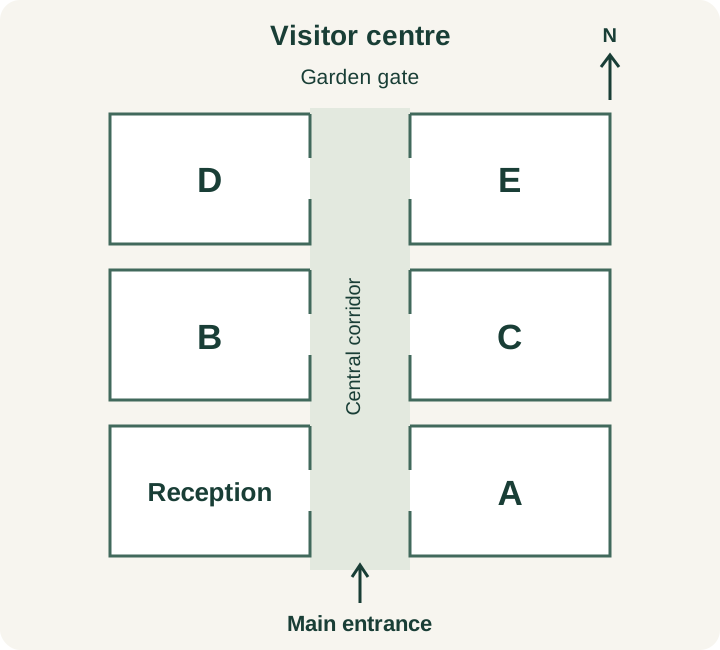
Text version: a straight corridor runs north from the south entrance to the garden gate. On its west side, moving north, are Reception, B and D. On the east side are A, C and E. Reception faces A across the corridor; B faces C; D faces E. All rooms open onto the corridor.
Read the directions in each example and select the correct letter before opening the explanation. These are written route drills; the following section explains how to transfer the method to audio.
1. Follow a route past a familiar landmark
To collect your equipment, come in through the main entrance and continue along the corridor. Once you have passed reception, take the next door on your left. Equipment used to be kept in the room opposite reception, but that room is now used for staff meetings.
Equipment collection: A, B, C, D or E?
Check the location
B. You enter facing north. Reception is on your left, and the next left-side door is B. A is opposite reception, but that is the former equipment room. D is also on the left, farther along; it is not the next door after reception.
2. Notice when the speaker changes the starting point
For the briefing, imagine you are standing at the garden gate, looking back towards the main entrance. The briefing room is the first room on your left. The room directly opposite is used for storing chairs.
Briefing room: A, B, C, D or E?
Check the location
E. At the north gate, looking towards the south entrance, your left is the east side of the plan. E is the first east-side room from that position. D is across the corridor; choosing it would preserve the viewpoint from the earlier example instead of adopting the new one.
3. Combine two location clues
The first-aid room is on the same side of the corridor as the briefing room. It is between the briefing room and the staff meeting room.
First-aid room: A, B, C, D or E?
Check the location
C. The briefing room is E and staff meetings take place in A. C lies between them on the east side. B is opposite C, so it fits the middle position but not the same-side condition.
Direction phrases: what relationship do they express?
| Phrase | What to check on the plan |
|---|---|
| Go past | Continue beyond the landmark; it is a reference point, not the destination. |
| Directly opposite | Look across the relevant corridor or path, rather than farther along the same side. |
| Between X and Y | Use both named boundaries. Being near one of them is insufficient. |
| At the far end | Establish the end that is farther from the speaker's stated position. |
| On your left | Use the direction the person is facing at that moment. |
| Used to be / has moved | Separate the previous location from the current one. |
Learn phrases through small routes rather than a long synonym list. Describe two different paths through this plan and check whether another person reaches your intended room.
How to practise with audio and review mistakes
Open the plan/map/diagram task on the official IELTS sample-test page. Inspect the plan and questions, then make a first attempt with the recording. Keep the transcript closed until you finish.
- Review the first point where you lost the route. It may occur before the answer you got wrong.
- Identify the cause. Did you miss a direction phrase, keep an old viewpoint, overlook a correction or select the wrong answer format?
- Use the transcript to explain the route. Point to each landmark and confirm which sentence fixes the answer.
- Replay the difficult phrase during review. If you can read it but cannot hear it clearly, work on recognising it in connected speech.
- Try fresh audio. A remembered route does not show whether the improvement transfers.
For broader error review, use the IELTS Listening practice guide, then choose a task in Listening practice. The hub offers section practice; check the available task and access before starting.
Common questions
How can I recover after missing a map answer?
Move your attention to the next item. Listen for a named landmark or a new stated position and restart from there. Trying to reconstruct several missed turns while new information arrives can cost additional answers.
Is left always the left side of the page?
No. “Your left” depends on the direction you face. Looking south reverses the page-side relationship on a north-up plan. A compass direction such as west remains fixed.
Should I write a place name or its letter?
Follow the task's answer format. If it asks for a letter, select the matching letter. If it asks for words from the recording, use the permitted number of words and check spelling.
Can the first place mentioned be a distractor?
Yes. A speaker may describe a former location, reject a route or mention a neighbouring room. Wait for the complete relationship that answers your question, while keeping up with the recording.
Sources and scope
The linked IELTS format, map-and-plan guidance and official sample tasks were checked on 2 October 2026. Use those samples for actual listening practice. Our visitor-centre example isolates spatial language in writing and is deliberately smaller than an exam section. For describing changes between maps in Writing, use the separate Academic Task 1 maps and processes guide.
Browse all IELTS preparation guides for related tasks and study resources.
Keep exploring
More from the journal