Task 1: Giving Advice
Address the person, prioritise useful suggestions and explain why each would help.
Three situations · audio · complete transcripts · analysis
Listen to one example belowCELPIP-General preparation
Study original CELPIP Speaking examples for all eight tasks. Listen to model audio, read transcripts and learn from task-specific analysis.
Reviewed October 2, 2026
These original PrepEx study answers cover all eight Speaking tasks. The recordings demonstrate the written model responses; they are not recordings of official test takers and have no official level assigned. A model is one defensible response, not the only acceptable answer.
Address the person, prioritise useful suggestions and explain why each would help.
Three situations · audio · complete transcripts · analysis
Listen to one example belowTell one past event with a turning point, a result and a personal reaction.
Three situations · audio · complete transcripts · analysis
Listen to one example belowStart with the setting, then guide the listener through visible actions and relationships.
Three situations · audio · complete transcripts · analysis
Listen to one example belowLink each plausible next action to a visible clue. Possibility is different from certainty.
Three situations · audio · complete transcripts · analysis
Listen to one example belowAfter the silent choice, persuade someone using the selected option and the newly revealed alternative.
Three situations · audio · complete transcripts · analysis
Listen to one example belowExplain a decision directly, acknowledge the inconvenience and give considerate, firm reasons.
Three situations · audio · complete transcripts · analysis
Listen to one example belowTake a clear position and develop reasons with examples; another well-supported position can also work.
Three situations · audio · complete transcripts · analysis
Listen to one example belowExplain an unusual object or scene to a person who cannot see it, using clear comparisons.
Three situations · audio · complete transcripts · analysis
Listen to one example belowTry the prompt yourself first. Listen once for the communicative purpose, then again for how each idea is developed. Read the transcript to find useful wording, but do not assume that fluent delivery or a longer response guarantees a CELPIP level. Record a new response using your own details.
Address the person, prioritise useful suggestions and explain why each would help.
Prepare 30 seconds; speak 90 seconds.
Your friend has joined a shared workspace and finds it difficult to concentrate or meet people. Give your friend advice.
Listen to the model response · 169 words · 90-second task window
Leah, I wouldn't give up on the workspace yet. It may take a little time to find a routine that suits you. First, try booking one of the quiet desks for work that needs concentration. You could spend your first hour there, with notifications switched off, and move to the common area once the demanding part is finished. That gives you some control over the noise rather than hoping everyone stays silent. Another thing you could do is introduce yourself to just one person at lunch. Ask what they work on instead of feeling you have to join a big conversation. A short, regular chat will probably feel more natural than a formal networking event. Finally, speak to the host about the busiest times. They might suggest a different day or a smaller room, so you won't pay for a space you rarely use. Try those changes for two weeks and see whether your concentration and confidence improve. Then you'll have a fair basis for deciding whether to stay.
Revision to practise: Replace 'Talk to people more' with 'Introduce yourself to one person at lunch and ask what they work on.' The action becomes specific and manageable.
Tell one past event with a turning point, a result and a personal reaction.
Prepare 30 seconds; speak 60 seconds.
Talk about a time when an unexpected problem made you change your plan.
Listen to the model response · 126 words · 60-second task window
Last spring, I helped present a neighbourhood history project at the library. We'd borrowed a projector, but when people arrived, the picture kept disappearing. I initially tried restarting the computer, which only made the audience wait longer. Then a colleague suggested using the printed photographs we'd brought for the display. We divided everyone into small groups and passed the pictures around while telling the stories. People began pointing out places they recognised and asking questions. The session became a conversation instead of the formal presentation we'd planned. I felt embarrassed at first, but relieved once the room started talking. Afterwards, we kept the small-group format for our next event. I learned that preserving the purpose of an activity can matter more than preserving its original plan.
Revision to practise: Change 'It was a good experience' to a reflection about the specific lesson: keeping the purpose while changing the method.
Start with the setting, then guide the listener through visible actions and relationships.
Prepare 30 seconds; speak 60 seconds.
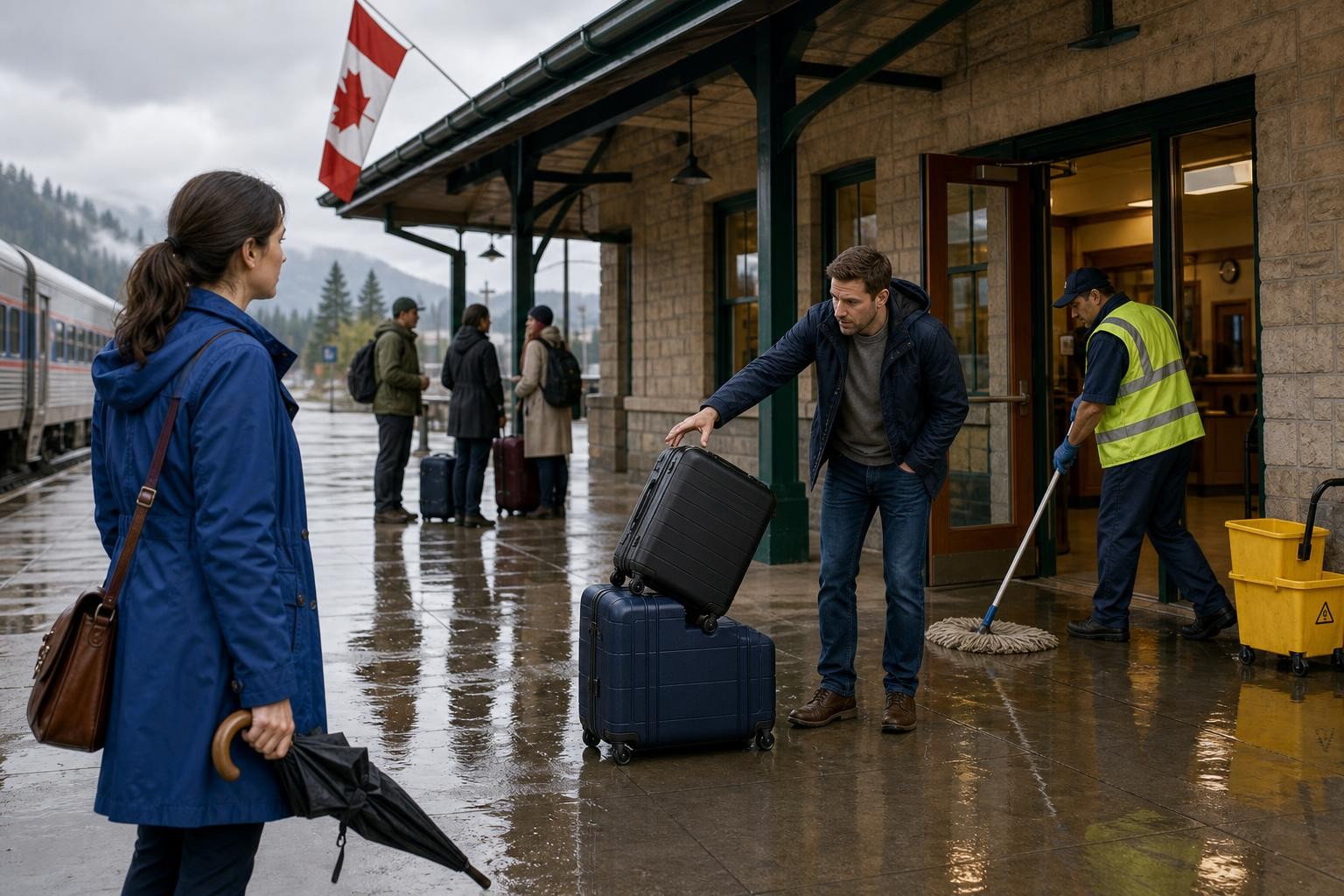
Describe the scene in the picture.
Listen to the model response · 120 words · 60-second task window
This looks like the entrance to a station on a rainy day. In the foreground, a woman in a blue coat is holding a folded umbrella. The pavement around her appears wet. To the right, a man is standing beside two stacked suitcases, and the upper one is leaning to one side. He is reaching towards the leaning bag. Closer to the doorway, a worker wearing a yellow vest is cleaning the floor. Several people are gathered under the canopy in the background, where they have some shelter from the rain. The picture brings together people arriving with luggage and staff looking after the entrance. There are several separate activities, but they all seem connected to moving through the station.
Revision to practise: Replace 'There is a woman. There is a man' with location and action: 'To the right, a man is standing beside two stacked suitcases.'
Link each plausible next action to a visible clue. Possibility is different from certainty.
Prepare 30 seconds; speak 60 seconds.
Look at the picture and explain what you think may happen next and why.
Listen to the model response · 120 words · 60-second task window
The traveller beside the suitcases will probably steady the upper bag, because it is leaning and someone is already reaching towards it. The man may then put that suitcase on the ground rather than leave the bags stacked. Near the doorway, I expect the worker to continue cleaning the wet floor as more passengers arrive. The rain and umbrellas suggest that people will keep bringing water inside. Some of the people under the canopy might wait until the rain eases before leaving the station. Others may open their umbrellas and walk out sooner. Those are possible next steps, rather than events we can know for certain. The luggage and the wet entrance seem likely to attract the most immediate attention.
Revision to practise: After 'The suitcase may fall,' add the clue and a plausible intervention: someone is already reaching to steady it.
After the silent choice, persuade someone using the selected option and the newly revealed alternative.
Prepare 60 seconds after the 60-second silent choice; speak 60 seconds.
Study example: your workshop has twenty attendees and a table-based group activity. After the silent choice, you selected Room A. Your colleague favours the newly revealed Room C. Persuade your colleague that Room A better suits the evening workshop.
Initial silent choice:
Selected: Room A
Revealed alternative: Room C: 80 seats, stage, tables arranged separately, closes at 8 p.m.
This worked example shows both phases for study. In a timed attempt, the third option appears after the initial choice.
Listen to the model response · 121 words · 60-second task window
Maya, I understand why you like Room C's large stage, but I think Room A suits our workshop better. We're expecting twenty people, so its twenty-four seats give us enough space without spreading everyone around a hall built for eighty. It also includes tables, which we'll need for the group activity. In Room C, we'd have to arrange those separately. The smaller room is available until nine, while the hall closes at eight, so we could finish the questions without rushing. The hall would certainly be better for a performance with a larger audience. For this event, though, conversation and table work matter more than a stage. Let's reserve Room A and use the time we save to prepare the materials.
Revision to practise: A comparison needs a consequence: 'Twenty-four seats' matters because a small group can discuss comfortably.
Explain a decision directly, acknowledge the inconvenience and give considerate, firm reasons.
Prepare 60 seconds; speak 60 seconds.
Your friend asks to use the room you booked for a quiet online interview. Explain to your friend why you have decided to keep the booking.
Listen to the model response · 122 words · 60-second task window
Sam, I know you wanted somewhere to rehearse this afternoon, and I'm sorry the other room is unavailable. I need to keep my booking, though, because my interview is at two and I have to speak somewhere quiet. Moving to the common area would make it difficult to hear the questions, and I can't change the interview time at this point. I don't want you to lose your rehearsal altogether. You're welcome to use the room after three, when I expect to be finished, or I can help you check whether the upstairs meeting space is free. I realise neither option is exactly what you asked for, but I can't risk missing this appointment. Let's see which alternative would help you most.
Revision to practise: Replace repeated apologies with one acknowledgement, a clear decision and a practical alternative.
Take a clear position and develop reasons with examples; another well-supported position can also work.
Prepare 30 seconds; speak 90 seconds.
Do you think a neighbourhood library should open later on two evenings each week? Explain your opinion.
Listen to the model response · 181 words · 90-second task window
I think opening later on two evenings would be worthwhile, provided the library can staff those hours properly. People who work during the day may otherwise have very little chance to use it. For example, someone finishing at six could collect a reserved book or use a quiet desk without rushing across town at lunchtime. Later hours could also make a few community activities more accessible. A short evening reading group would allow people with different schedules to meet, rather than serving only those who are free in the afternoon. Of course, longer opening hours involve staff time and operating costs. I wouldn't suggest keeping every branch open late every night. The library could begin with two evenings at this branch, record how the space is used and ask visitors which services they need. If most people only collect books, a smaller evening team might be enough. If there is sustained demand for study space, that would support expanding the trial. A measured extension seems more useful than either keeping the same hours forever or making a large change without evidence.
Revision to practise: Turn 'It helps everyone' into a concrete example of someone who cannot visit during existing hours.
Explain an unusual object or scene to a person who cannot see it, using clear comparisons.
Prepare 30 seconds; speak 60 seconds.

You are in a public square and see the unusual book stand in the picture. Call your friend and describe it so they can recognise it.
Listen to the model response · 124 words · 60-second task window
Hi Elena, I found a rather unusual book stand in the square. It isn't a normal table. Someone has built shelves onto a bright green bicycle, so the books are carried above the back wheel. There's even a little support near the handlebars with an open book on it. The bicycle is standing beside a bench, and a person is next to it, so you should be able to spot it easily. From a distance, it looks like an ordinary bike carrying a very large load, but up close you can see that the shelves are part of the design. I can't tell whether the owner rides it between locations. Come over to the bench when you arrive, and I'll meet you beside it.
Revision to practise: Describe the relationship between parts—shelves above the rear wheel—rather than naming only bicycle and books.
Task times and teaching focus were checked against the official 2026 Speaking Pro guide and official performance examples on October 2, 2026. PrepEx examples and annotations are independently authored study material; no official score or endorsement is implied.