Start with the setting, then guide the listener through visible actions and relationships.
Preparation: 30 seconds. Response: 60 seconds.
These three original study answers vary the situation and reasoning. They are unscored teaching examples. Try each prompt before listening, then identify how the response meets its audience and purpose.
Listen to the model response · 120 words · 60-second task window
Transcript
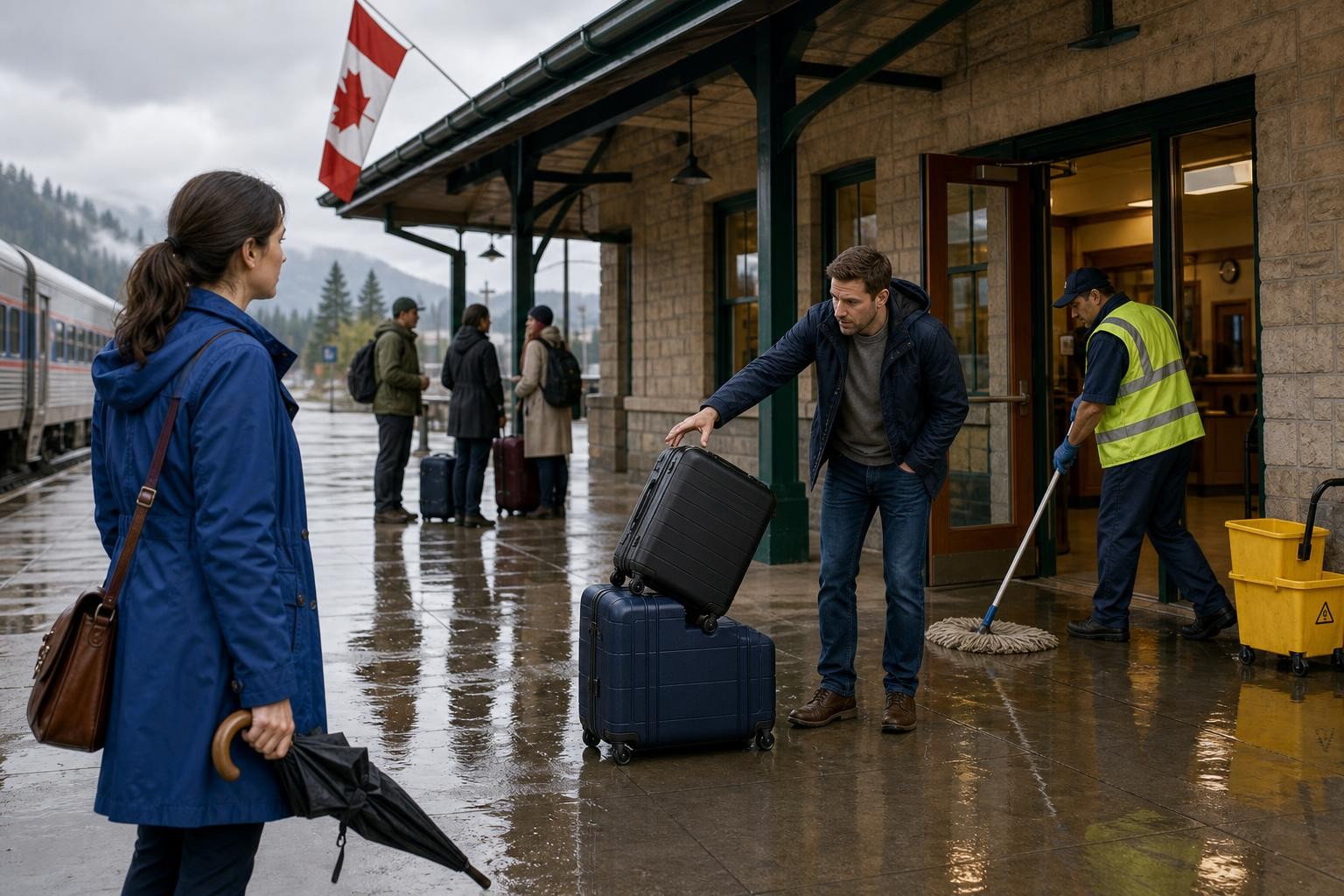
This looks like the entrance to a station on a rainy day. In the foreground, a woman in a blue coat is holding a folded umbrella. The pavement around her appears wet. To the right, a man is standing beside two stacked suitcases, and the upper one is leaning to one side. He is reaching towards the leaning bag. Closer to the doorway, a worker wearing a yellow vest is cleaning the floor. Several people are gathered under the canopy in the background, where they have some shelter from the rain. The picture brings together people arriving with luggage and staff looking after the entrance. There are several separate activities, but they all seem connected to moving through the station.
What to notice
The overview identifies the setting before the response moves from foreground to background.
The description distinguishes visible facts from impressions using 'looks like' and 'appears.' It does not predict that luggage will fall.
Spatial phrases connect details, so the listener receives an organised scene rather than an object list.
Revision to practise: Replace 'There is a woman. There is a man' with location and action: 'To the right, a man is standing beside two stacked suitcases.'
An organised workshop
Community workshop
Original study prompt
Describe the scene in the picture.
Listen to the model response · 125 words · 60-second task window
Transcript
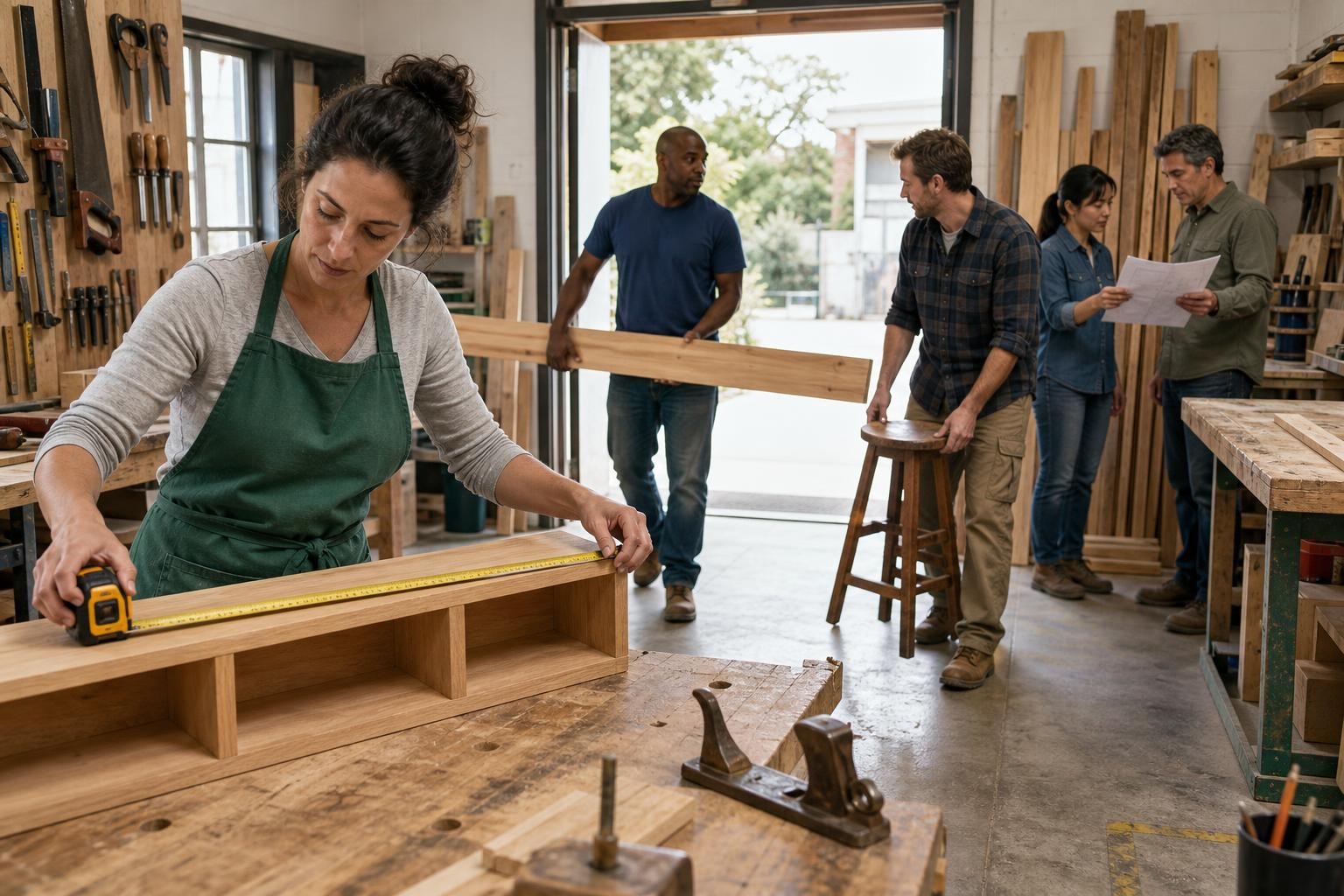
We're looking at a community workshop with several adults working around wooden materials. At the front table, a woman in a green apron is measuring a shelf. Her attention is on the wood in front of her. In the middle of the scene, a man is carrying a long plank through the doorway. Another person nearby is moving a stool out of his way. That gives the centre of the picture a sense of coordinated activity. Further back, two people are examining a drawing beside some stacked boards. The room looks bright and fairly busy, although everyone seems focused on a particular job. Rather than one person working alone, the scene shows several people sharing a space and helping with different parts of a project.
What to notice
The response groups related actions around three areas of the image.
'Coordinated activity' summarises the plank and stool actions without inventing a finished project.
Concrete verbs—measuring, carrying, moving and examining—do more work than repeated adjectives such as busy.
Revision to practise: A useful summary connects two observed actions; avoid guessing the exact object everyone is building.
A picnic beside the pond
Park picnic
Original study prompt
Describe the scene in the picture.
Listen to the model response · 121 words · 60-second task window
Transcript
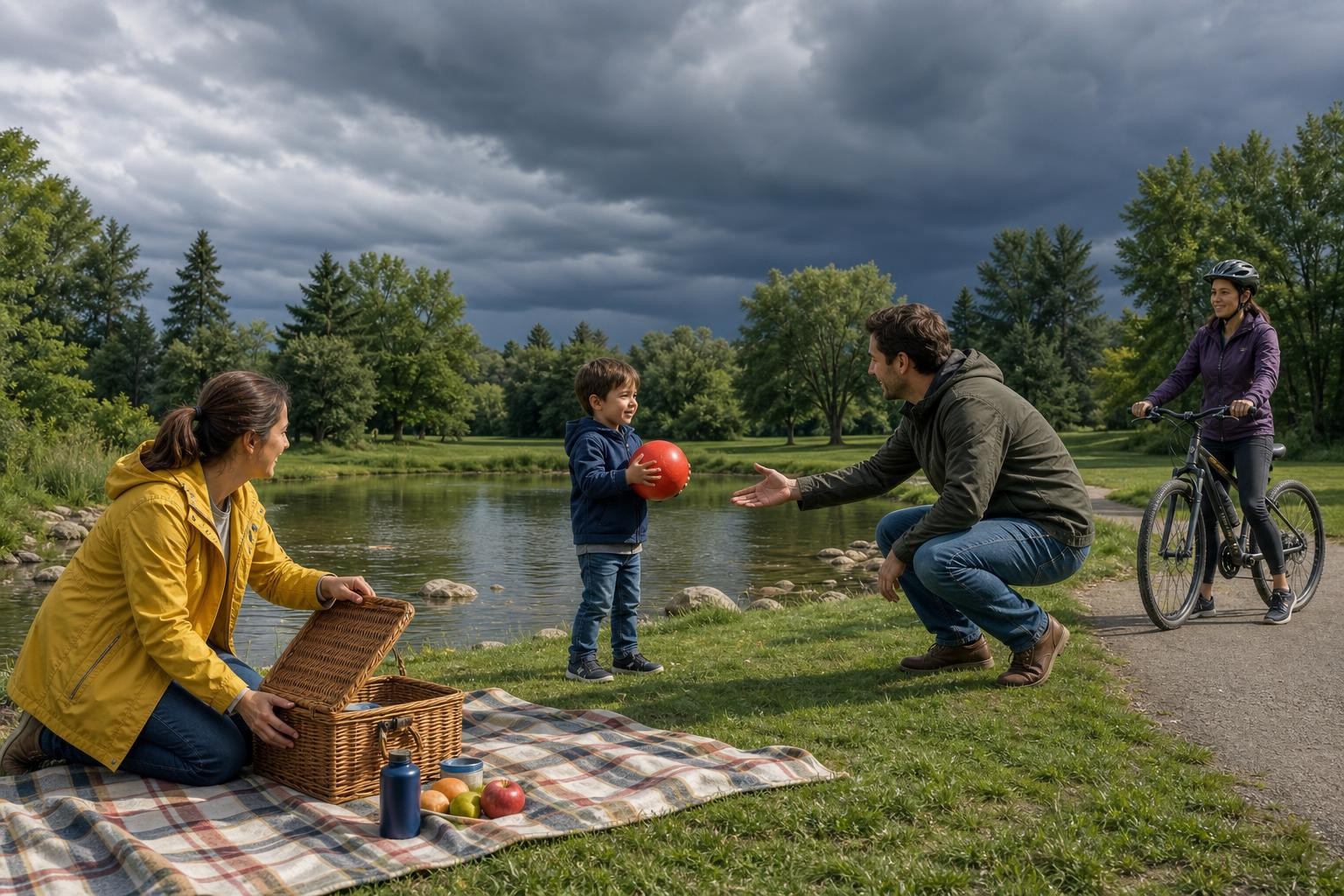
The picture shows a picnic area in a park beside a small pond. A blanket and a basket are visible near the front, and someone has a hand on the open basket lid. In the centre, a child is holding a red ball on the grass. An adult close by is reaching a hand towards the child. Beside the path, a cyclist has stopped and has one foot on the ground. Trees fill much of the background, with darker clouds above them. The people aren't all doing the same thing: some are gathered around the picnic, while the cyclist remains beside the path. Overall, it appears to be an ordinary outdoor gathering, with the changing weather forming part of the scene.
What to notice
The response stays with the present scene rather than turning Task 3 into a weather prediction.
The child's location on the grass is preserved; there is no invented fall or emergency.
Contrast between the picnic group and cyclist provides coherence without a long speculative story.
Revision to practise: 'The child will fall into the pond' is an unsupported prediction. Describe the visible ball, grass and reaching adult instead.
Make the next response your own
Keep the communicative purpose, but change the details you would naturally use. Practise the revision suggested after each example. Then record within the task window and check your actual audio for clarity and flow; a written transcript alone cannot establish listenability.
Format and assessment references
Task times and teaching focus were checked against the official 2026 Speaking Pro guide and official performance examples on October 2, 2026. PrepEx examples and annotations are independently authored study material; no official score or endorsement is implied.