The PrepEx Journal
IELTS Levels and CEFR: What IELTS Band Is B1, B2, C1 or C2?
IELTS 4.0–5.0 is B1, 5.5–6.5 is B2, 7.0–8.0 is C1 and 8.5–9.0 is C2 on IELTS's own CEFR chart, with 5.0, 6.5 and 8.0 on the borders. Is 6.5 B2 or C1, why C1 usually means 7.0, UK visa levels from A1 to B2, and how to check your level free.

On this page
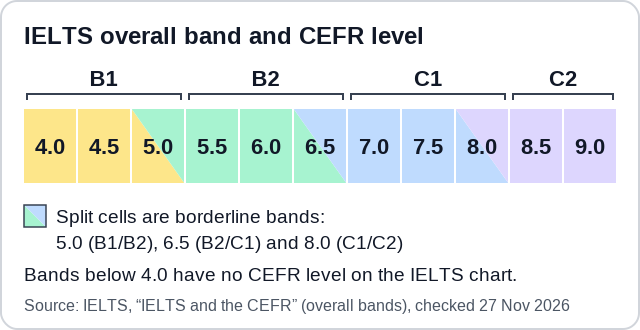
On IELTS's own CEFR chart, overall bands 4.0 to 5.0 are B1, 5.5 to 6.5 are B2, 7.0 to 8.0 are C1 and 8.5 to 9.0 are C2, with 5.0, 6.5 and 8.0 sitting on the border with the next level up. PrepEx's free IELTS diagnostic takes about 15 minutes and gives you a practice band range overall and for each skill, to show your level. If a requirement says C1, aim for 7.0; if it says B2, aim for 5.5 (in every skill for UK visas).
Find your IELTS band and CEFR level free
The diagnostic covers Listening, Reading, Writing and Speaking and shows which skill is furthest from your target. Already have four band scores? The calculator rounds your overall band the IELTS way and shows its CEFR level.
Facts checked on 27 November 2026 against IELTS's "IELTS and the CEFR" and IELTS for UKVI pages, Cambridge University Press & Assessment's "Comparing scores to IELTS", the Council of Europe's CEFR global scale and GOV.UK's English language rules for visas.
IELTS to CEFR chart: which band is B1, B2, C1 or C2?
IELTS 4.0 to 5.0 is B1, 5.5 to 6.5 is B2, 7.0 to 8.0 is C1, and 8.5 to 9.0 is C2. These are overall bands. IELTS says its CEFR chart refers to the overall band score, not to the separate Listening, Reading, Writing and Speaking bands.
| CEFR level | Council of Europe group | IELTS overall band | Border bands |
|---|---|---|---|
| C2 | Proficient user | 8.5–9.0 | 8.0 is borderline C1/C2 |
| C1 | Proficient user | 7.0–8.0 | C1 starts somewhere between 6.5 and 7.0 |
| B2 | Independent user | 5.5–6.5 | 6.5 is borderline B2/C1 |
| B1 | Independent user | 4.0–5.0 | 5.0 is borderline B1/B2; 4.0 is the lowest band on the chart |
| A2 | Basic user | No band on IELTS's chart | UK routes at A2 use IELTS for UKVI Life Skills A2 |
| A1 | Basic user | No band on IELTS's chart | UK routes at A1 use IELTS for UKVI Life Skills A1 |
IDP, one of IELTS's owners, gives A2 as roughly 3.0–3.5 and A1 as 2.0–3.0, but IELTS's own chart starts at 4.0. If you need to prove A1 or A2 English for a UK visa, the IELTS option is IELTS for UKVI Life Skills, which checks Listening and Speaking and gives a pass or a fail.
IELTS levels band by band: what each score means
Each whole IELTS band has a skill level name, from 9 "Expert" down to 1 "Non-user", and every band from 4.0 up also sits on a CEFR level.
| IELTS band | IELTS skill level | CEFR level (overall band) |
|---|---|---|
| 9.0 | Expert | C2 |
| 8.5 | – | C2 |
| 8.0 | Very good | C1, borderline C2 |
| 7.5 | – | C1 |
| 7.0 | Good | C1 |
| 6.5 | – | B2, borderline C1 |
| 6.0 | Competent | B2 |
| 5.5 | – | B2 |
| 5.0 | Modest | B1, borderline B2 |
| 4.5 | – | B1 |
| 4.0 | Limited | B1 |
| 3.5 and below | Extremely limited (3), Intermittent (2), Non-user (1) | No CEFR level on IELTS's chart |
A band of 0 means the person didn't attempt the test. There's no pass mark in IELTS: each university, employer or immigration office sets the band it needs, which is why the CEFR level matters most when a requirement is written as a level instead of a band.
Why do 5.0, 6.5 and 8.0 sit between two levels?
5.0, 6.5 and 8.0 sit between two levels because IELTS bands and CEFR levels were built separately, and their cut points don't line up. IELTS existed before the CEFR and uses one test with a nine-band scale for everyone, while the CEFR describes six levels. IELTS says there is no one-to-one match between its scores and CEFR levels.
The clearest case is 6.5. IELTS's research puts the start of C1 somewhere between 6.5 and 7.0. That means plenty of those who score 6.5 are already at C1, while some are just below it. That's why IELTS suggests that an organisation needing to be sure someone is at C1 should ask for 7 rather than 6.5.
Cambridge's figures show the same gap. On the Cambridge English Scale, which Cambridge uses to report its own exams, C1 starts at 180. IELTS 6.5 lines up with 176, just under that line, and 7.0 with 185. Cambridge also says a grade C on its C1 Advanced exam (180 to 192, which is C1) is comparable to IELTS 6.5 or 7.0.
The other two borders work the same way. IELTS recognises 8.5 and higher as C2 and calls 8 borderline. It also names band 5 as a case where it isn't clear whether the level is B1 or B2; its chart places 5 at the top of B1, and the Cambridge figure for 5.0, 154, is in the B1 range too.
What IELTS band is B1, B2, C1 or C2?
B1 is IELTS 4.0–5.0, B2 is 5.5–6.5, C1 is 7.0–8.0 and C2 is 8.5–9.0 overall.
What IELTS band is B1?
B1 is IELTS 4.0 to 5.0 overall. For UK routes that need B1 in all four skills, such as a Student visa below degree level, IELTS for UKVI asks for at least 4.0 in each component.
What IELTS band is B2?
B2 is IELTS 5.5 to 6.5 overall. It's the level the UK now asks of new Skilled Worker applicants and of students at degree level, and for those routes the IELTS score needed is 5.5 in each of Listening, Reading, Writing and Speaking, not just 5.5 overall.
Is 6.5 B2 or C1?
6.5 is B2 on IELTS's chart, at the very top of the level and next to C1. Many who score 6.5 are at C1 and some are just below it, so check how your requirement is written. If it says "6.5", a 6.5 meets it. If it says "C1", 7.0 is the safe target.
Is C1 the same as IELTS 7?
C1 starts at IELTS 7.0 overall and covers 7.0, 7.5 and 8.0, so 7.0 is the usual IELTS answer to a C1 requirement.
Is IELTS 8 C1 or C2, and what band is C2?
8.0 is C1, on the border with C2. C2 is 8.5 or 9.0 overall. Few requirements ask for C2, so this matters mostly when you describe your English on a CV or in a job application.
What do B1, B2, C1 and C2 mean in everyday English?
In the CEFR, B1 and B2 mean an independent user of English, C1 and C2 mean a proficient user, and A1 and A2 mean a basic user. The table paraphrases the Council of Europe's global scale for each level and adds an everyday example of our own.
| Level | What you can do (paraphrased) | Everyday example | IELTS overall band |
|---|---|---|---|
| A1 | Use familiar everyday phrases, introduce yourself and answer simple questions about yourself if the other person speaks slowly and helps | Giving your name, address and job at a reception desk | None on IELTS's chart |
| A2 | Understand common phrases about family, shopping, local places and work, and handle short routine exchanges | Buying a train ticket and asking which platform it leaves from | None on IELTS's chart |
| B1 | Follow the main points of clear speech on familiar topics, cope with most travel situations, write simple connected text and give brief reasons for your opinions | Explaining to a landlord what's broken and when you're at home | 4.0–5.0 |
| B2 | Understand the main ideas of complex texts, including technical ones in your field, talk with fluent speakers without strain on either side, and write clear, detailed text that argues a point of view | Arguing for your plan in a team meeting and following the replies | 5.5–6.5 |
| C1 | Understand long, demanding texts and what they imply, speak fluently without obvious searching for words, and write well-organised text on complex subjects | Following a university lecture, then writing an essay that weighs two theories | 7.0–8.0 |
| C2 | Understand almost everything you hear or read, summarise from several sources and express fine differences in meaning precisely | Summarising three reports for a manager and choosing exactly the right word for each point | 8.5–9.0 |
The jump from B2 to C1 is mostly about range and control: at C1 you handle abstract or unfamiliar topics without the language getting in the way. Our IELTS band descriptors guide shows what separates the bands, with marked samples.
Overall band or each skill: can you be C1 overall with B2 Writing?
Yes, you can be C1 overall with B2 Writing, and it's common. Your overall band is the average of your four skill bands rounded to the nearest half band, so one weaker skill can sit a whole CEFR level below the others while the overall band stays at C1.
Worked example 1: C1 overall, B2 Writing
Listening 8.0, Reading 7.5, Writing 6.0, Speaking 7.0. The average is 7.125, which rounds down to 7.0 overall, so the overall band is C1. Writing 6.0 is in the B2 range.
This meets a requirement of "C1" or "7.0 overall" with no skill minimum. It also meets ETH Zurich's Master's requirement (November 2026) of 7.0 overall with no section below 6.0. It doesn't meet the UK Nursing and Midwifery Council's IELTS Academic requirement (November 2026), which is 7 in Listening, Reading and Speaking and 6.5 in Writing.
Worked example 2: B2 overall, but not B2 for a UK work visa
IELTS for UKVI results of Listening 7.0, Reading 6.5, Writing 5.0, Speaking 6.5. The average is 6.25, which rounds up to 6.5 overall, so the overall band is B2. But the Skilled Worker visa needs B2 in every skill, which IELTS for UKVI sets at 5.5 per component, so Writing 5.0 means this result doesn't meet it.
IELTS's chart covers overall bands; for a single skill, use IELTS for UKVI's per-component minimums: 4.0 for B1, 5.5 for B2, 7.0 for C1. To turn a correct-answer count into a skill band first, use our IELTS Listening band score chart and IELTS Reading band score chart. IELTS for UKVI result forms for tests taken from 29 August 2024 show a CEFR level for each of the four components, not just one for the overall band. For any requirement, read two numbers: the overall band and the lowest score allowed in a single skill. Our guide to how IELTS band scores are calculated shows the rounding in detail.
Where CEFR levels matter: UK visas, universities and employers
UK immigration rules set English requirements as CEFR levels, so that's where the conversion matters most. Many universities and employers give an IELTS band instead, though some state a level. Canada's immigration programmes use Canadian Language Benchmarks rather than CEFR; see our IELTS to CLB calculator.
UK visas by CEFR level
| Route | CEFR level | IELTS test and minimum |
|---|---|---|
| Family visa (partner or parent), first application | A1 | IELTS for UKVI Life Skills A1, pass (Listening and Speaking) |
| Family visa, extension | A2 | IELTS for UKVI Life Skills A2, pass |
| Settlement (indefinite leave to remain) and British citizenship | B1 | IELTS for UKVI Life Skills B1, pass (applications before 26 March 2027; Life Skills has no B2 level). British citizenship stays at B1. |
| Settlement on routes moving to B2, applications from 26 March 2027 | B2 in Speaking and Listening | IELTS for UKVI, 5.5 in Speaking and Listening |
| Student visa, below degree level | B1 | IELTS for UKVI, 4.0 in each component |
| Student visa, degree level or above | B2 | IELTS or IELTS for UKVI, 5.5 in each component; the university can also assess your English itself |
| Skilled Worker, Scale-up and High Potential Individual | B2 for new applicants since 8 January 2026 | IELTS for UKVI, 5.5 in each component |
| C1 requirements | C1 (no current visa route; some universities and employers) | IELTS for UKVI sets C1 at 7.0 in each component |
Skilled Worker moved from B1 to B2 on 8 January 2026. If you held the visa before that date and you're extending it, B1 still applies. Settlement is next: for applications made on or after 26 March 2027, the rules require B2 in Speaking and Listening on routes including Skilled Worker, Scale-up and family settlement. Skilled Worker and Scale-up holders currently need no new English test to settle. Our IELTS for UKVI guide explains which version of the test to book for each route.
Universities asking for C1
Some universities write their English requirement as a CEFR level instead of a band. ETH Zurich is one: its English-taught Master's programmes need C1, and its list of accepted certificates (November 2026) sets IELTS Academic at 7.0 overall with at least 6.0 in each section. When a university gives a band instead of a level, the band is what counts. Our guide to what counts as a good IELTS score lists the bands some well-known universities ask for.
Employers and professional bodies
Job adverts often ask for "B2 English" or "C1 English" without naming a test. An IELTS result lets you show it: quote the overall band and its level together, for example "IELTS Academic 7.5 overall (CEFR C1)", and give the skill bands if the job leans on one skill. Professional regulators often set a band for each skill instead of a level. The UK's Nursing and Midwifery Council, for example, asks for 7 in Listening, Reading and Speaking and 6.5 in Writing (November 2026).
How do other English tests compare on the CEFR?
Each test owner publishes its own CEFR alignment, so compare tests through those published tables, not through a single converter. For IELTS and Cambridge English Qualifications, Cambridge University Press & Assessment, one of IELTS's owners, publishes how IELTS bands line up with its own exams on the Cambridge English Scale.
| IELTS band | Cambridge English Scale score | CEFR level on the Scale |
|---|---|---|
| 7.5 | 191 | C1 (180–199) |
| 7.0 | 185 | C1 (180–199) |
| 6.5 | 176 | B2 (160–179), just below C1 |
| 6.0 | 169 | B2 (160–179) |
| 5.5 | 162 | B2 (160–179) |
| 5.0 | 154 | B1 (140–159) |
Cambridge suggests that a university asking for IELTS 6.5 with no skill below 6.0 could accept 176 overall on C1 Advanced with no paper below 169. It also warns that a grade A on B2 First (180 to 190), which places a candidate at C1, needs careful thought before being treated as IELTS 7.0, because B2 First covers less of C1. Whether a Cambridge certificate is accepted instead of IELTS is the receiving organisation's decision. For TOEFL, PTE, CELPIP and the Duolingo English Test, see our English test comparison.
How do I find my IELTS level now?
Take a timed, scored sample of all four skills, then read each skill band against the chart above. A vocabulary quiz or a self-rating tells you much less, because IELTS bands depend on how you handle real tasks.
- Take PrepEx's free IELTS diagnostic, about 15 minutes across all four skills, for a practice band range overall and for each skill.
- Turn your overall range into a level with the table, then check each skill against 4.0, 5.5 and 7.0.
- Practise the weakest skill with scored tasks. A free PrepEx account includes Practice Hub samples in all four skills, scored instantly with feedback, such as a Writing Task 2 prompt. The four skills share two scored submissions a day.
- Check your total. Once you have four bands, the IELTS band score calculator gives the rounded overall band and its CEFR level.
Mistakes we see when learners convert bands to levels
- Checking only the overall band. UK visas and many professional bodies look at each skill, and one low skill fails the whole requirement.
- Booking the wrong version. If you're using IELTS for a UK work or family visa, it has to be IELTS for UKVI or IELTS for UKVI Life Skills, taken in person at an approved centre.
- Expecting a band to show A1 or A2. IELTS's chart starts at 4.0; UK A1 and A2 requirements are met with Life Skills.
- Underestimating the time a level takes. Cambridge's guideline is about 200 guided learning hours to move up one CEFR level, so going from a solid B2 to C1 usually takes months, not weeks. Our guide to getting band 7 breaks that work down by skill.
IELTS and CEFR levels FAQ
What is A1 and A2 in IELTS?
IDP, one of IELTS's owners, gives A2 as roughly 3.0–3.5 and A1 as 2.0–3.0, but IELTS's own chart starts at 4.0, which is B1. If you need A1 or A2 English for a UK visa, such as a first family visa (A1) or its extension (A2), the IELTS option is IELTS for UKVI Life Skills A1 or A2, which tests Listening and Speaking and gives a pass or a fail.
Is IELTS 5.5 B1 or B2?
IELTS 5.5 is B2. It's the lowest band in the B2 range, which runs from 5.5 to 6.5 overall. For UK visas that need B2, such as the Skilled Worker visa, you need at least 5.5 in each of Listening, Reading, Writing and Speaking in IELTS for UKVI, so a 5.5 overall with a 5.0 in one skill isn't enough.
Is 7.5 IELTS C1 or C2?
IELTS 7.5 is C1. It sits in the middle of the C1 range, which covers 7.0, 7.5 and 8.0 overall. IELTS recognises 8.5 and higher as C2, and it calls 8.0 borderline between C1 and C2. A 7.5 meets any requirement written as C1, as long as your skill bands also meet any minimum the organisation sets for each skill.
What CEFR level is IELTS 6.0?
IELTS 6.0 is B2, in the middle of the B2 range of 5.5 to 6.5. IELTS's skill level name for band 6 is "Competent". A 6.0 in each skill of IELTS for UKVI meets the B2 level the UK asks for Skilled Worker visas and degree-level study, but it's below what most C1 requirements expect, where 7.0 is the usual target.
Does my IELTS result show a CEFR level?
Yes. IELTS Academic and General Training result forms show one CEFR level, for your overall band. IELTS for UKVI forms for tests taken from 29 August 2024 also show a level for each skill. You can read it from the overall band: 4.0–5.0 is B1, 5.5–6.5 B2, 7.0–8.0 C1, 8.5–9.0 C2.
How long does it take to go from B2 to C1?
Cambridge's guideline is about 200 guided learning hours to move up one CEFR level, and roughly 700–800 hours to reach C1 from the beginning. In IELTS terms, B2 to C1 usually means 6.0 or 6.5 to 7.0, and the weakest skill sets the pace. PrepEx's IELTS Pro gives unlimited scored practice in all four skills with feedback on every criterion and progress tracking, so you can see that skill move.
Can I convert my CEFR certificate to an IELTS score?
Only where the test owner publishes a comparison. Cambridge publishes one for its exams: 162 on the Cambridge English Scale compares with IELTS 5.5, 176 with 6.5 and 185 with 7.0. A certificate that only says "B2" or "C1" has no exact IELTS band, because B2 alone covers 5.5 to 6.5. Whether a non-IELTS certificate is accepted is the university's, employer's or government's decision.
How can I check my IELTS level for free?
Take PrepEx's free IELTS diagnostic. It takes about 15 minutes and covers all four skills: 10 Listening questions, a short Reading extract, a 50–80 word opinion and three recorded Speaking answers. You get practice band ranges overall and for each skill, which you can read against the CEFR chart, plus the skill to work on first.
Sources
- IELTS and the CEFR (IELTS), checked 27 November 2026
- Everything you need to know about IELTS and the CEFR (IELTS, 17 November 2023), checked 27 November 2026
- IELTS scoring in detail (IELTS), checked 27 November 2026
- IELTS for UKVI: UK Visa and Immigration tests (IELTS), checked 27 November 2026
- IELTS results (Cambridge University Press & Assessment), checked 27 November 2026
- IELTS and CEFR levels: in-depth score comparison (IDP), checked 27 November 2026
- Learn about the IELTS digital Test Report Form (eTRF) (IDP), checked 27 November 2026
- Important updates to IELTS Test Report Forms for UKVI (IELTS, 28 August 2024), checked 27 November 2026
- Comparing scores to IELTS: B2 First and C1 Advanced (Cambridge University Press & Assessment), checked 27 November 2026
- Guided learning hours (Cambridge English), checked 27 November 2026
- Global scale: Common Reference Levels (CEFR Table 1) (Council of Europe), checked 27 November 2026
- Skilled Worker visa: knowledge of English (GOV.UK), checked 27 November 2026
- High Potential Individual visa: knowledge of English (GOV.UK), checked 27 November 2026
- Student visa: knowledge of English (GOV.UK), checked 27 November 2026
- Family visa: knowledge of English (GOV.UK), checked 27 November 2026
- Prove your knowledge of English for citizenship and settling (GOV.UK), checked 27 November 2026
- English language requirement levels for immigration applications (Home Office), checked 27 November 2026
- Explanatory memorandum to the Statement of Changes HC 1691 (Home Office, 5 March 2026), checked 27 November 2026
- Statement of Changes to the Immigration Rules HC 1691 (Home Office, 5 March 2026), checked 27 November 2026
- Higher standard of English now required to settle in the UK (Home Office news, 5 March 2026), checked 27 November 2026
- Language requirements, Master's degree studies (ETH Zurich), checked 27 November 2026
- English language requirements: accepted tests (Nursing and Midwifery Council), checked 27 November 2026
Keep exploring
More from the journal