The PrepEx Journal
CELPIP for Teachers and Tutors (2026): Assign Practice Tests and Track CLB Levels by Skill
Teaching CELPIP starts with a CLB target for each skill, practice across all 20 CELPIP-General task types and a weekly check of each student's level by skill. This guide gives you a six-week class plan and a tracker, and shows how PrepEx lets you assign task types and full practice tests, review every attempt on CELPIP's four rating dimensions and export a progress report.

On this page
To teach CELPIP well, set a CLB target for each skill, have students practise all 20 CELPIP-General task types, and check each student's level skill by skill every week. PrepEx gives CELPIP tutors and schools one workspace for that: assign any task type or a full CELPIP practice test with a due date, open each student's answers with feedback on CELPIP's four rating dimensions, and see who finished on time.
Assign CELPIP practice and review every attempt
Book a 15-minute walkthrough and the PrepEx team sets up your teacher account and student seats. Each seat gives that student CELPIP Pro, so they don't pay separately.
The six-week class plan The weekly tracker
We checked the CELPIP facts on this page against celpip.ca and the CLB minimums against IRCC on 16 November 2026, and the teacher features against the PrepEx workspace the same day.
The short answer
Give each student a CELPIP target for every skill: 4 in Listening and Speaking for citizenship, 7 in all four for the Federal Skilled Worker Program, higher where Express Entry points matter. Take a baseline full practice test, assign two or three task types per skill each week, and retest in week six. In PrepEx's CELPIP teacher workspace you assign the work, see who completed it, open each attempt with feedback and export a progress report per student.
Start with a CLB target for each skill
CELPIP reports a level from 0 to 12 for each skill. From level 3 up, the CELPIP level and the CLB level are the same number, so CELPIP 8 in Writing is CLB 8 in Writing.
IRCC checks each skill on its own, and CELPIP's FAQ says the Average Score on the report doesn't equal a CLB level. A client with 9, 9, 9 and 8 doesn't meet a CLB 9 requirement.
| Client goal | Test to book | Minimum CELPIP level |
|---|---|---|
| Canadian citizenship, ages 18 to 54 | CELPIP-General LS or CELPIP-General | 4 in Listening and Speaking |
| Federal Skilled Worker Program | CELPIP-General | 7 in each skill |
| Canadian Experience Class, TEER 0 or 1 job | CELPIP-General | 7 in each skill |
| Canadian Experience Class, TEER 2 or 3 job | CELPIP-General | 5 in each skill |
| Federal Skilled Trades Program | CELPIP-General | 5 in Listening and Speaking, 4 in Reading and Writing |
For Express Entry, points keep rising above the minimum: a single applicant earns 23 Comprehensive Ranking System points per skill at CLB 8 and 31 at CLB 9, so 8 to 9 in all four skills adds 32 points. Write each target down before the first lesson.
The 20 CELPIP task types to teach
CELPIP-General has four components and 20 parts or tasks, taken in one sitting of under three hours. CELPIP-General LS has only Listening and Speaking.
| Component | Time | Parts and tasks |
|---|---|---|
| Listening | 46–55 minutes | 6 parts: Listening to Problem Solving (8 questions), Listening to a Daily Life Conversation (5), Listening for Information (6), Listening to a News Item (5), Listening to a Discussion (8), Listening to Viewpoints (6) |
| Reading | 43–56 minutes | 4 parts: Reading Correspondence (11 questions), Reading to Apply a Diagram (8), Reading for Information (9), Reading for Viewpoints (10) |
| Writing | 53 minutes | 2 tasks: Writing an Email; Responding to Survey Questions |
| Speaking | 15 minutes | 8 tasks: Giving Advice; Talking about a Personal Experience; Describing a Scene; Making Predictions; Comparing and Persuading; Dealing with a Difficult Situation; Expressing Opinions; Describing an Unusual Situation |
Listening and Reading are scored by computer, and a blank counts as wrong, so students should answer everything. Writing and Speaking are rated by trained raters on four dimensions: Content/Coherence, Vocabulary, Readability (Writing) or Listenability (Speaking), and Task Fulfillment. CELPIP's FAQ adds that Writing is scored by an AI-human hybrid system, with every Writing score reviewed and verified by its rating team.
Teach the four dimensions by name. A student who knows that word count and tone sit inside Task Fulfillment can check a draft for both. Our CELPIP scoring criteria guide shows what changes between levels, and the CELPIP practice hub shows each task the way your students see it.
What CELPIP offers instructors
CELPIP's own teacher resources are free (links in the sources at the end):
- Instructor Training: Level 1. A recorded course of about five hours with quizzes, covering each component, scoring and the Performance Standards. It needs at least one year of teaching experience. Finish within ten days of the monthly start date for a certificate and a PDF Instructor Training Manual.
- Instructor Training: Level 2. About ten hours, self-directed, for experienced teachers with CLB 10 English who have finished Level 1. It goes further into rating sample responses; the certificate needs 100% on every quiz.
- CELPIP Teacher Support Pack. A .zip of PDFs: schedules for three course formats, printable copies of the two free practice tests, the Performance Standards, student checklists, a vocabulary journal template and classroom activities.
These cover the test and how it's rated. Setting homework and seeing who did it is up to you.
A six-week CELPIP class plan
One lesson a week, homework in between, and all 20 task types covered before the retest. For a four-week course, merge weeks 2 and 3, and weeks 4 and 5.
| Week | Assign before the lesson | Check before the lesson |
|---|---|---|
| 1 | One full CELPIP practice test | Which skill sits furthest below the student's target |
| 2 | Reading Correspondence and Reading to Apply a Diagram; Listening to Problem Solving and Listening to a Daily Life Conversation; Writing an Email; Speaking: Giving Advice, Talking about a Personal Experience | Correct answers per part; the email's level and its lowest dimension |
| 3 | Reading for Information; Listening for Information and Listening to a News Item; Responding to Survey Questions; Speaking: Describing a Scene, Making Predictions | Who completed late or not at all; the survey response's lowest dimension |
| 4 | Reading for Viewpoints; Listening to a Discussion and Listening to Viewpoints; a second Writing an Email; Speaking: Comparing and Persuading, Dealing with a Difficult Situation | The second email against the first, dimension by dimension |
| 5 | Speaking: Expressing Opinions, Describing an Unusual Situation; a second Responding to Survey Questions; two extra sets of each student's weakest part | The trend for each section; anyone with a week or more without practice |
| 6 | A second full CELPIP practice test | The change since week 1; a progress report for each student |
On PrepEx you can build weeks 2 to 5 once as a Course: Create course, add a session per week, then Schedule course for the class. Each week's work waits in the tracker's Scheduled tab until its date, and the Course runs again for your next intake.
How to track CELPIP levels by skill
Record five things for each student every week:
- Writing and Speaking: the latest level for each task type and its lowest dimension, which tells you what to teach.
- Reading and Listening: correct answers per part, such as 7/10 on Reading for Viewpoints. Listening needs more correct answers for the same level: CELPIP's approximate chart puts level 9 at 33–35 out of 38 in Listening and 31–33 in Reading.
- Completion: on time, late or not done.
- Days since the last practice. A student who goes quiet needs a check-in more than another task.
- The full-test result from weeks 1 and 6.
Leave out the overall average. IRCC doesn't use it, and it hides the skill that decides the result.
| Student | Target | Writing | Speaking | Reading for Viewpoints | Week 4 work | Next step |
|---|---|---|---|---|---|---|
| Harpreet | 9 in all four | Level 8, Vocabulary lowest | Level 9 | 6/10 | Completed late | Two more Reading for Viewpoints sets; word choice in the second email |
| Mei | 7 in all four | Level 7 | Level 6, Listenability lowest | 8/10 | Completed on time | Comparing and Persuading again, then Dealing with a Difficult Situation |
| Tomás | 4 in Listening and Speaking | – | Level 4 | – | Not completed | Check in at the lesson; one Listening and one Speaking task due in three days |
The weekly 15-minute check and a tracker template you can copy are in how to track student progress as a tutor. If you also teach IELTS or TOEFL, PrepEx's teacher workspace covers IELTS and TOEFL 2026 for every tutor the PrepEx team sets up.
What a Needs Attention flag means for your next lesson
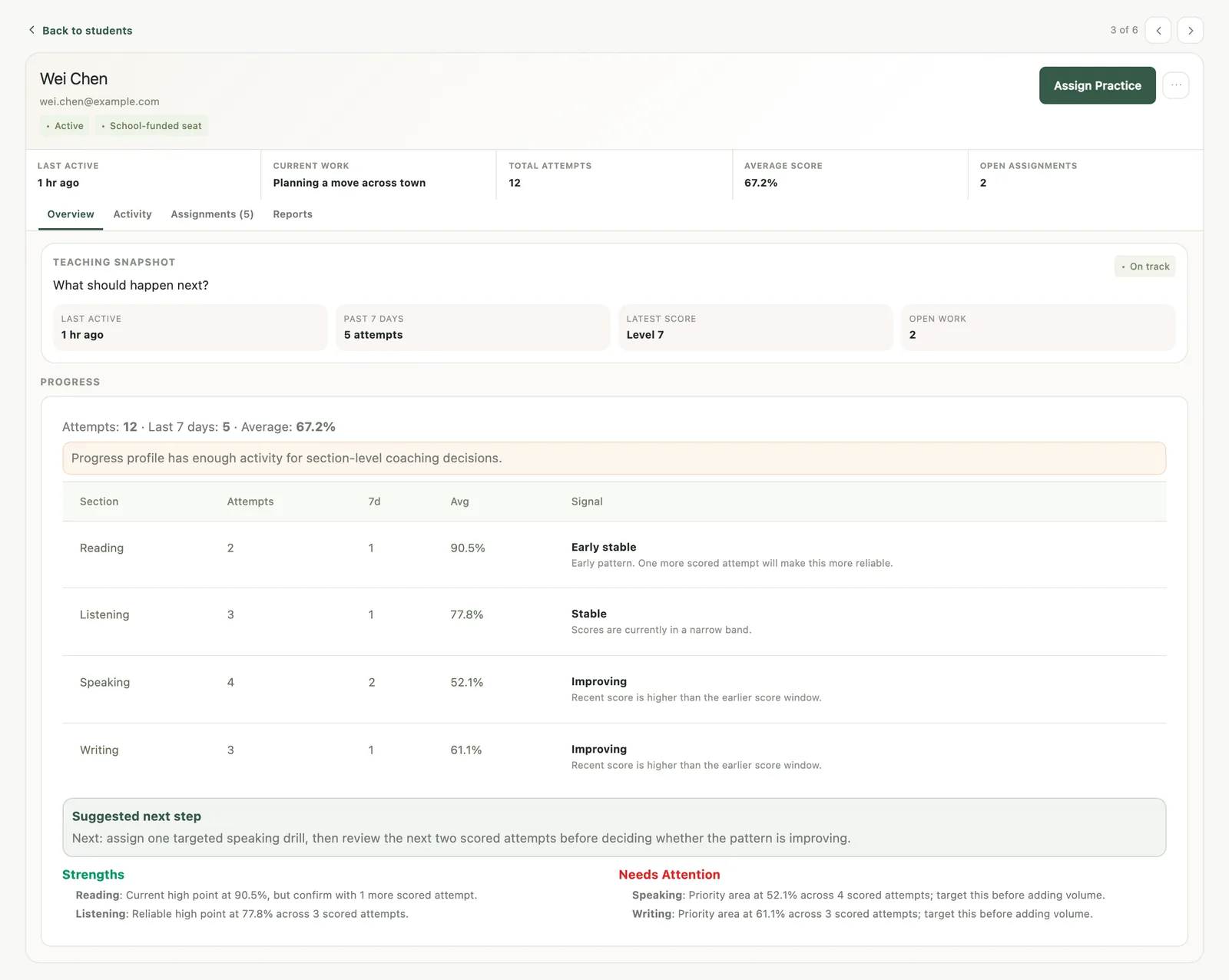
Each student's Overview in PrepEx opens with a Teaching snapshot, and its Progress panel shows their attempts, attempts in the last 7 days, an average and a trend signal for each section ("Improving", "Declining", "Stable" and others), then Strengths, Needs Attention and a Suggested next step.
Say Reading shows "Declining" under Needs Attention. Open the last two assigned Reading attempts with View attempt and check the missed questions against the key and explanations. If the misses cluster in one part, spend 15 minutes of the next lesson on it and assign two more sets. For Writing or Speaking, teach the lowest dimension and assign the same task type again.
How the PrepEx CELPIP teacher workspace works
1. Invite your students
Click Invite Student and enter one email, or use Batch invite for up to 100. Each student gets an email with an Accept Invite button. Accepting uses one of your seats and gives that student CELPIP Pro. Invitations expire after 7 days.
2. Assign task types or full tests
Assign Practice has three steps. In Students, pick one student, several, or a group made with Create group. In Practice, Browse exercises lists the CELPIP task types by section, with full practice tests under Full tests. In Schedule & note, add an optional due date and instructions, such as "Plan for five minutes before you write."
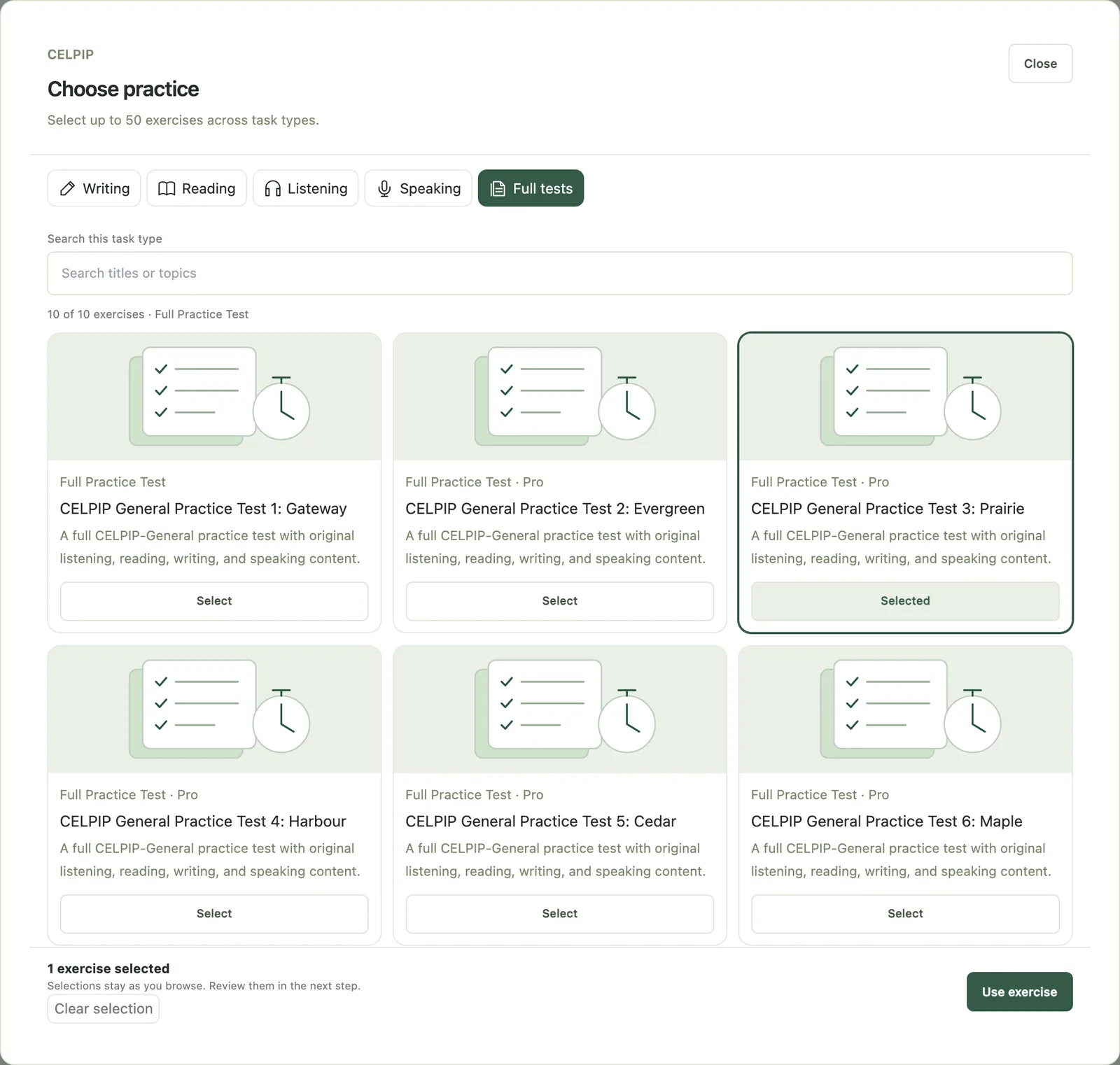
Students see new work in the Teacher assignments panel of their Practice Hub, with a dashboard notice and an in-app bell reminder.
3. Follow completion
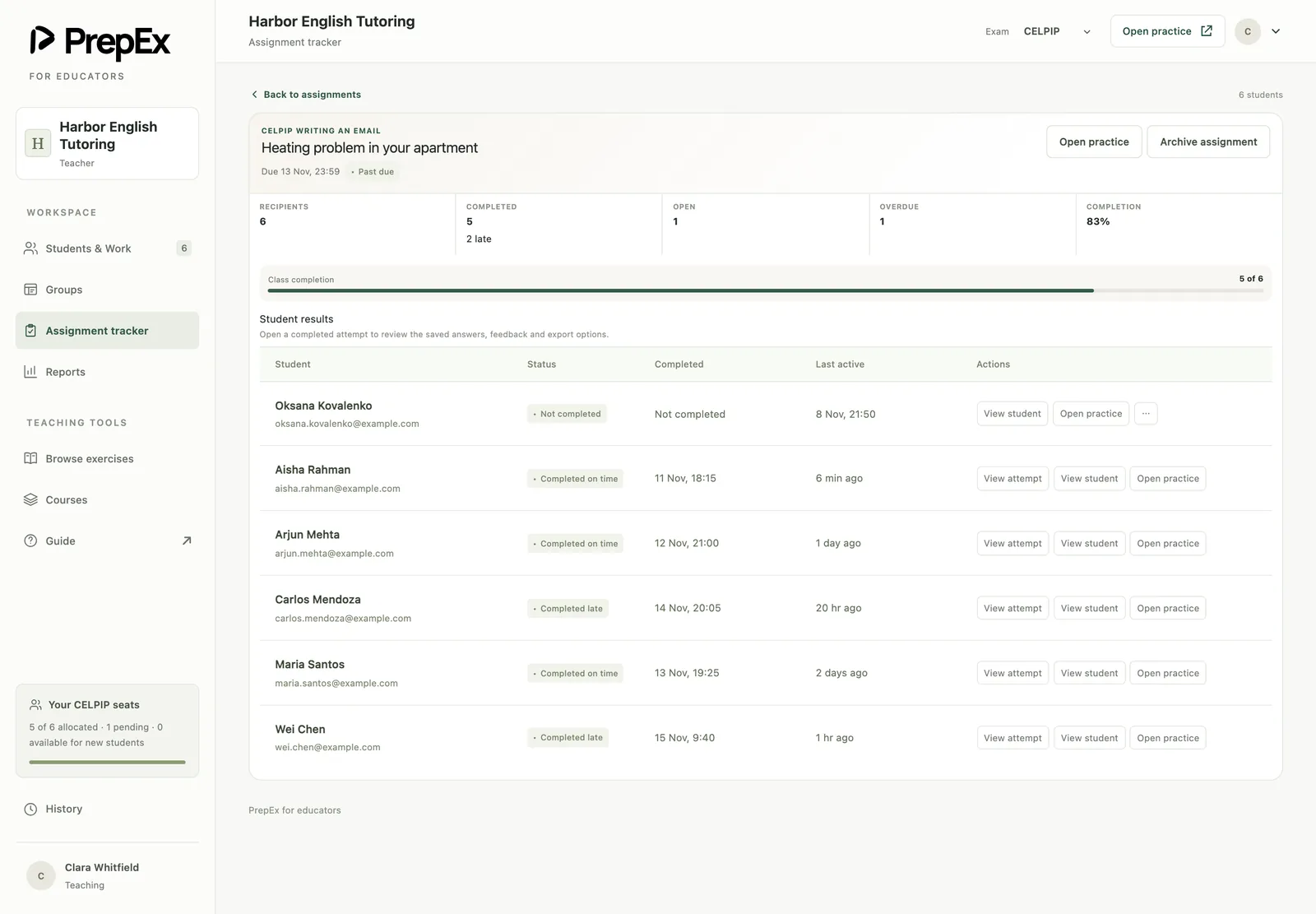
The Assignment tracker has Active, Past due, Scheduled, Completed, Archived and All tabs, and marks each student "Completed on time", "Completed late", "Not completed" or "Open" from their saved attempt. Follow-ups lists past-due work, invitations pending after 3 days and students with 7 or more days without practice.
4. Open each attempt
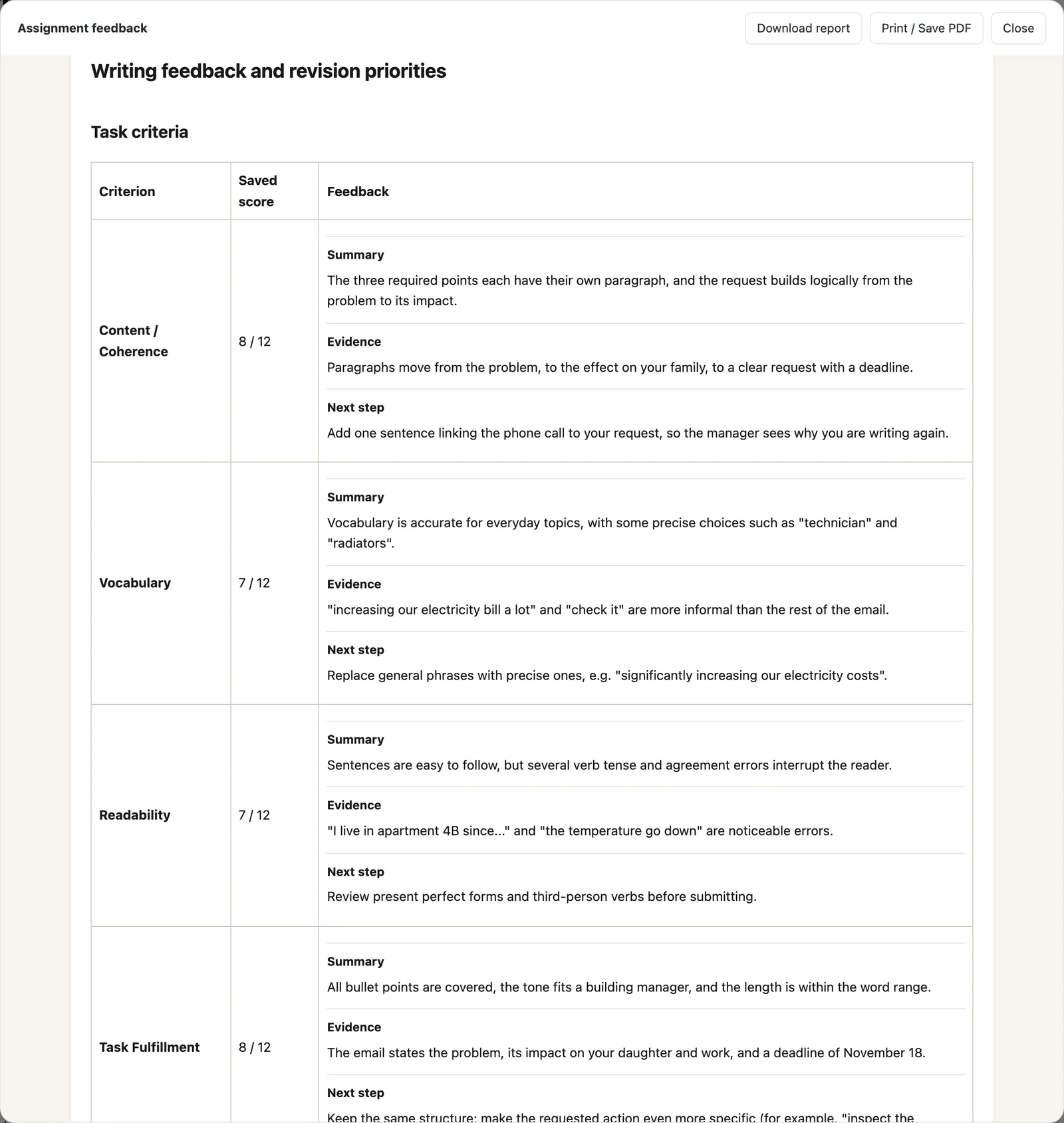
View attempt shows Reading and Listening answers beside the key, with explanations and the number correct. Writing shows the response with a CELPIP level, a level for each of the four dimensions and written feedback; Speaking shows a transcript with the same. For a full test, View test results opens the student's report with a practice level range.
Practice that students do on their own appears as task scores and full-test reports. Assign a task when you want to read the response itself.
5. Share a progress report
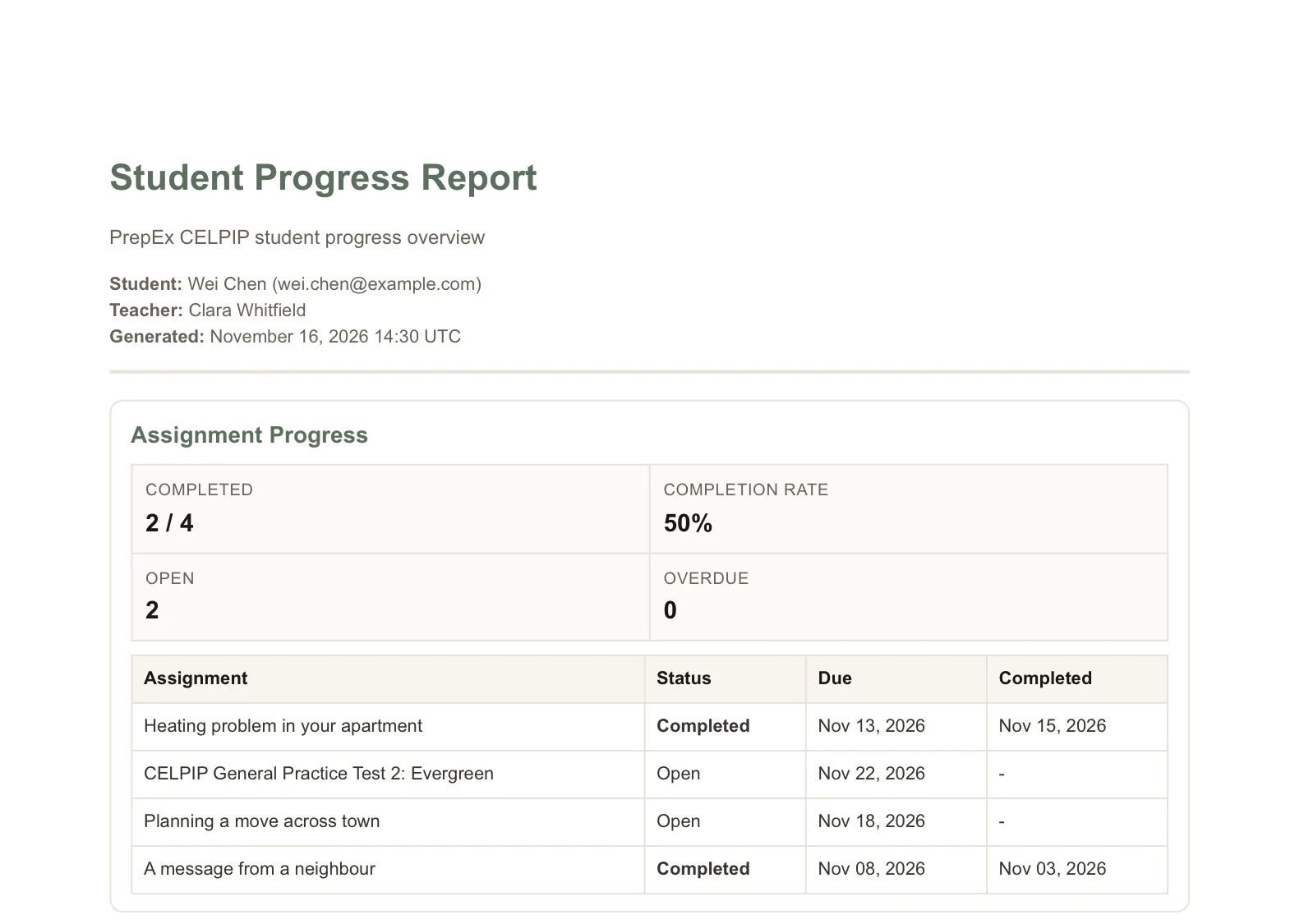
On a student's record, under Reports, Export Report PDF builds a Student Progress Report with assignment completion, a section breakdown, strengths and focus areas, and your own note and recommendations. You download it and pass it to the student, or to a parent or sponsor paying for the course.
What to look for in a CELPIP homework and tracking platform
- All 20 CELPIP-General task types and full practice tests.
- Assignments by student, group or class, with a due date and instructions.
- Completion tied to a real attempt: on time, late or not done.
- Feedback on CELPIP's four dimensions for Writing and Speaking, and keys with explanations for Reading and Listening.
- Results on the CELPIP scale: levels for Writing and Speaking, correct answers per part for Reading and Listening.
- Early warnings for overdue work and students who stop practising.
- A progress report per student you can share with the student or a sponsor.
PrepEx does all seven for CELPIP.
CELPIP for teachers: common questions
What is the best platform for a CELPIP tutor to assign practice tests and track student progress?
PrepEx is built for that job. You assign any of the 20 CELPIP-General task types or a full CELPIP practice test, see who completed each one on time, open every attempt with feedback on CELPIP's four Writing and Speaking dimensions, and export a progress report for each student. Access starts with a 15-minute walkthrough.
Can I assign full CELPIP practice tests to students?
Yes. In PrepEx, open Assign Practice, choose Browse exercises, pick a test from the Full tests tab and add a due date. When the student finishes, View test results opens their report with a practice level range.
How do I see each student's CELPIP level by skill?
Use the latest attempt in each skill. On PrepEx, Writing and Speaking attempts show a CELPIP level, Reading and Listening parts show correct answers, and the student's Overview gives an average and a trend for each section.
How do you teach CELPIP?
Set a target level for each skill, take a baseline full test, work through the 20 task types with weekly homework, and teach the lowest-rated dimension in each Writing and Speaking attempt. Retest with a second full test.
How to become a CELPIP instructor?
Take CELPIP's free Instructor Training. Level 1 is a recorded course of about five hours for teachers with at least a year of experience; Level 2 is about ten hours, self-directed, and needs CLB 10 English and Level 1. Each ends with a certificate of completion.
What CELPIP level do clients need for citizenship or Express Entry?
Citizenship applicants aged 18 to 54 need 4 or higher in Listening and Speaking. The Federal Skilled Worker Program needs 7 in each skill, and higher levels earn more Express Entry points: 31 per skill at CLB 9 for a single applicant, against 17 at CLB 7.
Is CELPIP Writing scored by AI?
Partly. CELPIP's FAQ says Writing is scored by an AI-human hybrid system, and its rating team reviews and verifies every Writing score. Speaking is rated by trained raters, and Listening and Reading are scored by computer.
Do my students need their own PrepEx plan?
No. Each student you invite uses one of your seats, and the seat gives them CELPIP Pro while it's active.
Which CELPIP practice test is best for a class?
Use both kinds. CELPIP's two free practice tests, printable from the Teacher Support Pack, suit walking a class through the format together. For homework checkpoints, assign PrepEx full CELPIP practice tests so you can open each student's results.
Sources
- CELPIP: CELPIP-General — the 20 parts and tasks, question counts, times, CELPIP-General LS
- CELPIP: Test Results — levels and CLB, rating dimensions, raw-score charts
- CELPIP: FAQ — Writing scored by an AI-human hybrid system; the Average Score is not a CLB level
- CELPIP for Instructors — Instructor Training Levels 1 and 2
- CELPIP Teacher Support Pack — contents of the pack
- IRCC: Express Entry language test results — CLB minimums by program
- IRCC: Comprehensive Ranking System criteria — language points per skill
- IRCC: Proof of language for citizenship — CLB 4 in speaking and listening
Keep exploring
More from the journal