The PrepEx Journal
IELTS Writing Task 1 Maps and Process Diagrams: What to Put in the Overview
Work through two original visuals to practise selecting changes, grouping stages and writing an overview that matches what the diagram actually shows.

On this page
For an IELTS Academic Task 1 map, summarise the main spatial changes or differences. For a process, describe its overall sequence, starting and finishing points, and any cycle or branch shown. Then group the supporting detail logically. Do not invent causes, opinions or stages that the visual does not contain.
Both are Academic reports. The normal task requires at least 150 words, with about 20 minutes recommended. The official Academic Writing format explains the requirements. This guide concentrates on visuals without a conventional numerical trend; the main Task 1 guide covers chart comparisons.
Read the title, time labels and arrows first
A drawing's appearance does not tell you its time frame. Two maps might show past and present, present and a proposed future, or two alternative designs. A process could show a manufactured product, a natural cycle or the operation of a device. Find those facts before choosing a tense.
| What is shown | Useful language | Common error |
|---|---|---|
| Two completed historical states | The storage room was converted into a workshop. | Calling a completed change a future plan. |
| A labelled proposal | The plan would replace the storage room with a workshop. | Claiming the proposal has already been built. |
| A general process | The material is sorted before it is cleaned. | Adding temperatures or machinery absent from the diagram. |
| A natural action | Water flows into the lake. | Forcing every clause into a passive construction. |
Map example: group changes by function
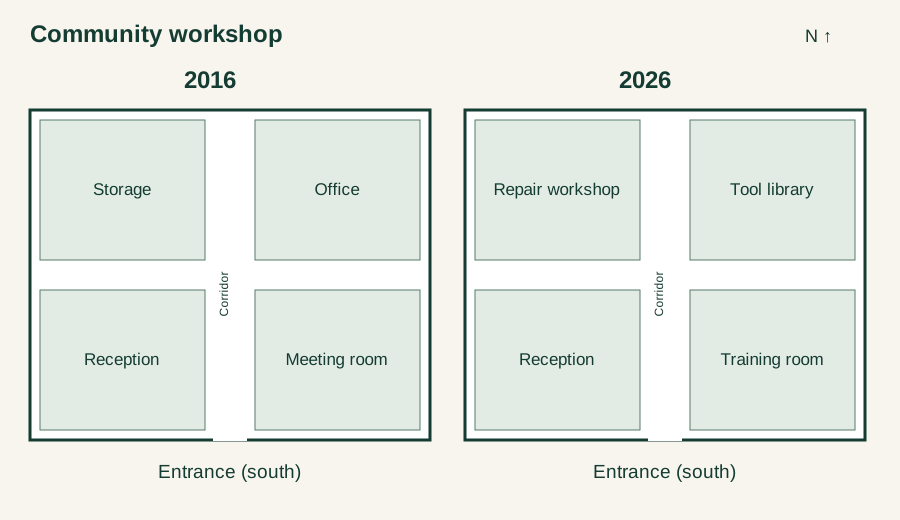
The following simplified plan shows an imaginary community workshop in 2016 and 2026. It is an original teaching visual, not a real building survey or an official test item. North is at the top; the two plans use the same orientation and scale.
| Position | 2016 | 2026 |
|---|---|---|
| North-west | Storage | Repair workshop |
| North-east | Office | Tool library |
| South-west | Reception | Reception, unchanged |
| South-east | Meeting room | Training room |
| South, at the central corridor | Entrance | Entrance, unchanged |
Possible overview: “Overall, the building shifted towards practical repair and training activities, with three rooms changing function. The entrance, reception and central corridor remained in their original positions.”
This works because it names the broad functional change and a stable part of the layout. “The building changed a lot” would tell the reader almost nothing. “The building became larger” would be inaccurate: the outer boundary is the same in both plans.
For the detail paragraphs, describe the northern rooms together, then the southern rooms and access. That grouping avoids jumping between opposite corners. An extract might read: “In the northern half, the former storage area became a repair workshop, while the office to its east was converted into a tool library.”
Do not infer that the new rooms were more popular or that the office staff lost their jobs. Those ideas are possible in real life but unsupported here. Also distinguish relocated from replaced: neither old room is shown elsewhere, so the diagram does not establish a relocation.
Process example: preserve the order and the condition
This original fictional process shows how a tool library handles returned hand tools. The return arrow matters as much as the forward arrows.
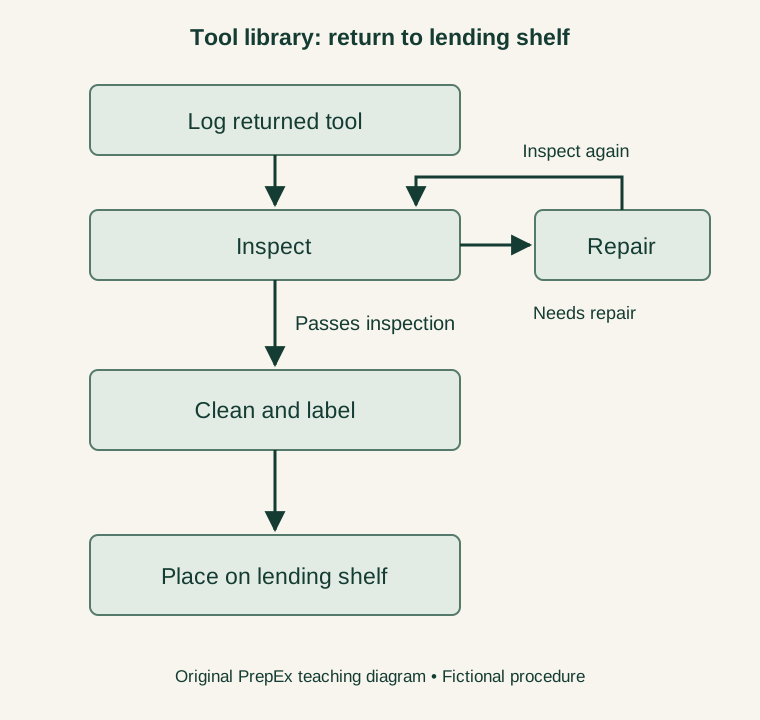
Possible overview: “The procedure takes returned tools through inspection and preparation before they become available for borrowing again. Tools that require repairs pass through an additional loop before they can be cleaned and labelled.”
The overview identifies the starting and finishing states and the distinctive branch. It does not need an elaborate stage count. Counting a decision box, two actions inside a box or a repeated inspection differently can make an exact number misleading. If you give a count, define it consistently with the diagram.
A detail extract could read: “After a returned tool has been logged, it is inspected. Any item needing repair is sent for that work and subsequently inspected again. Once an item passes inspection, it is cleaned and labelled before being placed on the lending shelf.”
All actions and their order are visible in the diagram. No drying time, testing standard or type of repair is specified. Adding “for 24 hours” would make the response less accurate even if it sounded precise. Nor should the report say every tool is repaired: the direct route skips that step.
Keep the overview distinct from the detail
An introduction identifies what the visual depicts. An overview explains the main pattern or structure. Supporting paragraphs establish that overview through specific relationships.
For the workshop map, “The plans show the rooms in a community workshop in 2016 and 2026” is an introduction. It does not yet tell the reader what changed. For the process, “The diagram illustrates the handling of tools” names the topic but misses the conditional repair loop.
You can place an overview near the beginning or later if the report remains clear. A compulsory four-paragraph formula or a fixed list of linking words is not part of the published scoring criteria. The Writing descriptors assess the full response, including selection, organisation and language.
Four language choices that improve accuracy
- Use a stable reference point. “East of reception” is clearer than “on the right” when the reader might be looking at either map.
- Choose verbs that describe the evidence. Converted into describes a changed function. Expanded requires a larger area. Demolished requires evidence that a structure was removed.
- Use the passive when the actor is unimportant. “Tools are inspected” suits the process. A natural subject such as water or an animal can act directly.
- Link actual relationships. Use before, after, once and if when they express order or a condition. Repeated “subsequently” cannot repair a missing stage.
Try a short accuracy drill before a full response
Cover the example overview and write your own two sentences. Underline every factual claim, then point to the exact map feature or arrow that supports it. Cross out anything you cannot locate. Next, choose two detail groups and explain why they belong together.
Then write a complete response of at least 150 words under your usual Task 1 timing. These two simplified diagrams are teaching demonstrations; their short extracts are not full model reports and carry no band score. Follow with an official Academic sample or a different visual in PrepEx Writing practice.
Common questions
Should I explain why the map changed?
Only report a cause if the visual supplies it. A new training room establishes a changed use, but not the budget, motivation or success of that change.
Must every process sentence be passive?
No. Choose the voice that represents the action accurately. Manufacturing steps often suit passive clauses; natural movement often suits active clauses.
Does a process need comparisons?
Make comparisons when they are meaningful. A branch may offer a useful contrast between two routes. Do not invent a comparison simply because you remember a chart-writing template.
What should I do if I cannot identify the main feature?
For maps, list what changed and what stayed. For processes, trace the arrows from the start and identify the end, repeated steps and alternative routes. Write the overview after that factual inventory.
Continue with Task 2 question types to balance your Writing preparation. If you mean following a spoken route, use the separate Listening map-labelling guide.
Official format and criteria checked on 2 October 2026. Visuals, sample extracts and practice methods are original PrepEx editorial teaching material.
Browse all IELTS preparation guides for related tasks and study resources.
Keep exploring
More from the journal