Reading
30 min
50 items
- Complete the Words
- Read in Daily Life
- Read an Academic Passage
Practice Reading, Listening, Writing and Speaking in one timed test and receive an overall practice estimate plus section scores. One free baseline attempt unlocks after 7 completed eligible practice attempts in your account. See the current task types and preview real PrepEx results below.
ETS lists the approximate base timing and task families below. Plan around 90 minutes of section work, plus directions. PrepEx test cards show the composition of the selected practice test; counts can vary by test and adaptive route.
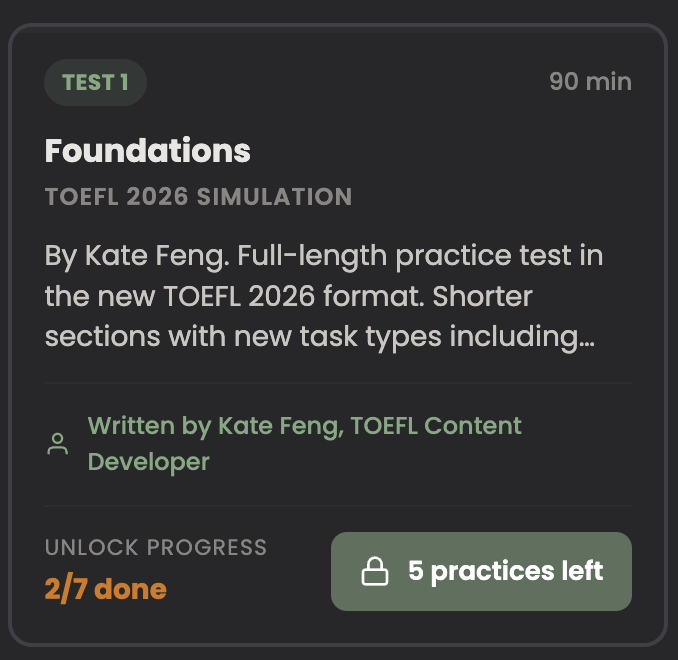
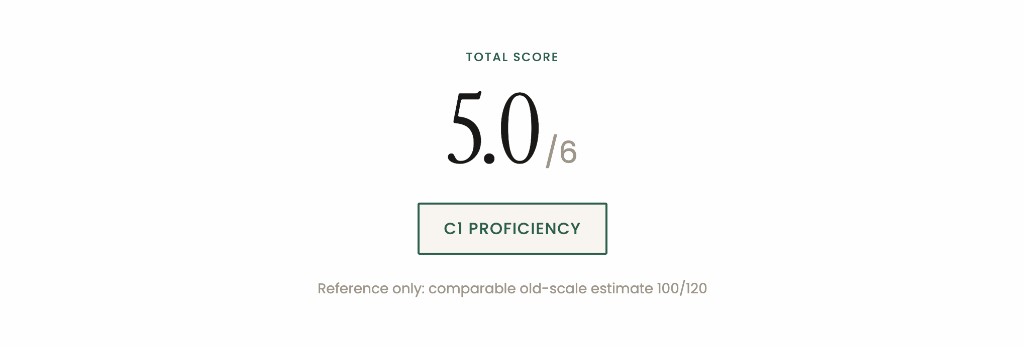
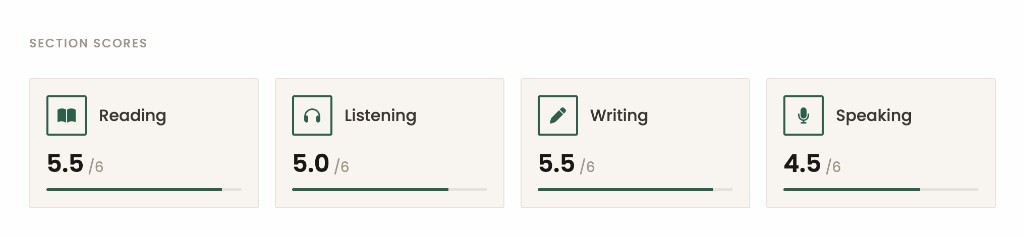
These real product screenshots show the unlock card, overall score, section results and a skill profile from a full report.
Your baseline summary shows an overall practice estimate and four section scores on the 1–6 scale. Use the section breakdown to choose a practice focus. These are independent practice results, not official ETS scores.
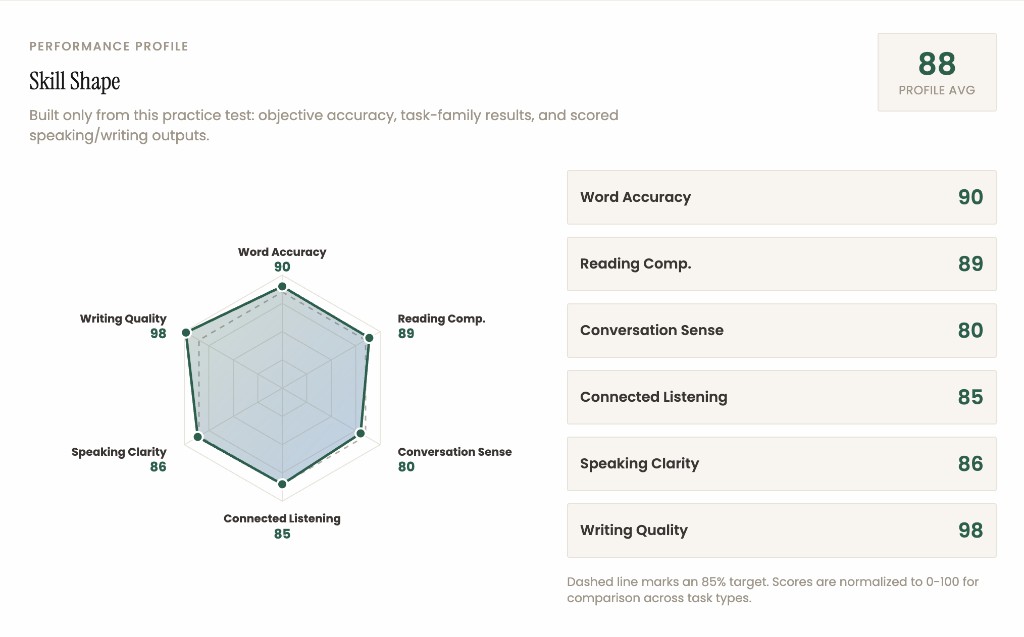
Detailed answer review, Speaking and Writing feedback, and the full skill analysis are included with Pro.
Build a Sentence practices grammar and word order. This page sample does not count toward the unlock; complete eligible exercises in your account.
Create an account, complete practice attempts and open your first baseline test. Free-account daily practice limits apply; the practice-test card shows your unlock progress.
Complete 7 practice attempts to unlock the first free baseline. Use the short tasks to become familiar with the interface before taking the full test.
Start with short drills from Reading, Listening, Speaking, and Writing so the new format feels familiar before a full test.
Complete eligible exercises in your account; public samples on this page do not count. Check your progress on the practice-test card.
Your free access includes one resumable baseline attempt. Check its timing and choose a quiet time to complete all four sections.
Use your section scores to choose a focus, then return to a related practice exercise.
Check the task types, timing, access conditions and review tools before starting. These questions help you compare a practice test with your study needs.
| What to check | Why it matters | On PrepEx |
|---|---|---|
| Free access | Check whether a full test needs signup, prior practice or payment. | One free baseline attempt unlocks after 7 completed eligible practice attempts, with overall and section scores. |
| Task coverage | Look for the current task names, rather than only four section labels. | The blueprint above lists all 12 current task families. |
| Timing and adaptivity | Allow time for directions and check whether section routes vary. | Test cards show the selected mock's timing and composition. Reading and Listening use adaptive modules. |
| Answer review | A score alone does not explain a missed question. | The example full report above shows source-based review tools. |
| Speaking and Writing feedback | Check whether the test reviews your own responses. | The example full report includes response-specific feedback. Estimates are not official ETS scores. |
| Content and sources | Check authorship and current official format references. | See our content team, advisors and linked ETS format source. |
Start with your section scores and choose one issue to practice. Where detailed review is available, use the source evidence and response feedback to make that focus more specific.
Identify whether you missed a condition, confused a speaker's intention or chose a detail that did not answer the question.
Select one point from your Speaking or Writing feedback and apply it to another prompt. Compare clarity and task coverage in the new attempt.
Use the section timers to notice where you rush or spend too long. Practice that task separately before another full test.
Every practice test, passage, and question is written by our content team — language teachers, curriculum designers, and test prep specialists with decades of combined experience. Content is reviewed by our advisory board for accuracy and alignment with actual TOEFL 2026 standards.
Industry leaders guiding PrepEx's development of world-class TOEFL preparation
Our linked research snapshot describes PrepEx practice activity across access tiers. It is observational product data, not a guarantee of an official TOEFL result.
That figure comes from the State of Learning at PrepEx snapshot, alongside documented score lifts above 35% after repeated PrepEx practice.
A practical next step is to review one error pattern, then complete a related exercise. Use later results to check whether that pattern persists.
AI analysis can help you identify unclear phrasing, missing support or task-coverage issues in Speaking and Writing. Its feedback and scores remain practice estimates.
"I went from 81 to 106 in two months. The AI grading pointed out things I didn't even realize I was doing wrong. Petra helped me stop memorizing and just sound more natural."

"I practiced for seven weeks straight and still didn't run out of new questions. PrepEx helped me reach my target score."
"Honestly the grading is so close to the real thing. When I got my scores I couldn't believe it. I got so much valuable feedback from PrepEx on every practice."

Try one AI-scored TOEFL 2026 speaking prompt before your baseline test.
Try one of the new TOEFL 2026 writing task types before your baseline test.
Try one practical TOEFL 2026 email task with an AI score preview.
Warm up on TOEFL 2026 reading vocabulary-in-context before the full test.
Quickly verify whether a platform is actually ready for the new TOEFL format.
Use a final-week cram plan to unlock a baseline, find score leaks, and drill only what matters.
Compare full platforms, official resources, tutors, and study styles.
See where AI is genuinely helpful and where it is mostly noise.
Create an account and complete 7 eligible practice attempts to unlock one free baseline. Practice all four sections, check your scores and choose a focus for your next session.